

From Wall Street boardrooms to hedge fund offices, a growing chorus of respected investors is expressing concern that today’s stock market may be approaching a dangerous turning point.
While predicting the exact timing of a correction is impossible, many believe the combination of lofty valuations, excessive leverage and relentless enthusiasm for artificial intelligence has created conditions that investors should not ignore.
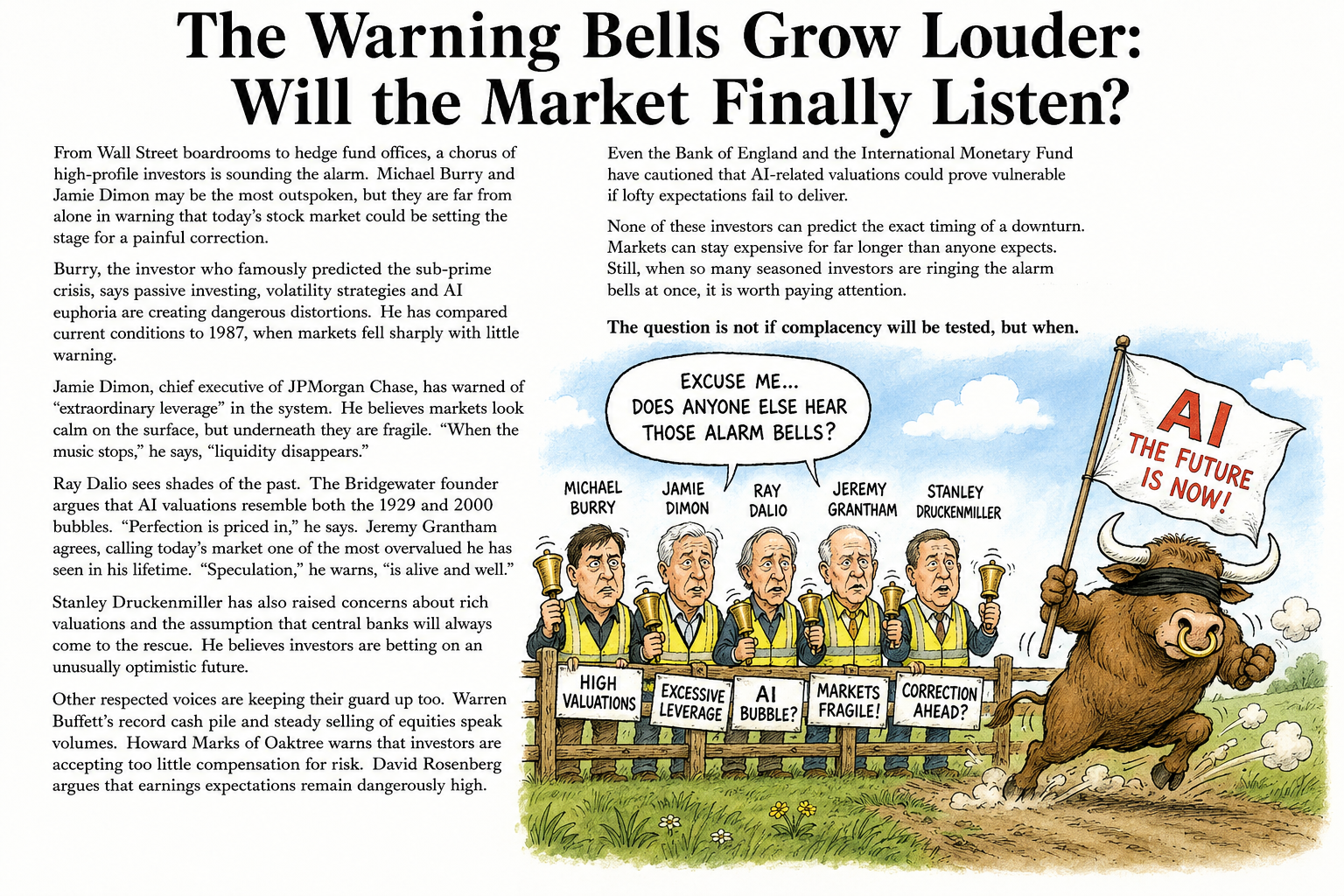
Michael Burry
Among the most vocal is Michael Burry, the investor who famously anticipated the sub-prime mortgage collapse. Burry has repeatedly warned that passive investing, speculative trading and the extraordinary excitement surrounding AI are creating distortions that bear uncomfortable similarities to previous market bubbles.
He has suggested that investors are becoming increasingly complacent, assuming prices can only continue to rise.
Jamie Dimon
Jamie Dimon, Chief Executive of JPMorgan Chase, has also been reported to have raised concerns. While acknowledging the strength of the wider economy, he has warned that significant leverage remains embedded throughout the financial system.
His view is that markets often appear calm on the surface until liquidity suddenly evaporates, leaving investors scrambling for the exits.
Ray Dalio
Bridgewater founder Ray Dalio has reportedly drawn comparisons between today’s AI-driven optimism and previous periods of speculative excess, including the late 1920s and the technology bubble of 2000.
He argues that exceptional expectations have already been priced into many of the largest companies, leaving little room for disappointment should earnings fail to match investors’ hopes.
Jeremy Grantham
Veteran investor Jeremy Grantham has been reported to have echoed those concerns, describing many areas of the market as historically expensive.
He reportedly believes speculative behaviour has once again become widespread, with investors willing to overlook traditional valuation measures in favour of chasing momentum.
Stanley Druckenmiller
Meanwhile, billionaire investor Stanley Druckenmiller has questioned whether markets are becoming overly dependent upon the expectation that central banks will always provide support during periods of weakness. He believes that assumption could eventually be tested.
Warren Buffet and others
Other experienced voices have also adopted a more cautious stance. Warren Buffett‘s substantial cash holdings and continued selling of equities suggest he is finding fewer attractive opportunities at current prices.
Howard Marks has consistently warned that investors are accepting too little compensation for risk, while economist David Rosenberg reportedly believes earnings expectations remain overly optimistic.
It’s anyone’s guess
None of these investors claims to know precisely when a downturn might begin. Markets have a habit of remaining expensive for far longer than many expect.
However, when so many experienced market participants are independently highlighting the same risks—rich valuations, growing leverage, speculative enthusiasm and excessive confidence—it becomes increasingly difficult to dismiss the warnings.
Timing?
Whether the next correction arrives next month or several years from now remains uncertain.
What is becoming harder to ignore is that the warning bells are no longer being rung by one or two cautious observers, but by an increasingly influential chorus of some of the world’s most respected investors.
History suggests that while markets often ignore such warnings during the final stages of a bull run, they rarely do so forever.