

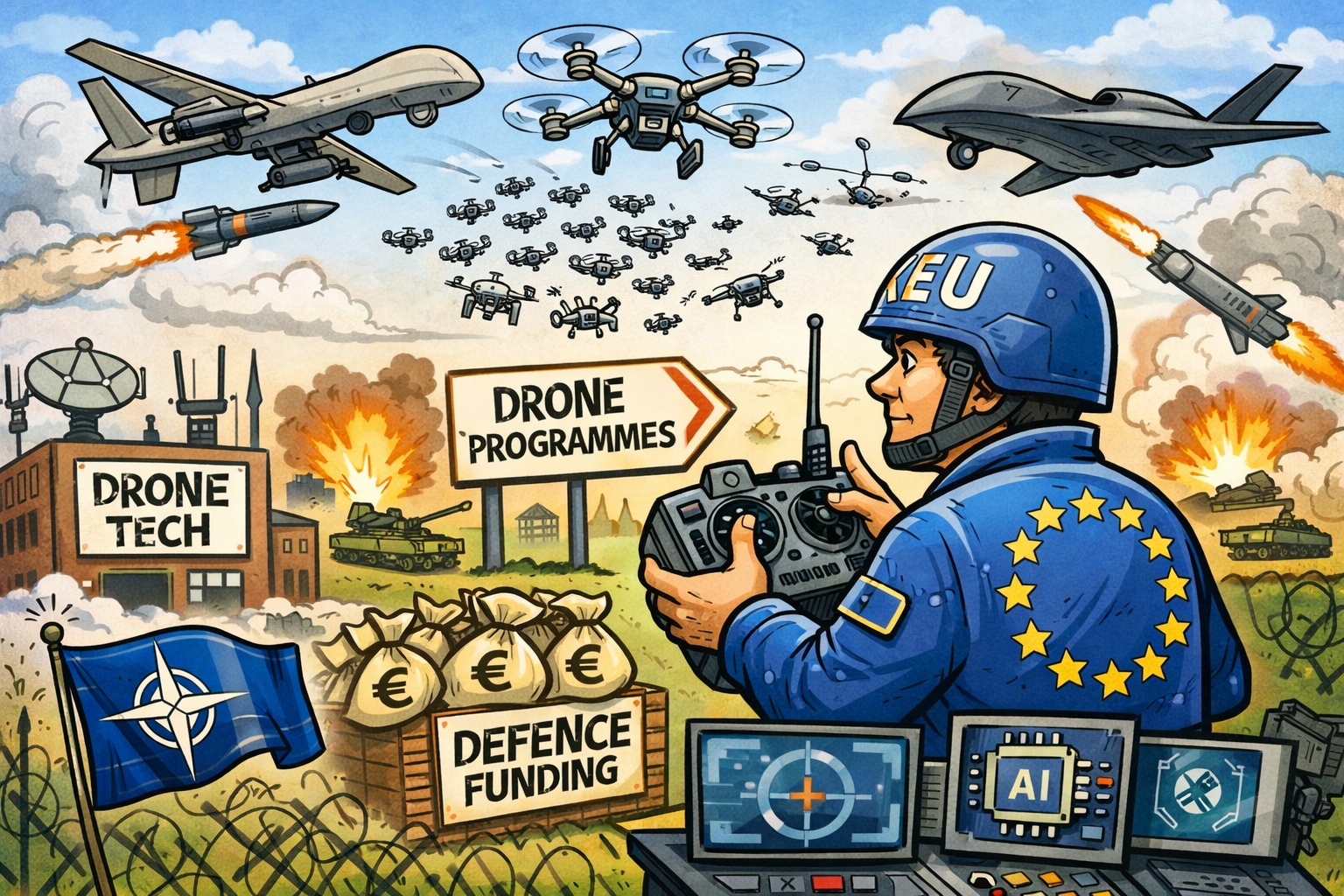
Europe’s accelerating bet on drone technology marks one of the most significant strategic pivots in its modern defence posture.
After years of rebuilding military capacity in response to Russia’s invasion of Ukraine, European governments are now converging on drones and autonomous systems as the backbone of future security planning.
The shift is rapid, coordinated, and backed by unprecedented investment.
NATO
Over recent weeks, NATO, the U.K., Germany and major defence-tech firms have all announced large-scale programmes centred on drones.
NATO’s new initiative commits allies to more than $40 billion in counter‑drone capabilities over five years, reflecting Secretary General Mark Rutte’s assessment that drones have “fundamentally altered” modern warfare.
The U.K.’s Defence Investment Plan allocates £5 billion to a national drone transformation programme, while Germany has moved to procure 50,000 drones for Ukraine—an order that underscores how battlefield lessons from Ukraine are shaping procurement across the continent.
Lesson
Those lessons are clear: low‑cost, AI‑enabled drones can gather intelligence, extend the reach of conventional weapons, and operate effectively even in contested electronic environments.
Companies such as Auterion are developing operating systems that allow drones to strike targets despite jamming, navigate below the radio horizon, and eventually operate in coordinated swarms.
AI enabled
This software‑first approach signals a broader trend: Europe’s defence industry increasingly sees autonomy, AI, secure communications, and electronic warfare as central to future military capability.
Investment boom
The investment boom is also reshaping Europe’s defence‑tech sector. Venture funding has surged from €200 million in 2021 to €2.6 billion in 2025, and firms like Munich‑based Helsing—now valued at $18 billion—are emerging as continental champions in autonomous defence systems.
Europe’s big bet on drones is ultimately a bet on a new model of warfare: networked, data‑driven, and increasingly autonomous.
It reflects both urgency and ambition as the continent adapts to a rapidly changing security landscape.