

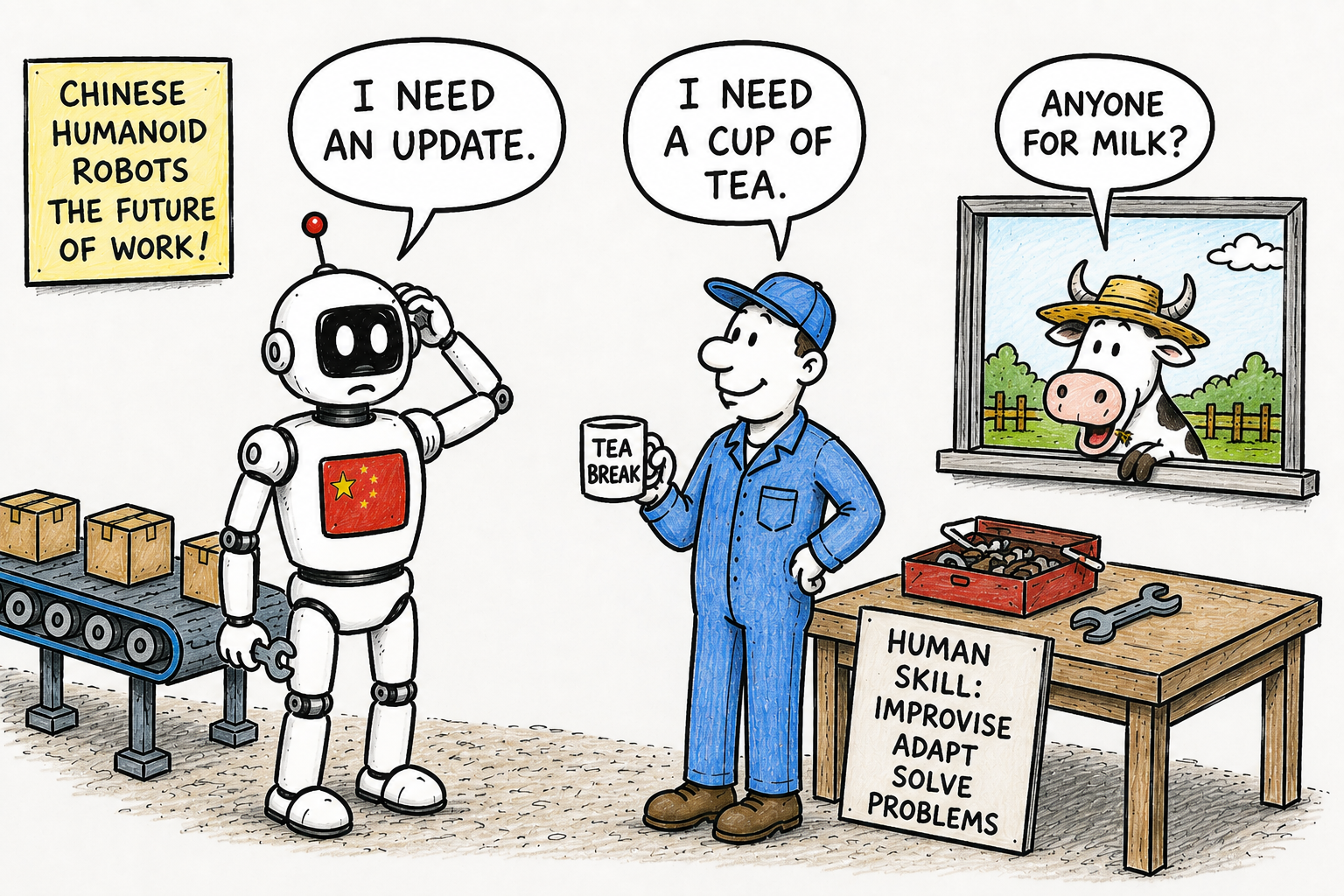
China is rapidly emerging as one of the world’s leading players in humanoid robotics, with companies developing machines designed to walk, run, lift, assemble, serve and even perform increasingly complex industrial tasks.
Yet the biggest obstacle facing this robotic revolution may not be technology at all. It could simply be the human being standing next to the robot.
Humans
Humans remain remarkably difficult to replace. We can recognise unfamiliar objects, adapt instantly to unexpected situations, understand context and make decisions with surprisingly little information.
We can also learn new tasks without requiring enormous amounts of training data or carefully controlled environments.
Humanoids
Humanoid robots, by comparison, can be impressive but remain vulnerable to the real world. A factory floor is one thing; a busy workplace filled with unpredictable people, changing conditions and objects in unfamiliar positions is quite another.
A robot may be capable of performing a task perfectly under controlled conditions but struggle when something changes.
China’s enormous manufacturing sector provides an ideal testing ground for humanoid robots. Companies are investing heavily in machines that could eventually take on repetitive, dangerous or physically demanding work.
Collaboration
The economic attraction is obvious: robots do not need holidays, sleep or wages, and they can potentially operate around the clock.
But replacing humans entirely is a much bigger challenge. The more realistic future may be collaboration rather than elimination, with robots handling repetitive physical work while humans provide judgement, flexibility and problem-solving.
Ironically, the success of humanoid robots may therefore depend on how well they learn from humans. The goal is not necessarily to create machines that are better than us at everything, but machines that are good enough at the right things to work alongside us.
For now, however, humans still have one considerable advantage: when something goes wrong, we usually know how to improvise.