
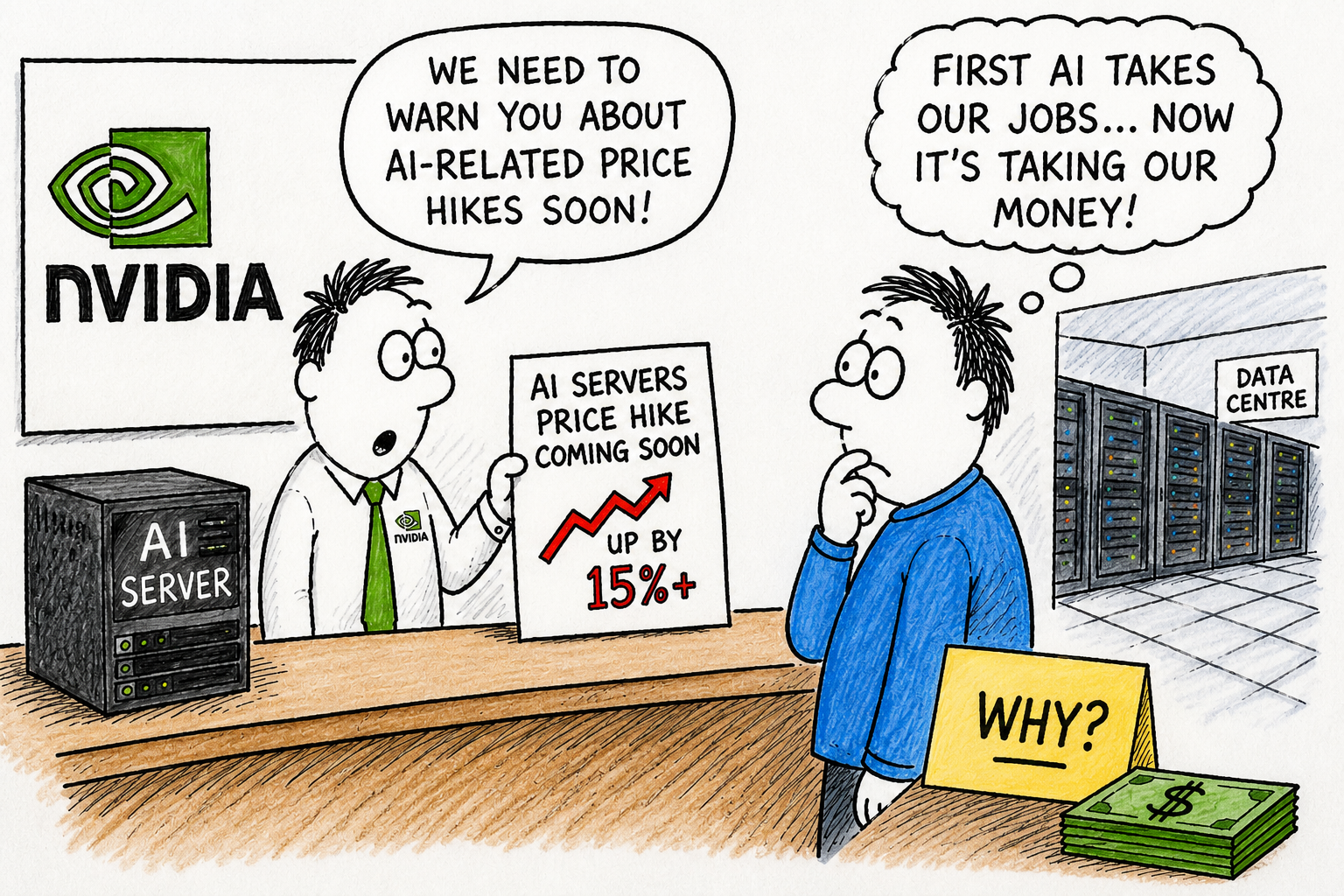
Nvidia customers are reportedly being warned that the cost of AI infrastructure could rise sharply, highlighting a new problem for an industry already spending billions to expand computing capacity.
According to reports, some of Nvidia’s largest customers have been told that prices for servers containing its artificial intelligence chips could increase by more than 15% in many cases.
In 2027
The increases are expected to affect systems shipped early next year, including those using Nvidia’s flagship Vera Rubin and Grace Blackwell platforms.
The immediate pressure appears to be coming from the soaring cost of memory. AI accelerators require large quantities of high-performance memory, particularly high-bandwidth memory and DRAM.
High demand
Demand from data-centre operators has surged so rapidly that leading memory manufacturers, including Samsung Electronics, SK Hynix and Micron, are struggling to keep supply aligned with demand.
For Nvidia, this creates an unusual situation. The company has enormous pricing power because its processors remain central to the development of modern AI systems.
However, even Nvidia cannot completely escape shortages elsewhere in the semiconductor supply chain.
The reported increases could therefore have consequences well beyond Nvidia itself. Companies such as Microsoft, Google and Oracle are investing heavily in AI data centres, and higher server costs could increase the amount they must spend before those facilities generate revenue.
AI economy
Some of that additional cost could ultimately find its way into cloud-computing prices and AI services.
The development also raises a broader question about the economics of the AI boom. Massive demand has encouraged unprecedented investment in computing infrastructure, but scarce components are becoming increasingly expensive.
The AI revolution may still be accelerating, but the latest warning suggests that building the machines powering it is becoming more costly.
The era of ever-increasing AI capacity may come with an increasingly hefty price tag.