


AI Rout Hits Seoul: Kospi Sinks Over 5% as Chip Giants Slide

AI chip stock fall

South Korea’s markets were hit hard on Friday 5th June 2026, with AI‑linked stocks leading a sharp regional sell‑off after Wall Street’s tech slump rippled across Asia.

The Kospi tumbled 5.54%, closing at 8,160.59, its steepest one‑day fall in months, as investors rapidly unwound positions in semiconductor and AI beneficiaries.

Heavyweights Samsung Electronics and SK Hynix were at the centre of the decline, sliding 6.40% and 9.92% respectively. This demonstrates how tightly exposed Seoul’s market has become to the global AI cycle.

The pullback followed a sharp rotation out of chipmakers in the United States, triggered by disappointing revenue data from Broadcom. This shook confidence in the sector’s near‑term momentum.

With AI names having powered much of 2026’s rally, even a modest earnings wobble proved enough to spark a broader de‑risking.

Domestic strain

Domestic pressures added to the strain. South Korea’s labour minister urged major tech firms to share more of their AI‑driven semiconductor profits with workers and suppliers. This is a signal that political scrutiny of the sector is rising just as global sentiment cools.

For now, the sell‑off looks like a reminder of how tightly South Korea’s market is tethered to global AI expectations.

If Wall Street’s AI led enthusiasm falters, Seoul’s tech giants may face a more prolonged test.
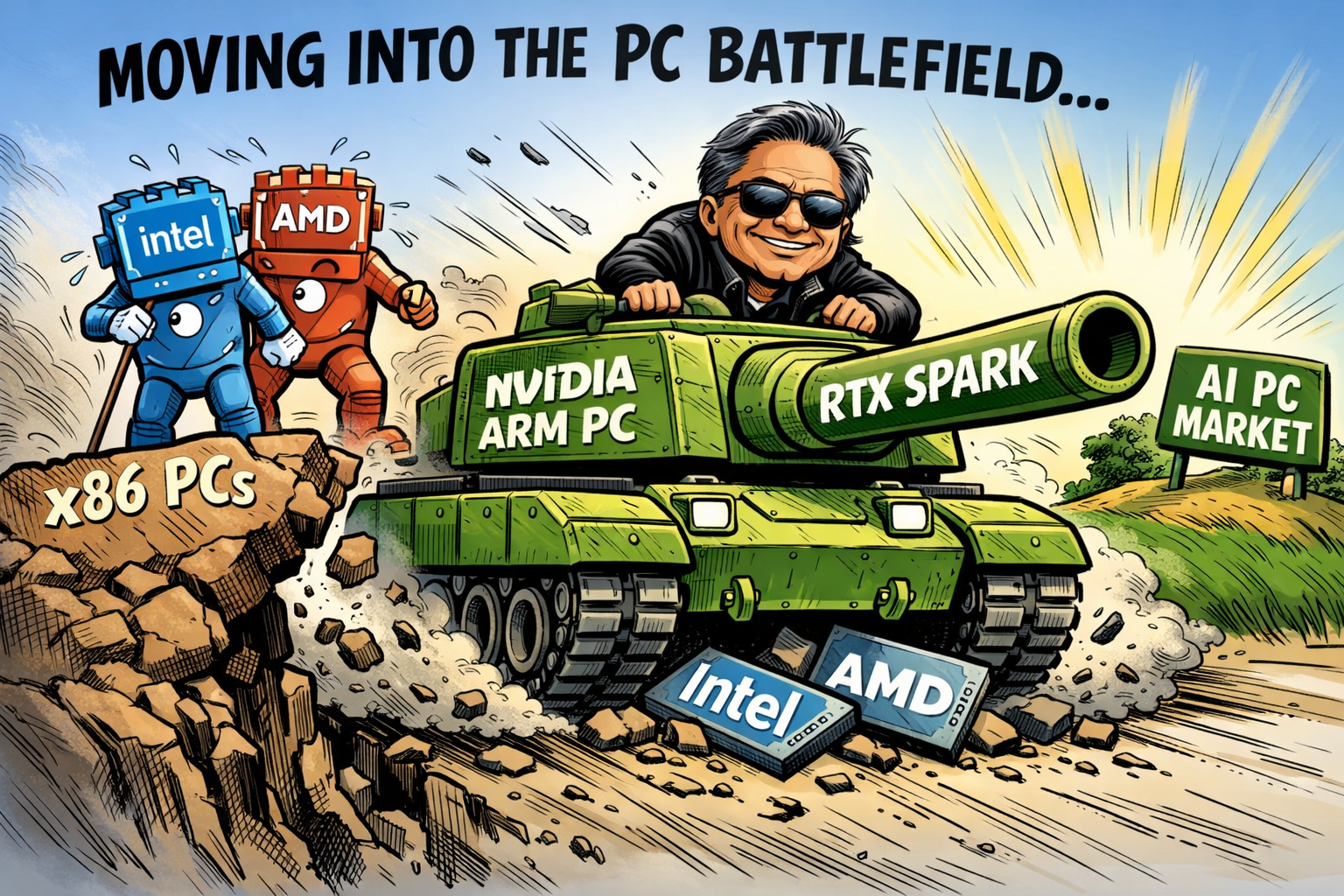
Nvidia moves into PCs – All hail Nvidia!

New AI PC chips from Nvidia

Nvidia’s long‑anticipated push into the PC market has finally materialised — and it marks the company’s most aggressive attempt yet to extend its dominance beyond the data centre.

At Computex in Taipei, Jensen Huang unveiled the N1X, an Arm‑based CPU fused with a Blackwell‑class GPU into a new RTX Spark superchip, set to appear this autumn in premium Windows laptops from Microsoft, Dell, HP, ASUS, Lenovo and MSI .

The move is strategically significant. For decades, the PC’s central processor has been the guarded territory of Intel and AMD, with Apple’s M‑series proving the only major Arm‑based disruption.

Nvidia is now entering that arena with a design built explicitly for the age of agentic AI — machines that run multiple AI processes simultaneously, shifting huge volumes of data between GPU and CPU.

Nvidia has argued for months that CPUs have become the bottleneck in modern AI workflows, and the N1X is its answer: a custom Arm design, co‑developed with Microsoft and manufactured on TSMC’s 3‑nanometre process, paired with 128GB of unified memory for high‑bandwidth compute.

Huang framed the launch as a generational reset: “the first completely re‑engineered, reinvented line of PCs in 40 years.” It’s hyperbole with intent.

Nvidia wants to define the AI PC in the same way it defined the AI data centre — not as an incremental upgrade, but as a new category.

More than 30 laptops and 10 desktops are reportedly planned over time, with early models aimed at creators, AI developers and high‑end gamers seeking thin, light machines with workstation‑level capability.

The competitive implications are profound. Arm‑based computing is accelerating across the industry, and Nvidia’s arrival puts direct pressure on Intel and AMD just as both are scrambling to articulate their own AI‑centric roadmaps.

If RTX Spark delivers the performance uplift Nvidia promises, the centre of gravity in the PC market could shift rapidly — from x86 incumbents to a company that has already rewritten the rules of modern computing once.

All hail Nvidia.