

Nvidia–Unitree: A BIG Strategic Investment on Physical AI

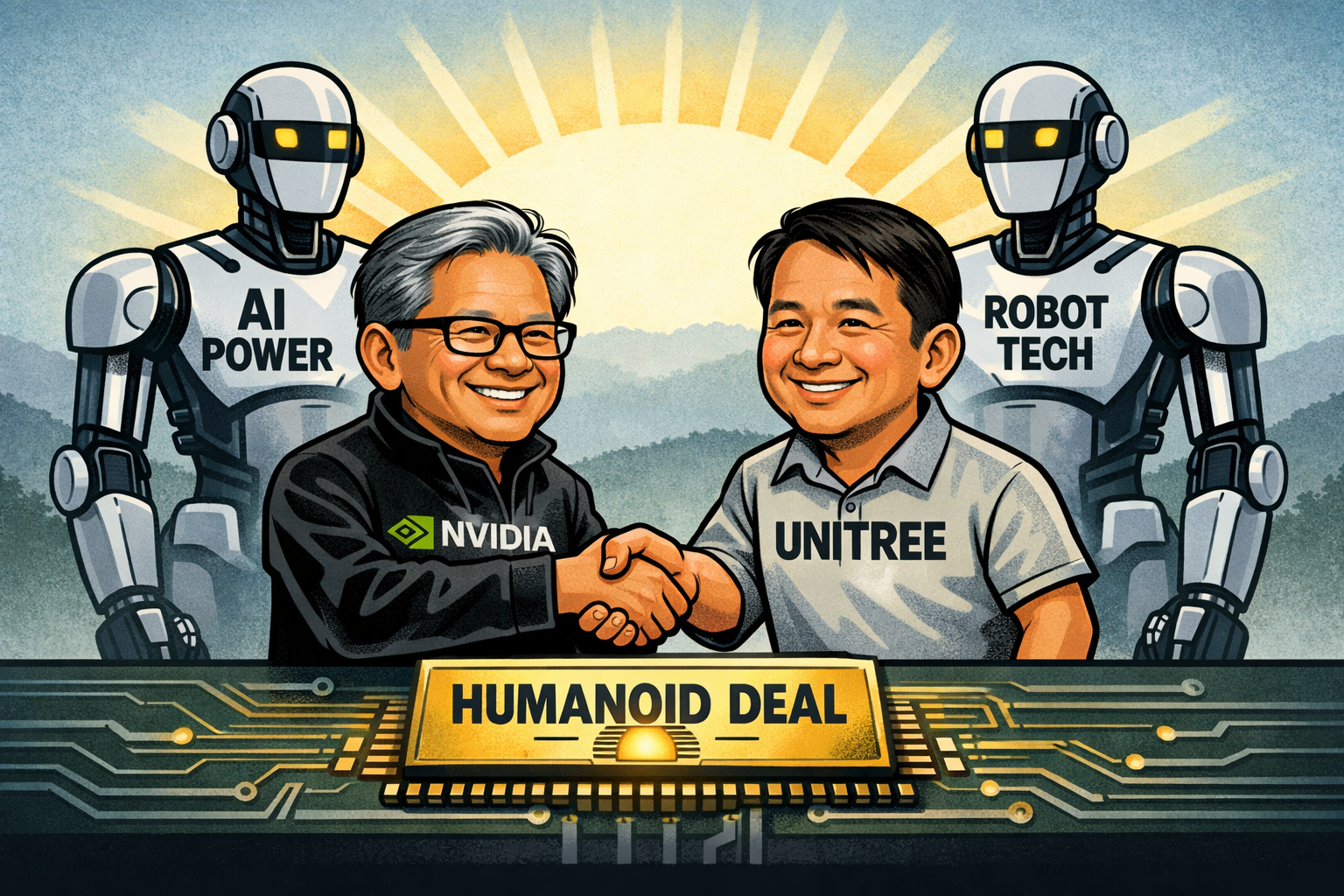
Nvidia has taken another decisive step into the world of “physical AI” by selecting China’s Unitree as its partner for a new humanoid robotics platform aimed squarely at global research institutions.

The collaboration pairs Nvidia’s Jetson Thor hardware — built around the company’s advanced Blackwell GPU — with Unitree’s nearly six‑foot H2 humanoid frame, creating a turnkey system designed to accelerate robotics development in universities and specialist labs.

Isaac Groot

The package integrates Nvidia’s Isaac GR00T humanoid‑focused AI models, simulation tools, and data‑generation stack, effectively offering researchers a complete environment for training, testing, and deploying humanoid behaviours.

Nvidia argues that building such a system independently is “insanely hard”, and that lowering the barrier to entry will broaden the field beyond the world’s largest tech companies.

Unitree timing

For Unitree, the timing is significant. The Hangzhou‑based robotics firm is preparing for a 4.2 billion yuan IPO on Shanghai’s STAR Market, with more than 40% of its revenue already coming from outside China.

The Nvidia partnership gives Unitree a high‑profile global showcase just as it seeks to convince investors of its international potential.

The upgraded H2 Plus model — available later this year — will be open for purchase by any lab, not just elite institutions. Early adopters include Stanford, ETH Zurich, UC San Diego and Seattle’s AI2, underlining Nvidia’s ambition to make humanoid research mainstream.
Multi-trillion-dollar industry in the making

Nvidia reportedly argues that building such a system independently is “insanely hard”, and that lowering the barrier to entry will broaden the field beyond the world’s largest tech companies.

Humanoid robots remain a nascent market, with deployments still limited and safety concerns unresolved. But Nvidia’s move signals a belief that physical AI will become a multi‑trillion‑dollar industry.

By fusing its AI stack with Unitree’s maturing hardware, Nvidia is positioning itself not just as the supplier of chips for the robotics boom, but as the architect of the ecosystem that powers it.
Humanoid Robots on the Front Line in Ukraine Signal a New Frontier in Warfare

The testing of humanoid robots in Ukraine marks a striking moment in the evolution of modern warfare, blending Silicon Valley ambition with the brutal pragmatism of a live conflict.

Foundation Future Industries

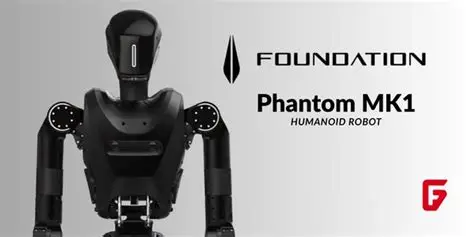
Foundation Future Industries, a San Francisco start-up founded in 2024, has positioned itself at the centre of this shift by deploying its Phantom MK‑1 robots for pilot demonstrations on the Ukrainian front lines.

The company’s pitch is simple but provocative: humanoid robots should be used not for household chores, but for the world’s most dangerous jobs. Ukraine, now in its fifth year of war, has become the proving ground.

The MK‑1 units tested so far are limited — they carry modest payloads, lack waterproofing, and cannot yet operate at scale. But their early tasks, such as retrieving supplies from hazardous areas, hint at the potential of autonomous systems shaped for human environments.

Urban combat, with its stairwells, basements and narrow corridors, is inherently built around the human form. Analysts note that this gives humanoid robots theoretical advantages over tracked or quadruped machines in certain scenarios.

Yet the technology’s military promise is entangled with political controversy. The company recently appointed Eric Trump as chief strategy adviser, prompting accusations of impropriety given its $24 million in U.S. government research contracts.

Two humanoid robots were reportedly sent to Ukraine in February 2026.

Foundation insists the partnership reflects a shared vision of rebuilding American manufacturing, but the optics are unavoidable.

Multiple sources describe this as the first recorded deployment of humanoid robots to an active warzone — not just Ukraine, but any modern conflict.

The robot race

The broader context is a deepening geopolitical race. Foundation openly frames its mission as part of a contest with China, whose own robotics sector has showcased early military prototypes.

The U.S. military, meanwhile, has not yet deployed humanoid systems, though it is increasingly integrating AI into battlefield decision-making.

Experts caution that cost, complexity and manufacturability may ultimately limit humanoids’ role. But the symbolism is unmistakable.

Whether or not these machines succeed, Ukraine has become the first real-world laboratory for autonomous, human-shaped robots — a glimpse of how future conflicts may be fought.