


Electric vehicle manufacturer BYD suggests that 80% China car sales will soon be electric

BYD says EVs soon to hit 80% of sales in China manufacture

But then they would say that wouldn’t they – because that is what they sell and to say anything else would be counterintuitive. But they may have a point.

The company’s forecast reflects a structural shift already visible across China’s automotive market.

EVs and plug‑in hybrids accounted for more than 50% of new sales earlier this year, and BYD argues that rapid technological gains, falling battery costs and intensifying competition will push that share dramatically higher.

Executives say the transition is no longer policy‑driven but consumer‑led, with buyers increasingly choosing electric models for performance, running costs and reliability.

China’s charging network—now the world’s largest—has also reached a level of density that removes much of the friction from EV ownership.

At the same time, domestic manufacturers are launching dozens of new models annually, compressing prices and accelerating innovation. BYD believes this pace will make combustion‑engine cars a niche product within a few years.

The prediction carries global implications. China is already the world’s biggest EV market and the largest exporter of electric vehicles.

If its domestic market becomes overwhelmingly electric, economies of scale will deepen, pushing prices down worldwide and reshaping competitive dynamics for legacy carmakers.

For BYD, the message is blunt: the combustion era is ending faster than expected, and China is leading the charge.
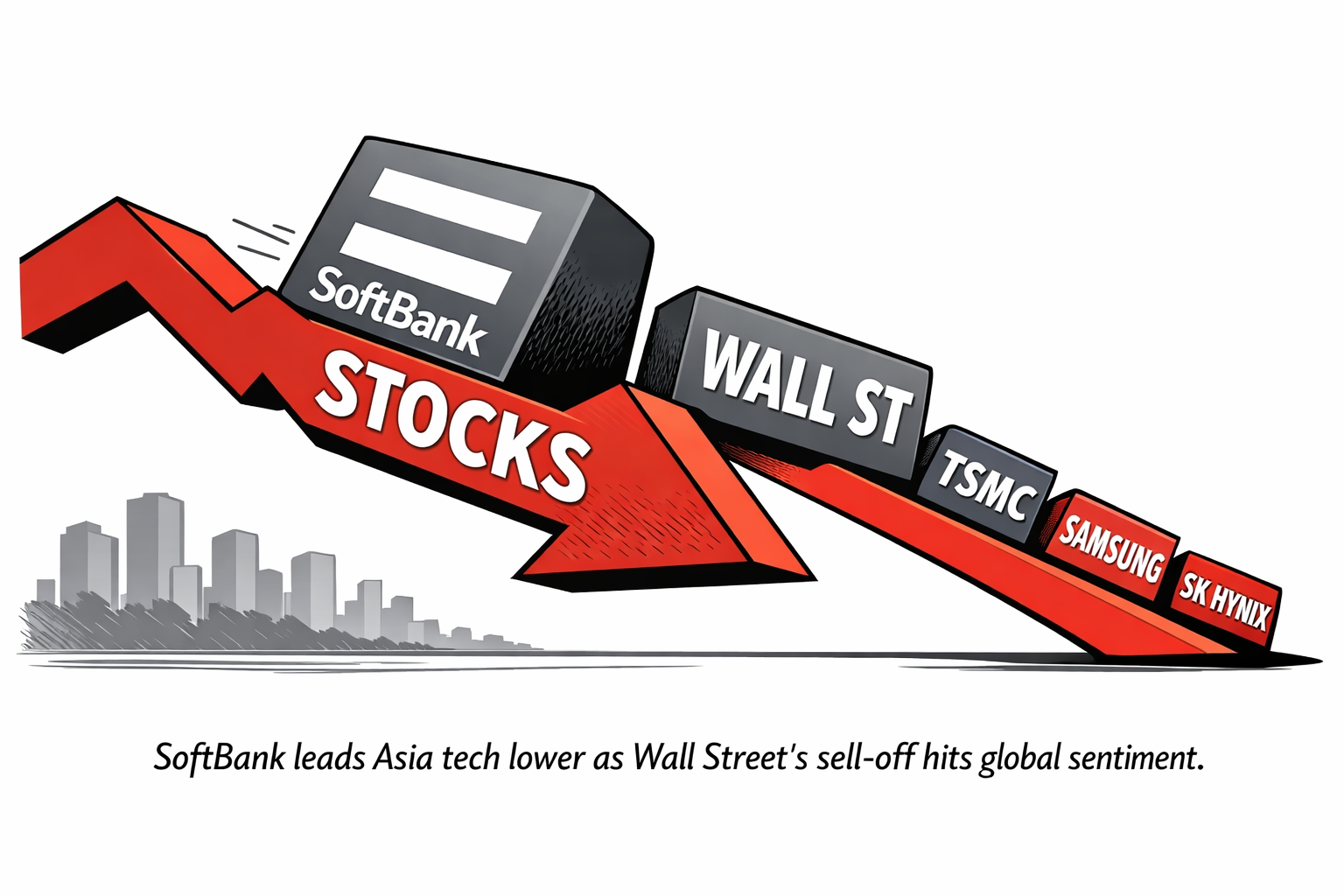
Markets in Asia continue volatility as Softbank falls 10%

Softbank down 10%

SoftBank’s sharp 10% slide on Wednesday became the defining symbol of a broader rout across Asia’s technology markets, as the region absorbed the full force of Wall Street’s overnight tech sell‑off.

The reversal ended a brief rebound in chipmakers and reignited concerns that valuations across the artificial‑intelligence complex have run too hot for too long.

The immediate pressure on SoftBank stemmed from reports that its attempt to raise at least $6 billion through a margin loan backed by its OpenAI stake had stalled.

That setback landed at a moment when sentiment toward high‑growth tech names was becoming more fragile, amplifying the downside.

Investors rotated out of risk, hitting Japan’s semiconductor ecosystem: Advantest and Renesas both fell more than 3%, while South Korea’s SK Hynix plunged over 8% and Samsung Electronics dropped 7.45%.

Taiwan’s TSMC and Hon Hai were also dragged lower.

A deeper structural worry is now taking hold. Massive AI‑related fundraising — including upcoming listings for SpaceX, Anthropic and OpenAI — appears to be siphoning capital away from publicly traded tech stocks.

Some investors see this as the early stage of a rotation; others fear it signals overheating. For Japan, one unexpected beneficiary could be defence contractors, with strategists suggesting a shift toward “heavies” as retail traders search for stability.