Stocks retreated Friday as a surge in the 10-year Treasury yield prompted broader concerns about the state of the economy.
The Dow Jones Industrial Average (DJIA) is one of the most widely followed stock market indices in the world. It tracks the performance of 30 large U.S. companies from various sectors, such as Boeing, Coca-Cola, Apple and Walmart.
The DJIA is often used as a proxy for the overall health of the U.S. economy and investor sentiment.
Market pressure
Lately, the DJIA has been under pressure as U.S. Treasury yields have climbed to their highest levels in over sixteen years.
Treasury yields are the interest rates that the U.S. government pays to borrow money by issuing bonds. When Treasury yields rise, it means that investors are demanding higher returns to lend money to the government, which reflects their expectations of higher inflation and economic growth.
Treasury yields
Higher Treasury yields can have a negative impact on the stock market for several reasons. Firstly, they increase the borrowing costs for companies and consumers, which can affect spending and profits.
Secondly, they make bonds more attractive as an alternative investment to stocks, which can reduce the demand for equities.
Thirdly, they can signal that the Federal Reserve may tighten its monetary policy sooner than expected, which can also dampen the stock market’s momentum.
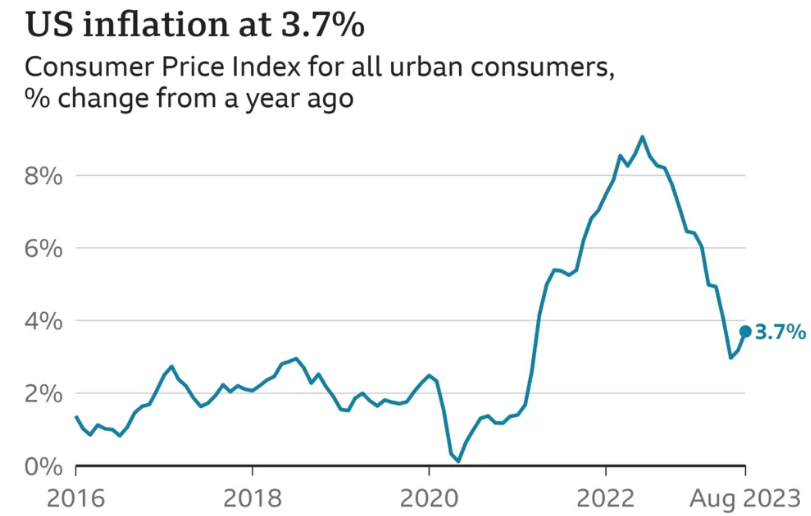
The DJIA has fallen by more than 300 points in recent days as Treasury yields climbed above 5%, a level not seen since 2007. The rise in yields was driven by strong economic data, such as the September 2023 consumer price index (CPI), which showed that inflation remained elevated at 3.7% year-over-year. But only 1.7% off the Fed target of 2%.
Dow Johns Industrial Average close 20th September 2023
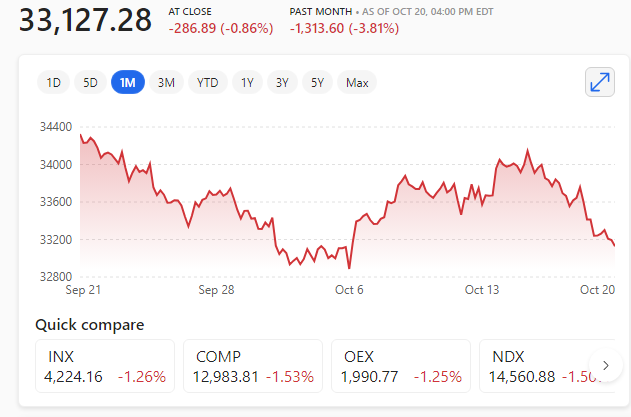
U.S. 10-year Treasury yield hits 5% for the first time since 2007 – Dow closes down nearly 300 points
The S&P 500 lost 1.26% to 4,224. The Nasdaq dropped 1.53% to 12,984. The Dow Jones Industrial Average lost 287 points, or 0.86%, to end at 33,127.28.
The yield on the benchmark 10-year Treasury crossed 5% for the first time in 16 years on Thursday 19th October 2023, a level that could easily spread through the economy by raising rates on mortgages, credit cards, vehicle loans and more. It retreated slightly from this value on Friday 20th October 2023.
Not to mention, it offers investors an attractive alternative to stocks.
The average rate on the U.S. 30-year fixed mortgage rate hit 8% on Wednesday 18th October 2023, according recently released data. That is the highest level since 2000.
The unwelcome milestone came as bond yields soared to levels not seen since 2007. Mortgage rates follow the yield of the 10-year U.S. Treasury.
Sharp rise
Rates climbed sharply in the last two weeks, as investors digested more economic data. On Wednesday 18th October 2023 it was housing starts, which rose in September 2023, although not as much as expected, according to the U.S. data.
Building permits, an indicator of future construction, fell but by a less than expected. Last week, retail sales came in far higher than expected, creating more uncertainty over the Federal Reserve’s long-term plan.
U.S. mortgage applications plummet
The higher rates have caused mortgage demand to plummet, as applications fell nearly 7% last week from the previous week.
The average rate on the 30-year fixed was as low as 3% just two years ago. To put it in perspective, a buyer purchasing a $400,000 home with a 20% cash deposit would have a payment increase of nearly $12,000 per year more than it would have been two years ago.
Shares of Chinese electric vehicle manufacturers took a hit on Thursday 18th October 2023 after Tesla reported disappointing 3Q results on Wednesday 17th October 2023.
It was the first time Tesla, co-founded by Elon Musk, missed on both earnings and revenue since Q2 2019.
On Thursday morning, Hong Kong-listed shares of Chinese EV makers BYD and Xpeng fell approximately 2.18% and 8.76%. Li Auto slid 3.14%, while Nio and Geely dropped 8.36% and 3.97%.
Elon Musk reportedly cautioned that the Tesla Cybertruck, the electric full-size pickup truck model; would not deliver substantial positive cashflow for 12-18 months after production begins.
Musk reportedly said the company is working to bring down the prices of its cars amid high interest rates. ‘I’m worried about the high interest rate environment we’re in,’ he said, adding that it will be much harder for consumers to purchase cars if interest rates were to increase further.
Tesla shares down
Tesla shares closed 4.78% lower on Wednesday 17th October 2023. Other U.S. EV rivals Lucid and Rivian fell more than 9% on the same day. Lucid’s stock dropped a day earlier after it reported disappointing Q3 EV deliveries.
Tesla shares closed 4.78% lower on Wednesday 17th October 2023.
In the first six months of the year, BYD was the world’s top EV manufacturer, contributing 21% of global sales of EVs, according to research firm Canalys. Tesla trailed behind at second place with 15% market share while German carmaker Volkswagen held 7% market share in third place.
Price pressure
EV players are under pressure from a price war to gain market share amid intense competition.
Tesla introduced a number of price cuts over the last few months, especially in China – the world’s biggest EV market.
Rivals BYD, Nio, Li Auto and Xpeng have also joined Tesla in lowering the prices for some of their EV models.
Shares in BYD, (Build Your Dreams), jumped this week after it said it expected third-quarter profits to more than double compared with last year.
BYD is now ahead of Tesla in quarterly production – and second to the U.S. car maker in global sales.
The curbs are aimed at closing loopholes that became apparent after the U.S. announced export curbs on microchips in October 2022. The restrictions are designed to prevent China’s military from importing advanced semiconductors or equipment.
Nvidia has said in a filing that the new export restrictions will block sales of two high-end artificial intelligence chips it created for the Chinese market – A800 and H800. It said that one of its gaming chips will also be blocked.
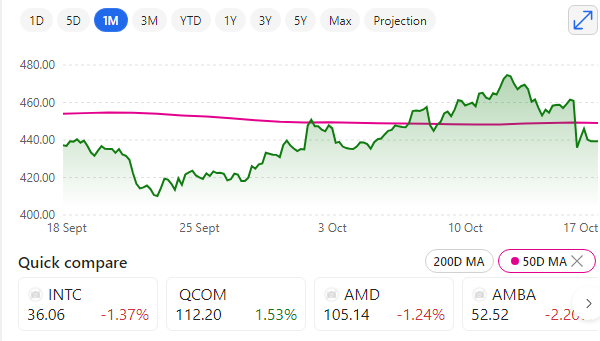
Nvidia Corp one month chart – closed at 439.38 17th October 2023
Although the curbs also affect other chip makers, analysts believe Nvidia will be hit the hardest because China accounts for up to 25% of its revenues from data centre chip sales. Nvidia’s shares, which are considered a star stock, fell by as much as 4.7% in the wake of the announcement.
Semiconductor Industry Association
The Semiconductor Industry Association, which represents 99% of the U.S. semiconductor industry by revenue, said in a statement that the new measures are ‘overly broad‘ and ‘risk harmingthe U.S. semiconductor structure without advancing national security as they encourage overseas customers to source elsewhere’.
China reacts
A spokesperson for the Chinese embassy also said that it ‘firmly opposes‘ the new restrictions, which also target Iran and Russia and go into effect in 30 days.
Nvidia stock falls after restrictions on AI chip exports from U.S. to China
Two months ago, China retaliated by restricting exports of two materials, gallium and germanium, which are key to the semiconductor industry.
The materials are ‘minor metals‘, meaning that they are not usually found on their own in nature, and are often the by-product of other processes. It’s not only the U.S., Japan and the Netherlands – which is home to key chip equipment maker ASML – have also imposed chip technology export restrictions on China.
Fallout
The constant ‘fall-out’ between the world’s two biggest economies has raised concerns over the rise of so-called ‘resource nationalism‘ – a practice where governments hoard critical materials to exert influence over other countries.
The world may be facing ‘the most dangerous time… in decades’, bank boss Jamie Dimon has reportedly warned.
The chief executive of JP Morgan Chase told investors recently that he was concerned about the risks to the economy from rising geo-political tensions. He said wars in Ukraine and Israel could hit energy and food prices, and global trade.
Thousands have been killed in Israel and Gaza after an unprecedented attack by Palestinian militant group Hamas. Mr Dimon, who leads America’s biggest bank, was speaking as the firm revealed its latest quarterly results.
Banking the profits from higher interest rates
The bank reported $13 billion (£10.7 billion) in profit over the three months to September 2023, up 35% from the same period in 2022.
Dimon said the bank had benefited from U.S. households and business in healthy financial shape but warned that he remained cautious about the state of the global economy, given the many risks emerging. What about the effect of interest rate increases on profits the bank has benefitted from too?
‘My caution is that we are facing so many uncertainties out there,‘ he reportedly said. So helpful Mr. Dimon. He told investors they should be prepared to face higher interest rates, persistent inflation, as well as fallout from the violent conflicts.
How perceptive?
I wouldn’t necessarily call his comments very intuitive – interest, inflation and conflict is there for all to see.
Shame he didn’t use his super magical powers of detection to get ahead of the inflation problem earlier.
The interest the government pays on national debt has reached a 20-year high as the rate on 30-year bonds touches 5.05%.
A rise in the cost of borrowing comes at a difficult time for the chancellor, Jeremy Hunt, as he prepares for the autumn statement on 22nd November 2023. The chancellor has already made clear that tax cuts will not be announced in the autumn statement.
National debt £2,590,000,000,000
The total amount the UK government owes is called the national debt and it is currently about £2.59 trillion – £2,590,000,000,000.
The government borrows money by selling financial products called bonds. A bond is a promise to pay money in the future. Most require the borrower to make regular interest payments over the bond’s lifetime.
UK government bonds – known as ‘gilts’ – are normally considered very safe, with little risk the money will not be repaid. Gilts are mainly bought by financial institutions in the UK and abroad, such as pension funds, investment funds, banks and insurance companies.
QE
The Bank of England (BoE) has also bought hundreds of billions of pounds’ worth of government bonds in the past to support the economy, through a process called quantitative easing or QE.
A higher rate of interest on government debt will mean the chancellor will have to set aside more cash, to the tune of £23 billion to meet interest payments to the owners of bonds. This in-turn means the UK government may choose to spend less money on public services like healthcare and schools at a time when workers in key industries are demanding pay rises to match the cost of living.
Double debt
The current level of debt is more than double what was seen from the 1980s through to the financial crisis of 2008. The combination of the financial crash in 2007/8 and the Covid pandemic pushed the UK’s debt up from those historic lows to where it stands now. However, in relation to the size of the economy, today’s debt is still low compared with much of the last century.
UK debt £2,590,000,000,000
The U.S, German and Italian borrowing costs also hit their highest levels for more than a decade as markets adjusted to the prospect of a long period of high interest rates and the need for governments around the world to borrow.
It follows an indication from global central banks, including the United States Federal Reserve and the Bank of England (BoE), that interest rates will stay ‘higher for longer’ to continue their jobs of bringing down inflation.
£111billion on debt interest in a year
During the last financial year, the government spent £111 billion on debt interest – more than it spent on education. Some economists fear the government is borrowing too much, at too great a cost. Others argue extra borrowing helps the economy grow faster – generating more tax revenue in the long run.
The Office for Budget Responsibility (OBR), has warned that public debt could soar as the population ages and tax income falls. In an ageing population, the proportion of people of working age drops, meaning the government takes less in tax while paying out more in pensions, welfare and healthcare services.
Wholesale U.S. prices rose more than expected in September 2023, according to latest data released indicating that inflation remains a problem for the U.S. economy.
The producer price index(PPI), which measures costs for finished goods that producers pay, increased 0.5% for the month, higher than estimated for a 0.3% rise, the U.S. Labor Department reported Wednesday 11th October 2023.
Excluding food and energy, core PPI was up 0.3%, versus the forecast for 0.2%.
Buying the dip means purchasing an asset, usually a stock, when its price has dropped. The expectation is that the drop is a short-term anomaly, and the asset’s price will soon go back up. It is a strategy that some traders and investors use to take advantage of price fluctuations and profit from market rebounds.
However, buying the dip can also be risky, as there is no guarantee that the price will recover or that the asset is not in a long-term downtrend. Therefore, it is important to do your research, use indicators, and have a risk management plan before buying the dip.
Current market situation and general ‘readout’
The S&P 500 is still ‘buy the dip’ for the next six months,’ some analysts suggest.
In some reports, it is expected that the profit cycle will be positive over the next six months and for data to improve before a consumer-spending led downturn leads to a selloff in U.S. stocks! That’s the ‘general’ readout.
Corporate profit expectations are behind much of that forecast for stocks. Analysts expect profit growth to accelerate over the next two quarters and see the S&P 500 in a range of 4,050 to 4,750. A mild recession in early or middle 2024 should lead to a higher risk premium, pushing the S&P 500 back close to 3,800. This is all conjecture.
Other analysts doubt the earnings uplift potential and anticipate stocks to fall back sooner as PE ratios sit at an already high level.
Take your pick
My view, for what it’s worth, is for stocks to climb for the time being through into the New Year and then to face pullback.
Truth is, no one knows. We can all make educated guesses.
Just watch the markets and be ready for the fall – that is coming for sure!
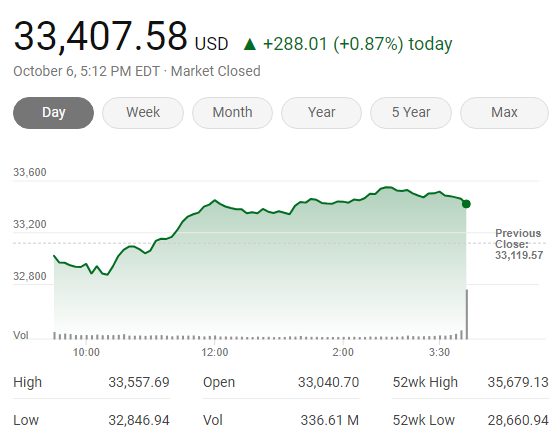
Stocks rallied Friday 6th October 2023 even after the release of stronger-than-expected U.S. jobs data and an increase in Treasury yields.
The U.S. economy added 336,000 jobs in September 2023, the Labour Department said. Economists expected 170,000 jobs.
Confused?
Stocks posted a surprise turnaround on Friday, 6th October 2023 after initially falling on a hotter-than-expected jobs report. At its session low, the Dow had fallen some 270 points, then surged by more than 400 points at in intraday trading. The Nasdaq and the S&P 500 also lost ground too only but then quickly recovered the losses.
Unclear
Traders were unclear as to the reason for the intraday reversal. Some noted it could be the softer wage number in the jobs report that made investors rethink their earlier bearish stance. Others noted the pullback in yields from the day’s highs.
Rally
The rally may just be because the market had been extremely oversold with the S&P 500 at one point in the week down more than 8% from its high earlier this year.
Yields initially surged after the report, with the 10-year Treasury rate trading near its highest level in 16 years. The benchmark rate later eased from those levels, but was still up around 6 basis points at 4.78%.
Extreme market movements maybe here for a while yet.
The latest U.S. jobs report for September 2023 was released on Friday, October 6, 2023.
The U.S. economy added 336,000 jobs last month, much more than expected, despite the Federal Reserve’s struggle to cool the world’s largest economy.
The unemployment rate was 3.8%, in line with August 2023. The data lifted hopes that the central bank will manage to guide the U.S. economy to a ‘soft landing’, where a recession is avoided. Bear in mind the Fed were late in dealing with the initial rise in inflation – so this battle has become harder and prolonged.
The job gains were the largest monthly rise since January 2023, and almost twice what economists had anticipated. Government and healthcare added the most jobs. The labour market still appears solid.
However, not all indicators were positive. The ADP’s national employment report showed that private-sector employers added only 89,000 jobs in September, far fewer than expected. Some factors outside the Fed’s control, such as the autoworker strike and the threat of a government shutdown, could yet damage the U.S. economy.
The labour force participation rate also remained low at 63.2%, indicating that many workers have yet to return to the labour market since the Covid19 pandemic of 2020.
The average rate on the popular 30-year fixed mortgage rose to 7.72% on Tuesday 3rd October 2023, according to latest data
Mortgage rates follow loosely the yield on the 10-year Treasury, which has been climbing this week following strong economic data. Rates have not been this high since the end of 2000.
At the beginning of this year, the 30-year fixed rate dropped mortgage to around 6%, creating a short-lived burst of activity in the spring 2023. But it began rising steadily again over the summer months, causing sales to drop, despite strong demand. The current trend appears to be even higher, with the possibility of rates reaching over 8%.
U.S. mortgage rates, which are close to 8% according to some sources. This is a very high level compared to the recent years, and it may have significant implications for the housing market and the economy.
Main points
Some experts believe that rates could reach 8% later by the end of October, and possibly stay at that level for the remainder of the year. Others, however, think that rates may stabilize or decline slightly if the economic growth slows down or inflation eases.
30 year fixed mortgage rate at 7.72%
The average rate on the popular 30-year fixed mortgage rose to 7.72% as of Oct. 3, according to Mortgage News Daily. This is the highest rate since 2000.
Rates are rising as more economic indicators point to a strong U.S. economy, which increases the likelihood of the Federal Reserve to hike rates further. The 10-year Treasury yield, which closely tracks the mortgage rates, reached 4.8% on Tuesday, the highest level since August 2007.
Hitting 8% will be like crossing a psychological barrier for many buyers, as it will increase their monthly payments and reduce their affordability. It may also dampen the demand for housing, which has already been affected by low inventory and high prices.
Some buyers are already seeing 8% mortgage rates, especially those who have high loan-to-value ratios, high balance-conforming loans, or non-qualified mortgage loans. These could also be borrowers with lower credit scores or non-prime borrowers.
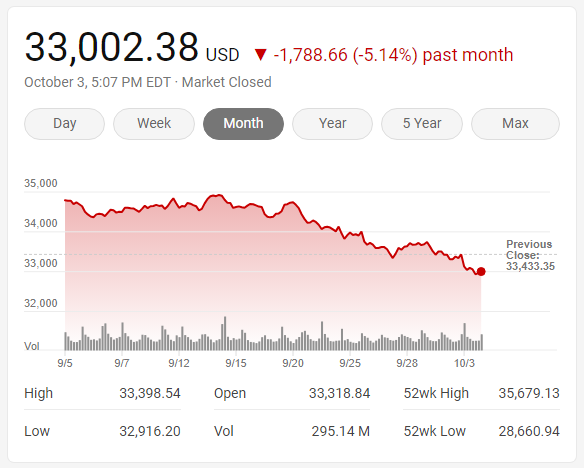
Dow Jones Industrial Average (Dow) performance on 3rd October 2023.
The Dow fell more than 400 points, turning negative for the year. The main reason for the drop was the surge in U.S. Treasury yields, which reached their highest levels in 16 years.
Higher yields mean higher borrowing costs for businesses and consumers, which could hurt the economic recovery and the housing market.
S&P 500 on 3rd October 2023
Nasdaq on 3rd October 2023
The tech-heavy Nasdaq Composite gained a 0.7% on October 3rd, 2023, as some investors saw an opportunity to buy some of the high-growth stocks that had been under pressure recently.
The stock market has been experiencing some volatility and uncertainty in September and October 2023, as investors fret about inflation, interest rates, and the possibility of a U.S. recession.
Main facts affecting the current stock market
The month of October has produced some severe stock market crashes over the past century, such as the Bank Panic of 1907, the Wall Street Crash of 1929, and Black Monday 1987.
October has also marked the start of several major long-term stock market rallies, such as Black Monday itself and the 2002 nadir of the Nasdaq-100 after the bursting of the dot-com bubble.
The S&P 500 dropped 4.5% in September 2023 and finished the third quarter in the red.
The U.S. Treasury yield curve has been inverted for months – which is a historically strong recession indicator.
The Fed maintained interest rates at the current target range of between 5.25% and 5.5% in September 2023, but signalled that it may need to raise rates again to combat inflation.
The consumer price index gained 3.7% year-over-year in August 2023, down from peak inflation levels of 9.1% in June 2022 but still well above the Fed’s 2% long-term target.
The bond market is currently pricing in an 81.7% chance the Fed will choose not to raise rates again on 1st November 2023.
The Dow Jones Industrial Average was down at 33002, Tuesday 3rd October 2023.
Stocks fell as investors pulled money from equities and moved it to the hot bond market.
International markets also faced significant turmoil, sending mini shockwaves through global financial centres, which reverberated in equities.
The dollar rose to the highest since December and is heading towards the twelfth positive week in a row.
Uncertainty
Uncertainty in the U.S. political system is having a major affect too. Especially with the ousting of the speaker and the real fear of a government shutdown looming large.
The U.S. Treasury yields are the interest rates that the U.S. government pays to borrow money. The 10-year and 30-year Treasury yields are the most widely followed indicators of the long-term health of the U.S. economy and the expectations of inflation and growth.
10 year yield at 4.80%
According to the latest data, the 10-year Treasury yield surged to 4.80% on Tuesday, 3rd October 2023, which is the highest level since 12th October 2007.
30 year yield at 4.79
The 30-year Treasury yield rose to 4.79% on Monday, 2nd October 2023, which is the highest since 6th April 2010.
The main reasons for the rise in the Treasury yields
The strong U.S. economic data that showed that the labour market remains hot and the manufacturing sector rebounded in September 2023.
The Federal Reserve’s ‘higher for longer’ mantra signalled that the central bank would keep raising rates until inflation is under control.
The reduced demand for safe-haven assets as the U.S. government averted a shutdown over the weekend by passing a short-term stopgap funding measure.
Uncertainty at the heart of the U.S. political system.
The implications of higher Treasury yields
The higher borrowing costs could weigh on the economic growth and consumer spending in the future.
Higher inflation expectations could erode the purchasing power of the fixed-income investors and increase the risk of a bond market sell-off.
The higher interest rate differential could attract more foreign capital inflows into the U.S. dollar and strengthen its value against other currencies.
The benchmark 10-year Treasury yield rose Wednesday 27th September 2023, to its highest level in more than 15 years, as traders navigated fears of persistent inflation and higher interest rates for longer than expected.
The 10-year Treasury yield climbed to 4.612%. It had reached 4.566% on Tuesday 26th September 2023, its highest level since 2007.
2 year yield
The 2-year Treasury yield also added 6 basis points to 5.139%.
FED said
Federal Reserve suggested last week that interest rates would go higher still and remain elevated for longer, prompting concerns among investors about what it could mean for the economy.
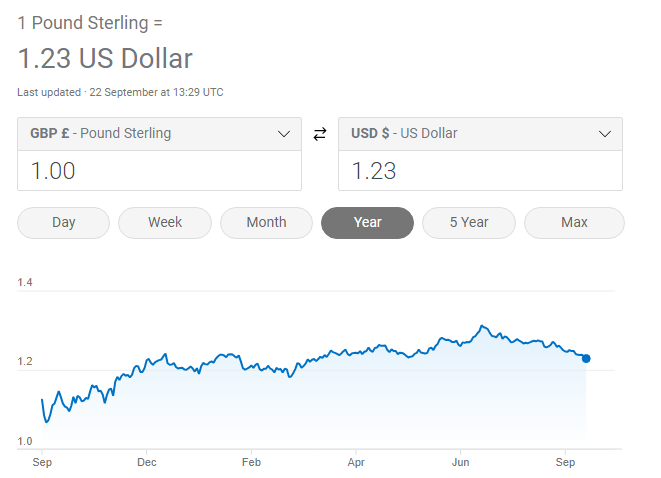
According to the latest data, 1.00 GBP is equal to 1.22 USD
This means that one British pound can buy 1.22 U.S. dollars at the current market rate. The exchange rate fluctuates depending on various factors such as supply and demand, interest rates, inflation, trade balance, and political stability.
Weak against U.S. dollar
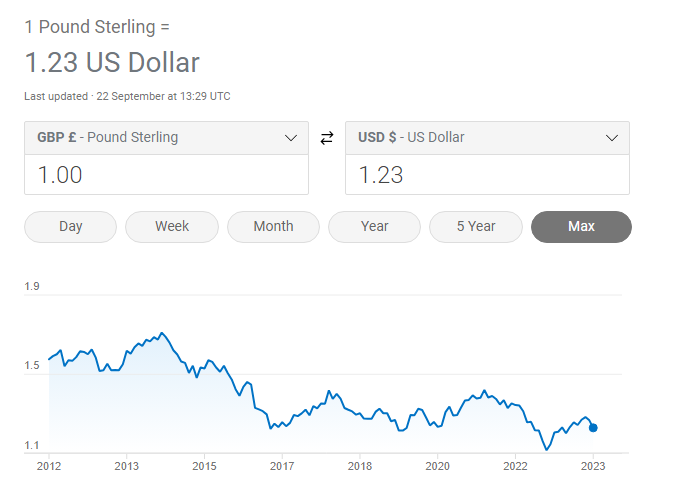
The British pound has been weakening against the U.S. dollar since the Brexit referendum in 2016, when the UK voted to leave the European Union. The uncertainty and instability caused by the Brexit process have reduced the confidence and attractiveness of the British currency in the global market. The U.S. dollar, on the other hand, has been strengthening due to its status as a safe haven and a reserve currency in times of crisis.
In September 2022 the pound fell to its lowest level against the U.S. dollar
Excessive government spending and tax cuts that undermined confidence in the UK economy.
Price caps and record high inflation that eroded the purchasing power of the pound.
The strength of the dollar as a safe haven currency amid global uncertainty.
The prospect of a new Scottish independence referendum that increased political risk.
The impact of the Covid pandemic and the Russia-Ukraine conflict on supply chains and trade.
Artwork of GBP
UK pound closes in on a six month low
September 2022
The pound reached $1.0327 at one point in late September 2022, its lowest since Britain went decimal in 1971. It also fell more than 1% against the euro to about 86.80p, its lowest level since May 2020.
Today, 22nd Septmber 2023
The current exchange rate of 1.22 USD per GBP is near the lowest point in the last 30 and 90 days, which was 1.2383 USD per GBP.
The highest point in the same period was 1.3128 USD per GBP. The average exchange rate in the last 30 days was 1.2563 USD per GBP, and in the last 90 days was 1.2721 USD per GB pound.
The Federal Reserve held interest rates steady in a decision released Wednesday 20th September 2023, while also indicating it still expects one more hike before the end of the year and fewer cuts than previously indicated next year.
That final increase, if realised, would be it for now according to data released at the end of the Fed two-day meeting. If the Fed goes ahead with the move, it would be the twelfth rate hike since policy tightening began in March 2022.
No change priced in
Markets had fully priced in no move at this meeting, which kept the fed funds rate targeted in a range between 5.25%-5.5%, the highest in some 22 years. The rate fixes what banks charge each other for overnight lending but also affects many other forms of consumer debt too.
While the no-hike was expected, there was plenty of uncertainty over where the rate-setting Federal Open Market Committee (FOMC), would go from here.
Judging from reports released Wednesday 20th September 2023, the bias appears towards more restrictive policy and a higher-for-longer approach to interest rates.
Investors gobbled up UK microchip designer Arm Holdings at its U.S. debut on the Nasdaq on 14th September 2023, sending its market value soaring to $60 billion (£48.3 billion).
The shares ended the day worth more than $63 each, after climbing by almost 25% from the high end start of $51 per share set by Arm.
The sale was the biggest initial public offering of the year, raising $4.87 billion for owner Softbank Group.
Despite some concerns surrounding the company’s exposure to risks in China and a potential AI slowdown – the shares soared.
British tech
A star of the British technology industry, Arm designs microchips for devices including smartphones and game consoles. It estimates that some 70% of the world’s population uses products that rely on its chips, including nearly all of the world’s smartphones. And with AI nestling in on the horizon, the future potential for Arm is massive.
Arm stock chart 14th September 2023
Arm said it expects the total market for its chip designs to be worth about $250 billion by 2025, including new growth areas such as data centres and cars.
Legacy
Many of Arm’s royalties come from products released decades ago. About half of the company’s royalty revenue of $1.68 billion in 2022, came from products released between 1990 and 2012.
Bright Future
The future looks bright for Arm but the company is trading at more than 25 times its most recent full year of revenue, and at more than 100 times profit.
And that could be where things get tricky for Arm in the not too distant future. Projections for future profits will be interesting, esecially if it’s to keep up with Nvidia for instance.
According to news reports, France has banned the Apple iPhone 12 because it emits too much electromagnetic radiation, which could be harmful to human health.
The French watchdog (ANFR) said that the iPhone 12’s specific absorption rate (SAR), which measures the rate of radio frequency energy absorbed by the body, was above the legal limit of 4.0 watts per kilogram in tests simulating the phone being held in the hand or kept in a pocket.
Dispute
Apple disputed the tests and said that the iPhone 12 was certified by multiple international bodies and compliant with all global radiation standards. The French digital minister said that Apple had two weeks to respond and fix the issue, or else he would order a recall of all iPhone 12 devices sold in the country.
The minister also said that France would share its findings with other regulators in the European Union, which could lead to a wider ban of the phone.
France ban Apple iPhone 12 due to excessive radiation fears
What is electromagnetic radiation?
Radiation from mobile phones is a type of electromagnetic radiation that is emitted by cell phones and cordless phones when they send and receive signals. Electromagnetic radiation is a form of energy that travels in waves or particles through space.
It can be classified into two types: ionizing and non-ionizing radiation. Ionizing radiation has high energy and can damage DNA, which may increase the risk of cancer such as; x-rays, radon, and cosmic rays. Non-ionizing radiation has low energy and cannot damage DNA directly – such as; radio waves, microwaves, infrared, visible light, and ultraviolet light.
Cell phone radiation
Cell phones use radiofrequency (RF) waves, which are a type of non-ionizing radiation, to communicate with cell towers and other devices. RF waves have frequencies ranging from 0.7 to 80 GHz, depending on the generation of the cell phone (2G, 3G, 4G, or 5G). The human body can absorb some of the RF energy from cell phones, which may cause some heating to the area of the body where the phone is held (e.g., the ear and head). However, it is suggested this heating is not enough to raise the core body temperature or cause any harmful effects.
Research
There has been a lot of research on whether cell phone use can cause health problems, such as cancer, in humans. However, it has been reported that the evidence so far is not conclusive and does not show a clear link between cell phone use and cancer risk. There could be a link but we do not know 100%… yet?
Some studies have suggested that there may be a small increase in the risk of certain types of brain tumors (such as acoustic neuromas) for people who use cell phones for a long time or frequently. However, other studies have not found any consistent evidence to support this.
The incidence of brain and central nervous system cancers has not changed significantly during the time that cell phone use has increased dramatically. Therefore, more research is needed to understand the possible effects of cell phone use on human health.
The latest inflation figures for the U.S. show that the annual inflation rate rose to 3.7% in August 2021, up from 3.2% in July 2021. This was mainly driven by a sharp increase in energy prices, which jumped up 10.5% over the last month. Gas (petrol) prices accounted for more than half of the increase in the overall inflation rate.
Core inflation
However, core inflation, which excludes the volatile food and energy sectors, slowed down to 4.3% in August 2021, down from 4.7% in July 2021. This suggests that the Federal Reserve’s ’11’ rate hikes are having some effect on cooling the inflationary pressures in the economy. Some sectors, such as used cars, medical care services and airfare, saw price decreases in August 2021.
Will the Fed keep interest rates unchanged at its next meeting on September 20, 2021, as we wait to see the full impact of its previous rate hikes on the economy?
However, the Fed may still raise interest rates later this year if inflation remains persistently above its target of 2%. Higher interest rates could introduce more volatility to the U.S. economy and potentially trigger a recession.
Japan launched a rocket on 7th September 2023 carrying an X-ray telescope that will explore the origins of the universe and a small lunar lander.
The launch of the HII-A rocket from Tanegashima Space Centre in southwestern Japan was shown live by the Japan Aerospace Exploration Agency (JAXA).
Thirteen minutes after the launch, the rocket put into orbit around Earth a satellite called the X-Ray Imaging and Spectroscopy Mission, or XRISM, which will measure the speed and makeup of what lies between galaxies.
That information helps in studying how celestial objects were formed, and hopefully can lead to solving the mystery of how the universe was created, JAXA reports.
In cooperation with NASA, JAXA will look at the strength of light at different wavelengths, the temperature of things in space and their shapes and brightness.
Smart
Also aboard the Japanese rocket is the Smart Lander for Investigating Moon, or SLIM, a lightweight lunar lander. The Smart Lander reportedly won’t make lunar orbit for three or four months after the launch and would likely attempt a landing early 2024, according to the space agency.
Japan launched a rocket on 6th September 2023 carrying an X-ray telescope that will explore the origins of the universe and a small lunar lander.
Going to the moon has fascinated humankind for decades. Under the U.S. Apollo program, astronauts Neil Armstrong and Buzz Aldrin walked on the moon in 1969.
Only four nations have successfully landed on the moon, the U.S., Russia, China and India.
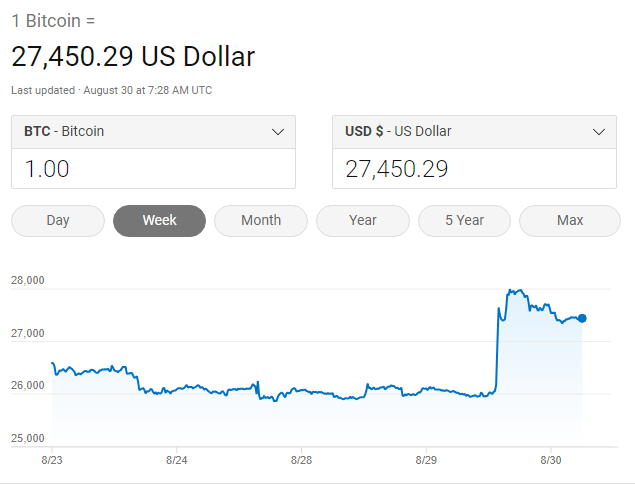
The price of bitcoin surged Tuesday 29th August 2023 after the U.S. Court of Appeals ruled that the Securities and Exchange Commission (SEC) was wrong to deny crypto investment giant Grayscale permission to convert its popular bitcoin trust into an ETF.
Bitcoin jumped around 7% following the ruling to $27,852. The move lifted other cryptocurrencies as well as crypto equities higher.
Grayscale
Grayscale’s lawsuit against the SEC has been closely watched by investors and other industry participants as a key catalyst that would shake up a market governed by low volatility and liquidity.
Earlier this month, bitcoin trading volatility fell to its lowest level in more than four years as investors had been waiting on the sidelines for more regulatory clarity on crypto activity .
Several bitcoin futures ETFs have already been approved in the U.S.
‘Shackles being removed from crypto regulation paving way for easier crypto trading’
Court ruling
‘The denial of Grayscale’s proposal was arbitrary and capricious … The Commission failed to adequately explain why it approved the listing of two bitcoin futures ETPs but not Grayscale’s proposed bitcoin Exchange Trade Product (ETP),‘the court said in the ruling. ‘In the absence of a coherent explanation, this unlike regulatory treatment of like products is unlawful. We therefore grant Grayscale’s petition for review and vacate the Commission’s order‘.
Tuesday’s ruling may increase the chances that the SEC will approve other bitcoin ETF applications, including that of BlackRock, whose filing in late June 2023 drove one of bitcoin’s big rallies this year, as well as Fidelity, Invesco and many others.
A U.S. bitcoin ETF would provide a way to get exposure to bitcoin without having to hold it, which would invite retail and institutional investors as well as wealth managers into the market.
A spokesperson for the SEC said it’s ‘reviewing the court’s decision to determine next steps‘.
‘Today’s decision reaffirms that a bitcoin ETF in the U.S. is a matter of when, not if’, said the global head of asset management at Galaxy, which filed with Invesco for its bitcoin ETF. ‘In order for digital assets to continue to flourish, they must be accessible to all investors. We believe that the ETF structure can enable greater access to and transparency across cryptocurrency investing, and truly help further democratize the asset class‘.
Dark cloud for crypto finally lifting?
The ruling also comes as a relief to many crypto market traders who have been frustrated by the SEC, particularly under Chair Gary Gensler, and its insistence on regulating by enforcement.
The crypto industry has long sought out clarity in rules businesses can apply to establish and build long-lasting, compliant companies. The U.S. regulatory crackdown on crypto in 2023 – which includes SEC enforcements and a lawsuit against the biggest U.S. crypto exchange Coinbase and also its case against XRP Ripple has been a dark cloud over the market.
Lawsuit filed June 2022
Grayscale initiated its lawsuit against the SEC in June 2022 after the agency rejected its application to turn its bitcoin trust, better known by its ticker GBTC, into an ETF. The company decided to pursue the ETF, which would be backed by bitcoin rather than bitcoin derivatives, after the SEC approved ProShares’ futures-based bitcoin ETF in October 2021.
The ruling faced multiple delays but the SEC ultimately rejected the application last summer, citing failure by Grayscale to answer questions related to concerns about market manipulation and investor protections.
At 4.33%, the 10-year Treasury yield in the U.S. is at its highest in 16 years. That represents a risk-free, long-duration asset with relatively high returns and this is challenging the stock market.
Why should traders invest in stocks that may not return as much, or just slightly more and take unecessary risks, when there is an asset class that guarantees around 4% return or slighlty more?
Cash is king?
Cash is now yielding 5% in the U.S., short term bonds are yielding 5% plus, so equities for the first time in a long time, have actually got some competition.
Typically stocks if they do well, are likely to return more than a risk-free asset, precisely because it isn’t certain stocks will rise. That’s called the equity risk premium, a return that’s supposed to compensate stock investors for the chance that they might lose money. But, as the premium is below 1% now. Historically, it’s been between 2% and 4% – meaning stocks are looking much less attractive than Treasuries.
Harder job for the Fed?
Another potential issue that could crop up with high Treasury yields is that it could make the Federal Reserve’s job tougher. During the recent Jackson Hole gathering, the Fed head has indicated that more interest rate hikes are still high possibility.
But don’t panic just yet… this is likely a pullback phase of a bull market analysts suggest. That is, it’s still too early to be bearish on stocks.
Yardeni Research president Ed Yardeni is reported to have said that the market is ‘going to hang in there’ and ‘a year-end rally will bring the S&P 500 back to something like 4,600‘.
That implied an increase of almost 5% in stocks – while not certain – would give Treasuries a run for their money again.
The latest U.S. mortgage rates are the highest they have been in decades.
The average 30-year fixed-rate mortgage rose to 7.23% in the week ending 25th August 2023, up from 7.09% the week before, according to latest bank reports from U.S. This is the highest level since June 2001, when it was 7.24%.
The rate on a 30-year fixed mortgage increased to 7.31% in the week ended 18th August 2023, according to Mortgage Bankers Association data. This is the highest level since late 2000.
The 30-year fixed mortgage rate averaged 7.16% with 0.68 points as of August 16, according to U.S. News. This is up from 7.09% with 0.7 points the previous week. The adjustable-rate mortgage increased to 7.6%.
Inflation driving interest rates up
The rise in mortgage rates is driven by indications of ongoing economic strength and inflation pressures, which have also pushed up Treasury yields and the Federal Reserve’s interest rate expectations.
Higher mortgage rates make home buying more expensive and reduce the affordability of homeownership. They also discourage existing homeowners from selling or refinancing their homes, which contributes to the low inventory of available homes for sale.
As a result, home sales have declined and home prices have soared in many markets. Will interest rates touch 8%?
The U.S. stock market has experienced a 5.6% slide for the S&P 500 index over 15 trading sessions through 17th August 2023 and levelling off in the last trading day of that week.
This is about as bad as August typically gets, as August is a rocky month with low volume and high volatility. Some of the reasons for the pullback include the rise in the 10-year Treasury yield, the strengthening of the U.S. dollar, and the signs of a slowing Chinese economy.
Pullback temporary for August?
However, some analysts argue that the pullback will likely prove to be temporary and not turn into a serious market rout. It has been suggested that the bull run isn’t quite over just yet, and that a 10% ‘pullback’ was on the cards.
Analysts also suggest that the rise in yields would need to threaten a serious shift or there would need to be an additional shock to cause a larger selloff.
NASDAQ
NASDAQ drops some 7% in one month from 19th July – 18th August 2023
However, some suggest that the market is showing signs of stability, as the speed of the surge in the 10-year yield often occurs near the end of a selling cycle for equities. Investors should watch for indicators such as oil prices, wage pressures, and inflation expectations to gauge the market sentiment.
The S&P 500 and the Dow levelled off the week at the close of trading Friday 18th August 2023.
The NASDAQ did score its best first half of the trading year since 1983 January to June 2023 so a pullback was likely to happen.
Singapore’s financial regulator has reportedly said it had finalised rules for a type of digital currency called ‘stablecoin’, placing it among some of first the regulators worldwide to do so.
Stablecoins are a type of digital currency designed to hold a constant value against a fiat currency. Many claim to be backed by a reserve of real-world assets, such as cash or government bonds.
Reserves that back stabelcoins must be held in low-risk and highly-liquid assets. They must equal or exceed the value of the stablecoin in circulation at all times, the rules say. The stablecoin market is valued at around $125 billion, with two tokens – Tether’s USDT and Circle’s USDC – dominating roughly 90% of the market cap value. Stablecoins are broadly unregulated around the world.
The Monetary Authority of Singapore’s (MAS) framework requirement
Reserves that back stabelcoins must be held in low-risk and highly-liquid assets. They must equal or exceed the value of the stablecoin in circulation at all times
Stablecoin issuers must return the par value of the digital currency to holders within five business days of a redemption request.
Issuers must also provide ‘appropriate disclosures‘ to users, including the audit results of reserves.
These rules will apply to stablecoins that are issued in Singapore and mimic the value of the Singapore dollar, or of any G10 currencies, such as the U.S. dollar.
‘Shackles being removed from crypto regulation paving way for stablecoin adoption’
Last year, the collapse of a so-called algorithmic stablecoin named UST put this type of stablecoin in the crosshairs of regulators. Unlike USDT and USDC, UST was governed by an algorithm and did not have real-world assets like bonds in its reserves.
Singapore’s stablecoin framework puts it among one of the first jurisdictions to have such rules. In June, the U.K. passed a law that gives regulators the ability to oversee stablecoins, though there are no concrete rules yet. Hong Kong is meanwhile undergoing a public consultation on stablecoins and seeks to introduce regulation next year.
What is a stablecoin
A stablecoin is a type of cryptocurrency that tries to maintain a stable value by being pegged to another asset, such as a fiat currency, a commodity, or another cryptocurrency. Stablecoins aim to offer the benefits of cryptocurrencies, such as decentralisation, security, and transparency, without the drawbacks of high volatility and price fluctuations.
Stablecoins can be used for payments, remittances, trading, and storing value. However, stablecoins also face some challenges and risks, such as regulatory uncertainty, technical issues, and trust issues.
There are different ways to create and manage stablecoins, depending on the mechanism used to stabilize their value.
Main types of stablecoins
Fiat-backed: These stablecoins are backed by a reserve of fiat currency, such as the US dollar or the euro, held by a third-party entity. The stablecoin issuer promises to redeem the stablecoin for the fiat currency at a fixed ratio. Examples of fiat-backed stablecoins are Tether (USDT), USD Coin (USDC), and TrueUSD (TUSD).
Commodity-backed: These stablecoins are backed by a reserve of physical commodities, such as gold, silver, or oil, held by a third-party entity. The stablecoin issuer promises to redeem the stablecoin for the commodity at a fixed ratio. Examples of commodity-backed stablecoins are Paxos Gold (PAXG), Tether Gold (XAUT), and Digix Gold (DGX).
Crypto-backed: These stablecoins are backed by a reserve of other cryptocurrencies, such as Bitcoin or Ethereum, held in a smart contract. The stablecoin issuer uses over-collateralization or algorithmic adjustments to maintain the stability of the stablecoin. Examples of crypto-backed stablecoins are Dai (DAI), sUSD (SUSD), and BitUSD (BITUSD).
Algorithmic: These stablecoins are not backed by any reserve, but instead use an algorithm to control the supply and demand of the stablecoin. The algorithm adjusts the supply of the stablecoin according to the market conditions and the target price. Examples of algorithmic stablecoins are Basis Cash (BAC), Empty Set Dollar (ESD), and TerraUSD (UST).
What is ‘crypto’
Crypto has attracted a lot of attention in recent years. Crypto is short for cryptocurrency, which is a digital or virtual currency that uses cryptography to secure and verify transactions. Crypto can also refer to the underlying technology that powers cryptocurrencies, such as blockchain.
Some examples of popular cryptocurrencies are Bitcoin, Ethereum, Ripple ( XRP)and Cardano (ADA).
Cryptoman superhero
Cryptocurrencies have many advantages over traditional currencies, such as decentralisation, transparency, anonymity, and lower fees. However, they also face some challenges, such as volatility, regulation, security, and scalability. Crypto enthusiasts believe that cryptocurrencies have the potential to revolutionise the world of finance and beyond.
Some examples of popular stablecoins are Tether, USD Coin and Binance USD.