

Is America’s Safe-Haven Status Starting to Slip? Why Central Banks Are Moving Gold Out of New York

U.S. Gold Migration

For decades, the United States has been regarded as the world’s ultimate financial safe haven. Is America’s Safe-Haven Status Starting to Slip?

From U.S. Treasury bonds to the U.S. dollar and the vaults of the Federal Reserve Bank of New York, global investors have traditionally trusted American institutions to protect their wealth in times of crisis.

That confidence is now being tested.

The Dutch

The Netherlands has recently moved around 86 tonnes of gold from the United States and Canada to London. The country cites growing geopolitical uncertainty and the need to ensure its reserves can be accessed quickly in a crisis.

The Dutch central bank reportedly said the move was designed to improve the “tradability” of its gold. Distributing its reserves more evenly is considered a top priority.

France and Germany

France has also reportedly removed its remaining gold holdings from New York, while Germany previously repatriated a substantial proportion of its reserves.

These moves do not necessarily mean central banks believe their gold is unsafe in America. Rather, they reflect a growing desire for greater control and diversification.

Poland and China

Gold has become increasingly attractive as governments confront geopolitical tensions, sanctions, inflation and concerns about the long-term sustainability of government debt.

Central banks bought 289 tonnes of gold in the second quarter of 2026 alone, with Poland and China among the largest buyers.

The question, therefore, is whether this represents the beginning of a broader shift away from the U.S. financial system.

Treasuries are still desirable

The evidence is mixed. The Federal Reserve itself argues that Treasury securities remain an important component of global reserves, with foreign official investors still buying U.S. Treasuries overall since 2022.

Yet symbolism matters. When countries start moving their gold away from New York, they are signalling that diversification and control have become more important.

The U.S. may not have lost its safe-haven status. But the world’s central banks are clearly no longer taking it entirely for granted.


Dutch Gold Moves Out of the U.S. and Canada

Gold on the move to London

The Dutch central bank has made a striking move that says much about the changing geopolitical and financial landscape.

Between March and August 2026, De Nederlandsche Bank (DNB) reportedly moved around 86 tonnes of gold from the United States and Canada to London, describing the decision as part of its efforts to strengthen “crisis preparedness”.

The move does not mean the Netherlands has lost confidence in American or Canadian vaults. Rather, it is about accessibility, diversification and the possibility that the international system could become considerably less predictable.

London

Before the transfer, 31.3% of Dutch gold was held in New York and 19.7% in Ottawa. Those proportions have now fallen to 18.5% each, while London’s share has risen from 18.1% to 32.1%. Around 30.8% remains in the Netherlands.

Why London? Quite simply, liquidity. London is the world’s biggest centre for physical gold trading, meaning bullion stored there can be bought, sold, lent or mobilised rapidly if financial markets are disrupted.

DNB says gold held in New York and Ottawa cannot be utilised as quickly or directly during a crisis.

Strategy

There is also a broader strategic calculation. DNB has been examining geopolitical risks ranging from cyber attacks and disrupted supply chains to economic and physical warfare.

Gold, unlike government debt or bank deposits, carries no issuer’s credit risk and can act as a reserve asset when confidence in financial institutions is severely tested.

The timing is nevertheless significant. Relations between Europe and the U.S. have become more politically complicated, while concerns about the reliability of international alliances and financial infrastructure have increased.

Preparedness

DNB insists the move is about resilience rather than politics. But central banks rarely move tens of tonnes of bullion without careful thought.

The message is therefore subtle but important: in an increasingly uncertain world, central banks want their emergency assets not merely to be safe, but immediately usable. And increasingly, gold is becoming that asset.

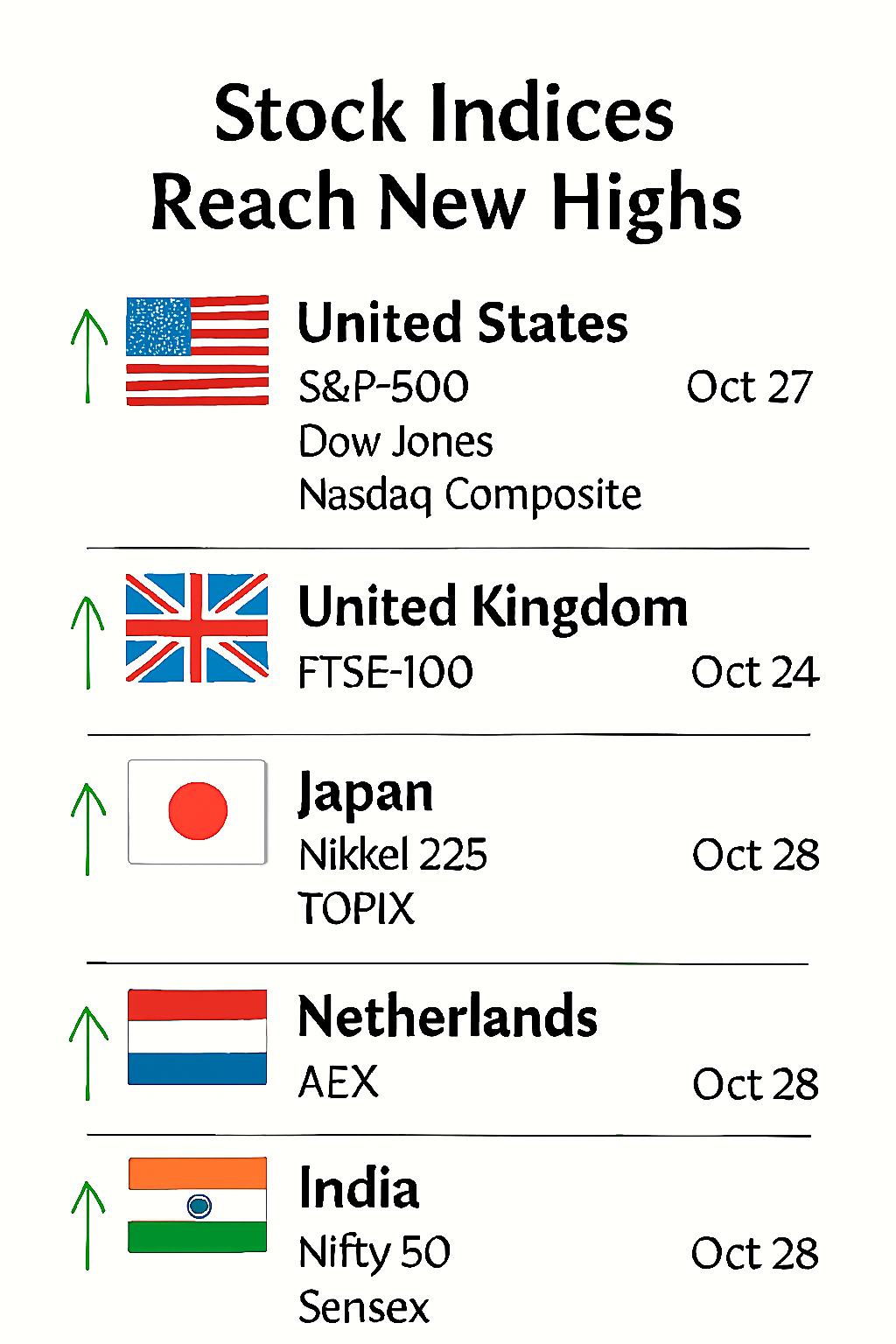
Stock market roundup of latest all-time highs! October 2025

Stocks hit all-time high

Scaling the Summit: Markets Hit Record Highs Amid Global Uncertainty led by the Nasdaq and S&P 500 reflecting the AI race

Global stock hit new highs October 2025

🌍 Country📈 Index Name🗓️ Date🔝 Closing Value
🇺🇸 United StatesS&P 500Oct 276,875.16
🇺🇸 United StatesDow JonesOct 2747,544.59
🇺🇸 United StatesNasdaq CompositeOct 2723,637.46
🇬🇧 United KingdomFTSE 100Oct 249,662.00
🇳🇱 NetherlandsAEX IndexOct 28966.82
🇮🇳 IndiaNifty 50Oct 2825,966
🇮🇳 IndiaSensexOct 2884,778.84
🇯🇵 JapanNikkei 225Oct 2850,342.25
🇯🇵 JapanTOPIXOct 283,285.87

These rallies were largely fueled by optimism over a potential U.S.–China trade deal, cooler inflation data, and expectations of interest rate cuts from the Fed.

Is there a market crash, correction or a pullback coming to a stock market near you soon?