


The first phase of the artificial intelligence boom was largely about the companies building the technology. Nvidia, Microsoft, Amazon and other giants have poured billions into chips, data centres and cloud infrastructure, creating some of the biggest investment stories of recent years.
But the next phase could be rather different. The real financial payoff from AI may increasingly emerge inside ordinary businesses as companies discover that intelligent software can make their existing workforces significantly more productive.
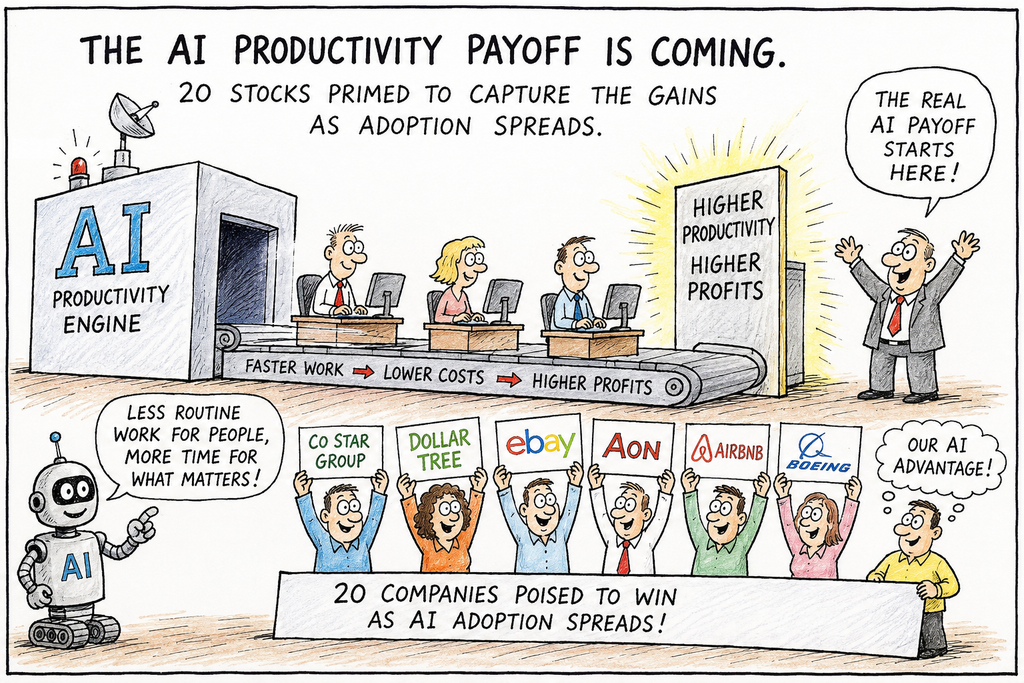
Goldman Sachs has reportedly identified 20 stocks it believes could be particularly well positioned to capture these gains as AI adoption spreads.
Big AI benefactors
The list includes CoStar Group, Dollar Tree, eBay, Arthur J. Gallagher, Brown & Brown, Axon Enterprise, Trade Desk, CMS Energy, Jacobs Solutions, Edison International, Aon, Marsh & McLennan, Kimberly-Clark, Willis Towers Watson, Airbnb, Iron Mountain, CBRE Group, RTX, Boeing and Expedia.
What makes the selection interesting is that most are not conventional AI companies. Goldman focused on businesses with substantial labour costs and significant exposure to occupations where AI could potentially automate or accelerate tasks.
Insurance
Insurance companies are particularly prominent. Aon, Marsh & McLennan, Arthur J. Gallagher, Brown & Brown and Willis Towers Watson employ thousands of people in areas involving analysis, administration, documentation and customer service.
AI could increasingly handle routine work, allowing employees to concentrate on more complex and valuable activities.
Travel, property and advertising businesses could also benefit through improved customer service, pricing, marketing and data analysis.
Productivity promise
However, the productivity revolution remains more promise than proven financial reality. Only a relatively small proportion of companies are currently quantifying AI’s direct contribution to earnings.
That could change rapidly. If businesses begin converting AI-driven efficiency into lower costs, higher margins and stronger profits, investors may start looking beyond the obvious AI winners.
The most important AI stocks of the next few years, therefore, may not necessarily be the companies selling the technology. They could be the companies quietly using it to do more with fewer resources.
The AI revolution may finally be moving from the data centre into the income statement.