
The Great Nutrition Food Label Lie – Fix this and you’ll help fix a Nation’s health

Food labelling needs fixing

Walk into any British or European supermarket and you’ll see the same reassuring fiction printed on every packet: neat percentages, confident numbers, a promise of scientific clarity and colour coded convenience.

It is theatre. The modern food label is not a health tool — it is a relic of the 1970s – 1990s, embalmed in regulation and defended by an industry that knows honesty would collapse half its product line.

These labelling standards have undergone updates in the 1990’s and early and mid 2000’s but still they fundamentally sit out of date and therefore remain misleading.

Defunct food labelling system

In the UK and EU, the entire labelling system still rests on a reference framework that includes 90 g of “sugars” per day, a number carried forward into EU Regulation 1169/2011 and still used in UK guidance after Brexit. That figure is not a modern health limit; it is a bureaucratic fossil.

Even though the label says “90 g total sugars”, it’s presented as if that number were a health benchmark.

In reality:

“Total sugars” mixes harmless natural sugars (lactose in milk, fructose in whole fruit) with harmful free sugars (added sugar, honey, syrups, juice).

The 90 g figure was never meant to represent a safe or recommended intake — it’s just a reference value for all sugars combined, created for packaging consistency.

Because the label doesn’t separate the types, it makes high‑sugar products look acceptable. A drink with 30 g of added sugar can appear to be only “⅓ of your daily intake,” when it’s actually 100 % of your real free‑sugar limit.

Even though it’s sold as ‘total’ sugar, the system labelling is misleading and outdated. It hides the distinction that matters most for health: free sugars vs natural sugars.

RI – reference intake, GDAs Guideline Daily Amounts, Fats, Saturated Fats, Sugars, Salt, and Calorific VALUES are relics of a by-gone age and desperately need updating to reflect our health standards now and not of the past.

30g of free sugars intake per day NOT 90g total

Today, the UK’s own scientific advisers recommend no more than 30 g of free sugars per day — one third of the value used on the label.

Yet the packaging continues to tell consumers that a drink containing 30 g of sugar represents “33% of your daily intake”. It is a mathematical truth wrapped around a public‑health deception.

Deception

This is not a rounding error. It is structural deception. A system that knowingly uses outdated reference values is not neutral — it is actively distorting consumer perception.

Informs parents that a cereal bowl full of sugar is “fine”.

Tells children that a bottle of fizzy drink is “OK” at these levels.

It makes adults think that they are staying “within their daily intake” while quietly pushing them into metabolic disease.

Lies

And sugar is only the most egregious example. The same legacy scaffolding props up the numbers for fat, saturated fat and salt. The 2,000 kcal baseline is generous for many adults.

The 70 g fat and 20 g saturated fat references are compromises from another era. The 6 g salt figure remains stubbornly high in a continent battling hypertension.

The label percentages are calculated against the 90 g total and not the 30 g limit. This is misleading. 90 g of total sugars is not 30 g of free sugars (added). The 90 g is far too high. It should be calculated on the 30 g figure as an added free sugar total.

Example: If you drink a can of cola, it contains approximately 35 g of added sugar. In terms of your daily ‘healthy’ allowance, you have consumed over 115% of your daily limit in just that one drink.

However, because regulations dictate that the label must be calculated against Total sugars of 90 g, the can of cola will read as on around 39% of your reference intake.

This allows for a higher sugar on a percentage basis, matching the misleading total sugar levels. Convenient for the food industry but shockingly bad for your health.

These numbers persist not because they are right, but because changing them would expose the truth: a vast proportion of the modern food supply is incompatible with modern health science.

Authorities know this but it has been calculated that approximately just 1% of the general population know

Governments know this. Industry knows this. Everyone involved understands that if labels were recalibrated to reflect current evidence — 30 g free sugars, lower salt, tighter saturated fat limits — supermarket shelves would light up like hazard boards.

Half the “family favourites” would show triple‑digit percentages. “Per portion” tricks would collapse. The quiet illusion of moderation would die overnight.

Broken

So the system stays broken. Regulators hide behind “reference intakes”. Manufacturers hide behind “portion sizes” no human actually eats.

Politicians hide behind the language of “consumer choice”. And the public — especially children — pay the price.

Rising obesity, fatty liver disease, overweight, type 2 diabetes and dental decay are not mysterious social trends. They are the predictable outcome of a labelling regime designed to soothe, not inform.

Scandal

This is a scandal. Not a dramatic one, but a slow, grinding, bureaucratic scandal — the kind that reshapes a population’s health without ever making the front page.

An honest labelling system would be simple: use current scientific limits, distinguish clearly between total and free sugars, and ban fictional portion sizes.

Until that happens, every label in the supermarket is a small act of misdirection — and we are raising a generation inside a nutritional hall of mirrors.

The health of a nation would be improved dramatically improved overnight by removing this disception.

We eat too much and these misleading labels encourage that problem.

It’s easily fixed.

Stop misleading the public and change the labelling to reflect our current deteriorating health in the UK and other countries too.

Eat less.

Fix the labels.

Nvidia–Unitree: A BIG Strategic Investment on Physical AI

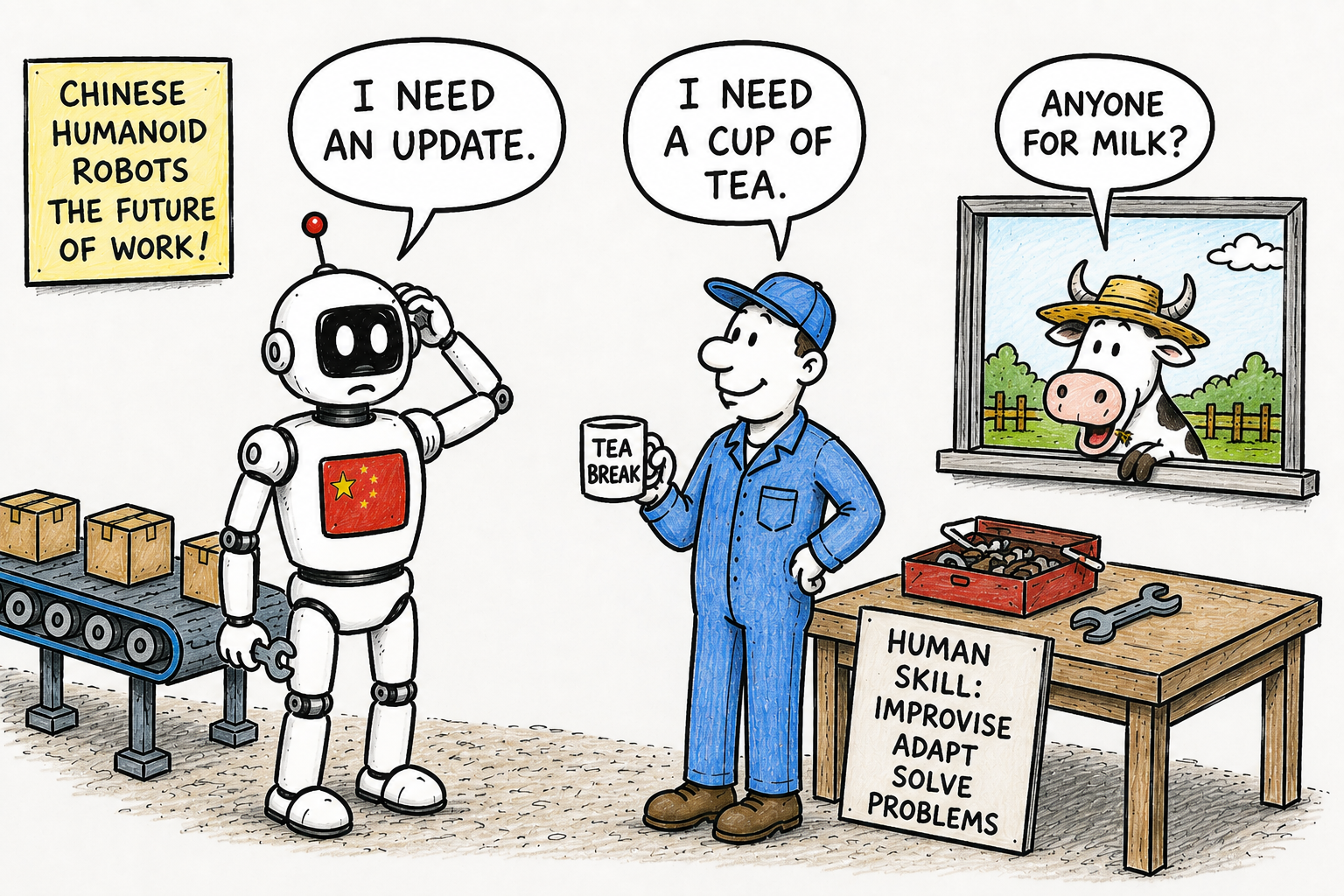
Nvidia has taken another decisive step into the world of “physical AI” by selecting China’s Unitree as its partner for a new humanoid robotics platform aimed squarely at global research institutions.

The collaboration pairs Nvidia’s Jetson Thor hardware — built around the company’s advanced Blackwell GPU — with Unitree’s nearly six‑foot H2 humanoid frame, creating a turnkey system designed to accelerate robotics development in universities and specialist labs.

Isaac Groot

The package integrates Nvidia’s Isaac GR00T humanoid‑focused AI models, simulation tools, and data‑generation stack, effectively offering researchers a complete environment for training, testing, and deploying humanoid behaviours.

Nvidia argues that building such a system independently is “insanely hard”, and that lowering the barrier to entry will broaden the field beyond the world’s largest tech companies.

Unitree timing

For Unitree, the timing is significant. The Hangzhou‑based robotics firm is preparing for a 4.2 billion yuan IPO on Shanghai’s STAR Market, with more than 40% of its revenue already coming from outside China.

The Nvidia partnership gives Unitree a high‑profile global showcase just as it seeks to convince investors of its international potential.

The upgraded H2 Plus model — available later this year — will be open for purchase by any lab, not just elite institutions. Early adopters include Stanford, ETH Zurich, UC San Diego and Seattle’s AI2, underlining Nvidia’s ambition to make humanoid research mainstream.

Multi-trillion-dollar industry in the making

Nvidia reportedly argues that building such a system independently is “insanely hard”, and that lowering the barrier to entry will broaden the field beyond the world’s largest tech companies.

Humanoid robots remain a nascent market, with deployments still limited and safety concerns unresolved. But Nvidia’s move signals a belief that physical AI will become a multi‑trillion‑dollar industry.

By fusing its AI stack with Unitree’s maturing hardware, Nvidia is positioning itself not just as the supplier of chips for the robotics boom, but as the architect of the ecosystem that powers it.

Humanoid Robots on the Front Line in Ukraine Signal a New Frontier in Warfare

The testing of humanoid robots in Ukraine marks a striking moment in the evolution of modern warfare, blending Silicon Valley ambition with the brutal pragmatism of a live conflict.

Foundation Future Industries

Foundation Future Industries, a San Francisco start-up founded in 2024, has positioned itself at the centre of this shift by deploying its Phantom MK‑1 robots for pilot demonstrations on the Ukrainian front lines.

The company’s pitch is simple but provocative: humanoid robots should be used not for household chores, but for the world’s most dangerous jobs. Ukraine, now in its fifth year of war, has become the proving ground.

The MK‑1 units tested so far are limited — they carry modest payloads, lack waterproofing, and cannot yet operate at scale. But their early tasks, such as retrieving supplies from hazardous areas, hint at the potential of autonomous systems shaped for human environments.

Urban combat, with its stairwells, basements and narrow corridors, is inherently built around the human form. Analysts note that this gives humanoid robots theoretical advantages over tracked or quadruped machines in certain scenarios.

Yet the technology’s military promise is entangled with political controversy. The company recently appointed Eric Trump as chief strategy adviser, prompting accusations of impropriety given its $24 million in U.S. government research contracts.

Two humanoid robots were reportedly sent to Ukraine in February 2026.

Foundation insists the partnership reflects a shared vision of rebuilding American manufacturing, but the optics are unavoidable.

Multiple sources describe this as the first recorded deployment of humanoid robots to an active warzone — not just Ukraine, but any modern conflict.

The robot race

The broader context is a deepening geopolitical race. Foundation openly frames its mission as part of a contest with China, whose own robotics sector has showcased early military prototypes.

The U.S. military, meanwhile, has not yet deployed humanoid systems, though it is increasingly integrating AI into battlefield decision-making.

Experts caution that cost, complexity and manufacturability may ultimately limit humanoids’ role. But the symbolism is unmistakable.

Whether or not these machines succeed, Ukraine has become the first real-world laboratory for autonomous, human-shaped robots — a glimpse of how future conflicts may be fought.

South Korea’s Market Faces a Fragile Balancing Act

Risks to South Korea stocks

South Korean equities are showing signs of strain after a powerful rally led almost entirely by semiconductor giants Samsung Electronics and SK Hynix.

Analysts warn that the market’s narrow leadership leaves it exposed to sudden reversals if global chip demand cools or investor sentiment shifts.

Overbought

It has been cautioned that the Kospi’s momentum indicators are flashing overbought signals, suggesting limited room for further gains before a correction sets in.

The country’s heavy reliance on the semiconductor cycle means any slowdown in AI‑related investment or memory‑chip orders could quickly erode confidence.

Broader industrial and consumer sectors have lagged, amplifying the sense that Korea’s stock market is running on a single engine.

Risks

While optimism remains high, the risks are clear: a fragile rally built on concentrated strength and global tech exuberance.

If macro headwinds return, the dust from “macro risks” may finally settle on Seoul’s fast‑moving market.

South Korea’s Kospi hit another new record high despite mixed trading across Asia-Pacific markets and this despite U.S. Iran deal caution.

All three major U.S. indices closed at new all‑time record highs on Friday 29th May 2026 – ending May 2026 on a high!

All three U.S. indices hit new reocrd highs!

Wall Street ended Friday 29th May on a historic note, with the Dow, S&P 500 and Nasdaq each closing at fresh record highs.

The Dow broke decisively above the 51,000 mark for the first time, finishing at 51,032.46, driven by powerful gains in AI‑linked industrial and technology names.

The S&P 500 closed at 7,580.06, extending its remarkable nine‑week winning streak — its longest run since 2023 — as investors continued to reward strong earnings and the broadening impact of AI infrastructure spending.

The Nasdaq also set a new peak at 26,972.62, supported by renewed momentum across semiconductors and enterprise technology.

Record Closing Levels — Friday 29 May 2026

Dow Jones Industrial Average: 51,032.46

S&P 500: 7,580.06

Nasdaq Composite: 26,972.62

Markets took geopolitical tensions and mixed macro signals in their stride, focusing instead on resilient corporate performance and easing energy pressures.

Despite narrow market breadth, the rally underscored investors’ confidence that the AI‑driven earnings cycle remains intact heading into the summer.

The Strait of Make‑Believe: How a Failed Policy Is Being Sold as Statesmanship. A Fantasy story in the making – straight to you the gullible ‘consumer’ – Opinion

U.S. Iran Brinkmanship

If you step back from the headlines and strip away the diplomatic theatre, the current U.S.–Iran “negotiation” looks less like a triumph and more like a clumsy attempt to repackage failure as progress.

Strait of Hormuz – an open and shut case

The public is being told that Washington has secured major achievements: the Strait of Hormuz reopening, tensions easing, and Iran’s nuclear ambitions supposedly contained. But look closer and the narrative collapses under its own contradictions.

Start with the Strait of Hormuz. It was not closed because of some spontaneous regional flare‑up; it was closed because a U.S. administration attempted, and largely failed, to force regime change in Tehran.

That failure triggered retaliation, escalation, and a strategic choke point being shut down. Now, after months of chaos, the U.S. is celebrating the Strait reopening (or is it?) — essentially applauding itself for returning the region to the status quo that existed before it destabilised it. It isn’t open… is it?

It is the geopolitical equivalent of setting your own kitchen on fire, putting it out, and then demanding praise for your firefighting skills.

Nuclear problem

The nuclear issue is no less farcical. The media narrative implies that Iran’s nuclear ambitions have been “addressed”, “contained”, or “rolled back”. Yet nothing in the public domain suggests any meaningful rollback at all.

Iran has not dismantled centrifuges, surrendered stockpiles, or accepted intrusive inspections as far as we are being told. In fact, the regime appears to have conceded almost nothing of strategic value.

Regime change or spin?

The U.S. has simply stopped trying to remove them from power and is now negotiating with the very government regime it previously sought to topple. That is not a diplomatic victory; it is an admission of strategic defeat dressed up as pragmatism.

And yet the stock market — ever eager to reward the appearance of stability, however artificial — rallies on cue. Investors do not care whether the underlying policy is coherent, honest, or even remotely successful. Watch the ‘weekend’ timings.

They care only that the headlines signal “reduced risk”. If the White House can spin a failed regime‑change attempt into a “peace process”, markets will happily play along.

The absurdity is that the worse the original policy was, the more dramatic the rebound looks when the U.S. quietly abandons it.

Media’s ‘predictability’

The media’s role in this is depressingly predictable. Rather than interrogating the contradictions, they amplify the official line: progress, diplomacy, de‑escalation.

Little attention is given to the fact that the U.S. is negotiating from a position of weakness created by its own miscalculations.

Even less attention is given to the reality that Iran has emerged from the crisis with its regime intact, its nuclear programme largely untouched, and its regional leverage arguably strengthened.

Toxic

So why is it being sold like this? Because admitting the truth — that a major U.S. foreign‑policy gambit backfired and is now being quietly reversed — is politically toxic.

It is far easier to rebrand failure as maturity, escalation as diplomacy, and retreat as statesmanship. Politics!

The public deserves better than this theatre. What we are witnessing is not a breakthrough but a reset, not a triumph but a cover‑up, and not a solution but a return to the very conditions that existed before the U.S. “messed up” in the first place.

It’s farcical.

And the markets move on every whimsical social media post amplified by the hungry media to fill white space.

And who suffers the most through all these ill-judged actions – you and me.

But is there an argument in favour of preventing nuclear weapons falling into the arms of potentially ‘bad’ actors.

Yes, of course,

But is that what this is about?

Let’s hope so.

Headline: China’s Industrial Profits Surge 24.7% in April as Energy Shock Lifts Upstream Sectors

China's Industrial Profits Climb April 2026

China’s industrial sector delivered its strongest profit performance in more than two years in April 2026, with earnings jumping 24.7% year‑on‑year, a sharp acceleration from March’s 15.8% rise.

The latest figures, published by the National Bureau of Statistics, point to a profit rebound driven overwhelmingly by upstream industries and high‑tech manufacturing — even as large parts of the economy continue to lose momentum.

April 2026 surge

The April surge marks the fastest pace of growth since late 2023 and lifts year‑to‑date industrial profit expansion to 18.2%. Analysts note that the improvement is closely tied to rising producer prices, fuelled by the global energy shock and higher crude benchmarks.

That dynamic has delivered a windfall to mining, oil extraction and petroleum processing, where profits have swung sharply higher after a weak first quarter.

High-tech

High‑tech manufacturing — particularly computing and electronics equipment — remained the single largest contributor to overall profits.

Earnings in the sector more than doubled from a year earlier, reflecting China’s continued investment in AI‑related hardware, data‑centre components and advanced manufacturing capacity.

However, the pace of expansion eased slightly compared with March on a year‑to‑date basis, suggesting some early signs of normalisation.

Not all a bed of roses

The picture elsewhere is far less buoyant. Automobile manufacturers saw profits fall 16.8% in the first four months of the year, despite marginal improvement from the first quarter.

Furniture manufacturing deteriorated further, with profit declines deepening to 54.4%. These figures underscore the unevenness of China’s industrial recovery, with consumer‑facing and property‑linked sectors still under heavy strain.

Broader economic indicators reinforce that contrast. Industrial output grew just 4.1% in April 2026, retail sales barely rose 0.2%, and fixed‑asset investment continued to contract under the weight of the property downturn.

Exports

Yet exports remained a rare bright spot, surging 14.1%, while imports jumped 25.3%, hinting at resilient external demand and restocking activity.

Economists warn that April’s profit surge, while impressive, rests on a narrow base. Upstream sectors are thriving, but the recovery remains fragile — and heavily exposed to global energy volatility.

S&P 500 and Nasdaq Composite and 100 All Hit Fresh Record Highs as Tech Momentum Intensifies – 26th May 2026

New record all-time highs for U.S. indices

The S&P 500 and Nasdaq Composite surged to new all‑time highs yesterday, extending a rally that shows little sign of fatigue as investors continue to pile into megacap technology and AI‑linked names.

The move higher came despite a patchy run of U.S. macro data, underscoring how dominant earnings strength and sector‑specific momentum have become in driving equity sentiment.

S&P 500: 7,519.12, up 45.65 points (+0.61%) — a record closing high.

S&P 500 26th May 2026

The S&P 500’s climb was supported by broad participation across technology, communication services and consumer discretionary, with investors rewarding companies delivering consistent revenue and margin expansion.

Market breadth has improved modestly in recent weeks, helping reinforce confidence that the rally is not solely dependent on a handful of giants.

Nasdaq Composite: 26,656.18, up 312.21 points (+1.19%) — also a record closing high, with an intraday peak of 26,725.29.

Nasdaq Composite 26th May 2026

Nasdaq‑100 (NDX): 30,001.32Up: +519.68 points (+1.76%) Intraday high: 30,044.49 – a new record high.

Nasdaq 100 26th May 2026

The Nasdaq once again outperformed, propelled by heavy demand for semiconductor, cloud and AI infrastructure stocks.

Upbeat guidance from several major tech firms earlier this month has strengthened the view that the sector’s earnings cycle still has room to run.

While valuations remain elevated and leave the market exposed to any negative surprise, investors have so far shown little inclination to rotate away from the winners.

Yesterday’s triple records highlight the market’s conviction that the AI‑driven profit cycle remains intact.

Micron is the latest company to reach $1 trillion valuation

Micron at $1 trillion Cap

Micron has surged past the $1 trillion valuation mark, becoming the latest chipmaker to ride the relentless global demand for advanced memory used in AI data centres.

The company’s shares have climbed sharply as hyperscalers race to secure high‑bandwidth memory for next‑generation training clusters, pushing Micron’s order book to record levels and transforming what was once a cyclical manufacturer into a strategic pillar of the AI supply chain.

Milestone

The milestone reflects a dramatic shift in investor perception. Micron’s HBM3E and emerging HBM4 lines are now viewed as essential infrastructure, commanding premium pricing and long‑term supply agreements.

Profitability has strengthened accordingly, with margins expanding as production scales and shortages persist across the industry.

While the trillion‑dollar threshold underscores Micron’s new status among the semiconductor elite, it also raises expectations.

Sustaining this valuation will depend on flawless execution, continued technological leadership, and the durability of the AI investment boom.

Global Trillion‑Dollar Companies (May 2026) – Micron and SK-Hynix to join

RankCompanyMarket Cap (USD trillions)SectorNotes
1️⃣Nvidia (NVDA)≈ 5.3 – 5.2SemiconductorAI  hardwareWorld’s most valuable firm; GPUs power global AI infrastructure.
2️⃣Alphabet ≈ 4.6 – 4.7Comms ServicesAI‑driven growth via Google Cloud, Gemini, and YouTube ads.
3️⃣Apple (AAPL)≈ 4.5 – 4.4Consumer TechStill a top‑three giant; hardware + services ecosystem.
4️⃣Microsoft ≈ 3.1Software  Cloud  ComputingAzure and enterprise AI remain core drivers.
5️⃣Amazon ≈ 2.8 – 2.9E‑commerce / CloudAWS and retail logistics sustain trillion‑plus value.
6️⃣TSMC (TSM)≈ 2.1SemiconductorCritical foundry for global chip supply chain.
7️⃣Broadcom ≈ 2.0SemiconductorSoftwareRides HBM and networking chip demand.
8️⃣Saudi Aramco≈ 1.8EnergyLargest non‑tech member; oil and petrochemical dominance.
9️⃣Tesla (TSLA)≈ 1.5 – 1.6Automotive /
Energy
EV and AI‑driven autonomy keep valuation high.
🔟Meta Platforms (META)≈ 1.5 – 1.6Social Media   AI  advertisingStill above $1 T despite rotation toward semiconductors.
11️⃣Samsung Electronics≈ 1.3Semiconductors / MemoryNew entrant; HBM and AI‑memory surge.
12️⃣Berkshire Hathaway (BRK.A)≈ 1.0Financial ConglomerateDiversified holdings across insurance, energy, and rail.

What would happen to the S&P 500 should one or some or all of the Magnificent Seven companies fail to deliver their AI promise – even just a little?

Magnificent Seven and the S&P 500

If the Magnificent Seven were to fall short of the AI and tech transformation investors have priced in, the S&P 500 would face one of the most severe valuation resets in its modern history.

With the group now representing roughly one‑third of the entire index, any collective disappointment would ripple far beyond technology and into every sector tied to index‑tracking capital.

The concentration problem

The S&P 500 has never been this top‑heavy. Microsoft, Apple, Nvidia, Alphabet, Amazon, Meta and Tesla have become the gravitational centre of global equity markets.

Their valuations are not merely high; they are explicitly built on the assumption of future dominance in AI infrastructure, cloud, automation, consumer platforms and next‑generation hardware.

If that future fails to materialise — or even arrives more slowly than expected — the index’s structure becomes a liability. A small number of companies would be responsible for a large portion of the downside.

Scenario 1: One or two companies stumble

If a single member — say Apple or Tesla — fails to deliver, the impact is sharp but contained. The S&P 500 would likely see a 3–5% drawdown, driven by index‑weight mechanics rather than systemic panic.

Investors have already priced in uneven performance within the group, and the remaining leaders would absorb some of the shock.

The more dangerous case is if one of the AI‑infrastructure engines — Microsoft, Nvidia or Alphabet — disappoints. These companies sit at the centre of the capex cycle.

A miss on AI demand, margins or utilisation would trigger a broader reassessment of the entire AI investment thesis.

Scenario 2: Several of the Seven disappoint simultaneously

A coordinated earnings miss or guidance reset across multiple names would force a valuation compression across the entire index. Because passive flows mechanically overweight the winners, a reversal would unwind years of momentum.

A realistic outcome:

  • S&P 500 correction of 10–15%
  • Volatility spike as systematic strategies de‑risk
  • Rotation into defensives and energy, sectors less dependent on AI narratives
  • Credit spreads widen, reflecting lower confidence in tech‑driven earnings growth

This is the point where the market stops treating AI as inevitability and starts treating it as a risk.

Scenario 3: The AI thesis breaks entirely

If all seven fail to deliver the productivity, revenue and margin expansion implied by their valuations, the S&P 500 would undergo a structural reset.

The index could fall 20% or more, not because of recessionary conditions but because the market would need to rebuild a new leadership structure from scratch.

The last time leadership collapsed this dramatically was the dot‑com unwind — but today’s concentration is far higher, and passive ownership is far larger. but AI has far more upfront utility, doesn’t it?

The core truth

The S&P 500’s fate is now inseparable from the Magnificent Seven. If they deliver, the index continues to levitate. If they falter, the entire market must reprice what growth, innovation and leadership look like in the post‑AI era.

When the Magnificent Seven Slip: Who Rises Next?

If the AI tide recedes, the market’s leadership will not vanish — it will rotate. The beneficiaries will be the sectors that have quietly compounded earnings while the spotlight stayed fixed on Silicon Valley.

1. Energy and Utilities With AI‑driven data centres consuming vast power, any slowdown in tech expansion would ease pressure on grids and shift investor focus back to traditional producers. Dividend yields and defensive cash flow would regain appeal as growth multiples compress.

2. Industrials and Infrastructure A retreat from speculative tech would redirect capital toward physical productivity — logistics, construction, and manufacturing modernisation. Firms tied to electrification, rail, and defence could see valuation upgrades as investors seek real‑world output rather than digital promise.

3. Healthcare and Pharmaceuticals The sector’s secular growth and pricing power make it a natural refuge when tech falters. Biotech innovation continues independently of AI cycles, and ageing demographics ensure steady demand.

4. Financials Banks and insurers benefit from higher rates and wider spreads when tech valuations deflate. A correction in mega‑caps could even restore balance to passive indices, giving financials a larger share of inflows.

5. Consumer Staples In a post‑AI correction, investors rediscover the comfort of predictable earnings. Food, beverages, and household goods regain their defensive premium as volatility rises.

The narrative shift: The market would move from promise to proof — from speculative AI multiples to tangible earnings. The S&P 500 would not collapse; it would evolve. Leadership would pass from code to concrete, from algorithms to assets.

Key Points — S&P 500 Risk if the Magnificent Seven Falter

1. The S&P 500 is structurally dependent on seven companies

  • The Magnificent Seven now make up ~35% of the entire index’s market cap.
  • This is the highest concentration in modern history, making the S&P 500 behave more like a mega‑cap tech fund than a diversified benchmark.

2. Their valuations are priced for an AI‑driven future

  • Current multiples assume sustained exponential AI demand, cloud capex growth, and productivity gains.
  • Any slowdown in AI adoption, monetisation, or enterprise rollout would force a valuation reset across the leaders.

3. A single-company stumble is absorbable — but still painful

  • If one member (e.g., Apple or Tesla) disappoints, the index likely sees a 3–5% pullback.
  • The remaining leaders can offset the drag, but the psychological impact is non‑trivial.

4. A slowdown in the AI infrastructure core is the real risk

  • Microsoft, Nvidia and Alphabet sit at the centre of the global AI capex cycle.
  • If cloud AI demand proves slower or less profitable than expected, the S&P 500 could face a 10–15% correction as earnings expectations compress.

5. A broad failure of the AI thesis triggers a structural reset

  • If AI productivity gains don’t materialise, or margins erode under cost/regulatory pressure, the index could fall 20%+.
  • This would resemble a leadership collapse, not a normal recession — similar to the dot‑com unwind but with far more concentration and passive capital tied to the winners.

6. Passive flows amplify both upside and downside

  • With so much capital in index funds, any derating of the top names mechanically drags the entire index lower.
  • The S&P 500’s fate is now mathematically tethered to the Magnificent Seven.

7. The uncomfortable conclusion

  • The S&P 500’s trajectory is inseparable from the success or failure of the AI narrative.
  • If the Magnificent Seven deliver, the index continues to defy gravity.
  • If they falter, the market must rebuild a new leadership structure from scratch.

The S&P 500 is fundamentally in the danger zone – be careful!

Nvidia’s latest figures continue to shape AI mood – May 2026

Nvidia reports May 2026

Nvidia’s latest figures have once again reshaped the mood of global markets, reinforcing its position as the defining force of the AI investment cycle.

The company reported another quarter of exceptional revenue growth, driven by unrelenting demand for its data‑centre GPUs and the rapid rollout of next‑generation Blackwell systems.

Elevated expectations

Sales and profits both exceeded already‑elevated expectations, underscoring how deeply Nvidia’s hardware is now embedded in cloud infrastructure, sovereign AI projects, and enterprise adoption.

The immediate market reaction was sharp. Nvidia’s shares jumped at the open, extending a rally that has already made it the world’s most valuable listed company.

The surge briefly pushed its valuation further into uncharted territory, with traders describing the stock as both “unstoppable” and “structurally bid” due to long‑term AI spending commitments from hyperscalers.

Options activity spiked as investors positioned for continued volatility, while short sellers once again retreated.

Broad impact

The broader market felt the impact too. The S&P 500 and Nasdaq both moved higher, lifted by the gravitational pull of Nvidia’s results and renewed confidence in the AI supply chain.

Semiconductor peers such as AMD, Broadcom, and TSMC saw sympathetic gains, while AI‑exposed software names rallied on expectations of stronger infrastructure investment.

Yet the enthusiasm comes with a familiar caveat. Nvidia’s dominance now exerts an outsized influence on index performance, and any future stumble—whether from supply constraints, competitive pressure, or a slowdown in AI capex—would reverberate across global markets.

For now, though, the company remains the engine powering the bull case for technology and all AI follows.

Why is UK Politics in such a Shambles?

UK Political Shambles

Britain has ripped through five prime ministers in just over five years — Theresa May, Boris Johnson, Liz Truss, Rishi Sunak, and now the prospect of yet another change.

It is not simply bad luck or a run of flawed leaders. It is the visible symptom of a political system that has lost focus and direction.

Conservative infighting to Labour back biting!

The core problem is structural volatility. The UK’s unwritten constitution relies heavily on norms, restraint and party discipline. Over the past decade, those stabilising forces have collapsed.

Brexit

Brexit detonated the old Conservative coalition, splitting MPs into factions that no longer share a common project. Once a party becomes a collection of tribes, leadership becomes temporary management rather than authority.

Prime ministers are installed not to govern but to contain internal warfare — and they are removed the moment they fail to do so.

Exhaustion

The second driver is institutional exhaustion. Westminster has been running in crisis mode since 2016: Brexit negotiations, minority government, pandemic, inflation shock, energy crisis, geopolitical instability.

The machinery of state has been asked to deliver transformation while simultaneously firefighting. That combination breeds short-termism. Policies are launched for headlines, not outcomes.

Leaders are judged by weekly polling, not national strategy. The result is a political class that behaves like a boardroom under siege — reactive, brittle, and constantly reshuffling the chief executive.

Disillusioned

A third factor is public disillusionment. Trust in politics has fallen to historic lows. Voters now punish governments faster and more aggressively than at any point in modern British history.

The electoral cycle has shortened psychologically: every scandal becomes existential, every by‑election a referendum on the prime minister’s survival.

This creates a feedback loop where MPs panic, parties fracture, and leaders lose authority long before the public formally removes them.

Gap

Finally, the UK faces a governance gap. The country has major structural problems — weak productivity, regional inequality, an overstretched NHS, fragile public finances — but no long-term political consensus on how to fix them.

Without a shared national direction, governments drift, parties implode, and leadership churn becomes inevitable.

Britain’s political chaos is not random. It is the predictable outcome of a system that has lost coherence, a governing party that has lost unity, and a public that has lost patience. Until those three forces stabilise, the revolving door at No. 10 will keep spinning.

Just look at the calibre of politicians in the UK – or lack thereof.

I rest my case.

The self-destruct button is being pressed yet again…

UK politicians – it’s time to grow-up.

Definition of politician

A person who is professionally involved in politics, especially someone who holds or seeks public office in government.

More broadly, it refers to anyone who participates in governing, policy‑making, or political leadership at local, national, or international level.

Three words immediately jump out at me: professional, govern and leadership.

I see very little of any of these right now in our political ‘elite’.

Fracking – Oil Exports – and the U.S. Oil Success

Fracking - Oil Exports - and the U.S. Oil Success

One of the least‑discussed forces helping to shape the current U.S.–Iran confrontation is the quiet revolution beneath American soil.

Over the past decade, hydraulic fracturing transformed the United States from a vulnerable energy importer into the world’s largest oil and gas producer.

Pumped up

Nowhere has this shift been more dramatic than in Texas, where the Permian Basin alone pumps more oil than many OPEC members. This surge has not only reshaped global markets — it has altered Washington’s strategic outlook.

The United States now exports record volumes of crude oil and liquefied natural gas, with outbound shipments regularly exceeding 4 million barrels per day.

The conflict with Iran isn’t impacting oil production in the U.S.—if anything, it has boosted output and increased overseas sales.

This would have been unthinkable twenty years ago, when U.S. foreign policy was constrained by dependence on Middle Eastern supply.

U.S. Shale Boom

Today, the shale boom has given Washington a buffer: even severe disruption in the Strait of Hormuz would no longer threaten the U.S. economy in the way it once did.

This energy independence has had political consequences. Analysts note that President Trump’s willingness to escalate against Iran — including strikes, sanctions, and naval deployments — is partly rooted in the belief that the U.S. can withstand an oil shock far better than its rivals.

Iran, by contrast, relies heavily on oil revenues and is already weakened by sanctions. A prolonged disruption to its exports hurts Tehran far more than Washington.

Texas fracking plays directly into this dynamic. The combination of horizontal drilling, high‑pressure fracturing, and vast shale formations has created a production engine capable of rapid growth.

When global prices rise, U.S. shale responds within months, softening the blow to consumers and limiting the geopolitical leverage of traditional producers.

Texas Asset

In effect, the Permian Basin has become a strategic asset — a domestic shock absorber that reduces the economic risks of confrontation abroad.

Critics argue that this new confidence borders on complacency. A major conflict in the Gulf would still send global prices sharply higher, with knock‑on effects for inflation, supply chains, and allied economies.

But there is no doubt that the fracking boom has changed the psychology of U.S. power. For the first time in modern history, America can contemplate a showdown in the Middle East without fearing an immediate energy crisis at home.

Texas may not be the reason the U.S. is confronting Iran — but it has certainly made the White House feel far safer doing so.

Bank busting figures as profits pile up!

Banks' profits surge

Banks are reporting unusually strong profits because higher interest rates have widened margins, while slow pass‑through to savers, cost‑cutting, and capital optimisation have amplified returns — even as credit risks begin to rise.

Why profits are so high

The latest figures show that UK banks are still benefiting from the long tail of the interest‑rate cycle.

Even though the Bank of England has not raised rates since August 2023, the base rate remains at 4.5%, allowing lenders to earn significantly more on mortgages and credit than they pay out on deposits.

This margin expansion has been the single biggest driver of profit growth. Research from recently highlighted from Positive Money shows that the UK’s four largest banks have generated £136.8 billion in pre‑tax profits since rate rises began in December 2021, and are on track to exceed their record £45.9 billion made in 2024 by around 14% in 2025.

A second factor is the government’s interest payments on central bank reserves. Because commercial banks are paid the base rate on their risk‑free deposits at the Bank of England, they stand to receive around £30 billion a year in transfers through to 2030 — effectively a public subsidy that boosts earnings without requiring additional lending.

Banks have also been aggressively returning capital to shareholders. Between 2022 and 2024, the big four spent £42 billion on dividends and £32 billion on share buybacks, reinforcing the perception that profits are being harvested rather than reinvested.

How banks are sustaining these profits

The profitability story is not just about rates. Structural shifts are helping banks defend margins even as the rate cycle turns.

1. Slow deposit repricing High Street banks have been reluctant to raise savings rates in line with market levels. As consumers move deposits to specialist lenders offering better returns, the big banks still retain a large, low‑cost funding base.

KPMG reportedly notes that high street banks’ share of deposits has only slipped from 84% in 2019 to 80% in 2024 — still dominant enough to preserve cheap funding.

2. Capital optimisation through securitisation Banks are increasingly using Significant Risk Transfer (SRT) securitisations to free up capital and improve return on equity. Securitised loan volumes have grown at a 4% CAGR between 2022 and 2025, allowing banks to recycle capital into higher‑yielding assets.

3. Cost discipline and digital transformation With margins expected to compress as rates eventually fall, banks are pushing cost‑cutting, automation, and AI‑driven process redesign.

KPMG reportedly forecasts sector‑wide returns on equity could fall from 18% in 2023 to 10% by 2027 without structural change — making efficiency programmes essential to sustaining profitability.

The emerging risk: impairments

Barclays’ latest results show rising credit impairment charges, including an £823 million provision linked to mortgage‑market stress and fraud‑related losses.

This raises the question of whether the credit cycle is turning. If impairments rise across the sector, the profit boom could fade.

The biggest emerging credit risks sit outside the banking system and that is private credit, leveraged borrowers, and liquidity mismatches that could spill back into banks.

Private credit is now large, interconnected, and showing signs of strain. Rising defaults, deteriorating loan quality, and withdrawal caps at major funds point to mounting stress. Defaults could climb sharply, with Morgan Stanley reportedly warning they may reach 8%, far above historical norms.

A second risk is liquidity pressure. Funds are restricting redemptions as investors rush for the exit, exposing the fragility of semi‑liquid structures.

Finally, contagion risk is growing because banks finance private‑credit funds and pipelines. As analysts note, deeper interconnections mean a downturn could transmit stress back into the regulated system.

Conclusion

Banks are reporting strong profits because the rate environment, public transfers, and capital strategies have created a uniquely favourable backdrop.

But the model is fragile: as impairments rise and rates eventually fall, the sector may be approaching the end of its profit‑supercycle.

Nothing to see here… Nasdaq – S&P 500 and Nikkei 225 each break all-time record highs and set new intraday highs… again!

Indices at new record highs!

Global equity markets delivered a remarkable synchronised milestone on Friday, as the Nikkei 225, Nasdaq Composite, and S&P 500 each registered fresh all‑time highs, underscoring the strength of the ongoing technology‑led rally and a renewed wave of risk appetite.

Nikkei

In Tokyo, the Nikkei 225 briefly surged to a record intraday high of 63,385.04, propelled by powerful follow‑through from Thursday’s post‑holiday catch‑up rally. Although the index later eased into modest profit‑taking, it still finished at 62,713.65, comfortably within record territory.

AI here we go!

Semiconductor and AI‑linked names continued to dominate flows, reflecting Japan’s deep integration into the global chip supply chain.

Nasdaq

Across the Pacific, Wall Street delivered a similarly emphatic performance. The Nasdaq Composite pushed to a new intraday peak of 26,248.62 before closing at 26,247.08, its highest level on record.

Strong earnings from major technology firms, combined with renewed optimism around US–Iran de‑escalation efforts, helped extend the index’s multi‑week winning streak.

S&P 500

The S&P 500 also broke new ground, touching an intraday high of 7,401.50 and settling at a record close of 7,398.93.

Each indices continued to hit even higher intraday records after the bell on Friday 8th May 2026.

A stronger‑than‑expected US jobs report reinforced confidence in the resilience of the American economy, even as geopolitical tensions and elevated energy prices continue to shape market sentiment.

Tech cycle

Taken together, the simultaneous records across the U.S. and Japan highlight the dominance of the global technology cycle and the market’s willingness to look through near‑term macro risks.

For now, momentum remains firmly on the side of the bulls. Nothing appears to be able to knock this bull off course.

Private credit – Banks Say “Contained” — Markets Aren’t So Sure

Private credit concerns

Private credit has become the fault line running beneath the banking system. And it’s now large enough to matter, opaque enough to worry investors, and now visible enough that banks can’t wave it away.

Complicated picture

European lenders spent this earnings season insisting their exposures are “well diversified” or “immaterial”, yet the numbers tell a more complicated story.

Barclays alone reportedly disclosed £15 billion of private‑credit exposure, part of a much larger £66 billion book tied to non‑bank financial intermediaries.

Its hit from the collapse of Market Financial Solutions — a specialist lender undone by alleged fraud — was small in accounting terms, but symbolically important. One cockroach rarely travels alone.

Structural

The deeper issue is structural. Private credit has ballooned into a parallel lending system, lightly regulated and increasingly interconnected with banks through financing lines, securitisations, and business‑development companies.

When these semi‑liquid vehicles face redemption pressure — as several have this year — the stress ricochets back into the banking system. UBS and Deutsche Bank both reportedly emphasised their underwriting standards, but neither disputed that liquidity strains are real.

What unnerves investors is not a wave of defaults — yet — but opacity. Bank of America’s latest survey shows investment‑grade investors are uneasy because they simply cannot see where the risks sit.

Software lending in the U.S., chemicals in Europe, and China‑driven price pressure all add sector‑specific fragility. High‑yield specialists, closer to the coalface, are oddly calmer; they know where the bodies usually fall.

Contained?

The banking system’s official line is that everything is contained. But containment depends on liquidity holding, valuations staying stable, and no further MFS‑style surprises emerging.

Private credit has grown faster than transparency, and faster than the regulatory perimeter. That mismatch — not any single default — is what now shadows the banks.

The issue

The central concern with private credit is simple: it has grown faster than the safeguards designed to contain it.

What was once a niche corner of finance is now a multi‑trillion‑pound shadow banking system whose risks are only partially visible to regulators, banks, or investors. That opacity is now becoming a problem.

Expansion

Private‑credit funds have expanded aggressively by offering speed, flexibility, and looser covenants than traditional banks. In a low‑rate world, that model looked benign. In a high‑rate world, it looks fragile.

Many borrowers were underwritten on assumptions that no longer hold: stable cashflows, cheap refinancing, and buoyant valuations. As rates stay elevated, those assumptions are breaking down.

Defaults

Defaults are rising, and recovery values are uncertain because loans are bespoke, illiquid, and rarely traded.

Liquidity

Liquidity is the second fault line. Private‑credit vehicles promise semi‑liquid access to investors while holding assets that cannot be sold quickly without taking a loss.

When redemptions pick up, funds resort to withdrawal gates, side pockets, or emergency financing lines from banks.

That is where the contagion risk emerges. Banks insist their exposures are modest, but they provide leverage, subscription lines, and warehousing facilities to the very funds now under pressure.

A liquidity squeeze in private credit can therefore boomerang back into the regulated system.

Valuation

Valuation risk is the third issue. Because loans are marked to model rather than market, losses can be slow to surface.

That delays recognition, masks stress, and encourages complacency. When reality finally intrudes — through a default, a refinancing failure, or a forced sale — the adjustment can be abrupt.

The final concern is concentration. Private credit is heavily exposed to software, healthcare, and sponsor‑backed roll‑ups. If one of these sectors turns, the losses will not be isolated.

Private credit is not about to collapse as such. But it is large, opaque, and increasingly interconnected — and that combination is rarely harmless.

BYD’s EV sales drop for an eighth month in prolonged slowdown

BYD sales fall

BYD has entered its most prolonged slowdown on record, with April 2026 marking the eighth consecutive month of falling electric‑vehicle sales.

China’s EV champion BYD is facing a decisive shift in its growth story. The company reported 314,100 passenger‑vehicle sales in April, a 15.7% year‑on‑year decline, extending a downturn that has now lasted eight months — the longest in its history.

Weak demand

Although sales ticked up slightly from March 2026, the broader trend is unmistakable: domestic demand is weakening, and the once‑relentless rise of China’s largest EV maker has stalled.

The slowdown reflects the brutal reality of China’s EV market. A wave of new models, aggressive discounting, and rapid innovation from rivals such as Leapmotor, Zeekr, Geely and Xiaomi has intensified competition.

BYD’s core Dynasty and Ocean series — the backbone of its domestic volume — fell 21.2% year‑on‑year, signalling pressure at the heart of its line‑up.

Niche brands mixed

Meanwhile, premium and niche brands delivered a mixed performance: Fang Cheng Bao surged 190%, while Denza dropped 26.9%, and ultra‑luxury Yangwang grew from a small base.

Yet the picture is not uniformly bleak. Overseas sales are booming, hitting a record 134,542 vehicles in April, up 70.9% from a year earlier.

Exports now account for over 42% of BYD’s monthly volume, underscoring a strategic pivot toward global markets as China’s price war erodes margins at home.

From January to April 2026, international sales rose nearly 60%, even as total global volume fell. BYD is targeting 1.5 million overseas sales in 2026, a goal that now looks central to its future.

Profit plunge

Financially, the strain is clear. BYD’s Q1 profit plunged 55%, with revenue down nearly 12% as domestic competition intensified and hardware costs rose.

The company is responding with faster‑charging battery technology, expanded model launches, and a global manufacturing push spanning Brazil, Indonesia, Hungary and Malaysia.

The story of BYD in 2026 is one of divergence: a weakening home market colliding with accelerating global expansion.

The question now is whether overseas momentum can scale fast enough to counter China’s slowdown.

Are markets becoming complacent about the U.S. Iran war?

U.S. Iran war effect underestimated?

Markets are flashing warning signs that too many investors are still treating the U.S.-Iran war as a temporary disturbance rather than a structural shock.

Brent crude’s brief surge to around $125 a barrel — its highest level in four years — has reignited fears that the conflict’s economic fallout is being dangerously underpriced.

Complacency

Analysts argue that markets are behaving as though a clean resolution is imminent, even as evidence points in the opposite direction.

The core concern is complacency. Oil’s extreme pricing — where near‑term contracts trade at a steep premium to longer‑dated ones — shows traders are still assuming the Strait of Hormuz will reopen soon and that supply chains will normalise.

Yet millions of barrels per day remain blocked, inventories of refined products like diesel and jet fuel are sliding toward crisis levels, and the White House is reportedly weighing further military action.

None of that aligns with the market’s pricing of a quick return to stability.

The disconnect

This disconnect matters because the real economic damage has not yet fully surfaced. As one investment chief notes, the macro impact will “come back into stark focus” if oil stays elevated.

Higher energy costs feed directly into inflation, squeeze corporate margins, and erode consumer spending power. Equity markets have so far shown resilience, but that resilience is built on the assumption that the shock is temporary.

If the conflict drags into far into May 2026 — as several analysts expect — the stagflationary risk becomes harder to ignore.

Stress

The refined products market is already behaving like a stress test. Diesel prices have nearly doubled, and traders warn that refineries will soon be able to “charge whatever they want”.

Even a peace deal would not deliver instant relief: shipping logistics, sanctions decisions, and depleted reserves would take weeks to unwind.

The fear among seasoned investors is simple: markets are pricing for peace while the fundamentals are still pricing for war. Before long, that gap may close — abruptly and painfully.

What Happens to the S&P 500 if the Magnificent Seven Fail to Deliver on AI?

Mag 7 holding up the S&P 500 to the tune of almost 35% value of the entire S&P 500

The S&P 500 has never been so dependent on so few companies. The Magnificent Seven — Microsoft, Apple, Nvidia, Alphabet, Amazon, Meta and Tesla — now account for roughly one‑third of the entire index’s value – that’s 33% of the whole S&P 500 vlauation.

Their dominance is not simply a reflection of current earnings power; it is a collective bet on an AI‑centred future that investors assume will transform productivity, reshape industries and justify valuations that stretch far beyond historical norms.

If one, several, or all of these companies fail to deliver the AI revolution that markets have priced in, the consequences for the S&P 500 would be immediate, structural and potentially severe.

Mild

The mildest scenario is a stumble by one or two members. If Apple’s device strategy falters, or Tesla’s autonomy narrative weakens further for instance, the index absorbs the shock.

A 3–5% pullback is plausible, driven by mechanical index weighting rather than systemic fear. Investors already expect uneven performance within the group, and the remaining leaders could offset the disappointment.

Major

The more destabilising scenario is a collective slowdown among the AI infrastructure leaders – Microsoft, Nvidia and Alphabet. These firms sit at the centre of the global capex cycle.

If cloud AI demand proves slower, less profitable or more niche than expected, the market would be forced to reassess the entire economic promise of generative AI.

In this case, the S&P 500 could see a 10–15% correction as valuations compress, volatility spikes and passive flows unwind years of momentum.

Dramatic

The most dramatic outcome is a broad failure of the AI ‘sector’ itself. If the promised productivity gains do not materialise, if enterprise adoption stalls, or if regulatory and cost pressures erode margins, the S&P 500 would face a structural reset.

With a third of the index priced for exponential growth, a collective disappointment could trigger a decline of 20% or more.

This would not resemble a cyclical recession; it would be a leadership collapse similar to the dot‑com unwind, but with far greater concentration and far more passive capital tied to the winners.

The uncomfortable truth is that the S&P 500’s trajectory is now inseparable from the Magnificent Seven. If they deliver, the index continues to defy gravity. If they falter, the market must rebuild a new narrative — and a new set of leaders — from the ground up.

If the Magnificent Seven Lose Their Grip, Who Rises Next?

For years, the S&P 500 has been defined by the gravitational pull of the Magnificent Seven. Their dominance has shaped index performance, investor psychology and the entire narrative arc of global markets.

If these companies lose momentum — whether through slower AI adoption, regulatory pressure, margin compression or simple over‑expectation — leadership will not disappear.

It will rotate. And the beneficiaries are already hiding in plain sight.

Alternative investment to AI

The first and most obvious winners would be Energy and Utilities. As AI enthusiasm cools, investors tend to rediscover the appeal of tangible cash flow. Energy companies, with their dividends and pricing power, become natural refuges.

Utilities, often dismissed as dull, regain relevance as defensive anchors in a more volatile market. If AI‑driven data‑centre demand slows, the sector’s cost pressures ease, improving margins.

Next in line are Industrials and Infrastructure. A retreat from speculative tech would likely redirect capital towards physical productivity — logistics, construction, defence, electrification and manufacturing modernisation.

These sectors have been quietly compounding earnings while Silicon Valley has monopolised attention. If the market shifts from promise to proof, industrials become the new growth story.

Healthcare and Pharmaceuticals would also rise. Their earnings cycles are largely independent of AI hype, driven instead by demographics, innovation and regulatory frameworks. When tech stumbles, healthcare’s stability becomes a premium rather than an afterthought.

Biotech, in particular, benefits from capital rotation when investors seek uncorrelated growth.

Financials stand to gain as well. A correction in mega‑cap tech would rebalance passive flows, giving banks and insurers a larger share of index‑tracking capital. Higher rates and wider spreads already support the sector; a shift away from tech simply amplifies the effect.

Finally, Consumer Staples would reassert themselves. In a market recalibrating after an AI disappointment, investors gravitate towards predictable earnings. Food, beverages and household goods regain their defensive premium as volatility rises.

The broader truth is simple: if the Magnificent Seven falter, the S&P 500 does not collapse — it redistributes. Leadership moves from code to concrete, from speculative multiples to operational reality. The market has always found new champions. It will again.

Big Tech’s Talent Exodus Fuels a New Wave of AI Startups

Big Tech AI Exodus

A quiet but decisive shift is under way in the global AI race: some of the most accomplished researchers at Meta, Google, OpenAI and other frontier labs are walking out of the biggest companies in the sector to build their own.

Trend

The trend has accelerated sharply over the past year, with new ventures raising extraordinary sums within months of being founded, as investors bet that smaller teams can move faster than the giants they left behind.

The motivations are remarkably consistent. Researchers say that the commercial pressure inside the largest AI labs has narrowed the scope of what they are allowed to explore.

Rush

With Big Tech locked into a high‑stakes contest to release ever‑larger models on tight schedules, entire areas of research — from new architectures to interpretability and agentic systems — are being deprioritised.

That creates an opening for smaller firms that can pursue ideas too experimental or too slow‑burn for corporate roadmaps.

Investors

Investors have responded with enthusiasm. Former Google DeepMind scientist David Silver secured a record $1.1 billion seed round for his new company, Ineffable Intelligence, while other ex‑DeepMind and ex‑Meta researchers are raising similar sums for ventures focused on reinforcement learning, continuous‑learning systems and autonomous labs.

In total, AI startups founded since early 2025 have already attracted nearly $19 billion in funding this year, putting them on track to surpass last year’s total.

Independence

Founders argue that independence gives them both speed and neutrality. Chip‑design startup Ricursive Intelligence, for example, says customers are more willing to trust a standalone company than a Big Tech competitor with its own hardware ambitions.

Many of these startups are also rebuilding their old teams, hiring colleagues from the very companies they left.

The result is a new competitive dynamic: Big Tech still dominates the AI landscape, but the frontier of innovation is increasingly being pushed by smaller, highly focused labs that believe they can out‑pace the giants – and with lower investment too.

Nvidia hits extraordinary $5 trillion market capitalisation – first company to do so

Nvidia hits $5 Trillion market cap. The first single company in trading history to do so.

Nvidia has become the first company in history to reach a $5 trillion market capitalisation, driven by an extraordinary surge in global AI demand.

Nvidia’s stock jumped nearly 5% in a single session, lifting its valuation above the $5 trillion threshold and cementing its position as the world’s most valuable company by a wide margin.

Shares traded around $208–$209, briefly touching valuations as high as $5.12 trillion.

Nvidia One-year chart (24th April 2026) – New All-Time High

Game cards to major AI player

The milestone reflects Nvidia’s transformation from a gaming‑focused chipmaker into the backbone of the modern AI economy.

Demand for its advanced GPUs—particularly the Blackwell and B300 series—continues to outpace supply as data‑centre operators, cloud giants, and governments race to expand AI infrastructure.

This surge has pushed Nvidia’s revenue to more than $215.9 billion, with profits exceeding $120 billion, among the highest in the semiconductor industry.

Rally

The broader semiconductor sector has rallied alongside Nvidia, with Intel and AMD both posting double‑digit gains on strong earnings and renewed investor confidence.

Yet Nvidia remains the clear leader, commanding the majority of the data‑centre GPU market and benefiting from long‑term visibility as hyperscalers commit to multi‑year AI spending.

While the achievement underscores Nvidia’s dominance, analysts note that expectations are now exceptionally high.

Sustaining this momentum will depend on continued AI investment, stable macroeconomic conditions, and the company’s ability to stay ahead of rising competition and geopolitical constraints.

DeepSeek releases preview of Open Source V4 AI Model

DeepSeek V4 AI

DeepSeek’s newly released V4 model marks a significant step forward in open‑source AI, combining long‑context capability with major architectural upgrades.

DeepSeek V4 arrives as a preview release, offering two variants — V4‑Pro and V4‑Flash — both designed to push the boundaries of efficiency and reasoning performance.

The headline feature is the one‑million‑token context window, enabling the model to process and retain far larger bodies of information than previous generations.

Positioning

This positions V4 as a strong contender in tasks requiring extended reasoning, research support, and complex agentic workflows.

The V4 series introduces a refined Hybrid Attention Architecture, combining compressed sparse and heavily compressed attention mechanisms to dramatically reduce computational overhead.

DeepSeek claims this approach cuts inference FLOPs and KV‑cache requirements to a fraction of those seen in earlier models, making long‑context operation more practical and cost‑effective.

V4‑Pro, the flagship model, includes a maximum reasoning‑effort mode, which the company says significantly advances open‑source reasoning performance and narrows the gap with leading closed‑source systems.

Meanwhile, V4‑Flash offers a more economical, faster alternative while retaining strong capability across everyday tasks.

Accelerating AI ambition

The release underscores China’s accelerating AI ambitions. DeepSeek’s earlier R1 model shook global markets with its low‑cost, high‑performance profile, and V4 continues that trajectory — now optimised for domestic chips and supported by growing local hardware ecosystems.

With open‑source availability and aggressive efficiency gains, DeepSeek V4 strengthens the company’s position as one of the most closely watched challengers in the global AI race.

And it’s far cheaper than its peers and not so power hungry either.

Bank of England warns of potential stock market correction

BoE Stock Market Warning

The Bank of England has warned that today’s exceptionally high equity valuations leave global markets vulnerable to a sharp correction, with risks building across geopolitics, private credit, and the AI‑driven tech sector.

The Bank of England has become increasingly vocal about the dangers posed by super‑high stock valuations, arguing that markets are no longer pricing risk realistically.

Combined economic threats

Deputy Governor Sarah Breeden has stressed that asset prices are sitting at all‑time highs despite a growing list of global threats, including geopolitical instability, volatile energy markets, and rising borrowing costs.

She reportedly noted that investors appear to be underestimating the likelihood of multiple shocks occurring simultaneously, a scenario that could trigger a rapid and disorderly repricing of risk.

Breeden reportedly remarked that the BoE expects a market adjustment at some stage, even if the precise timing is impossible to predict.

Wide disconnect

Her concern centres on the widening disconnect between stretched valuations and the underlying economic environment.

The Bank has highlighted that equity markets—particularly those driven by AI‑related optimism—are trading at levels reminiscent of the dot‑com bubble, with concentrated gains in a handful of large technology firms amplifying systemic vulnerability.

The Bank also warns that the rapid expansion of the private credit sector, now worth trillions globally, has never been tested under severe stress.

Fragile

A correction in equity markets could interact with this fragile segment, tightening financial conditions and spilling over into the wider economy.

In short, the Bank of England’s message is clear: valuations are too high, risks are too many, and a correction is increasingly likely.

International Organisations: Drifting Away From Their Mandates

Institutional Paralysis

The debate over the dysfunction of international organisations has intensified in recent years, driven by a growing sense that institutions built for the post‑war order are struggling to operate in today’s fragmented global landscape.

Analysts note that many of these bodies now survive more through prestige than performance, with their ability to prevent conflict, enforce rules, or deliver meaningful global governance increasingly questioned.

Criticism

A central criticism is that organisations such as the UN, IMF, and various specialised agencies were designed for a world with clearer power structures and more limited public expectations.

Today’s environment—marked by empowered populations, rapid information flows, and complex transnational challenges—demands institutions that are more responsive, inclusive, and capable of decisive action.

Instead, many remain bureaucratic, state‑centric, and constrained by outdated governance models, leaving them ill‑equipped to address issues such as climate change, technological disruption, and inequality.

Weak Enforcement and Political Paralysis

A recurring theme in recent assessments is the weak enforcement capacity of these organisations. Without the ability to compel compliance, many bodies function more as forums for discussion than engines of action.

This has contributed to failures in peacekeeping, global financial regulation, and climate commitments.

Some institutions have even become part of the problem, with their directives blurring political accountability or reinforcing the interests of dominant powers rather than serving global needs.

Declining Relevance, Not Just Poor Performance

Research also suggests that while international organisations may not be collapsing in absolute terms, they are experiencing a relative decline in influence.

Mentions of these bodies in major diplomatic forums have fallen, indicating that states increasingly look elsewhere—regional blocs, ad‑hoc coalitions, or unilateral action—to solve problems.

This shift signals a reduced centrality of global institutions in international relations, even if they continue to exist structurally.

A System in Need of Renewal

Despite their shortcomings, international organisations remain vital for coordinating responses to global crises. Yet their funding models, governance structures, and enforcement mechanisms are widely seen as inadequate.

Scholars argue that without meaningful reform—or entirely new models of cooperation—these institutions risk further erosion of legitimacy and effectiveness.

The emerging consensus is clear: the world has changed, but its international institutions have not kept pace. Unless they adapt, their relevance will continue to fade, leaving a vacuum in global governance at a time when coordinated action is needed more than ever.

Top 12 Underperforming / Uderperforming / Threatened International Organisations

RankOrganisationWhy It Is Seen as Failing / Underperforming
1United Nations (UN)Has failed to prevent conflict; increasingly bureaucratic; survives more through prestige than performance; weak enforcement.
2UN Security Council (UNSC)Veto paralysis blocks action; structure frozen in 1945; unable to respond effectively to modern conflicts.
3World Trade Organization (WTO)Dispute system paralysed; states bypass it; too slow for modern trade cycles; struggles with major issues like subsidies and IP.
4International Monetary Fund (IMF)Criticised for austerity‑heavy loan conditions, governance dominated by wealthy nations, and poor crisis performance.
5World BankAccused of favouring rich nations, slow response, harmful loan conditions, governance imbalance, and data manipulation scandals.
6UN Human Rights System (incl. HRC)Human rights in global retreat; institutions unable to prevent abuses or uphold universality; politicisation undermines credibility.
7G20Increasingly a discussion forum rather than a decision‑making body; weak enforcement; limited real‑world impact.
8UN Specialised Agencies (e.g., WHO, UNHCR)Bureaucratic, slow to respond to crises, and constrained by limited enforcement power; often reactive rather than strategic.
9OSCE (Organisation for Security and Co‑operation in Europe)Struggles to prevent conflict or protect rights; effectiveness eroded by geopolitical tensions and consensus‑based paralysis.
10African Union (AU)Ambitious mandates but limited capacity; struggles with enforcement, peacekeeping, and coordination across diverse member states.
11OAS (Organisation of American States)Deep political divisions, declining legitimacy, and inability to manage regional crises effectively.
12Legacy Organisations That Have Already Collapsed (e.g., League of Nations, International Refugee Organization)Historical examples showing that major IOs can die when performance collapses and demand for cooperation disappears.

Why these 12 rise to the top

Across the sources, several themes recur

  • Failure to prevent conflict — especially the UN, UNSC, OSCE.
  • Weak enforcement — many bodies function as talking shops rather than action‑driving institutions.
  • Bureaucratic inertia — slow, rigid structures built for 1945, not 2026.
  • Loss of relevance — states increasingly bypass global bodies for regional or “minilateral” arrangements.
  • Prestige over performance — organisations persist because dismantling them is costlier than letting them drift.
  • Power imbalances — dominant states shape outcomes; smaller states join to avoid losing prestige.

These criticisms are consistent across GIS Reports, Oxford Academic, Meer, New Eastern Europe, and contemporary political commentary.

And then there is NATO?

Suspicious Market Timing Raises Fresh Questions Over Alleged Potential Insider Trading During the U.S.–Iran Crisis

Alleged Potential Insider trading storm erupts

Allegations of suspiciously timed trades have intensified in recent weeks as analysts, journalists, and regulators examine a series of market moves that coincided—sometimes to the minute—with major announcements about the U.S.–Iran conflict.

While no wrongdoing has been proven, the pattern has become difficult for commentators to ignore and calls for formal investigation are growing louder. Can these trades and market movement be explained as coincidence?

Potential ‘speculative’ trading?

Many media outlets are also highlighting anomalies. For instance, it has been reported that Wealth manager Rachel Winter indicated traders appeared to take out contracts positioned to profit from falling oil prices just minutes before a presidential post claiming “productive” talks with Iran—timing she described as “speculation about insider trading” and worthy of investigation.

This episode was not isolated. Multiple outlets have documented at least two major bursts of unusually large oil futures trades placed shortly before conflict‑related announcements.

On 17th April 2026, it was reported that roughly $760 million in Brent crude short positions were executed around 20 minutes before Iran’s foreign minister declared the Strait of Hormuz “completely open” following a ceasefire—an announcement that sent oil prices sharply lower.

Analysts at the London Stock Exchange Group reportedly described the volume as “completely atypical,” nearly nine times normal levels.

Earlier in March 2026, it has been reported that traders placed around $500 million in positions shortly before the White House delayed planned strikes on Iran’s energy sector.

A similar pattern emerged on 7th April 2026, when roughly $950 million was positioned for falling oil prices hours before another ceasefire announcement.

These repeated bursts—each ahead of market‑moving news—have fuelled concerns that some traders ‘may’ have had access to information not yet public. Or was it a good guess – a coincidence even?

Reports of ‘unusual’ trading patterns

These reports align with broader commentary. The Independent noted that at least 6 million barrels’ worth of Brent and WTI contracts were suddenly sold in the two minutes before a presidential post about “productive” talks—again raising questions about advance knowledge.

Meanwhile, The London Economic reported that around $580 million in oil bets were placed 15 minutes before the same announcement, with market strategists calling the timing “really abnormal” for a day with no scheduled events.

Even outside traditional markets, anomalies have surfaced. Blockchain analysts identified six newly funded crypto wallets that made nearly £780,000 by betting—hours before explosions were reported—that the U.S. would strike Iran on 28th February 2026.

Across all these cases, commentators stop short of asserting intent. But the clustering of high‑stakes trades immediately before geopolitical announcements has created a clear narrative: the market signals are too sharp, too well‑timed, and too frequent to dismiss without scrutiny.

No intent is suggested – it could just be coincidence?

Why Global Stocks Are Hitting Records Despite an Uncertain Middle East Backdrop

Global stock hit record highs!

Global equities have staged a striking recovery, erasing the losses triggered by the U.S.–Israel–Iran conflict and pushing into fresh record territory.

On the surface, this looks counter‑intuitive: the ceasefire remains fragile, diplomatic progress is uneven, and the threat of renewed escalation still hangs over the Strait of Hormuz. Yet markets have not only stabilised — they have surged.

It’s the AI boom stupid

The explanation lies less in geopolitics and more in positioning, psychology, and the gravitational pull of the AI boom.

The first phase of the conflict saw investors pile into defensive trades: higher oil, a stronger dollar, and a broad de‑risking across equities.

That created a sizeable war‑risk premium. Once even the possibility of a ceasefire emerged, that premium unwound at speed.

Analysts note that the rebound has been driven primarily by the rapid reversal of hedges rather than any fundamental improvement in the geopolitical outlook.

In other words, markets had priced in a worst‑case scenario — and when that scenario didn’t immediately materialise, the snap‑back was violent.

Short covering

This shift in sentiment was amplified by short‑covering, particularly among hedge funds that had positioned for prolonged disruption to energy flows.

As soon as investors judged the conflict likely to remain contained, the earlier sell‑off looked excessive. That alone was enough to propel global indices back above pre‑war levels. But it wasn’t the only force at work.

The macro backdrop has also proved more resilient than feared. U.S. labour market data has held up, and expectations for Federal Reserve rate cuts later in the year remain intact.

AI investment

Crucially, the AI‑driven investment cycle continues to dominate equity performance. Surging demand for compute, improving funding conditions, and strong earnings momentum in technology have provided a powerful counterweight to geopolitical anxiety.

For many investors, the structural growth story in AI simply outweighs the cyclical risks emanating from the Middle East.

Some caution

Still, the rally is not unqualified. Bond markets remain more cautious, with real yields and inflation expectations signalling that the risk of an energy‑driven slowdown has not disappeared.

And as peace talks wobble, equities have already begun to give back some gains — a reminder that this is a conditional rally, not a complacent one.

Markets may be hitting records, but they are doing so with one eye firmly on the horizon. The shadow of the conflict hasn’t lifted; investors have simply decided, for now, that it is not the dominant story.