

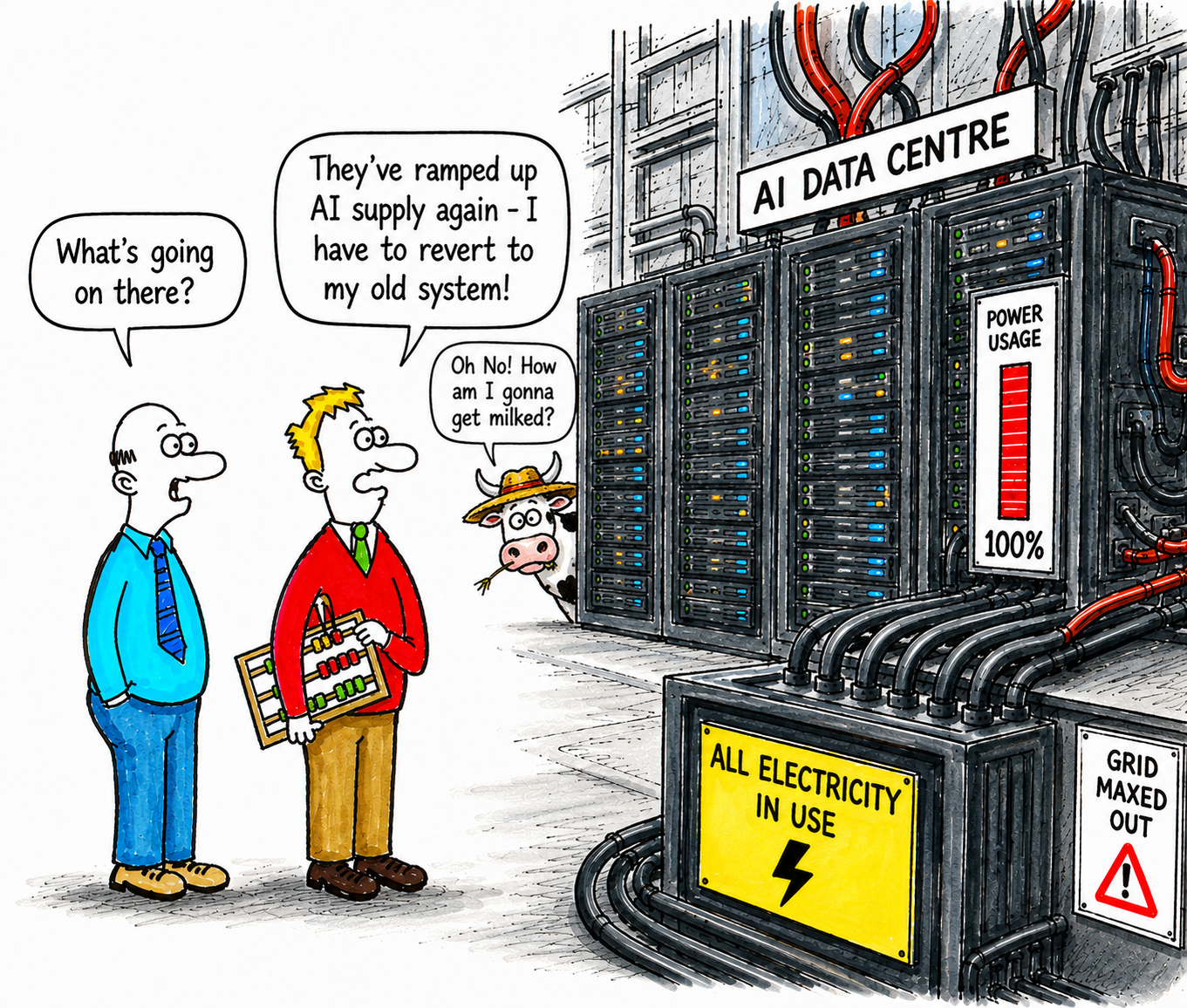
Artificial intelligence is facing a problem that cannot be solved by buying more chips: there may not be enough electricity to power the machines.
AI data centres are expanding rapidly. Training and running models requires enormous computing power, while the facilities themselves need electricity for cooling.
IEA
The International Energy Agency estimates data-centre electricity consumption could reportedly more than double, from about 415 terawatt-hours in 2024 to roughly 945 TWh by 2030. That would make data centres one of the fastest-growing sources of electricity demand.
Old Infrastructure is a big problem
The problem is not necessarily a global shortage of energy. It is a shortage of electricity generation and grid infrastructure in the right places, at the right time.
Data centres can require hundreds of megawatts, yet connecting new generation to the grid can take years. Ageing transmission networks, lengthy planning processes, transformer shortages and grid-connection queues are becoming bottlenecks.
So how is the industry going to fix it?
The short-term answer is likely to be a mixture of natural gas, renewable energy, batteries and existing nuclear plants. Gas can be deployed relatively quickly and provides reliable power, although it increases carbon emissions.
Renewables are cheaper and cleaner but need transmission and storage to provide reliable power. The IEA expects gas and coal together to supply more than 40% of the additional electricity required by data centres through 2030.
Further ahead, nuclear power could become important, including small modular reactors, alongside geothermal energy and improved battery storage. AI companies are also exploring dedicated power plants and locating data centres closer to abundant electricity.
No quick fix
But there is no instant solution. New gas generation and grid upgrades can take several years; major transmission projects can take much longer, while new nuclear facilities can take a decade or more.
The AI revolution is therefore becoming an energy race. Chips may determine how intelligent AI becomes, but electricity may determine how quickly it can grow.
And the effect for you and me?
For the general population, the AI energy crunch could eventually mean higher electricity bills, greater pressure on national power grids and tougher competition for available energy.
As technology companies build enormous data centres, they may compete with households and traditional industries for electricity, particularly in areas where grid capacity is already limited.
Governments could be forced to spend billions upgrading power networks and building new generation, with some of those costs potentially passed on to consumers through taxes or energy bills.
There is also a risk that greater reliance on gas-fired generation could slow efforts to cut emissions.
However, the picture is not entirely negative: investment in new renewable energy, nuclear power, batteries and upgraded grids could ultimately create a more reliable and modern electricity system.
The real question is who pays for the huge infrastructure needed to power the AI boom — and who benefits from it?
Water?
Water could become another major pressure point. AI data centres generate enormous amounts of heat and many rely on water-based cooling systems, meaning their expansion can increase demand for local water supplies.
This could become particularly problematic in areas already facing drought or water shortages, where data centres may be competing with households, agriculture and industry for a limited resource.
Supply issues
The issue is not simply the amount of water consumed, but where and when it is consumed. A data centre built in a water-stressed region could place significant additional pressure on local supplies.
New cooling technologies, including closed-loop systems, liquid cooling and air cooling, can reduce consumption, while locating data centres near plentiful water supplies can also help. These closed systems need cooling too and likely will add to power consumption.
Compete
But, just as with electricity, the rapid expansion of AI means infrastructure and resource planning must catch up — otherwise the technology boom could increasingly compete with the basic resources people depend upon.