Markets in Asia continue volatility as Softbank falls 10%

Softbank down 10%

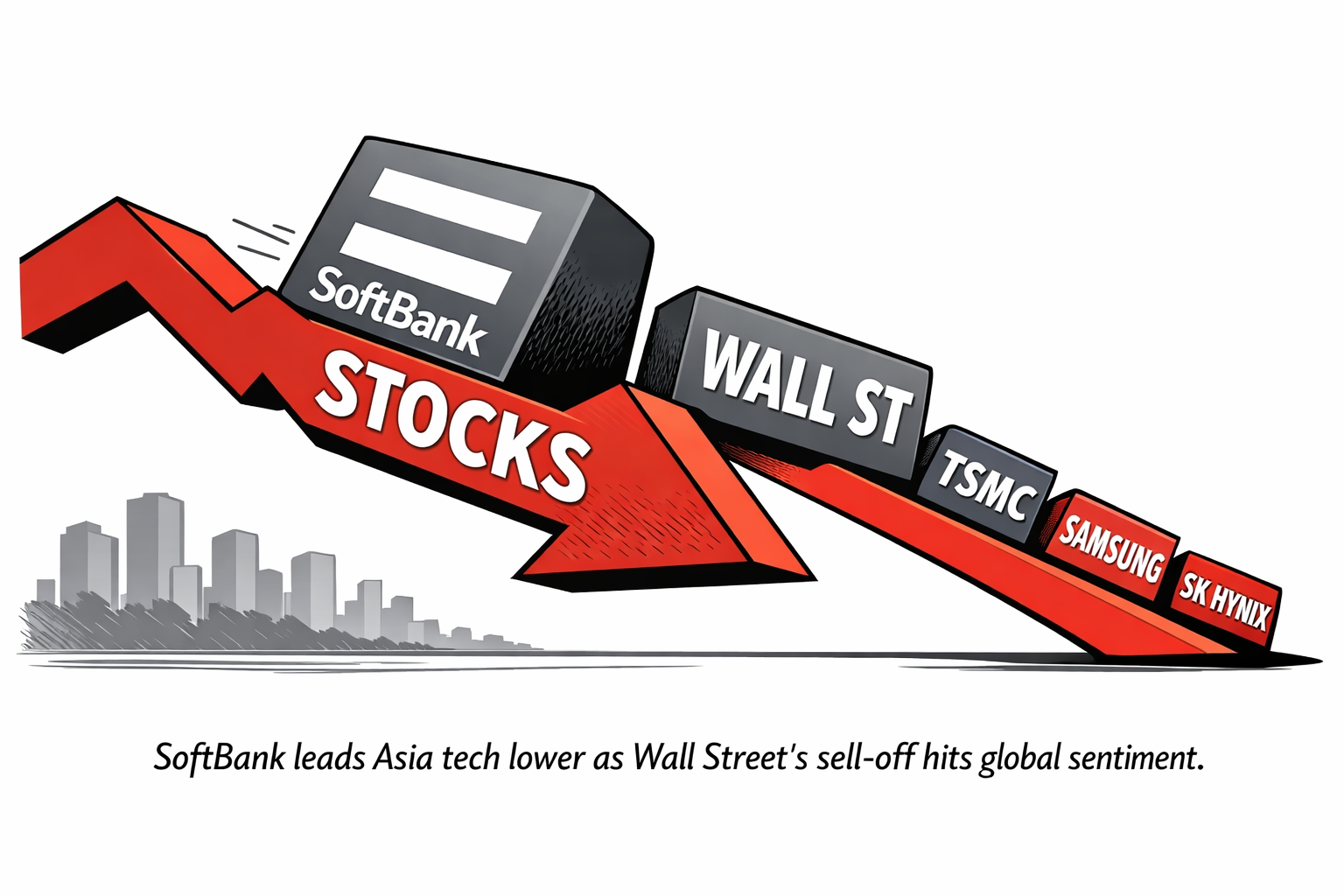
SoftBank’s sharp 10% slide on Wednesday became the defining symbol of a broader rout across Asia’s technology markets, as the region absorbed the full force of Wall Street’s overnight tech sell‑off.

The reversal ended a brief rebound in chipmakers and reignited concerns that valuations across the artificial‑intelligence complex have run too hot for too long.

The immediate pressure on SoftBank stemmed from reports that its attempt to raise at least $6 billion through a margin loan backed by its OpenAI stake had stalled.

That setback landed at a moment when sentiment toward high‑growth tech names was becoming more fragile, amplifying the downside.

Investors rotated out of risk, hitting Japan’s semiconductor ecosystem: Advantest and Renesas both fell more than 3%, while South Korea’s SK Hynix plunged over 8% and Samsung Electronics dropped 7.45%.

Taiwan’s TSMC and Hon Hai were also dragged lower.

A deeper structural worry is now taking hold. Massive AI‑related fundraising — including upcoming listings for SpaceX, Anthropic and OpenAI — appears to be siphoning capital away from publicly traded tech stocks.

Some investors see this as the early stage of a rotation; others fear it signals overheating. For Japan, one unexpected beneficiary could be defence contractors, with strategists suggesting a shift toward “heavies” as retail traders search for stability.

South Korea’s KOSPI plunges 8%!

Kospi Index falls again

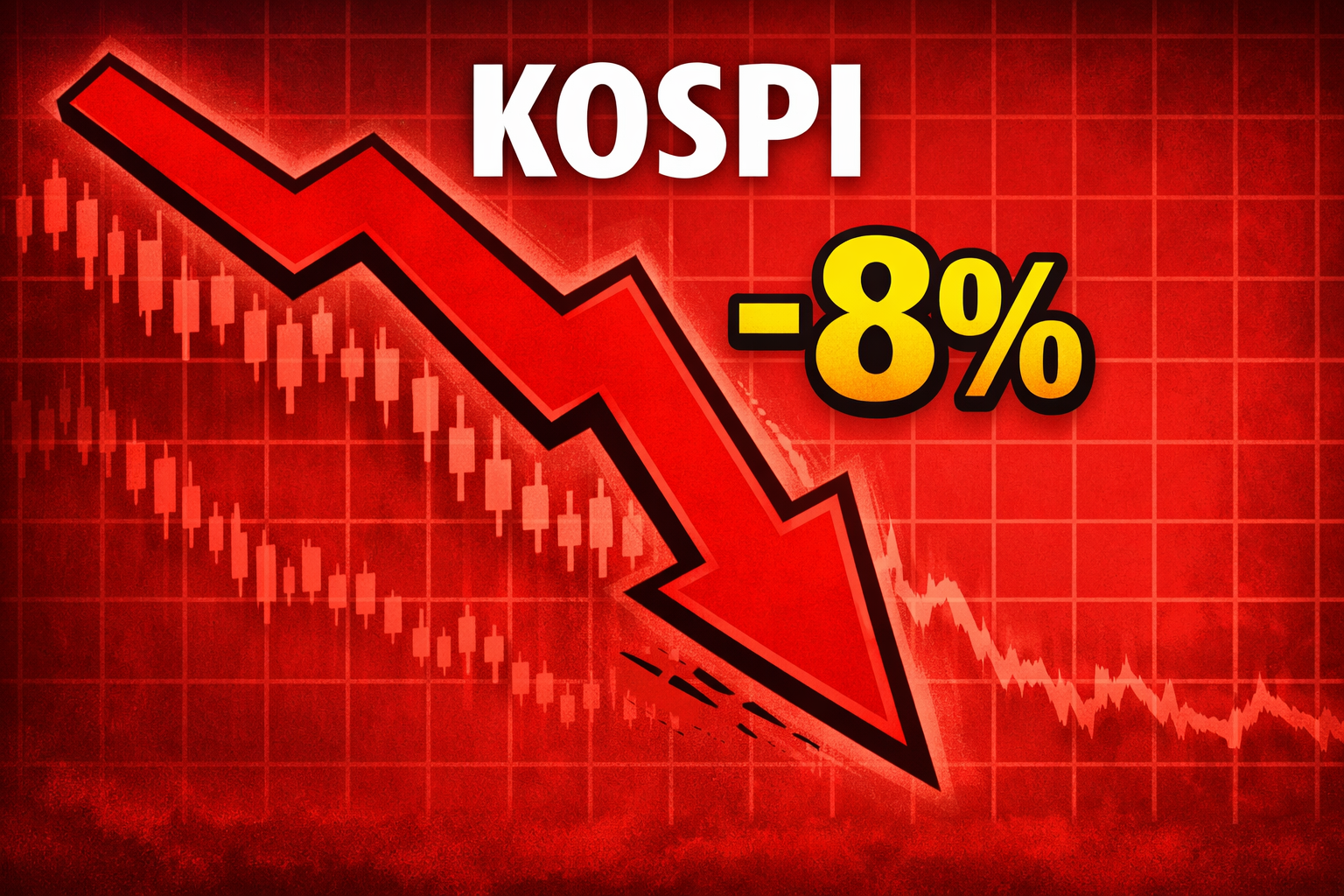
South Korea’s KOSPI index suffered a severe shock on Monday, 8th June, plunging more than 8% in early trading and triggering an automatic 20‑minute circuit breaker as panic selling swept through the market.

The index briefly fell to the mid‑7,400s, marking its third circuit‑breaker event of the year and underscoring the fragility of sentiment after a sharp global tech sell‑off.

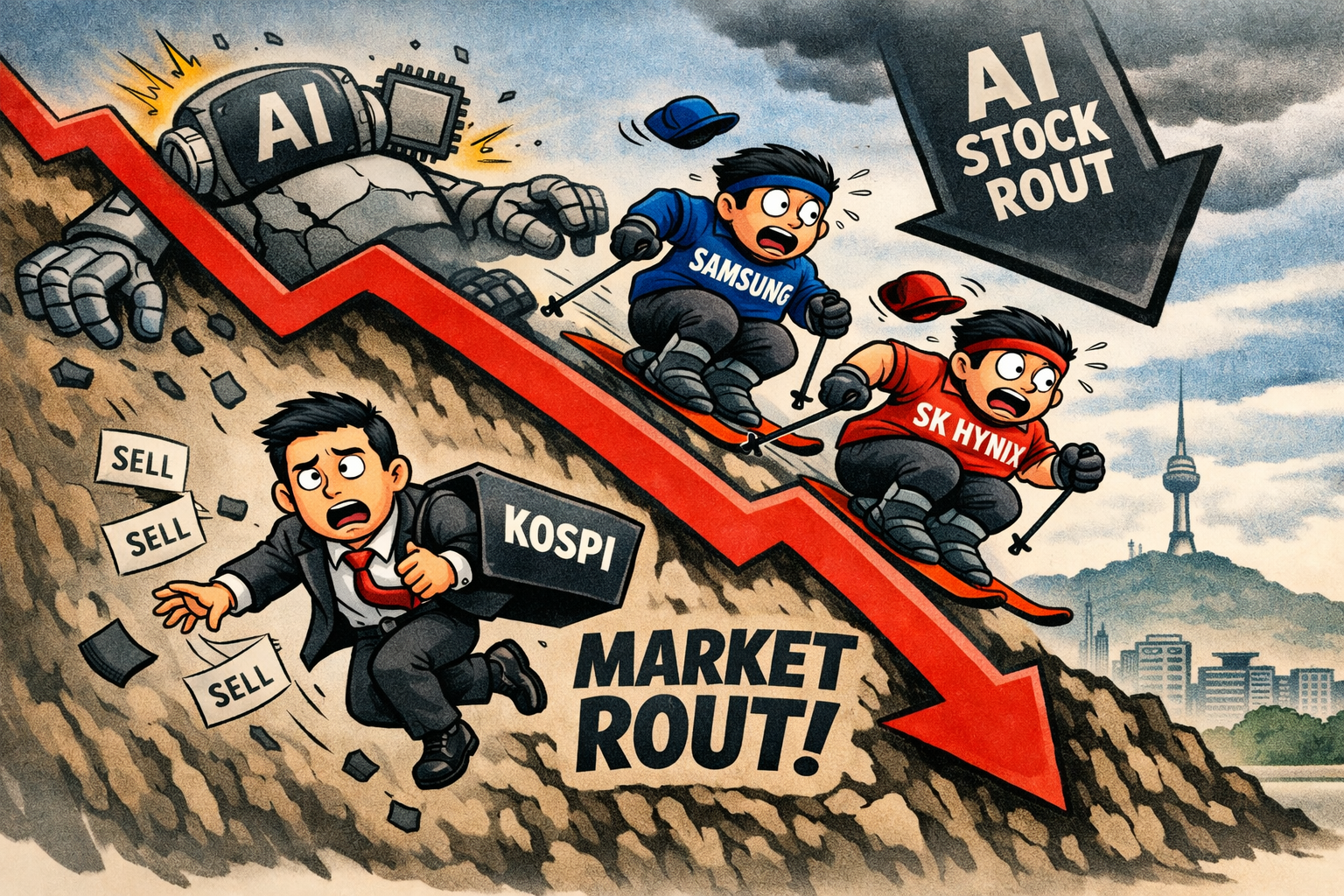
Semiconductor heavyweights led the rout. Samsung Electronics slumped more than 8.5%, while SK Hynix dropped over 7%, with additional steep losses across major industrial names including LG Electronics, Hyundai Motor and Samsung SDI.

The sell‑off mirrored a sharp downturn in U.S. markets the previous Friday 5th June 2026, where semiconductor giants such as Nvidia, Broadcom and Micron were hit hard, fuelling fears that the AI‑driven rally had overheated.

A hotter‑than‑expected U.S. jobs report also stoked concerns that the Federal Reserve may lean towards further rate hikes, adding to the risk‑off mood.

Currency markets reflected the stress: the Korean won weakened sharply to around 1,554 per dollar as foreign investors accelerated withdrawals.

Although local institutions and retail investors later stepped in to “buy the dip,” helping trim some losses, the episode highlighted the market’s vulnerability to global tech sentiment and shifting U.S. rate expectations.

AI Rout Hits Seoul: Kospi Sinks Over 5% as Chip Giants Slide

AI chip stock fall

South Korea’s markets were hit hard on Friday 5th June 2026, with AI‑linked stocks leading a sharp regional sell‑off after Wall Street’s tech slump rippled across Asia.

The Kospi tumbled 5.54%, closing at 8,160.59, its steepest one‑day fall in months, as investors rapidly unwound positions in semiconductor and AI beneficiaries.

Heavyweights Samsung Electronics and SK Hynix were at the centre of the decline, sliding 6.40% and 9.92% respectively. This demonstrates how tightly exposed Seoul’s market has become to the global AI cycle.

The pullback followed a sharp rotation out of chipmakers in the United States, triggered by disappointing revenue data from Broadcom. This shook confidence in the sector’s near‑term momentum.

With AI names having powered much of 2026’s rally, even a modest earnings wobble proved enough to spark a broader de‑risking.

Domestic strain

Domestic pressures added to the strain. South Korea’s labour minister urged major tech firms to share more of their AI‑driven semiconductor profits with workers and suppliers. This is a signal that political scrutiny of the sector is rising just as global sentiment cools.

For now, the sell‑off looks like a reminder of how tightly South Korea’s market is tethered to global AI expectations.

If Wall Street’s AI led enthusiasm falters, Seoul’s tech giants may face a more prolonged test.

South Korea’s Market Faces a Fragile Balancing Act

Risks to South Korea stocks

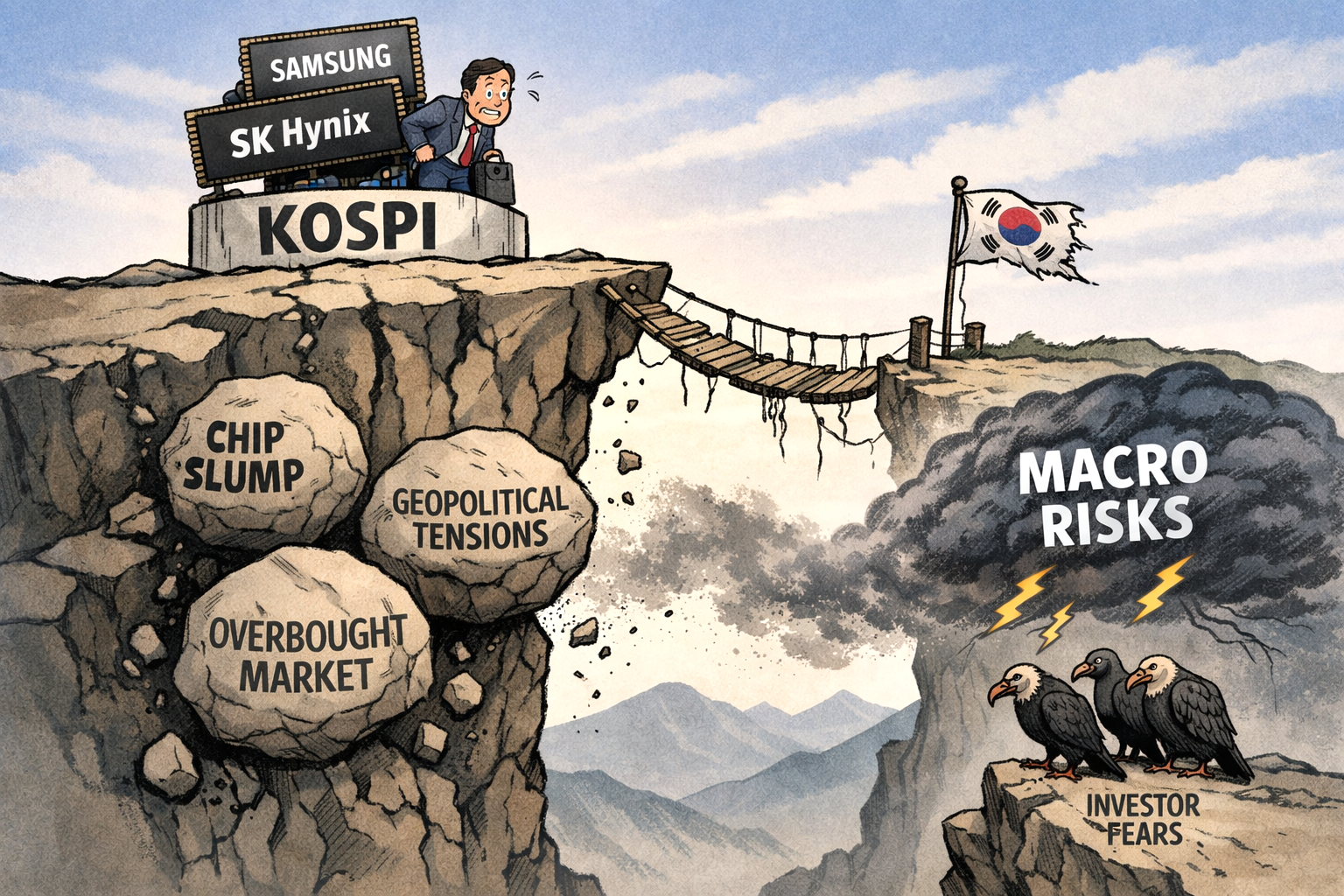
South Korean equities are showing signs of strain after a powerful rally led almost entirely by semiconductor giants Samsung Electronics and SK Hynix.

Analysts warn that the market’s narrow leadership leaves it exposed to sudden reversals if global chip demand cools or investor sentiment shifts.

Overbought

It has been cautioned that the Kospi’s momentum indicators are flashing overbought signals, suggesting limited room for further gains before a correction sets in.

The country’s heavy reliance on the semiconductor cycle means any slowdown in AI‑related investment or memory‑chip orders could quickly erode confidence.

Broader industrial and consumer sectors have lagged, amplifying the sense that Korea’s stock market is running on a single engine.

Risks

While optimism remains high, the risks are clear: a fragile rally built on concentrated strength and global tech exuberance.

If macro headwinds return, the dust from “macro risks” may finally settle on Seoul’s fast‑moving market.

South Korea’s Kospi hit another new record high despite mixed trading across Asia-Pacific markets and this despite U.S. Iran deal caution.

SK Hynix joins in AI boom to join the $1 trillion club

SK Hynix rockets to $1 trillion valuation

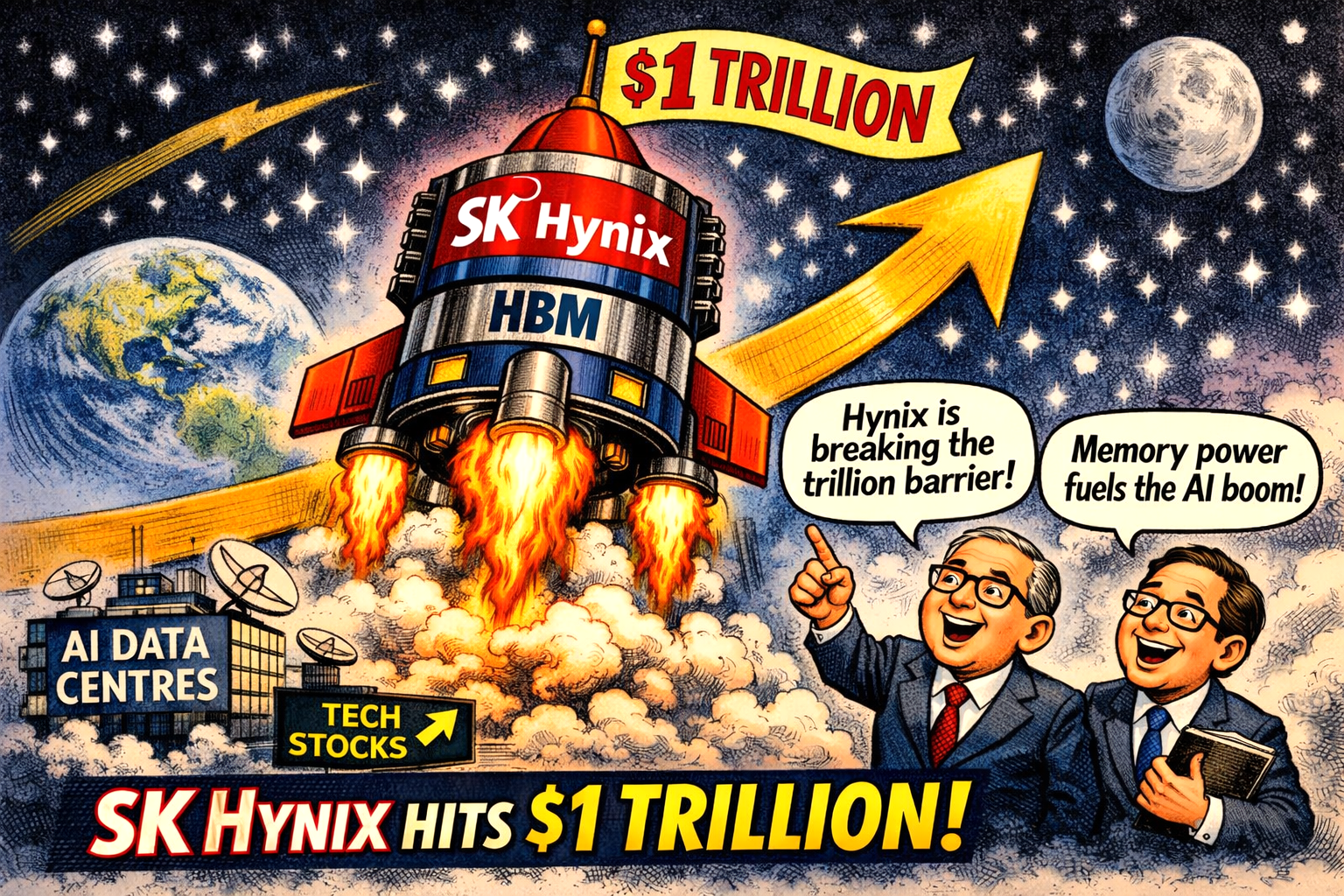
SK Hynix has joined the trillion‑dollar club, marking a historic moment for South Korea’s semiconductor industry.

The company’s valuation surge reflects its dominance in high‑bandwidth memory (HBM) production — the critical component powering AI training systems worldwide.

As demand for faster, more efficient data processing accelerates, SK Hynix’s chips have become indispensable to hyperscalers and GPU manufacturers alike.

The milestone underscores a broader reordering of global tech power. Once overshadowed by larger rivals, SK Hynix now stands as a cornerstone of the AI infrastructure boom, benefiting from long‑term supply contracts and premium pricing for its advanced HBM3E modules.

Investors have rewarded its precision engineering and disciplined expansion strategy, driving shares to record highs.

Crossing the trillion‑dollar threshold cements SK Hynix’s transformation from a memory supplier into a strategic technology leader — and signals that the AI era’s next wave of growth will be built on memory innovation.

Global Trillion‑Dollar Companies (May 2026) – Micron, SK Hynix and Walmart soon to join the club

RankCompanyMarket Cap (USD trillions)SectorNotes
1️⃣Nvidia (NVDA)≈ 5.3 – 5.2SemiconductorAI  hardwareWorld’s most valuable firm; GPUs power global AI infrastructure.
2️⃣Alphabet ≈ 4.6 – 4.7Comms Search ServicesAI‑driven growth via Google Cloud, Gemini, and YouTube ads.
3️⃣Apple (AAPL)≈ 4.5 – 4.4Consumer TechnologyStill a top‑three giant; hardware + services ecosystem.
4️⃣Microsoft ≈ 3.1Software  and Cloud  ComputingAzure and enterprise AI remain core drivers.
5️⃣Amazon ≈ 2.8 – 2.9E‑commerce   CloudAWS and retail logistics sustain trillion‑plus value.
6️⃣TSMC (TSM)≈ 2.1SemiconductorCritical foundry for global chip supply chain.
7️⃣Broadcom ≈ 2.0Semiconductor SoftwareRides HBM and networking chip demand.
8️⃣Saudi Aramco≈ 1.8EnergyLargest non‑tech member; oil and petrochemical dominance.
9️⃣Tesla (TSLA)≈ 1.5 – 1.6Automotive  EnergyEV and AI‑driven autonomy keep valuation high.
🔟Meta Platforms (META)≈ 1.5 – 1.6Social Media   AI  advertisingStill above $1 T despite rotation toward semiconductors.
11Samsung Electronics≈ 1.3Semiconductor MemoryNew entrant; HBM and AI‑memory surge.
12Berkshire Hathaway (BRK.A)≈ 1.0Financial ConglomerateDiversified holdings across insurance, energy, and rail.

Micron is the latest company to reach $1 trillion valuation

Micron at $1 trillion Cap

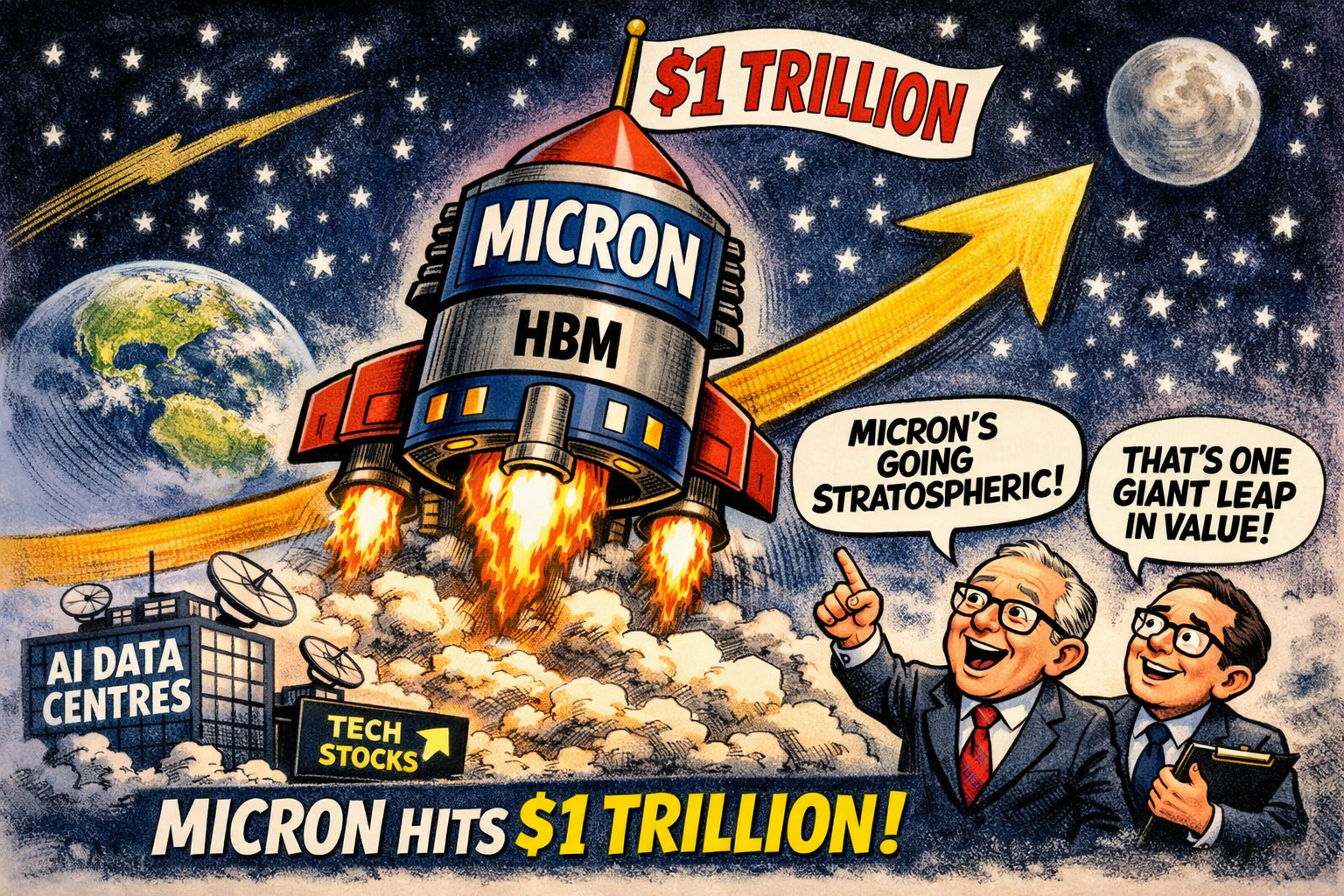
Micron has surged past the $1 trillion valuation mark, becoming the latest chipmaker to ride the relentless global demand for advanced memory used in AI data centres.

The company’s shares have climbed sharply as hyperscalers race to secure high‑bandwidth memory for next‑generation training clusters, pushing Micron’s order book to record levels and transforming what was once a cyclical manufacturer into a strategic pillar of the AI supply chain.

Milestone

The milestone reflects a dramatic shift in investor perception. Micron’s HBM3E and emerging HBM4 lines are now viewed as essential infrastructure, commanding premium pricing and long‑term supply agreements.

Profitability has strengthened accordingly, with margins expanding as production scales and shortages persist across the industry.

While the trillion‑dollar threshold underscores Micron’s new status among the semiconductor elite, it also raises expectations.

Sustaining this valuation will depend on flawless execution, continued technological leadership, and the durability of the AI investment boom.

Global Trillion‑Dollar Companies (May 2026) – Micron and SK-Hynix to join

RankCompanyMarket Cap (USD trillions)SectorNotes
1️⃣Nvidia (NVDA)≈ 5.3 – 5.2SemiconductorAI  hardwareWorld’s most valuable firm; GPUs power global AI infrastructure.
2️⃣Alphabet ≈ 4.6 – 4.7Comms ServicesAI‑driven growth via Google Cloud, Gemini, and YouTube ads.
3️⃣Apple (AAPL)≈ 4.5 – 4.4Consumer TechStill a top‑three giant; hardware + services ecosystem.
4️⃣Microsoft ≈ 3.1Software  Cloud  ComputingAzure and enterprise AI remain core drivers.
5️⃣Amazon ≈ 2.8 – 2.9E‑commerce / CloudAWS and retail logistics sustain trillion‑plus value.
6️⃣TSMC (TSM)≈ 2.1SemiconductorCritical foundry for global chip supply chain.
7️⃣Broadcom ≈ 2.0SemiconductorSoftwareRides HBM and networking chip demand.
8️⃣Saudi Aramco≈ 1.8EnergyLargest non‑tech member; oil and petrochemical dominance.
9️⃣Tesla (TSLA)≈ 1.5 – 1.6Automotive /
Energy
EV and AI‑driven autonomy keep valuation high.
🔟Meta Platforms (META)≈ 1.5 – 1.6Social Media   AI  advertisingStill above $1 T despite rotation toward semiconductors.
11️⃣Samsung Electronics≈ 1.3Semiconductors / MemoryNew entrant; HBM and AI‑memory surge.
12️⃣Berkshire Hathaway (BRK.A)≈ 1.0Financial ConglomerateDiversified holdings across insurance, energy, and rail.