

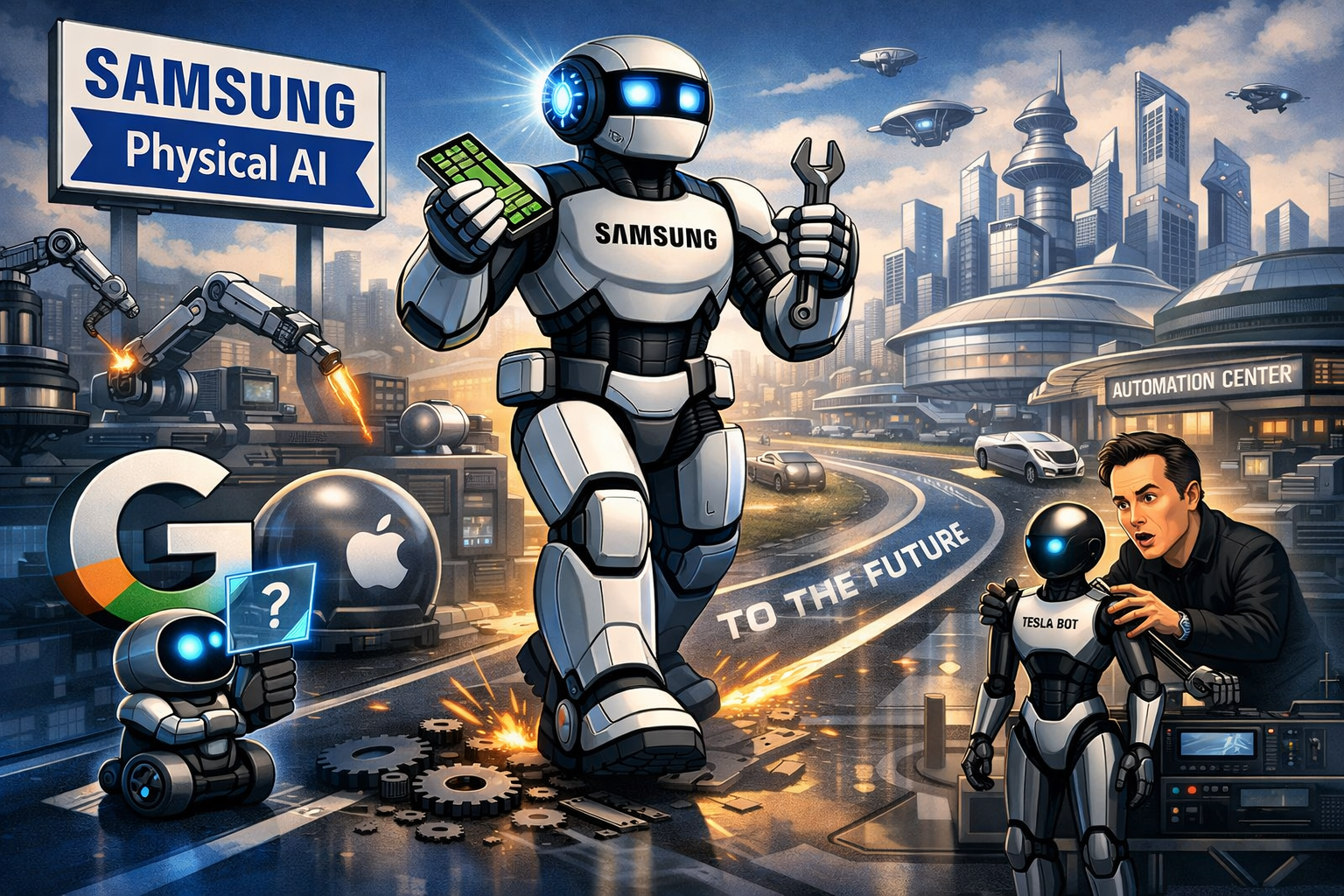
Samsung Electronics’ push into Physical AI through Robotics

Samsung’s push into physical AI marks one of the most significant strategic pivots in its recent history, signalling a future where artificial intelligence is not only embedded in silicon but expressed through motion, autonomy and real‑world interaction.

For years, the company has dominated consumer electronics through iterative hardware improvements and software refinement.

Now it is positioning robotics as the next frontier — a domain where AI becomes tangible, embodied and capable of acting directly within homes, workplaces and industrial environments.

RX Robotics eXperience

The newly created RX, or Robotics eXperience, will consolidate Samsung’s robotics capabilities and is intended to drive a mid- to long-term strategy from core tech development to commercialisation,

The shift is driven by two converging forces. First, generative and multimodal AI have matured to the point where machines can perceive, reason and respond with far greater nuance.

Second, global labour shortages and rising expectations for automation have created a commercial opening for robots that are not merely programmable tools but adaptive assistants.

Samsung’s investment in “physical AI” aims to bridge these trends, producing machines that can navigate complex spaces, manipulate objects safely and collaborate with humans.

Prototypes

Early prototypes, including household assistance robots and mobile platforms capable of environmental mapping, hint at Samsung’s ambition to build a robotics ecosystem rather than isolated products.

The company’s vast manufacturing footprint gives it a unique advantage: it can integrate sensors, processors, batteries and actuators at scale, reducing costs and accelerating iteration.

Useful

Crucially, Samsung appears intent on keeping robotics tied to everyday usefulness — from elder care and domestic support to logistics and retail automation.

If successful, Samsung’s move could reshape the competitive landscape. Rivals such as Apple and Google have focused heavily on software‑centric AI, while Tesla and various start‑ups pursue humanoid designs.

Samsung’s approach is more pragmatic: build robots that solve real problems now, while gradually increasing autonomy as AI models improve.

The result is a quiet but profound transition. Samsung is no longer just a hardware giant — it is becoming an architect of intelligent machines that operate in the physical world, signalling a new era where AI is not only something we use, but something that moves.

Elon Musk wants to make Tesla a $25 trillion company by 2040

Autonomous vehicle

Elon Musk’s Vision for Tesla’s Trillion Dollar Future

Elon Musk, the visionary CEO of Tesla, has consistently set ambitious goals for the company. Among his most audacious claims is that Tesla could potentially become a multi trillion-dollar company and even reach a valuation of $25 trillion, largely driven by the deployment of robotaxis.

Robotaxi vision

Tesla’s robotaxi concept is centred around autonomous vehicles that can operate as self-driving taxis. These vehicles are equipped with Tesla’s Full Self-Driving (FSD) technology, which Musk believes will revolutionize transportation. By transforming Tesla cars into autonomous ride-sharing vehicles, the company could generate significant revenue without increasing the number of cars sold.

Projections

Musk’s financial projections are based on the immense potential of the robotaxi market

  1. Revenue Generation: Each Tesla vehicle could earn substantial income as a robotaxi. If Tesla owners opt into the robotaxi network, Tesla could take a share of the revenue generated from these rides.
  2. Cost Efficiency: Autonomous driving reduces the need for human drivers, leading to lower operational costs. This efficiency could make robotaxis more affordable for users and highly profitable for Tesla.
  3. Reduced pollution: will help meet green energy goals.
  4. Market Penetration: As autonomous technology matures, the adoption of robotaxis could grow rapidly, capturing a significant share of the global transportation market.

Market potential

The global ride-hailing market is already valued at hundreds of billions of dollars, and with the introduction of autonomous vehicles, this market is expected to expand further. Tesla’s early entry and continuous advancements in FSD technology position it to be a dominant player in this space.

Challenges

While the potential is enormous, there are several challenges and scepticism surrounding Musk’s projections

  1. Regulatory Hurdles: Autonomous vehicles must navigate a complex regulatory landscape. Approval processes and safety standards vary by region, which could delay widespread adoption.
  2. Technical Milestones: Achieving full autonomy is a significant technical challenge. Tesla’s FSD technology is still in development, and perfecting it for widespread use requires overcoming numerous technical obstacles.
  3. Market Competition: Tesla is not the only player in the autonomous vehicle market. Competitors like Waymo, Cruise, and traditional automakers are also investing heavily in autonomous technology.

Conclusion

Elon Musk’s vision of making Tesla a trillion-dollar and eventually a $25 trillion company through robotaxis is both bold and captivating. The success of this vision hinges on the successful deployment and adoption of autonomous driving technology. While there are significant challenges to overcome, Musk’s track record of defying odds and achieving groundbreaking innovations keeps the possibility within the realm of achievable dreams.

The future of transportation, as envisioned by Musk, could fundamentally reshape how we move and how Tesla thrives as a pioneer in autonomous mobility.

Tesla’s future does seem promising with the introduction of Optimus, their humanoid robot, as well as their advancements in solar energy and battery technology.

The future looks very bright for Tesla.

Is Apple planning to build an AI robot?

Robotics

Reports indicate that Apple is delving into AI-powered robotics, aiming to innovate within the home robotics sector. A Bloomberg article reveals that the tech titan is exploring two fascinating initiatives.

Mobile Robot

Apple is reportedly exploring the development of a robot that can accompany its owner. Envision a congenial AI companion that travels with you.

Robotic Display

The project aims to develop a robotic mechanism capable of moving displays. Despite being periodically removed and reinstated on Apple’s roadmap; it is still in the preliminary research stage.

The projects are spearheaded by Matt Costello, Apple’s VP of Hardware Engineering, and Brian Lynch, the Senior Director of Home Hardware Engineering. Moreover, Apple’s AI team is developing algorithms to enable robots to navigate homes, potentially linking to the mobile robot initiative.

Apple’s foray into AI-driven home robots comes after shelving its electric vehicle project, marking an intriguing development. The company is exploring the integration of AI into AirPods and the possibility of creating smart glasses. Despite not launching generative AI tools as swiftly as some rivals, Apple is set to introduce some later this year.

In the realm of robotics, Apple enters a field with established entities like Amazon, Roomba, and Unitree, which have already introduced home robotics products.

Therefore, it’s worth watching for upcoming Apple AI products in the future!