

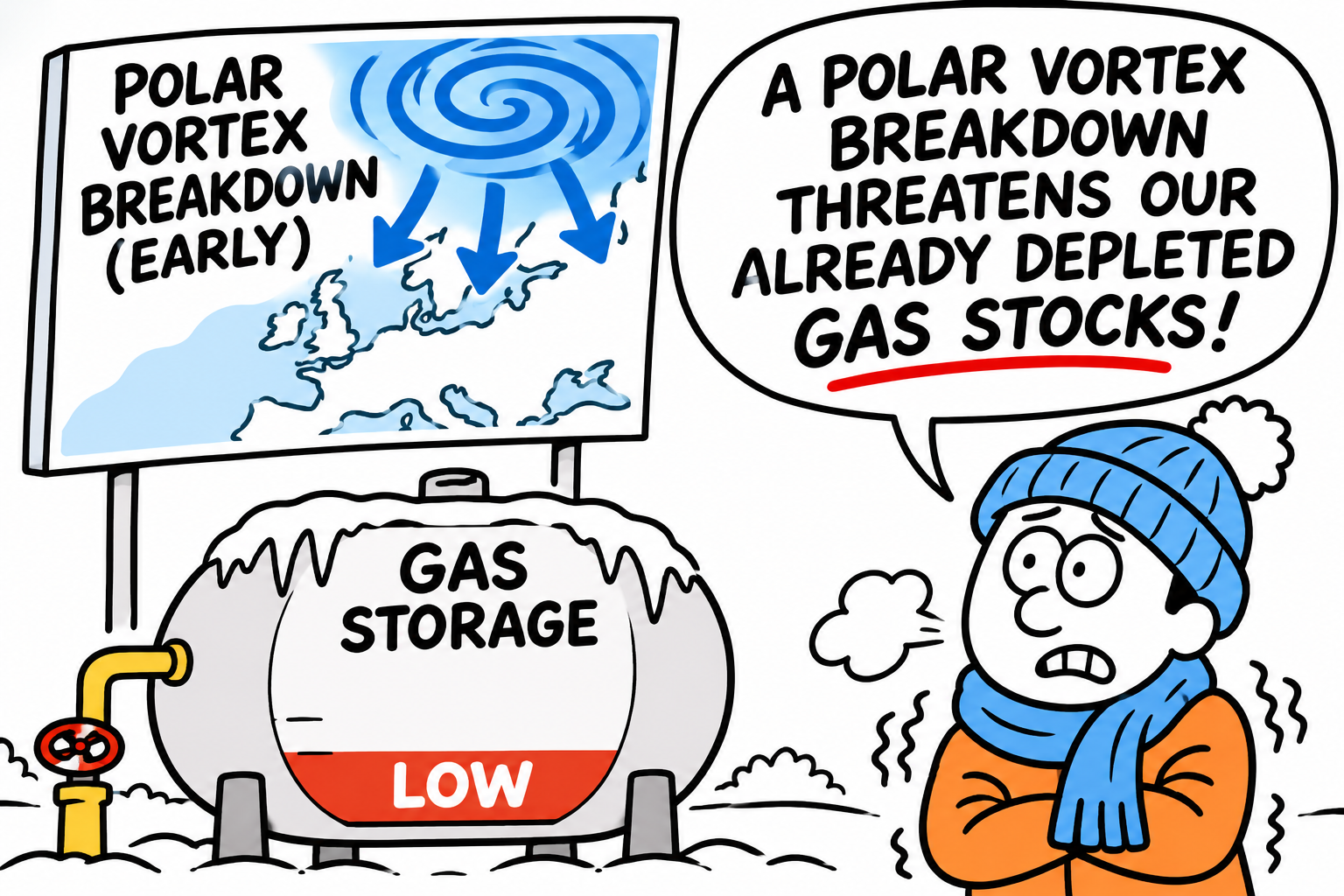
Europe is facing a potentially difficult winter as an unusually early breakdown of the polar vortex raises fears of prolonged cold weather, threatening already depleted natural gas reserves and increasing the prospect of another energy price shock.
Stratospheric disruption
Meteorologists are reporting an exceptionally early disruption to the stratospheric polar vortex, a powerful circulation of winds high above the Arctic that normally keeps freezing air trapped around the North Pole.
When this system weakens or breaks down, colder Arctic air can move southwards, potentially bringing freezing temperatures, snow and prolonged cold spells to parts of Europe and North America.
Timing
The timing is particularly concerning. Europe entered the 2026/27 winter with gas storage at its lowest levels in more than a decade.
Stocks have already experienced unusually heavy withdrawals during November 2026, adding pressure to a market struggling to rebuild its reserves.
The situation is further complicated by an exceptionally powerful El Niño weather phenomenon.
The combination of a disrupted polar vortex and strong El Niño is unusual, leaving forecasters without a reliable historical comparison for predicting the winter’s overall impact.
Lower temperatures
Lower temperatures would increase heating demand, while reduced wind speeds could force greater reliance on gas-fired electricity generation.
This would accelerate withdrawals from storage at precisely the time Europe needs to conserve its remaining supplies.
War
Geopolitical tensions are adding another complication. Disrupted Qatari liquefied natural gas (LNG) shipments through the Strait of Hormuz have tightened international supplies, increasing competition between Europe and Asia for available cargoes.
European wholesale gas prices have already surged towards levels last experienced during the 2022 energy crisis.
Concern
Analysts warn that continued heavy withdrawals, combined with colder weather, could trigger another substantial price increase.
A polar vortex breakdown does not guarantee a severe winter, but the combination of vulnerable gas reserves, uncertain weather and disrupted supplies presents a worrying prospect.
Europe may soon discover that its greatest energy threat this winter is not simply geopolitics, but the weather itself.