SpaceX Surges 20% on Debut as Wall Street’s Fear Gauge Falls

SpaceX up 20% in one day

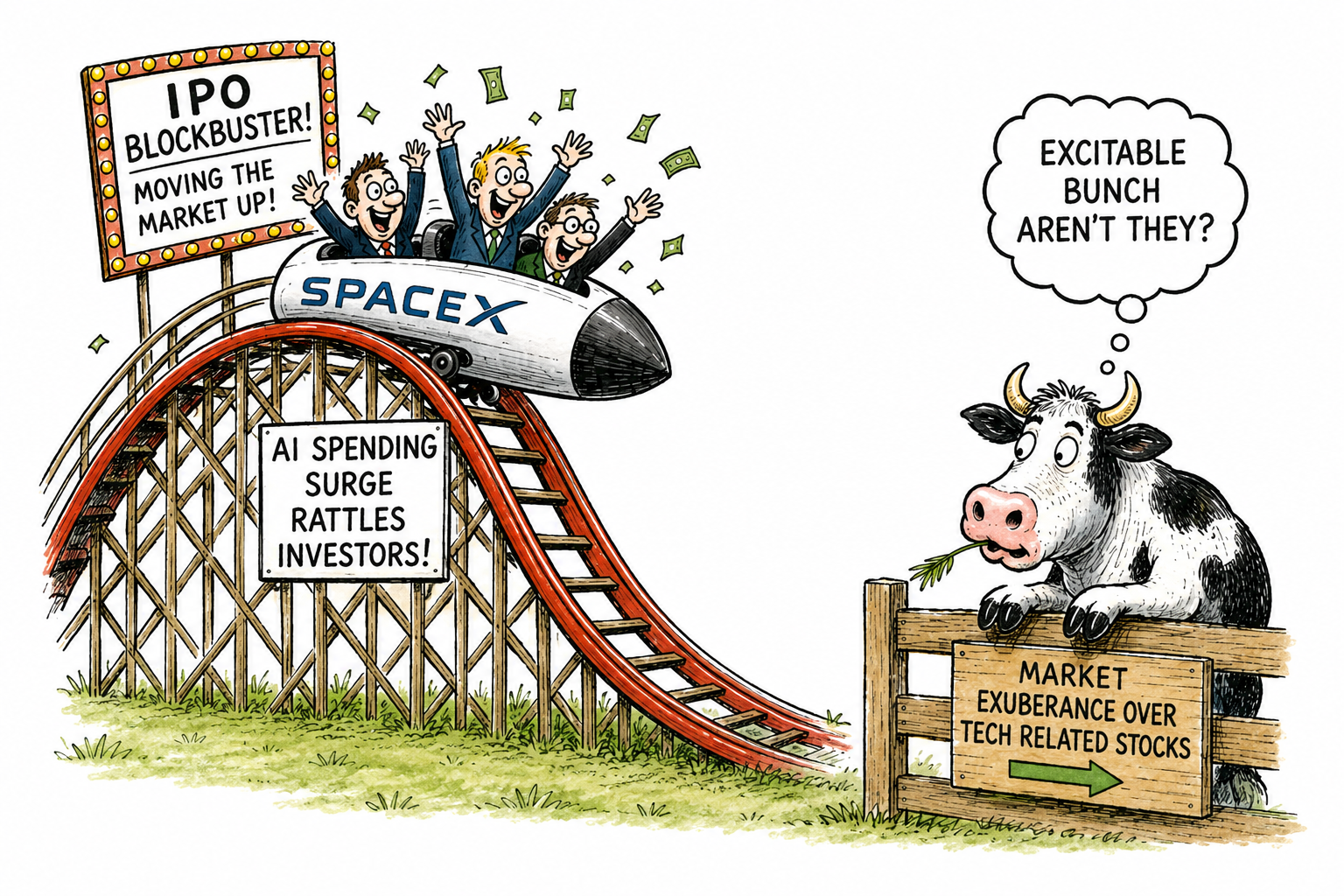
SpaceX’s long‑anticipated market debut delivered exactly the kind of spectacle investors had hoped for.

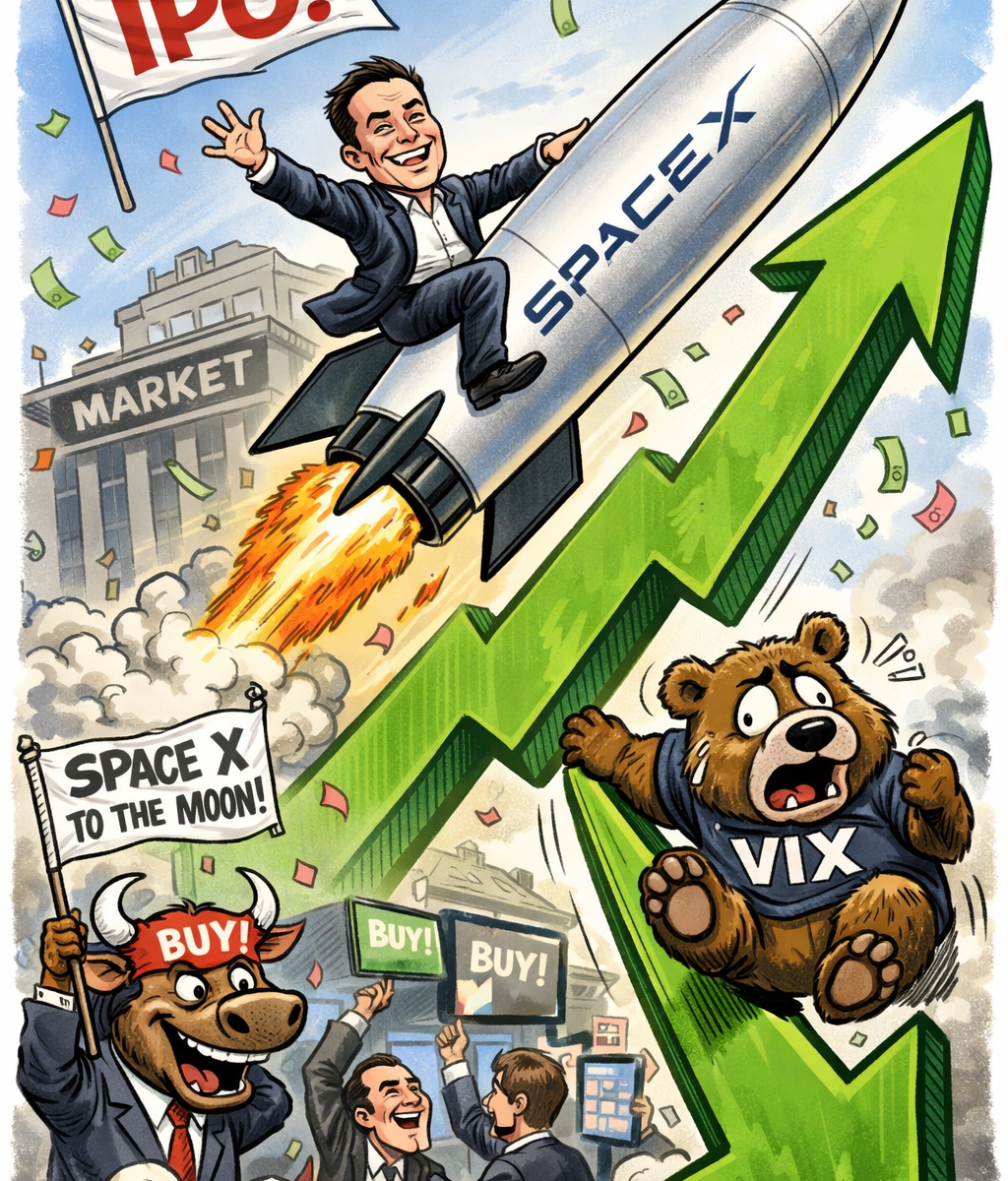
Shares in the rocket and satellite group jumped 20% on their first day of trading, instantly cementing the company as one of the most valuable entrants in modern market history and extending the extraordinary momentum behind the commercial space sector.

FOMO

The opening rally was driven by a mix of retail enthusiasm, institutional FOMO, and a broader belief that SpaceX now sits at the centre of three powerful structural trends: reusable launch economics, satellite‑based communications, and defence‑adjacent technology spending.

Traders described order books as “relentless” and “one‑way”, with demand spilling over into related aerospace names throughout the session.

VIX

The exuberance fed directly into the volatility complex. The VIX — Wall Street’s so‑called fear gauge — fell sharply, touching levels last seen before the recent geopolitical flare‑ups.

A successful mega‑IPO tends to act as a barometer for risk appetite, and the smooth execution of SpaceX’s listing appears to have reassured investors that liquidity remains deep and that the market can absorb large‑scale issuance without strain.

Analysts were quick to point out that the combination of a blockbuster debut and a falling VIX is rare. It suggests not only confidence in SpaceX’s growth story but also a broader willingness to rotate back into high‑beta sectors after weeks of defensive positioning.

For now, the market has delivered its verdict: SpaceX has arrived as a public company with gravitational pull, and investors are leaning back into risk rather than retreating from it.

Greenshoe

In major IPOs that jump 20% on day one, underwriters typically exercise the greenshoe to help stabilise trading and meet excess demand.

A surge that strong implies the banks were almost certainly allocating the extra 15% of shares to satisfy buyers.

However, the formal disclosure of greenshoe usage is normally filed several days after the IPO, once stabilisation activity ends. So, we won’t see the official paperwork immediately.

A greenshoe is an IPO mechanism letting underwriters sell up to 15% extra shares and buy them back at the offer price to stabilise trading and prevent early volatility.

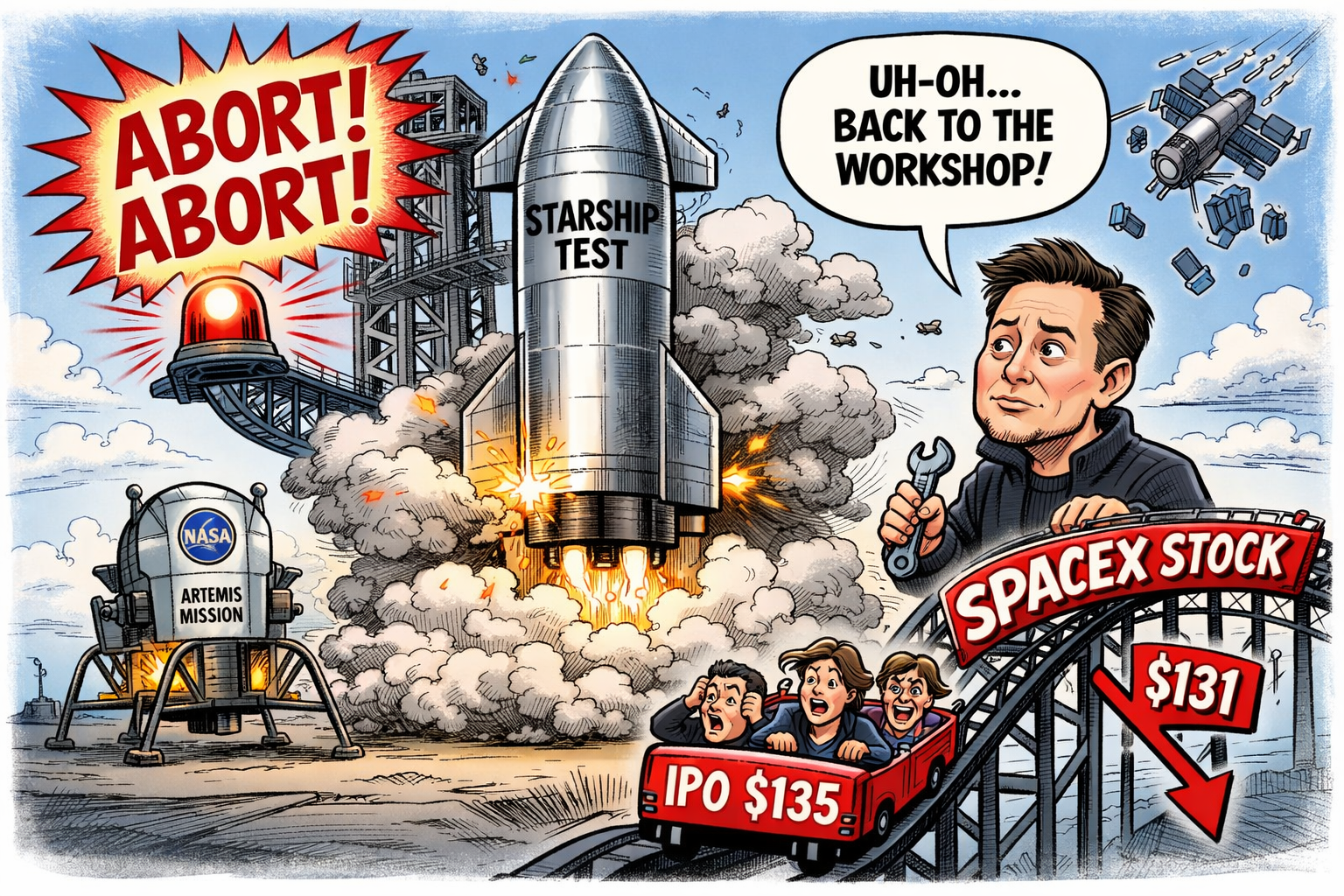
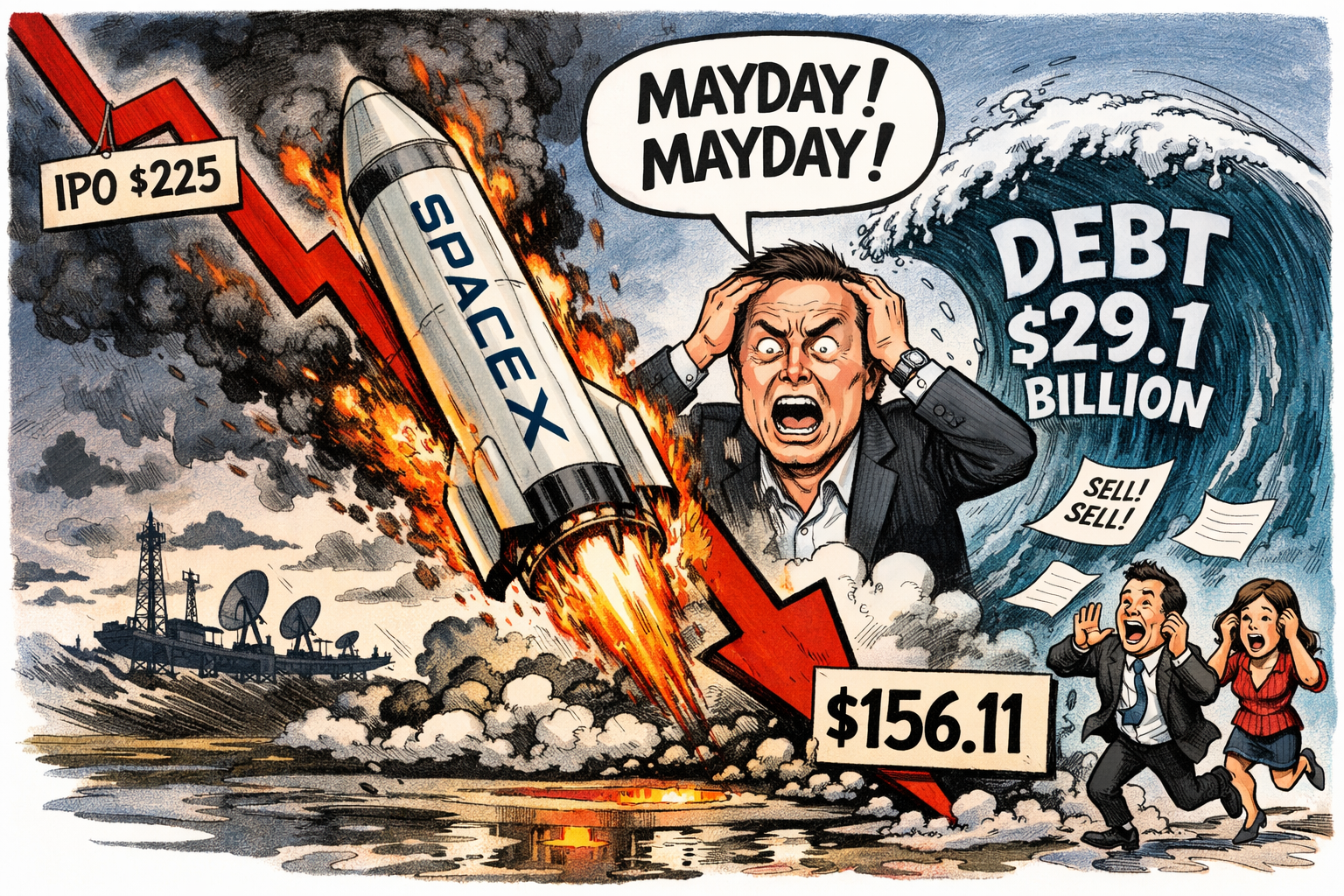
SpaceX is not a meme – it is very much real, for the future and it is here to stay. But we may get a bumpy ride as the company progresses.

Anthropic’s Fable: The Mythos-Class Model That Finally Goes Public

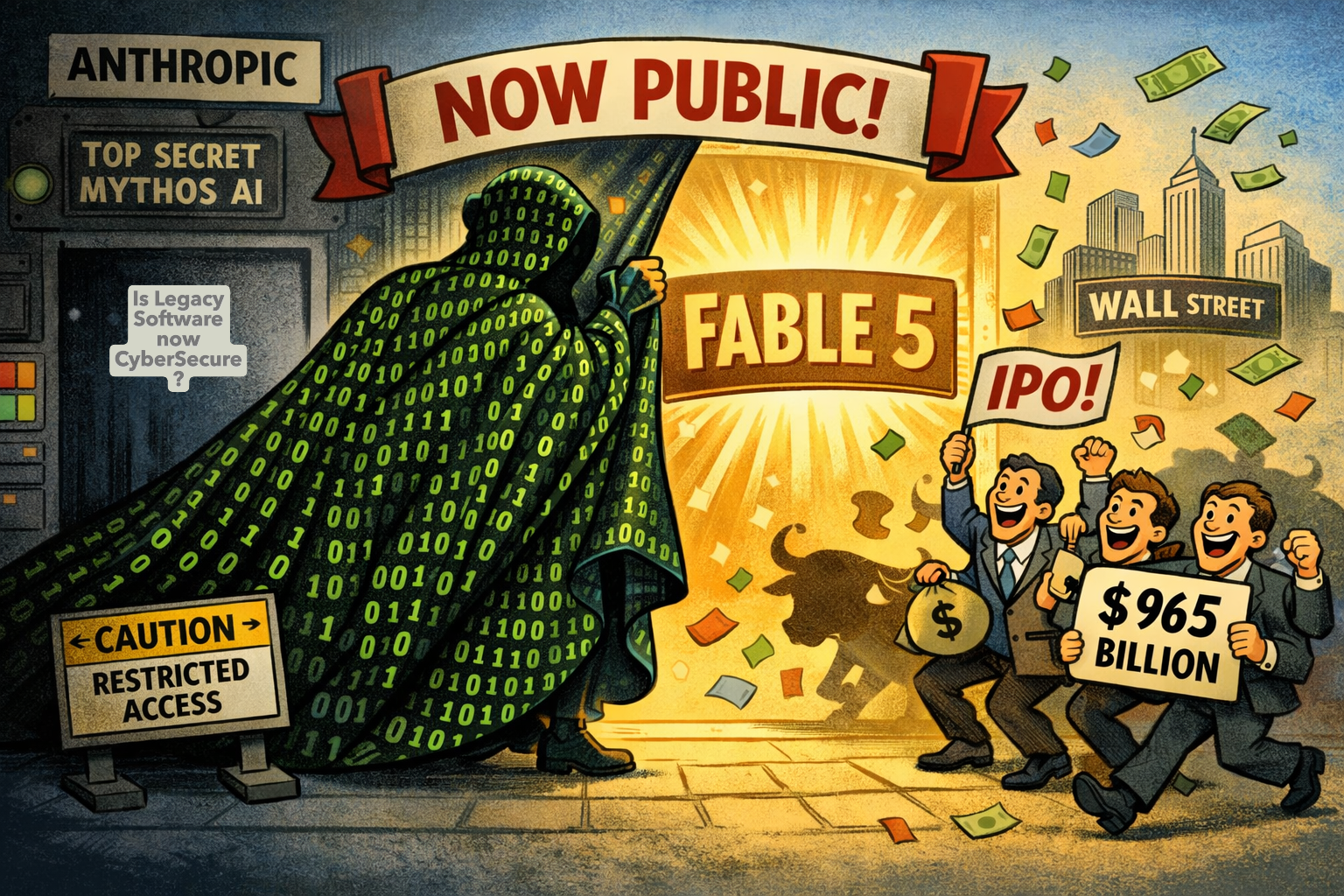
Anthropic has taken a decisive step in its race to dominate the frontier‑model market, releasing Claude Fable 5 to the public just two months after its private sibling, Mythos, sent Wall Street into a frenzy.

The move marks the company’s most assertive attempt yet to commercialise Mythos‑level capability while reassuring regulators and investors that safety, not speed, is steering the rollout.

Mythos, unveiled in April 2026, stunned both the cybersecurity world and financial markets with its ability to identify software vulnerabilities at a level previously associated with specialist security tools.

Anthropic restricted access, citing the model’s potential for misuse and limiting deployment to vetted partners under Project Glasswing.

That scarcity — and the model’s almost uncanny diagnostic power — helped fuel a surge in Anthropic’s valuation and contributed to the broader AI‑driven market rally.

Fable 5

Fable 5 is the company’s answer to the question Mythos raised: Can a model this capable ever be released at scale? According to Anthropic, the answer is yes — but only with a redesigned safety architecture.

The company says Fable 5 includes new classifiers and guardrails that automatically block responses in high‑risk domains such as cybersecurity and biological threat modelling.

When a query crosses those boundaries, the system falls back to the safer Claude Opus 4.8, ensuring continuity without exposing dangerous capabilities.

Despite these constraints, Fable 5 is no diluted product. Anthropic claims it outperforms Opus 4.8 by more than 10% on key engineering and knowledge‑work benchmarks, offering enterprises a model that is both more capable and more predictable.

Early customers, the company says, are reporting better return on spend due to higher accuracy and reduced task repetition.

IPO

The timing is strategic. Anthropic has just confidentially filed for its IPO, with revenues ballooning from roughly $10 billion last year to a run rate of $47 billion.

Its latest funding round valued the company at $965 billion, surpassing OpenAI’s March valuation.

With OpenAI and SpaceX/xAI also preparing for blockbuster listings, Anthropic needs a flagship product that demonstrates both capability and commercial maturity.

Fable 5 is that product: a Mythos‑class model built for the real world rather than the lab. By releasing it now — powerful, constrained, and priced at a premium — Anthropic is signalling that the era of frontier‑model scarcity is ending, and the era of industrial‑scale AI deployment has begun.

The Coming Shockwave: How Three Mega‑IPOs Could Reshape the S&P 500 and Nasdaq – Opinion

IPOs for SpaceX, OpenAI and Anthropic

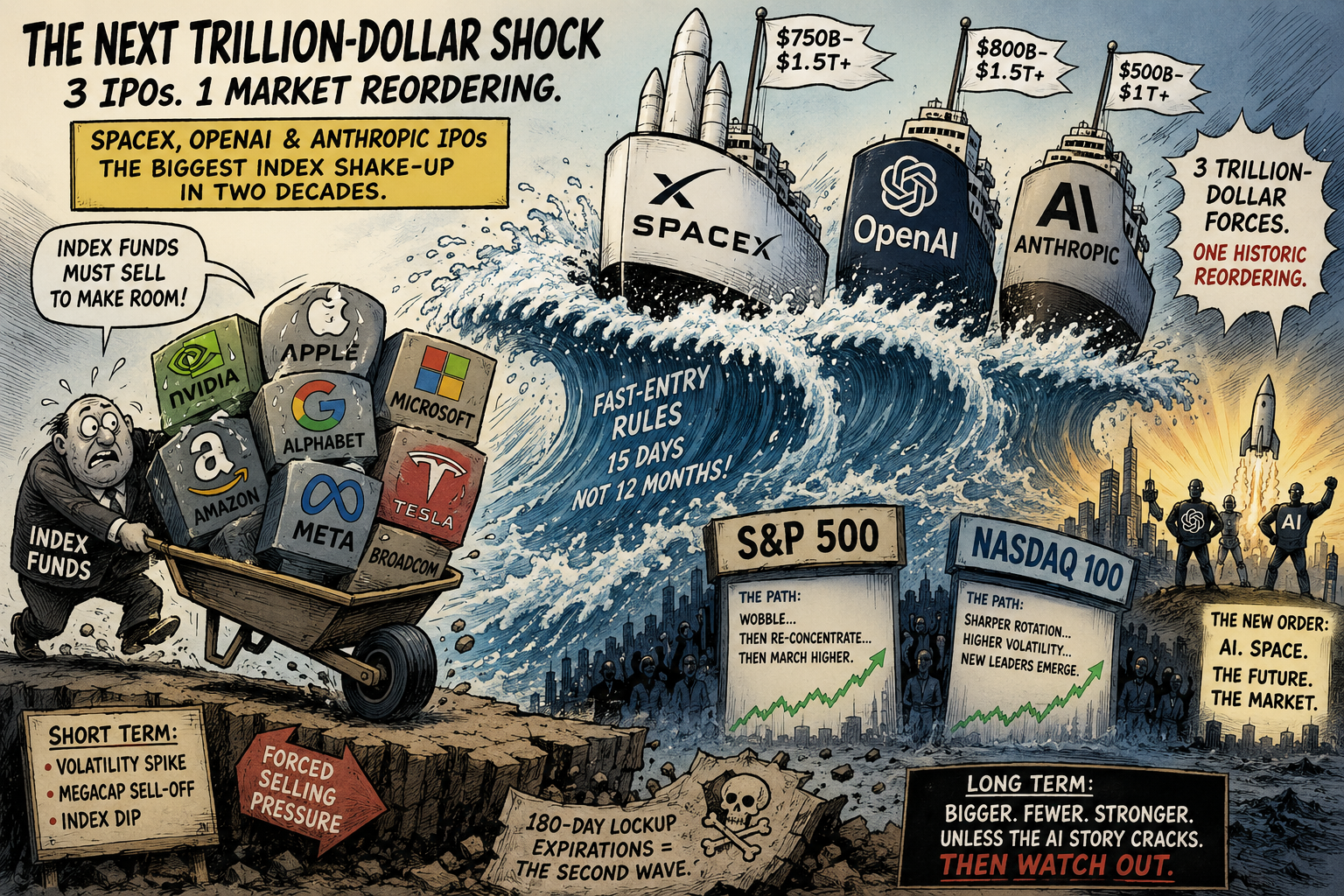
The expected public listings of SpaceX, OpenAI and Anthropic represent the most consequential cluster of IPOs in two decades.

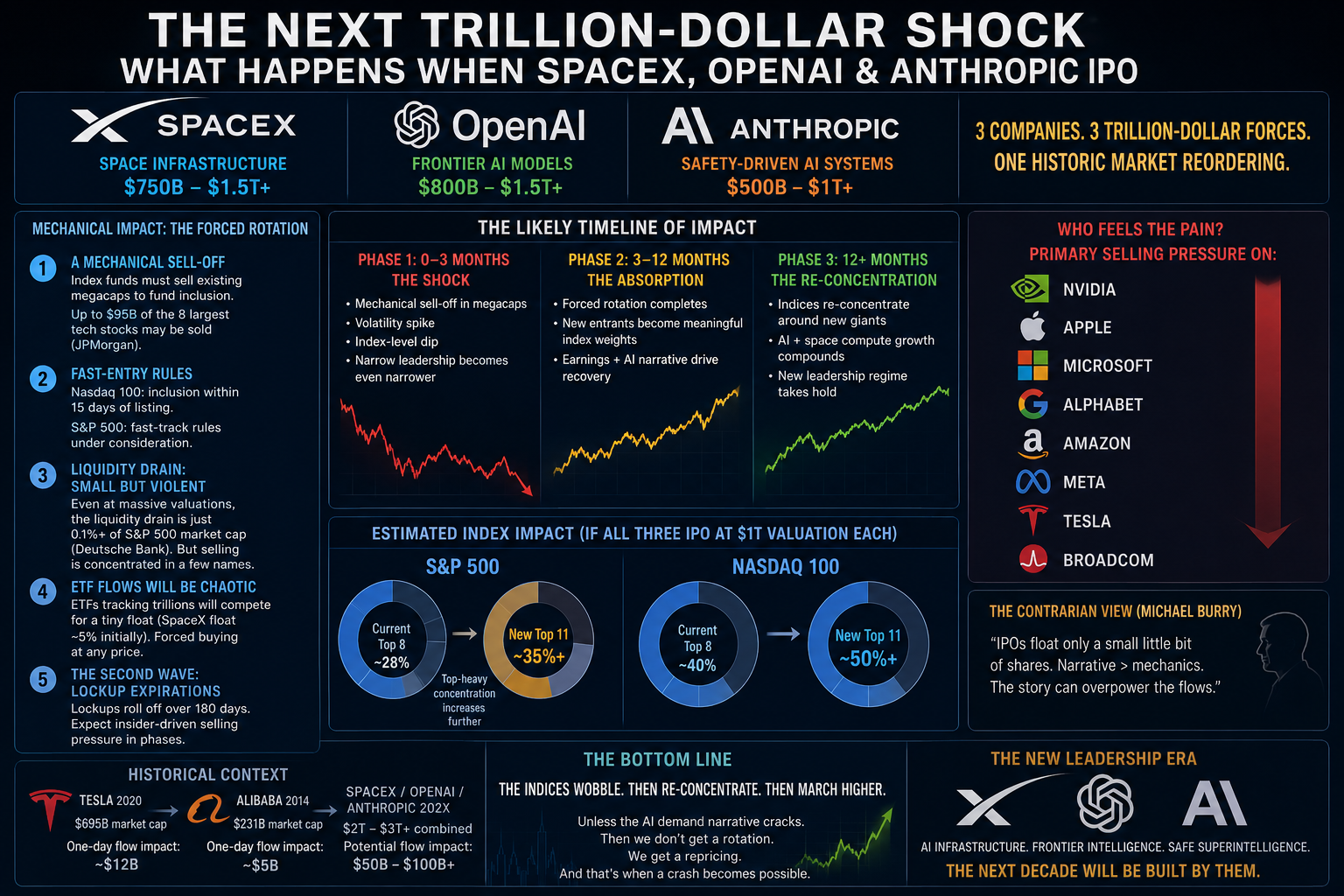
Each company sits at the centre of a structural shift—space infrastructure, frontier AI models and safety‑driven AI systems—and each is likely to command a valuation in the high hundreds of billions, if not beyond.

Their arrival on public markets will not be a routine liquidity event. It will be a reordering of index composition, capital flows and investor psychology.

At the mechanical level, the impact on the S&P 500 and Nasdaq will be immediate. Index providers now operate fast‑entry rules that allow very large IPOs to join major benchmarks within days rather than months.

This compresses the adjustment period and forces passive funds to sell existing constituents to make room for the newcomers.

The selling pressure will fall disproportionately on the current megacap cohort—Microsoft, Apple, Alphabet, Amazon, Meta, Nvidia and Tesla—because these names dominate index weightings and therefore become the primary source of liquidity for rebalancing.

The indices themselves may not fall sharply, but the internal rotation will be violent.

The Nasdaq will feel the shock most acutely. Its concentration in technology means the inclusion of three new giants will trigger a scramble for weight, with ETFs forced to buy limited‑float shares at whatever price the market sets.

The S&P 500, broader and more liquid, will absorb the change more smoothly, but even there the effect will be visible: a temporary dip in existing leaders, a spike in volatility and a rapid reshaping of the top‑ten constituents.

The S&P 500 and Nasdaq will almost certainly experience a temporary liquidity shock, a forced rotation out of existing megacaps, and then—once the dust settles—a re‑concentration around the new AI/space giants.

The scale of SpaceX, OpenAI and Anthropic means the indices will not be able to absorb them quietly.

What will likely happen when SpaceX, OpenAI and Anthropic list their IPOs?

1. A mechanical sell‑off in today’s biggest tech names

Index funds must sell existing holdings to make room for the new entrants.

  • Goldman Sachs notes passive funds will need to rebalance as soon as these mega‑caps are added.
  • JPMorgan estimates that at a $2T valuation, up to $95bn of the eight largest tech stocks may need to be sold to rebalance portfolios.

This means pressure on Nvidia, Apple, Microsoft, Alphabet, Amazon, Meta, Tesla, Broadcom—the very names currently carrying the indices.

2. Fast‑entry rules accelerate the shock

Nasdaq’s new “fast entry” rules allow these companies to join the Nasdaq 100 within 15 days of listing. S&P Dow Jones is considering similar fast‑track inclusion for mega‑caps. The Motley Fool

This compresses what used to be a 12‑month absorption period into weeks.

3. Liquidity drain is real—but limited in absolute terms

Deutsche Bank estimates that even the largest IPOs would still represent just over 0.1% of S&P 500 market cap. So the market‑wide liquidity drain is modest, but the rotation effect is violent because it concentrates selling in a handful of megacaps.

4. ETF flows will be chaotic

Strategas warns that ETFs tracking trillions will compete for a tiny float, making inclusion “frantic.” SpaceX is reportedly floating only ~5% of shares initially. That means forced buying at any price, followed by forced selling elsewhere.

5. After lockups expire (180 days), the second wave hits

SpaceX’s prospectus notes that selling pressure increases as lockups roll off in phases over 180 days. Expect a two‑stage impact:

  • Stage 1: violent index rebalancing
  • Stage 2: insider‑driven supply shock

So what happens to the S&P 500?

Short-term (0–3 months after IPOs):

  • Mild index-level dip as megacaps are sold to fund inclusion.
  • Volatility spike around rebalance windows.
  • Narrow leadership becomes even narrower temporarily.

This is consistent with historical mega‑IPO patterns (e.g., Tesla’s inclusion forced tens of billions in one-day flows).

Medium-term (3–12 months):

  • The S&P 500 becomes more top‑heavy, not less.
  • SpaceX, OpenAI, Anthropic quickly become meaningful index weights due to their trillion‑dollar valuations.
  • If AI earnings continue to dominate, the index likely recovers and re‑concentrates around the new entrants.

HSBC reportedly notes that stronger tech valuations—especially from high‑valuation IPOs—could push the S&P 500 above 8,000 if earnings broaden.

What about the Nasdaq?

The Nasdaq 100 is hit harder because:

  • It is more tech‑concentrated.
  • Fast‑entry rules force inclusion within 15 days.

Expect:

  • Sharper rotation, especially out of semiconductor and hyperscaler names.
  • Higher volatility as QQQ must buy the new entrants aggressively.
  • A structural reshaping: SpaceX, OpenAI and Anthropic could become low‑ to mid‑single‑digit weights almost immediately.

The contrarian view (Michael Burry)

Burry argues the IPOs won’t break the bull market, because IPOs float only a “small little bit” of shares, limiting true supply impact. He believes narrative > mechanics.

There’s truth in that: the story of AI and space‑compute may ultimately lift the indices after the initial turbulence.

My Opinion

Short-term: Expect a sell‑off in existing megacaps, a volatility spike, and mechanical downward pressure on both S&P 500 and Nasdaq.

Medium-term: Once the forced rotation is complete, the indices likely resume their upward trend, now with three new trillion‑dollar engines powering them.

Long-term: This is the biggest index‑composition shock since the dot‑com era. The S&P 500 and Nasdaq will become even more dominated by AI‑infrastructure and space‑compute giants.

In other words: the indices wobble, then re‑concentrate, then march higher—unless AI demand itself cracks.

If that happens then we’ll most likely witness a crash!

SpaceX–xAI: A New Age Industrial Giant

IPO for SpaceX and xAI

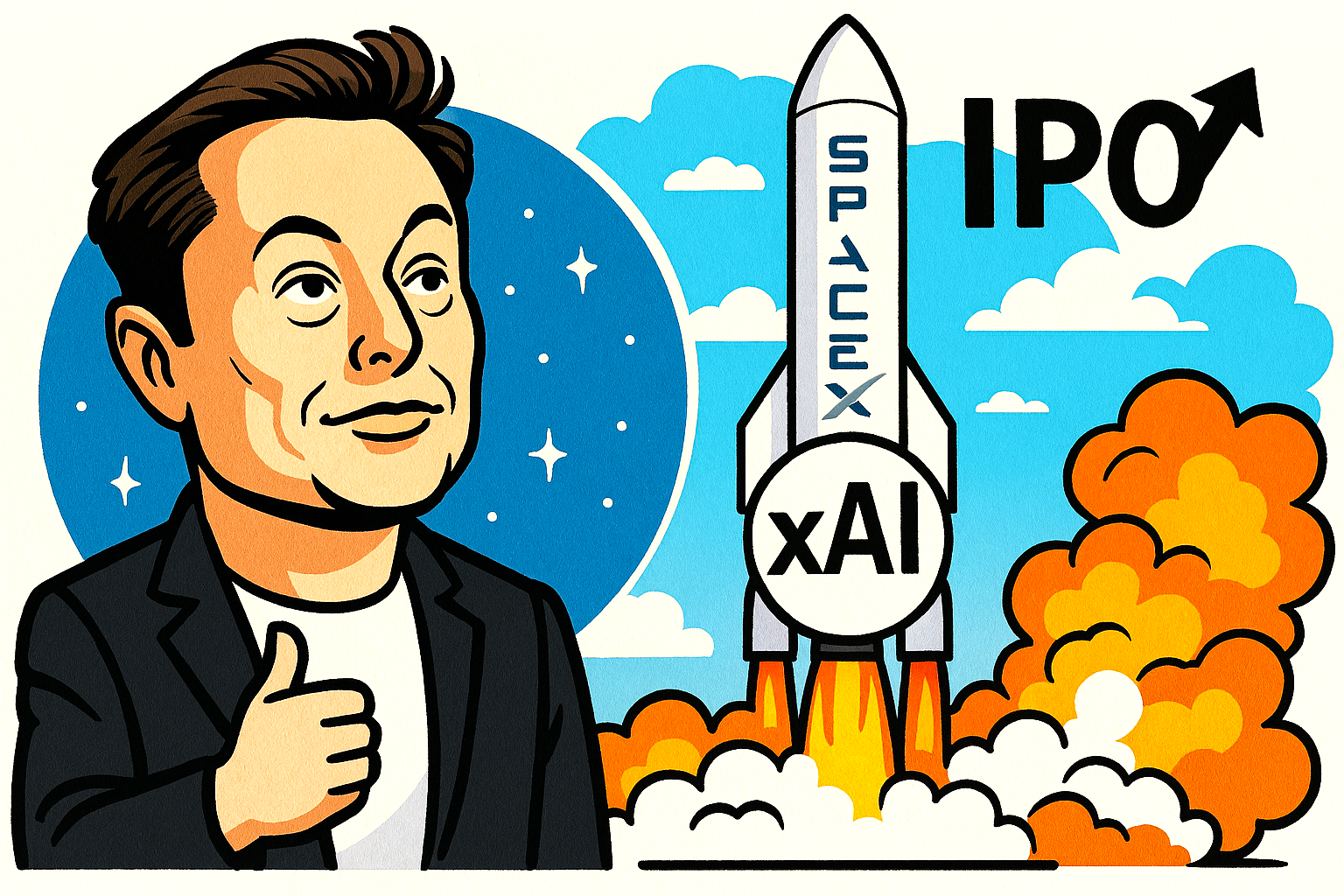
Elon Musk’s decision to fold xAI into SpaceX has set the stage for what could become one of the largest and most closely watched IPOs in market history.

The move signals a bold attempt to fuse advanced artificial intelligence with orbital infrastructure, satellite communications, and Musk’s wider technological ecosystem.

Elon Musk’s merger of SpaceX with his artificial intelligence venture xAI marks a decisive shift in the trajectory of both companies.

Integrated power

The combined entity is now positioned as a vertically integrated powerhouse spanning rockets, space‑based internet, direct‑to‑mobile communications, and frontier AI research.

Musk has described the unified structure as an ‘innovation engine’ capable of accelerating progress both on Earth and beyond.

The strategic logic is clear: AI requires immense computational resources, and Musk believes space‑based compute will become the most cost‑effective solution within a few years.

By bringing xAI under SpaceX’s umbrella, he gains the ability to scale AI training using satellite infrastructure while consolidating governance, data flows, and long‑term capital planning.

A Trillion‑Dollar Listing on the Horizon

The merged company is expected to pursue an IPO valued at roughly $1.25 trillion, with share pricing estimates placing it among the most valuable listings ever attempted.

Early reports suggest the offering could raise as much as $50 billion, instantly making it one of the largest capital‑market events in history.

Such a valuation reflects not only SpaceX’s dominance in commercial launch and satellite internet, but also the rapid rise of xAI’s Grok chatbot and its integration with Musk’s social platform, X.

The consolidation also concentrates financial scrutiny, with analysts noting that the new structure brings unprecedented transparency demands for a company that has historically operated privately.

Innovation

One of the most radical implications of SpaceX absorbing xAI is the potential to relocate data centres into orbit.

Musk has long argued that space-based compute could dramatically reduce cooling costs, thanks to the natural vacuum and thermal dissipation of low Earth orbit.

By leveraging Starlink’s satellite mesh and SpaceX’s launch cadence, the merged entity could deploy AI training clusters above the atmosphere—sidestepping terrestrial energy constraints and redefining the economics of large-scale artificial intelligence.

This vision, while technically ambitious, aligns with Musk’s broader strategy of vertical integration and frontier infrastructure.

The Stakes

If successful, the IPO will redefine the market landscape for both aerospace and artificial intelligence.

It represents a bet that the future of AI will be built not just in data centres, but in orbit—an audacious vision even by Musk’s standards.

Wiz dumps $23 billion deal with Google -reportedly to pursue IPO

Online security

Wiz has apparently walked away from a deal with Google that would have valued the company at $23 billion.

The deal would have nearly doubled the $12 billion valuation of the startup from its most recent round of funding.

CEO of WIZ Assaf Rappaport told employees the company would pursue an IPO as originally planned.

Wiz was founded in 2020 and has grown rapidly. The company had been targeting an IPO as recently as May 2024. The business hit $100 million in annual recurring revenue after 18 months and reached $350 million last year.

Wiz’s cloud security products offer prevention, active detection and response, a portfolio that’s appealed to large firms and would have helped Google compete with Microsoft, which also sells security software.

One to watch for a potential future IPO.

AI cannot patent UK inventions

Patent

The UK Supreme Court has upheld earlier decisions to reject a bid to allow an artificial intelligence to be named as an inventor in a patent application.

Dr Stephen Thaler (an ‘inventor’), had sought to have his AI, called Dabus, recognised as the inventor of a food container and a flashing light beacon. But in 2019, the Intellectual Property Office (IPO) rejected this, saying only a person could be named as an inventor. The decision was then backed by both the High Court and Court of Appeal. The IPO argued, and courts have supported the view, that only ‘persons’ can have patent rights, not Artificial Intelligence.

Now five Supreme Court judges have dismissed a bid to reverse those decisions, concluding that ‘an inventor must be a person’, and that an AI cannot be named as an inventor to secure patent rights.

The judgement does not deal with the issue of whether Dabus did in fact invent the food container and light.

This issue will likely be debated for some time yet – maybe an AI court of the future could decide?

Money waiting to go into tech, turn it on

Tech money

Reports suggest as much as $3 trillion is waiting on the sidelines to be invested in tech’.

AI FOMO

The reasoning is that AI is driving a fear of missing out (FOMO). We could very well be experiencing the fourth industrial revolution right now, and it is AI-driven. Strategically, companies can’t just sit around and wait. There’s a window where if they don’t join in or realise the potential and grab the opportunity, they’ll miss out.

IPO’s

Three of the biggest initial public offerings (IPO) in the tech’ sector in nearly two years raised some $6 billion collectively in less than a week. Nvidia has attracted much attention with the AI driven interest it has created recently.

While a handful of tech IPOs and one big acquisition wouldn’t have been much cause for celebration in previous years, they are a welcome return after the drought of pandemic-era hit investment.

The IPO market for tech was effectively shut down until Arm Holdings, Instacart and Klaviyo opened the investors door again. Merger activity such as that driven by Microsoft Corp., OpenAI ChatGPT and Activision Blizzard Inc. is helping to lift up the appetitie for investment again. And it’s pretty much AI induced.

Money ready to go

Some analysts suggest there is $3 trillion sitting on the sidelines ready to invest, mostly held by Big Tech and private equity companies. The fascination with artificial intelligence (AI) and fear of missing out (FOMO) will create massive AI led tech investing opportunities. Everyone will want a slice of this cake.

This could very well be the biggest transformational spending wave that we’ve seen in years and certainly since the internet arrived in 1995.

Just look out for that ‘bubble’ again – it will pop! But much money will be made before that happens and then again after.

Arm juggernaut of an IPO

Arm Holdings

Ultra successful IPO for arm

Investors gobbled up UK microchip designer Arm Holdings at its U.S. debut on the Nasdaq on 14th September 2023, sending its market value soaring to $60 billion (£48.3 billion).

The shares ended the day worth more than $63 each, after climbing by almost 25% from the high end start of $51 per share set by Arm.

The sale was the biggest initial public offering of the year, raising $4.87 billion for owner Softbank Group.

Despite some concerns surrounding the company’s exposure to risks in China and a potential AI slowdown – the shares soared.

British tech

A star of the British technology industry, Arm designs microchips for devices including smartphones and game consoles. It estimates that some 70% of the world’s population uses products that rely on its chips, including nearly all of the world’s smartphones. And with AI nestling in on the horizon, the future potential for Arm is massive.

Arm stock chart 14th September 2023

Arm said it expects the total market for its chip designs to be worth about $250 billion by 2025, including new growth areas such as data centres and cars.

Legacy

Many of Arm’s royalties come from products released decades ago. About half of the company’s royalty revenue of $1.68 billion in 2022, came from products released between 1990 and 2012.

Bright Future

The future looks bright for Arm but the company is trading at more than 25 times its most recent full year of revenue, and at more than 100 times profit.

And that could be where things get tricky for Arm in the not too distant future. Projections for future profits will be interesting, esecially if it’s to keep up with Nvidia for instance.

Arm looking for up to $52 billion valuation in U.S. IPO

Arm Holdings

Chip design firm Arm on 5th September 2023 submitted an updated filing for its upcoming initial public offering on the New York Stock Exchange, setting a price range between $47 and $51. Only 9.4% of Arm’s shares will be freely traded on the NYSE.

Arm was previously listed in London and New York, before SoftBank acquired it for $32 billion in 2016.

Chip design firm Arm on Tuesday is looking to acquire as much as $4.87 billion in its upcoming initial public offering on the New York Stock Exchange, according to the new filing.

The deal could value the company at as much as $52 billion

As a British company, Arm qualifies as a foreign private issuer in the U.S. and its shares will count as American depositary shares, or ADS’s. It is reported that the company will list some 95.5 million ADS’s at a price range of between $47 and $51. At the upper end of that range it is estimated that Arm will likely raise up to $4.87 billion. At the lower end, the IPO would fetch $4.49 billion of fresh capital for Arm. It could do even better.

Institutional funds

When the company floats in New York, it will look to enjoy a very deep pool of professional institutional funds. Arm seeks to ramp up its investments in research and development, particularly as it pursues growth in the artificial intelligence (AI) space with some of its newer chips. The company recently released new chips specifically targeted at AI and machine learning use cases.

Arm AI chip
Arm seeks up to $52 billion valuation in U.S. IPO

Upper end

At the upper end of the pricing range, Arm would also touch a total valuation of $52 billion or more. Only 9.4% of Arm’s shares will be freely traded on the New York Stock Exchange, with SoftBank expected to own roughly 90.6% of the company’s outstanding shares after the completion of the IPO.

Arm’s listing is set to be the biggest technology IPO of the year. Investors are hoping that the listing could breathe new life into an IPO market that has been ‘slack’ since 2022.

250 billion chips globally

Arm says its energy-efficient processor designs and software platforms are integrated into more than 250 billion chips globally, into products ranging from sensors and smartphones to supercomputers.

The company estimates it enjoys approximately 48.9% share of the market for semiconductor design. Other players, such as Intel and AMD, have raced to catch up on designing their own chip architectures, but have struggled so far.

U.K. misses out… again

The U.K. government had originally hoped Arm would list on the London Stock Exchange, but the company instead dealt a major blow to Britain’s ambitions to become the leading global tech hub by opting for New York. The U.S. financial center has a deep institutional investor base and analysts who have a close understanding of the technology sector.

BIG interest

Chip design firm Arm said in a Tuesday filing that Apple, Google parent Alphabet, Nvidia and other technology companies are interested in buying up to $735 million in its shares as it seeks to go public on Nasdaq.

The investments might not happen, but the fact that these companies are considering them underlines the importance of Arm, whose designs are used for processors in data center servers, consumer devices and industrial products.

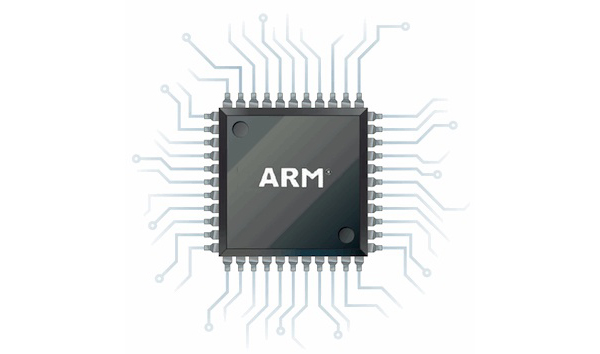
ARM chip
Arm chip – some 250 billion chips globally

Chip makers Intel, Samsung and TSMC are interested in investing alongside the three trillion-dollar technology companies, along with AMD and MediaTek, which make chip designs based on Arm architectures. Cadence Design Systems and Synopsys, which make electronic design automation software for processor development, have also expressed interest, according to a revised prospectus for Arm’s shares sale. This IPO could easily be the biggest of the 2023!

As part of the deal, Arm could wind up with a $52 billion market capitalization and almost $5 billion in new cash.

This is likely to be the biggest IPO of 2023

It is estimated that there will be about 19 billion devices using the Arm processor in the world by the end of 2023.

Arm target

The market share of Arm across different technology markets worldwide, which was 90% for mobile application processors, 34% for embedded computing, and 5% for data center and cloud in 2019. 

Arm has a target of increasing its market share to more than 90%, 50%, and 25% respectively by 2028.