Why Are Markets Still Rising Despite Ongoing Bad World News?

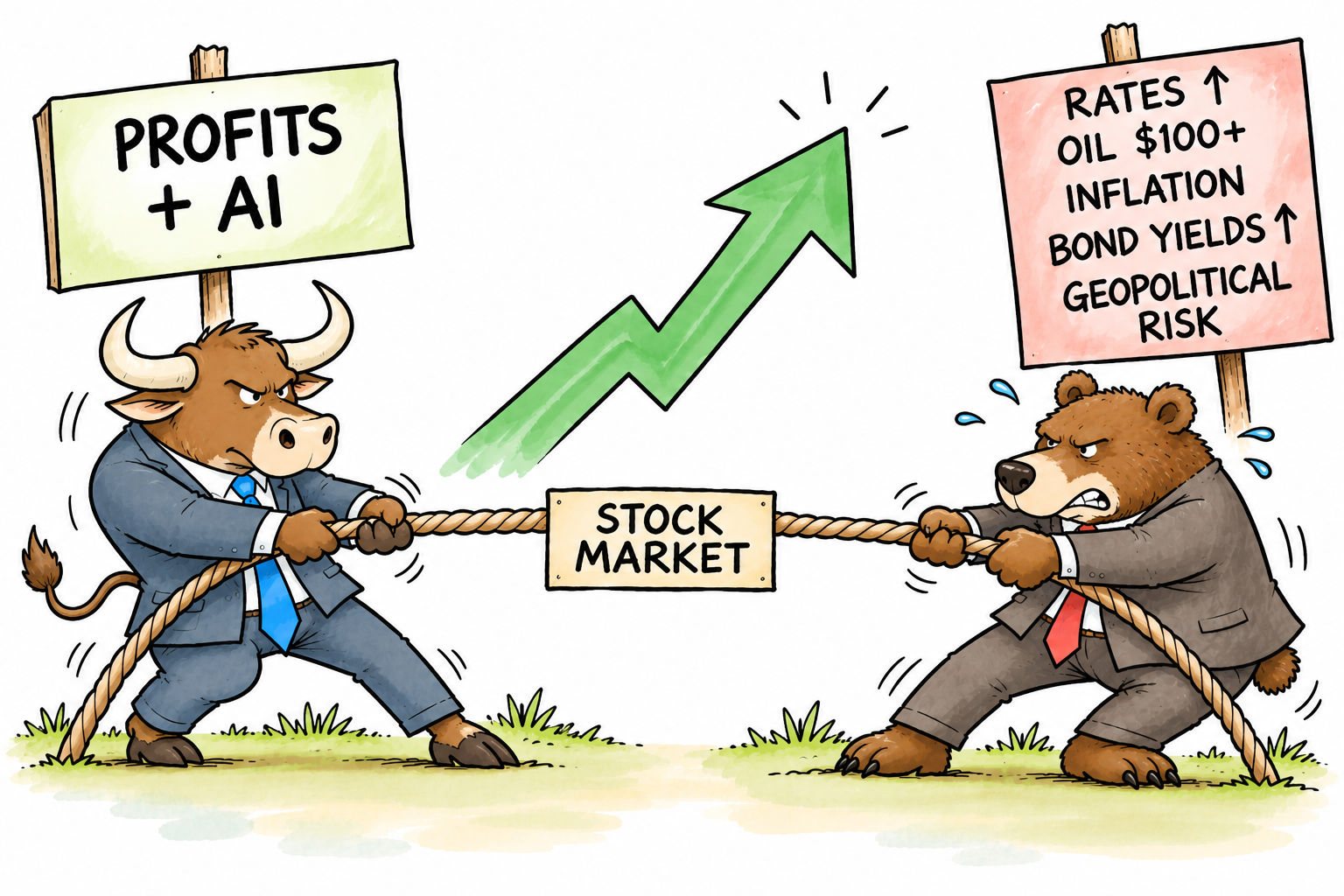
Stock market tug-o-war

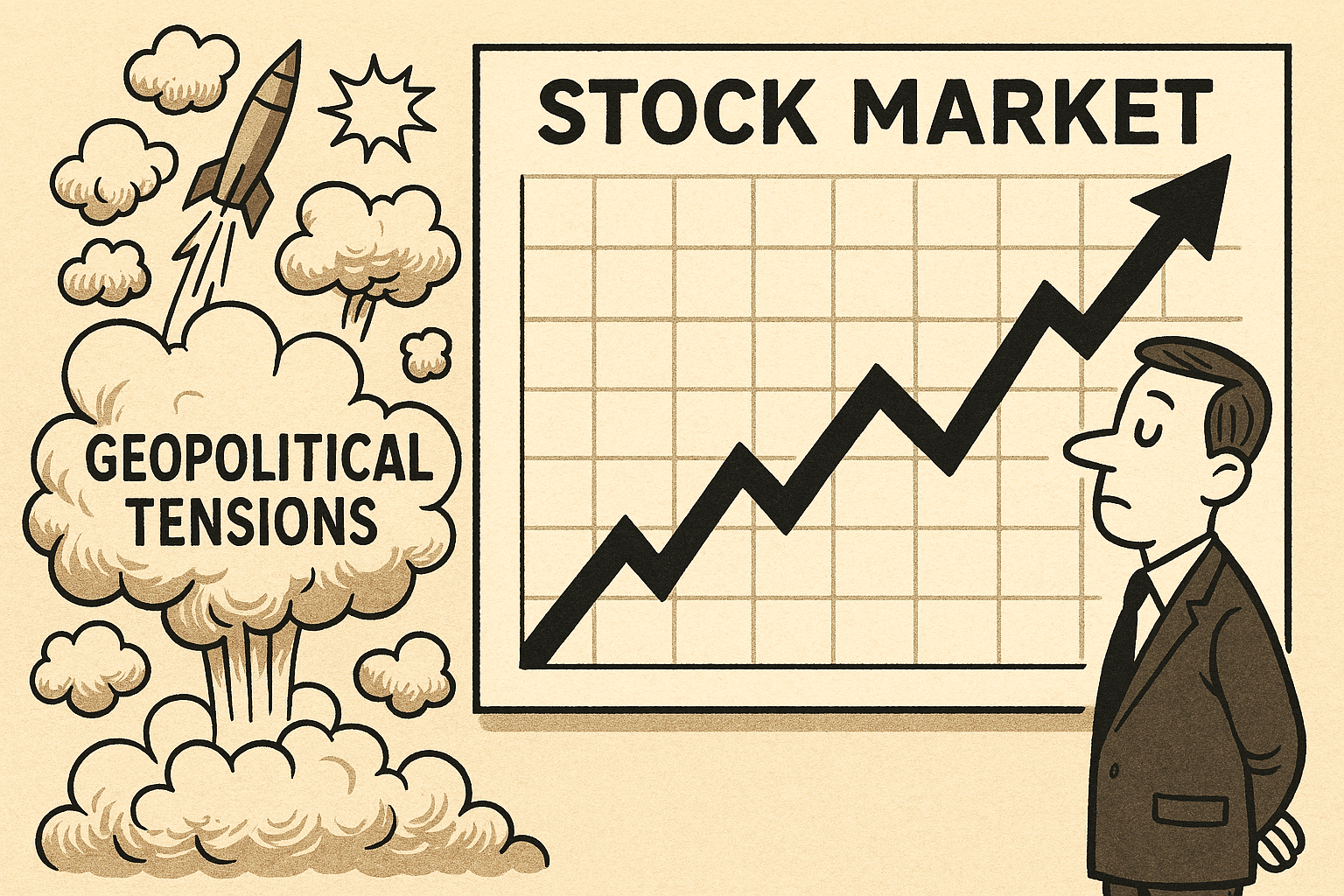
Stock markets are continuing to climb despite a growing list of concerns that would normally be expected to unsettle investors.

Interest rates are higher, government bond yields have risen, oil prices are elevated and inflation remains a concern. Geopolitical tensions are also creating uncertainty. Tariffs still on the agenda. Global debt rising and rogue AI concerns.

Yet investors continue to buy shares, particularly in the United States.

So why?

One important reason is corporate earnings. Investors appear willing to tolerate higher interest rates and expensive valuations while they believe company profits will continue to grow.

Large technology companies, in particular, remain at the centre of this optimism, with huge investment in artificial intelligence fuelling expectations of strong future earnings.

Buying dips

Another factor is the willingness of investors to buy market dips. When share prices fall, investors who remain confident about the longer-term outlook see an opportunity to buy at cheaper prices.

This can create a self-reinforcing cycle: markets fall, buyers move in, confidence returns and prices rise again.

There is also a belief that the economy remains sufficiently resilient to withstand higher borrowing costs and expensive energy.

Bad news is therefore being viewed as a problem, but not necessarily one capable of seriously damaging corporate profits.

However, this resilience could eventually be tested.

Earnings faith

The market is currently placing considerable faith in continued earnings growth and the economic benefits of artificial intelligence. If either begins to disappoint, investors could reassess the high valuations attached to many shares.

Higher oil prices could also keep inflation elevated, forcing interest rates to remain higher for longer. Rising bond yields would then provide investors with an increasingly attractive alternative to shares.

Bull Bear

For now, the bulls remain in control of market prices, even though the bears have plenty of arguments on their side.

The important question is whether company profits can continue to justify today’s share prices.

If they can, markets may continue climbing despite the bad news. If they cannot, investors may suddenly start paying much closer attention to all those warning signs they have recently been ignoring.
The Market’s Coiled Spring: Why Ultra‑Tight Ranges Rarely End Quietly

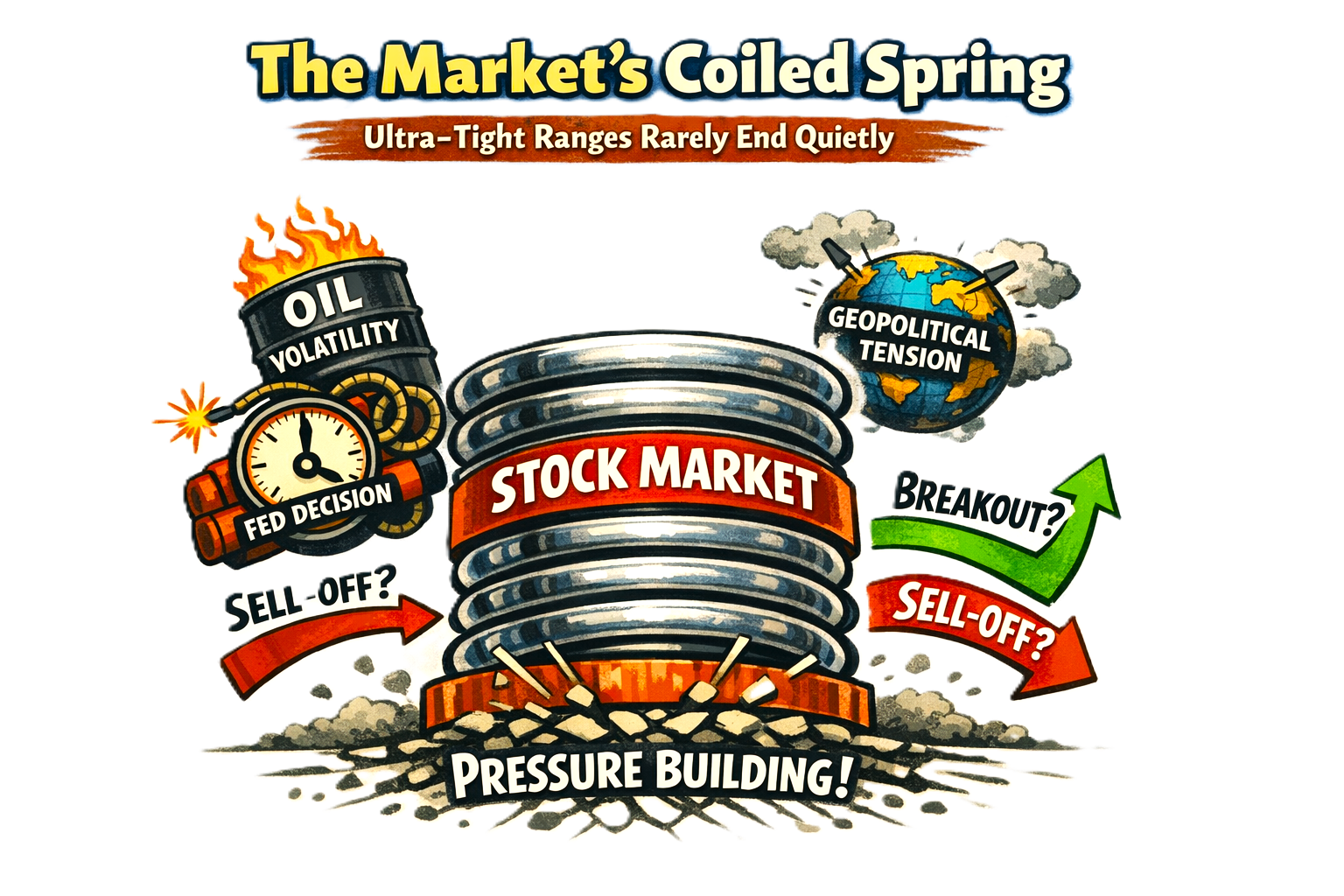
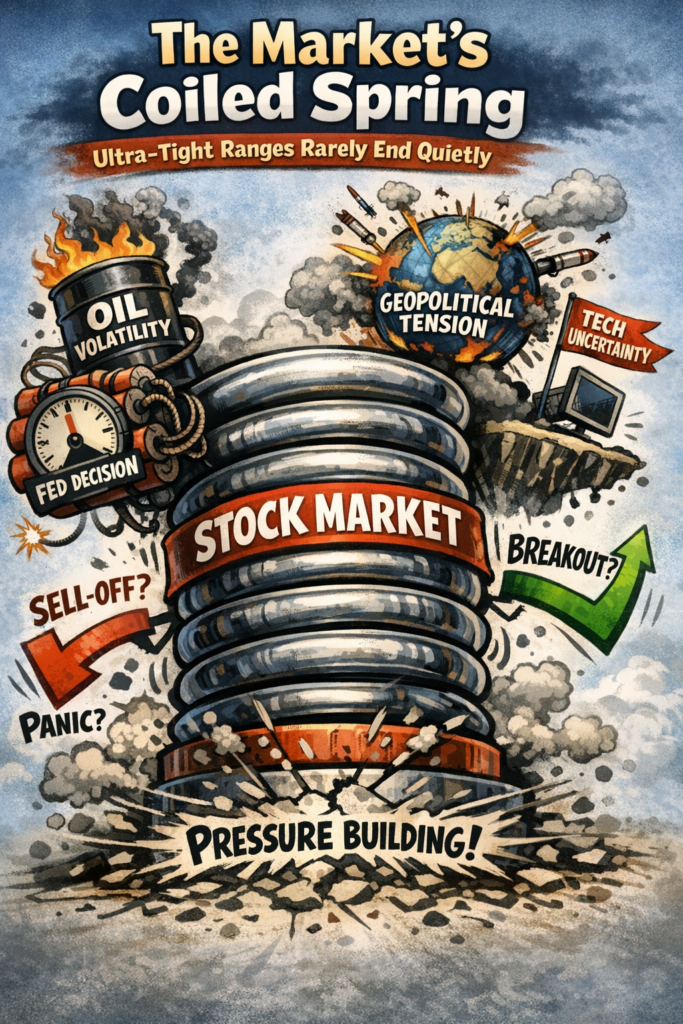
Coiled spring - pure stock market energy

Markets rarely sit still without reason. When they do — as they have in recent sessions, grinding sideways in an ultra‑tight range — it signals not calm but compression.

Price action becomes like a coiled spring: energy building, tension rising, and traders waiting for the moment when restraint snaps into motion.

This week’s narrow trading bands reflect a market holding its breath. Geopolitical tension in the Middle East, oil volatility, and a Federal Reserve decision all loom over investors, yet equities have refused to break down.

Futures are edging higher, European indices are opening firmer, and even the tech wobble — with Nvidia’s muted reaction to its latest showcase — hasn’t derailed broader sentiment

Tight range – a waiting game.

Historically, such tight ranges rarely resolve with a whimper. When volatility is suppressed for too long, the eventual breakout tends to be sharp and directional. The question, of course, is which way.

Right now, the evidence suggests upward. Markets have absorbed war‑driven oil swings, shrugged off hedge‑fund losses, and continued to find buyers on dips.

Breadth is stabilising, and risk appetite — surprisingly resilient given the backdrop — is creeping back into European and Asian sessions.

That doesn’t guarantee a bullish surge, but it does suggest the path of least resistance is higher.

Fed tone

If the Fed avoids surprising investors and signals comfort with the current trajectory, the spring is more likely to uncoil to the upside.

A dovish‑leaning tone could ignite a breakout as sidelined capital rushes back into equities. Conversely, a hawkish shock would release the same stored energy — but violently downward.

The market is coiled. The catalyst is imminent. And when the range finally breaks, it won’t be subtle.

You know, it almost doesn’t matter what disasters are ongoing in the world – the stock market just wants to win and go up!

Just how bad does it have to be before the stock market corrects? And what will be the catalyst to make that happen?

Debt, credit concerns, geopolitical tension, political scandal, Epstein, a rogue nuclear attack, AI failure, war or just another Trump tariff scenario?

Who knows? And does anybody really care as long as ‘making money’ isn’t interrupted.

Why are stock markets utterly unfazed by escalating geopolitical tensions throughout our world?

Markets unfazed by geopolitical tensions

For decades, geopolitical flare‑ups reliably rattled global markets. A coup, a missile test, a diplomatic rupture, an oil embargo or even the capture of a ‘sovereign state leader’ — any of these could send indices tumbling.

Yet today, even as governments threaten military action, regimes collapse, and global alliances wobble, equity markets barely blink. The question is no longer why markets panic, but why they don’t.

So why?

Part of the answer lies in the way modern markets interpret risk. Investors have become highly selective about which geopolitical events they consider economically meaningful.

As prominent news outlets have recently reported, even dramatic developments — from the overthrow of Venezuela’s government to threats of force against Iran — have coincided with rising equity indices.

Markets are not ignoring the headlines; they are discounting their economic relevance.

This shift is reinforced by a decade of ultra‑loose monetary policy. When central banks repeatedly step in to cushion shocks, investors learn that sell‑offs are opportunities, not warnings.

The ‘central bank put’ has become a psychological anchor. Even when geopolitical tensions escalate, the expectation of policy support dampens volatility.

Another factor is the professionalisation and algorithmic nature of modern trading. Quant* models and automated strategies respond to data, not drama.

IMF research

Research from the IMF highlights that geopolitical risks are difficult to price because they are rare, ambiguous, and often short‑lived.

When the economic channel is unclear — no immediate disruption to trade, supply chains, or corporate earnings — models simply don’t react. Human traders, increasingly outnumbered, follow suit.

Desensitised

Markets have also become desensitised by repetition. The past decade has delivered a relentless stream of geopolitical shocks: trade wars, sanctions, cyberattacks, territorial disputes, and political upheavals.

Each time, markets dipped briefly and recovered quickly. This pattern has conditioned investors to assume resilience. As analysts note, markets move on expectations, not events themselves.

If the expected outcome is ‘contained’, the market response is muted.

Last point

Finally, global capital has become more concentrated in sectors insulated from geopolitical turbulence. Technology, healthcare, and consumer platforms dominate major indices.

Their earnings are less sensitive to regional conflict than the industrial and energy-heavy markets of previous eras.

None of this means geopolitics no longer matters. It means markets have raised the threshold for what counts as a genuine economic threat.

When that threshold is finally crossed — as history suggests it eventually will be — the complacency now embedded in asset prices may prove painfully expensive.

*Explainer – Quant

A quant model is essentially a mathematical engine built to understand, explain, or predict real‑world behaviour using numbers.

In finance, it’s the backbone of how analysts, traders, and risk teams turn messy market data into something structured, testable, and (ideally) predictive.