

China’s Dancing Robots – Clever – But Can They Actually do Anything Useful – Can they Make Money?

China’s humanoid robots have become remarkably good at grabbing attention. They can dance, perform kung-fu, box, run, jump and even execute backflips that would leave most humans reaching for an ice pack.

But there is a rather important question behind all the impressive videos: what can they actually do that somebody is prepared to pay for?

The answer is increasingly encouraging — although it is considerably less glamorous than kung-fu.

The robots are coming

Chinese humanoid robots are already beginning to move into factories, warehouses and other controlled environments. Some are being used for repetitive tasks such as moving components, loading machines, inspecting products and sorting goods.

One Chinese electronics production trial reported a humanoid robot completing 2,283 operations during an eight-hour shift without errors.

Cup of tea anyone?

That is where the real commercial opportunity lies. A robot does not need to be ‘clever’ to make dinner, walk the dog and discuss the economy.

If it can reliably perform one repetitive task for hours without getting tired, injured or demanding a tea break, it can potentially save a company money.

China is particularly well placed to exploit this. It has enormous manufacturing capacity, established electronics and battery supply chains and a huge domestic industrial market.

The objective is increasingly to make humanoid robots cheaper and produce them in large numbers.

Unitree

There are signs that money is already being made. Unitree, one of China’s best-known robot manufacturers, reported 1.7 billion yuan in revenue in 2025 and was profitable. Its forthcoming Shanghai listing has attracted extraordinary investor enthusiasm.

But this does not mean the robot revolution has arrived in your kitchen.

The biggest problem is versatility. A robot can be extraordinarily impressive at one carefully prepared task while struggling with the chaos of an ordinary home.

Picking up identical components on a production line is one thing; finding a dropped sock under the sofa, loading a dishwasher and working out which cupboard contains the washing-up liquid is another.

That is why the immediate future is likely to involve robots as workers rather than robots as servants.

Work ethic

Factories, warehouses, logistics centres, hotels, shops and perhaps hospitals offer predictable environments where a machine can be trained to perform specific jobs.

Home robots will probably take longer because homes are messy, unpredictable and full of objects designed for humans rather than machines.

So, can China’s robots make money? Absolutely — but probably not because they can do backflips.

The backflips sell the dream. The boring eight-hour shift is where the business case is being tested.

And if Chinese manufacturers can make these machines cheap enough, reliable enough and useful enough, the robots really could become everywhere — not dancing on stage, but quietly doing the jobs nobody wants to do.

And the U.S.?

The U.S. is very much in the robot race, and in some respects it may be ahead of China — particularly in combining humanoid robots with advanced AI.

The interesting question is whether America can turn that technological lead into mass production and profitable businesses.

The leading U.S. names include Tesla and Optimus, Figure AI, Agility Robotics and Digit, and Apptronik with Apollo.

Apptronik, for example, raised more than $935 million in its latest funding round to scale Apollo, with investors including Google, Mercedes-Benz, John Deere and AT&T Ventures.

Agility’s Digit is probably one of the clearest examples of an American humanoid moving beyond the demonstration stage.

Digit has been used commercially in logistics, including work for GXO, where robots have been handling totes. Agility is now expanding its manufacturing and AI development capacity in the U.S.

Then there is Figure AI, which has attracted enormous investment and is concentrating on robots capable of learning a range of tasks rather than simply performing one pre-programmed movement.

Figure has demonstrated robots working in industrial environments, including BMW’s manufacturing operations.

Tesla

And, of course, there is Tesla’s Optimus. Tesla has something its rivals desperately want: enormous manufacturing experience, a huge AI operation and the potential ability to produce robots at scale.

Elon Musk’s ambition is considerably bigger than building a warehouse worker — he ultimately envisages a general-purpose robot that can work in factories and homes.

The fascinating difference is that China appears to have an advantage in manufacturing scale and cost, while the U.S. has extraordinary strengths in AI, software, robotics research and access to investment capital.

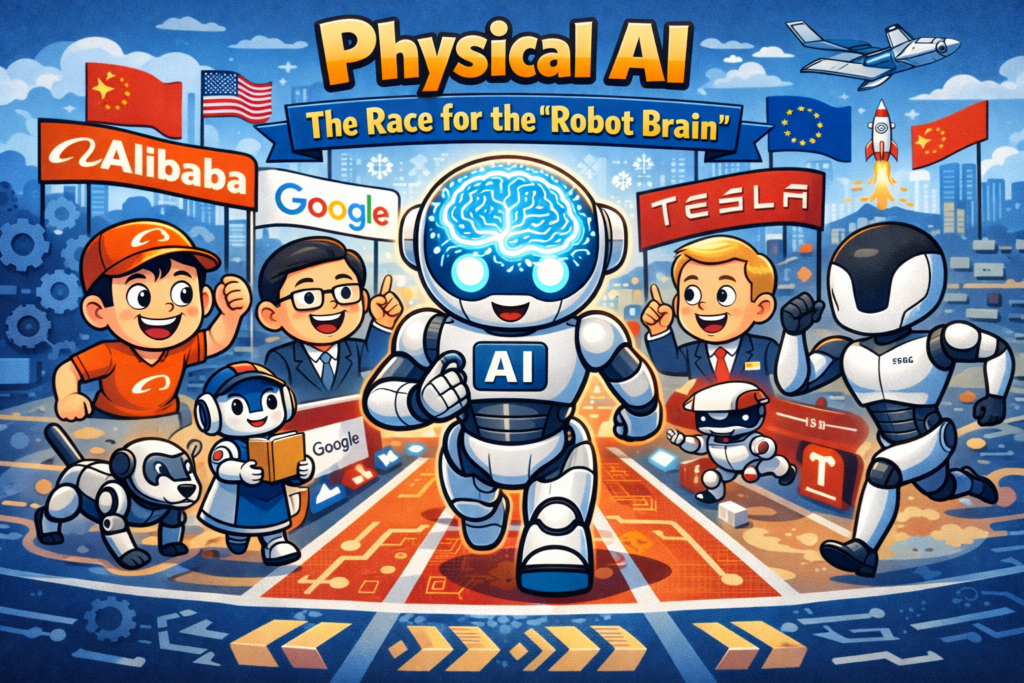
That makes this less like a traditional technology race and more like a three-way contest:

China: Can we manufacture millions cheaply?

America: Can we make them intelligent?

Everyone else: Can we work out how use and pay for them?

And there is an important reality check. The global humanoid industry is still tiny. Only around 13,000 humanoid robots were shipped worldwide in 2025, although forecasts suggest shipments could rise dramatically over the next decade.

So the U.S. is not losing the robot race. If anything, it is running a different race.

China may be trying to make humanoid robots into mass-produced industrial products.

America is trying to make them into AI-powered workers.

Whichever approach produces a robot that can reliably work an eight-hour shift — and costs less than employing a human to do the same job — could ultimately win.

The dancing and backflips are impressive.

But the real championship event is the payslip.
Alibaba Steps Into ‘Physical AI’ With New Robotics Model

AI robotics model

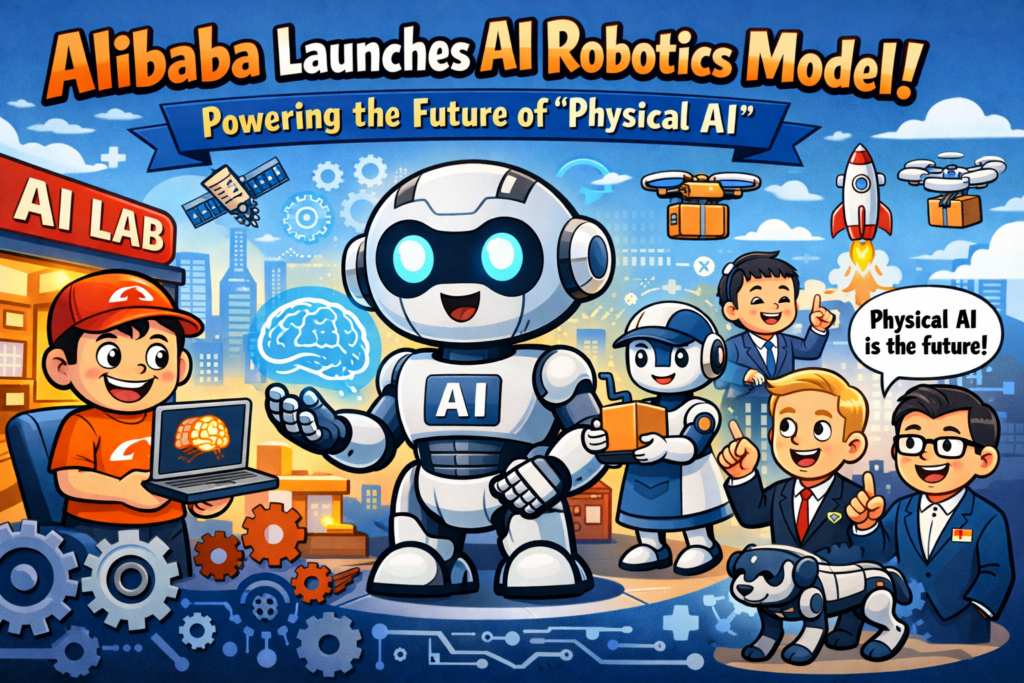
China’s Alibaba has taken a decisive step into the fast‑emerging field of ‘physical AI’ with the launch of a new foundation model designed specifically to power real‑world robots.

The model, known as RynnBrain*, marks one of the company’s most ambitious moves since restructuring its cloud and research divisions, and signals China’s intention to compete directly with the United States in embodied artificial intelligence.

Unlike traditional large language models, which operate entirely in digital environments, RynnBrain is built to interpret and act within the physical world.

It combines vision, language and spatial reasoning, enabling robots to recognise objects, understand their surroundings and plan multi‑step actions.

DAMO Acadamy

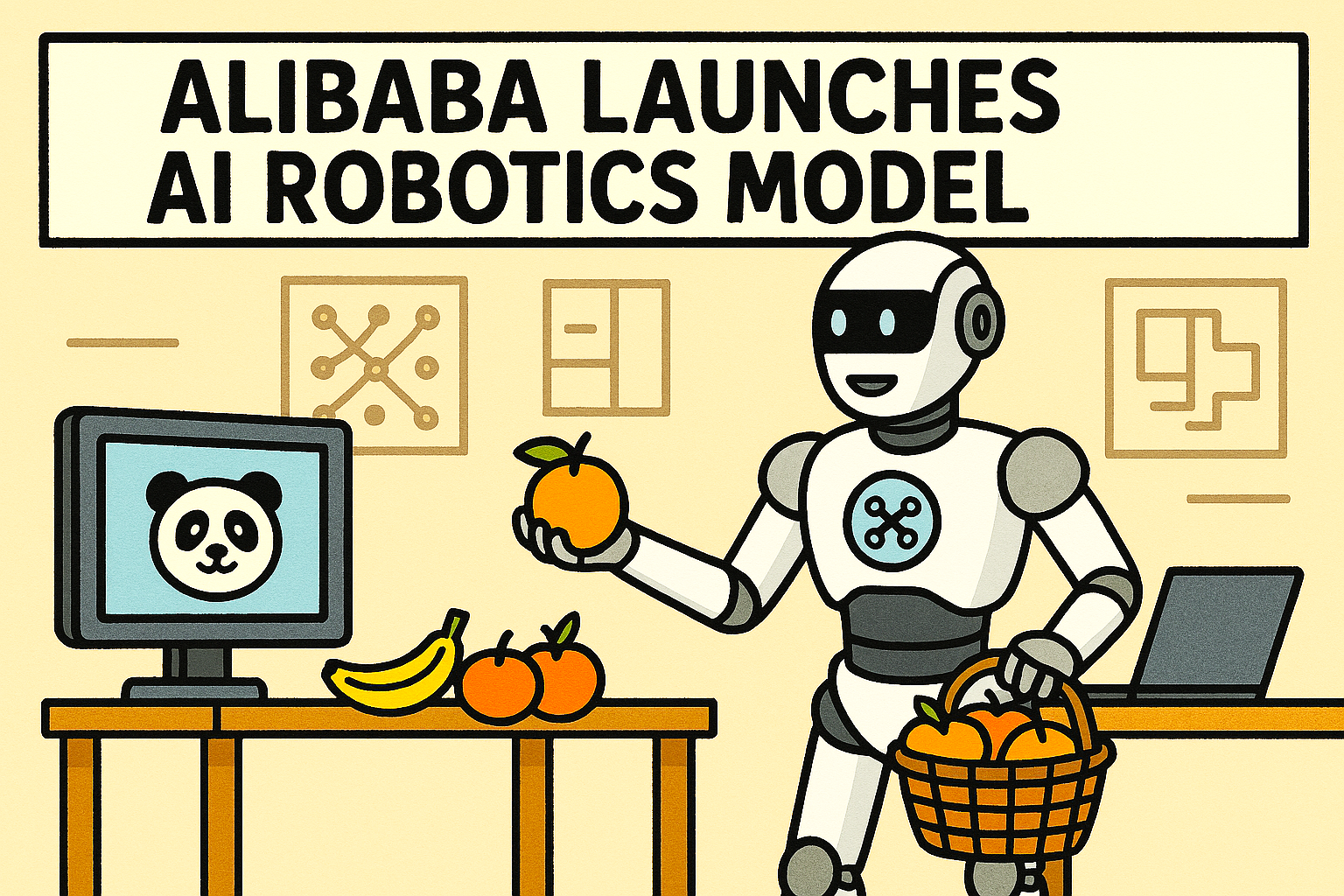
In demonstrations released by Alibaba’s DAMO Academy, the model guided a robot through tasks such as identifying fruit and sorting it into containers — a deceptively simple exercise that requires sophisticated perception and motor control.

The company describes RynnBrain as a ‘general‑purpose embodied intelligence model’, capable of supporting a wide range of robotic applications, from warehouse automation to domestic assistance.

Crucially, Alibaba has opted to open‑source the model, a strategic decision that invites global developers to build on its capabilities and accelerates the creation of a broader ecosystem around Chinese robotics research.

Physical AI

The timing is significant. Over the past year, major technology firms including Google, Nvidia and OpenAI have begun to emphasise physical AI as the next frontier of artificial intelligence.

The shift reflects a growing belief that the most transformative applications of AI will not be confined to screens, but will instead involve machines that can navigate, manipulate and collaborate within human environments.

Alibaba’s entry adds competitive pressure to a field already heating up. While U.S. companies currently dominate embodied AI research, China has made robotics a national priority, viewing it as a strategic industry with implications for manufacturing, logistics and economic resilience.

RynnBrain

By releasing RynnBrain openly, Alibaba positions itself as both a contributor to global research and a catalyst for domestic innovation.

The launch also highlights a broader trend: the convergence of AI models with physical systems. As robots become more capable and more affordable, the line between software intelligence and mechanical action is beginning to blur.

RynnBrain is an early example of this shift — a model designed not just to understand language or images, but to translate that understanding into purposeful action.

Whether Alibaba’s approach will reshape the global robotics landscape remains to be seen, but the message is clear: the race to build the brains of future machines is accelerating, and China intends to be at the forefront.

Other Major Players in Physical AI

Physical AI — AI that can perceive, reason and act in the real world — has become the next strategic battleground for global tech giants. Alibaba is far from alone.

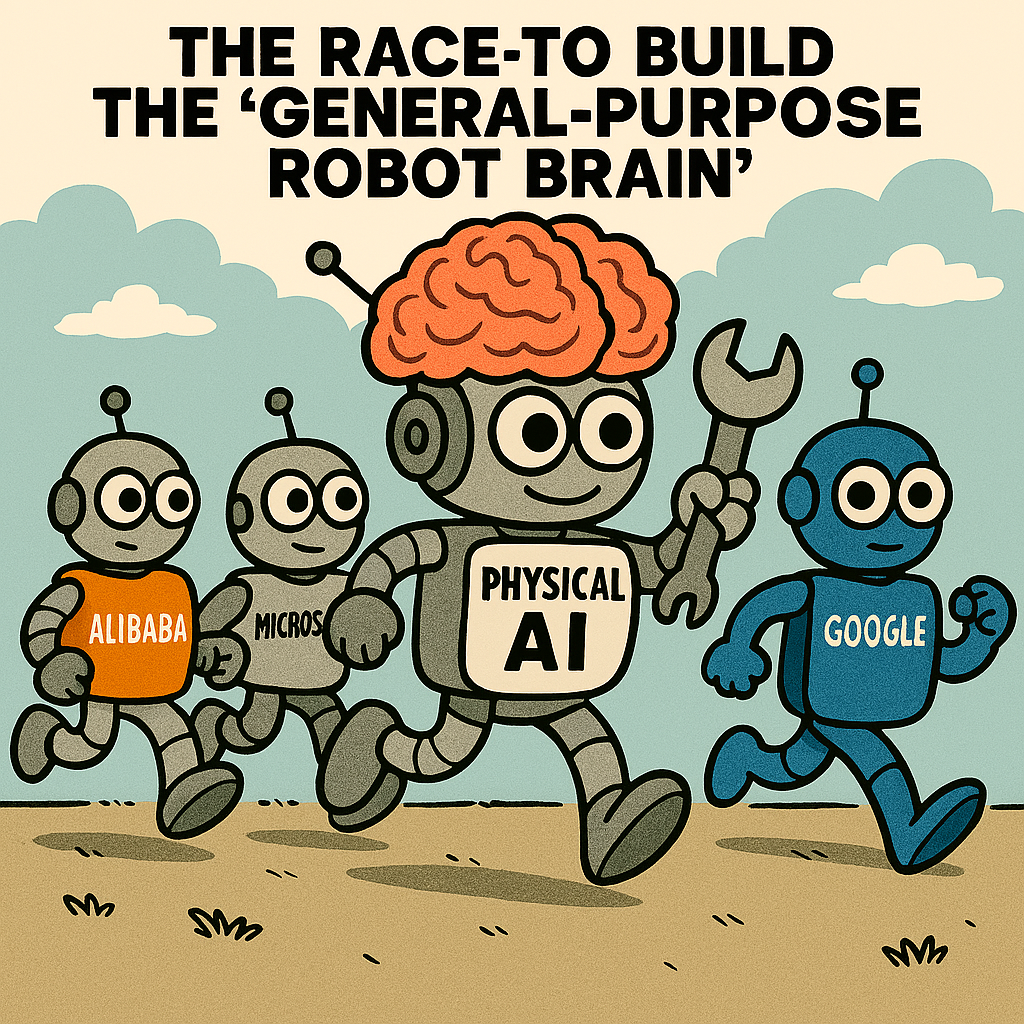
Several companies are racing to build the ‘general‑purpose robot brain’.

Below are the most significant players.

1. Google DeepMind

Focus: Embodied AI, robotics‑ready multimodal model’s Key systems:

RT‑2 (Robotic Transformer)

Gemini‑based robotics extensions

Google has been working on robotics for over a decade. RT‑2 was one of the first models to show that a language model could directly control a robot arm, interpret objects, and perform multi‑step tasks.

DeepMind is now integrating robotics capabilities into the Gemini family.

2. OpenAI

Focus: General‑purpose embodied intelligence Key systems:

OpenAI Robotics (revived internally)

Vision‑language‑action research

OpenAI paused robotics in 2020 but has quietly restarted the programme. Their models are being trained to understand video, track objects and perform physical tasks. They are also working with hardware partners to test embodied versions of their models.

3. Nvidia

Focus: The infrastructure layer for physical AI Key systems:

  • Nvidia Isaac (robotics platform)
  • Cosmos models
  • Omniverse simulation

Nvidia is not building consumer robots; it is building the entire ecosystem for everyone else. Its simulation tools, training environments and robotics‑ready AI models are becoming the backbone of the industry.

4. Tesla

Focus: Humanoid robotics Key system:

  • Optimus (Tesla Bot)

Tesla is training its robot using the same AI stack as its autonomous driving system. The company claims Optimus will eventually perform factory and household tasks.

It is one of the most visible attempts to build a general‑purpose humanoid robot.

5. Amazon

Focus: Warehouse automation and domestic robotics Key systems:

  • Proteus (autonomous warehouse robot)
  • Astro (home robot)

Amazon is integrating multimodal AI into its logistics robots and experimenting with home assistants that can navigate physical spaces.

6. Figure AI

Focus: General‑purpose humanoid robots’ Key system:

  • Figure 01

Backed by OpenAI, Microsoft and Nvidia, Figure is developing a humanoid robot designed to perform everyday tasks.

Their recent demos show robots manipulating objects and responding to natural language instructions.

7. Boston Dynamics

In partnership with Google’s DeepMind Boston Dynamics is also building a ‘foundation model intelligence’ robot brain.

The Big Picture

Alibaba is entering a field dominated by U.S. companies, but the global race is wide open. Physical AI is becoming the next strategic platform — the equivalent of smartphones in the 2000s or cloud computing in the 2010s.

*RynnBrain explained

RynnBrain is Alibaba’s open‑source ‘physical AI‘ framework designed to give robots far more capable real‑world intelligence, enabling them to plan, navigate, and manipulate objects across dynamic environments such as factories and homes.

Developed by the company’s DAMO Academy, it competes directly with Google’s Gemini Robotics and Nvidia’s Cosmos‑Reason models, with Alibaba claiming stronger benchmark performance.

The system is released openly on platforms like GitHub and Hugging Face, offered in configurations from lightweight 2‑billion‑parameter models to advanced mixture‑of‑experts variants, and includes specialised versions—Plan, Nav, and CoP—targeting manipulation, navigation, and spatial reasoning respectively.

Its launch signals China’s ambition to lead global robotics and embodied AI development.