

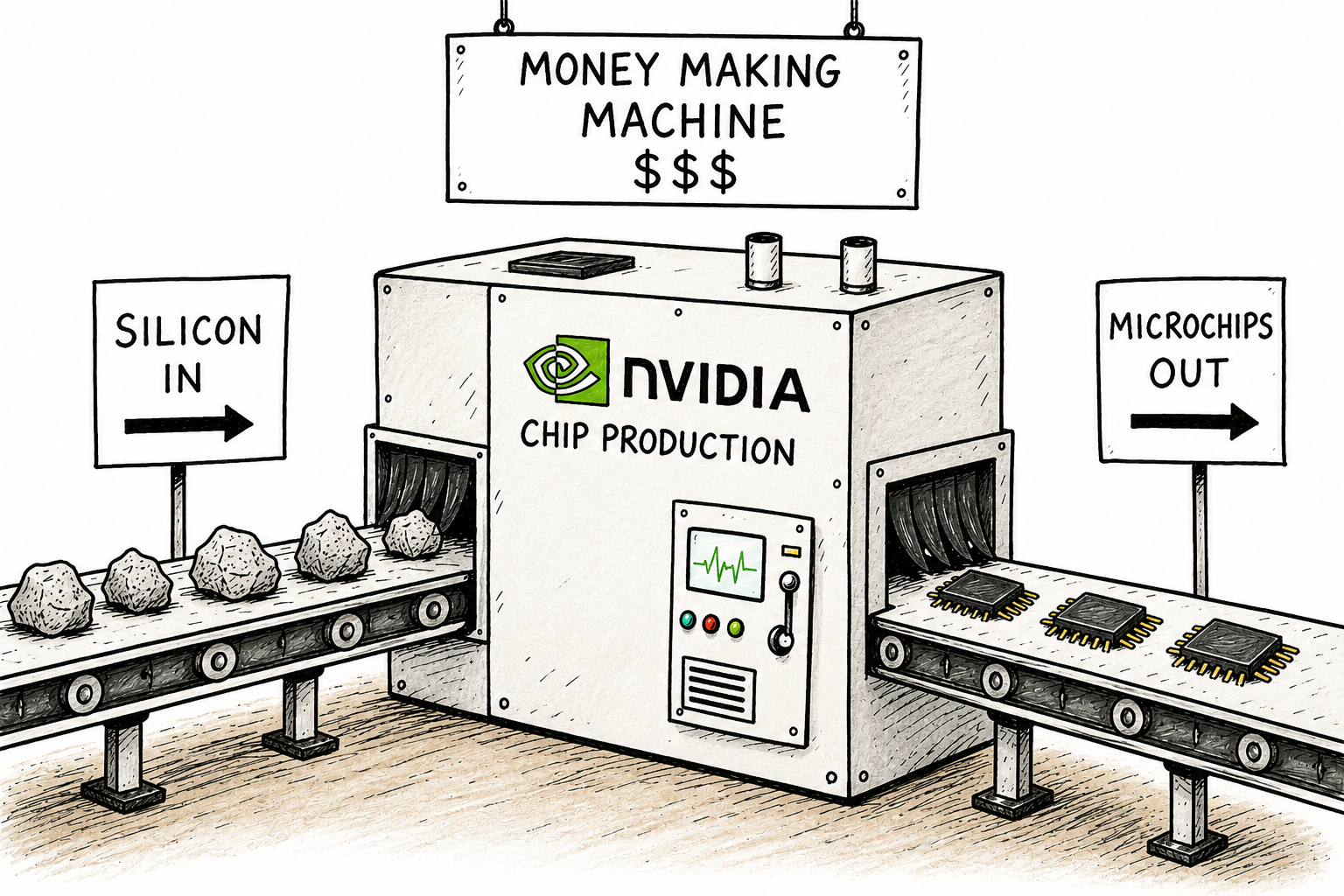
Nvidia has once again delivered figures that underline just how extraordinary the artificial intelligence boom has become.
Its latest results, reported on 26 August, showed second-quarter revenue soaring 106% year-on-year to $96.2 billion, comfortably ahead of Wall Street expectations of around $92.3 billion. Adjusted earnings reached $2.22 a share, also beating forecasts.
Data centres
The real powerhouse remains Nvidia’s data-centre business. Revenue from the division jumped 117% to $89 billion, reflecting the enormous sums being spent by cloud providers, AI laboratories and technology companies building increasingly powerful computing infrastructure.
More remarkable, however, was Nvidia’s outlook. The company expects third-quarter revenue to reach approximately $108 billion, plus or minus 2% — ahead of analysts’ expectations of roughly $104 billion.
Growth into 2028
Nvidia also revealed that it expects revenue to grow by around 70% in fiscal 2028, an unusually long-range forecast that suggests management believes the AI infrastructure boom has considerably further to run.
The company is already ramping up its next-generation Vera Rubin platform, while an expanded partnership with Amazon Web Services includes the deployment of an additional two million Nvidia GPUs.
Demand and risk
Demand is increasingly coming from AI labs, enterprises, sovereign customers and industrial users, rather than just the traditional hyperscalers.
There are still risks. Nvidia warned that shortages and soaring memory costs will squeeze margins, while its outlook assumes no data-centre compute revenue from China. Competition from customers developing their own chips is another potential challenge.
Nevertheless, the message from Nvidia is remarkably bullish: AI spending is not peaking — it is broadening.
The big question for investors is no longer whether Nvidia can grow, but how long growth of this extraordinary magnitude can continue before the law of large numbers finally catches up.