New rules and risk assessments for UK Crypto traders
Coinbase and Gemini, for example, are among cryptocurrency exchanges that now require U.K. users to fill out risk assessments. These questionnaires are designed to test their financial knowledge.
The measures are a response to new rules in the UK. The rules require crypto companies to clearly inform users of the risks involved in trading cryptocurrencies. If a customer fails to successfully complete the requests, they will be prevented from trading with their crypto account.
Risk warning
Crypto.com, Coinbase, Gemini and other cryptocurrency exchanges are warning UK users that they’ll need to complete investment questionnaires. Thes are aimed at testing their financial knowledge before being allowed to trade.
The companies have told UK users they are required to complete a declaration about what type of investor they are. Traders are required to respond to a set of questions on financial services to permit use of their platforms.
Clients’ declaration
In the client’s declaration section, users are asked to select their investor profile. A trader is directed to inform the company of their financial status.
Questions such as: are you a high-net-worth customer earning above £100,000 per annum or with a net worth of more than £250,000? Or, are you a ‘restricted investor’ who won’t invest more than 10% of their assets. If clients do not complete the requests, they are prevented from trading crypto related products.
The financial questionnaires, require users to respond to numerous questions about the range of products available. They want the client to fully understand the potential volatility of crypto assets.
Strict rules to protect the retail trader
Since the UK passed the Financial Services and Markets Act, companies that offer crypto assets and certain types of digital currency, known as stablecoins, are now covered by UK law.
These are the same rules as those that govern traditional financial services and are aimed at protecting the retail trader.
After years of regulatory rejection, the U.S. Securities and Exchange Commission on Wednesday 10th January 2024 finally approved the Bitcoin EFT.
It has approved what are known as ‘spot’ Bitcoin Exchange-Traded Funds (ETFs), which can be purchased by anyone from pension funds to retail investors. This now means that some of the biggest asset managers in the world, including BlackRock and Fidelity can trade a crypto related ETF.
Now, instead of using a crypto asset exchange such as Binance, Coinbase or Kraken to purchase and hold a token like Bitcoin, traders can now trade a ‘spot’ Bitcoin ETF for direct exposure to the digital asset market.
It may also mean that investors could pay lower fees than they would if they bought the digital currency from a crypto exchange directly.
Basically, it is now cheaper than ever to buy Bitcoin – but is this positive for the long-term?
Crypto fans can now invest in Exchange-Traded Funds (ETFs) – but what exactly are they?
A Bitcoin ETF allows investors to buy a product that tracks the price of Bitcoin through the same method they already use to buy stocks and other existing products. This also reduces additional worry of managing their crypto related holdings, which typically involves maintaining a cryptocurrency wallet and a safe storage system to safeguard that investment.
But what exactly is an ETF?
ETFs are holdings or portfolios that allow investors to ‘bet’ on multiple assets, without having to buy any themselves. Traded on stock exchanges like shares, their value depends on how the overall portfolio performs in real time.
An ETF could comprise a combination of gold and silver bullion, for example, or a mixture of shares in both big technology and energy companies. Some ETFs already contain Bitcoin indirectly – but a spot Bitcoin ETF will buy the cryptocurrency directly, ‘on the spot’, at its current live price, throughout the trading day.
Bitcoin, the first cryptocurrency
Based on an idea by someone called, Satoshi Nakamoto, Bitcoin was the first cryptocurrency and remains the most valuable and famous to-date. Its price is often seen as a barometer for the whole industry of thousands of other coins (altcoins), tokens and products built on the same blockchain technology.
Art illustration of Bitcoin blockchain
And with an influx of new money, many expect a surge in interest in cryptocurrency technology in general.
How will the decision affect cryptocurrency adoption and is this decentralisation as originally intended?
Some say this decision shows the existing ‘old financial school’ establishment is finally taking Bitcoin seriously, at least as a speculative asset. For those who consider Bitcoin legitimate ‘digital gold’, what better proof could there be than the biggest wealth-management institutions flocking to buy, and now overseen by regulators?
Others say cryptocurrency is about rejecting traditional financial systems in favour of a decentralised, people-powered alternative. And investment bankers buying Bitcoin just to get rich on U.S. dollars is not what Satoshi Nakamoto had in mind.
But judging from the chatter on social media, the prevailing sentiment is expecting the new cash injection will make existing Bitcoin investors and owners rich.
What are the risks to future investors?
It is possible to lose all of your investment
The price of Bitcoin can change rapidly and often without warning or explanation – it is a volatile asset. So investors will need to be aware when investing in ETFs linked to a digital coin.
Art illustration of Bitcoin trading
But ETFs are often sold as high-risk, high-reward products anyway. It is EXTREMELY high risk – don’t do it if you don’t understand it and even if you do, or think you do – BE CAREFUL! These products can rip the shirt off your back!
Cyber-crime risk
Another potential risk is cyber-crime. Bitcoin and other cryptocurrencies have been the subject of huge and costly attacks that have seen crypto companies drained of sometimes hundreds of millions of dollars overnight. And if the likes of Blackrock become major holders of Bitcoin, their cyber-security will be tested in ways never before. Let’s hope their security systems are extremely robust.
Cost of mining coins
Another downside is the heavy cost to the environment is that Bitcoin use a massive number of powerful computers around the world, to process transactions on the blockchain ledger and to create coins – this is known as mining.
Renewable energy use is growing – but it remains to be seen how investment companies will tackle the environmental cost of Bitcoin.
Be careful
ETFs are here now – but BE CAREFUL when entering a Bitcoin related ETF trade or investment, or any type of ETF for that matter. If it goes wrong, you will lose your money, and quickly.
Federal Reserve officials in December concluded that interest rate cuts are likely in 2024, though they appeared to provide little in the way of when that might occur, according to minutes from the meeting released Wednesday 3rd January 2024.
FOMC meeting minutes
The rate-setting Federal Open Market Committee (FOMC) agreed to keep its rate steady in a range between 5.25% and 5.5%. Members indicated they expect 0.75% cut by the end of 2024.
Uncertainty
However, the meeting summary noted a high level of uncertainty over how, or even if, that will happen. Markets have reacted negatively to this news.
The minutes noted an unusually elevated degree of uncertainty about the policy path. Several members said it might be necessary to keep the funds rate at an elevated level if inflation doesn’t cooperate, and others noted the potential for additional increases.
But, despite this cautionary tone from Fed officials, markets expect the central bank to cut rates in 2024.
Dot plot
The dot plot of individual members’ indications released following the meeting showed that members expect cuts over the coming three years. This will bring borrow back to the 2% desired target.
The minutes indicated that clear progress had been made against inflation, with a six-month measure of personal consumption expenditures even indicating that the inflation rate has edged below the Fed’s 2% target.
FOMC Dot plot projections through 2026
However, the document also noted that progress has been uneven across sectors, with energy and core goods moving lower but core services still moving higher.
The Dot plot – what is it?
The dot plot, in relation to the FED or FOMC, is a chart that shows the projections of the Federal Reserve Board members and Federal Reserve Bank presidents for the federal funds rate, which is the interest rate that U.S. banks charge each other for overnight loans.
The dot plot is updated four times a year, after each FOMC meeting, and reflects the individual views of the policymakers on the appropriate level of the federal funds rate for the current year, the next few years, and the longer run.
The graph (dot plot) can help markets and the general public understand the Fed’s monetary policy stance and expectations for the future path of interest rates.
However, the dot plot is not a policy commitment or a forecast, but rather a snapshot of the opinions of the FOMC participants at a given point in time. The dot plot can change over time as new information and economic conditions develop.
Wasted wind power will add £40 to the average UK household’s electricity bill in 2023, according to a think tank.
That figure could increase to £150 in 2026, Carbon Tracker has estimated.
When it is very windy, the grid cannot handle the extra power generated. So, wind farms are paid to switch off and gas-powered stations are paid to fire up. The cost is passed on to consumers.
The government said major reforms will halve the time it takes to build energy networks to cope with extra wind power. Energy regulator Ofgem announced new rules in November 2023, which it said would speed up grid connections.
Bottleneck
Most of the UK’s offshore wind farms are in England. Dogger Bank, off the coast of Yorkshire is the largest in the world. Meanwhile, around half of onshore wind farms are in Scotland but most electricity is used in south-east England.
Carbon Tracker said the main problem in getting electricity to where it is needed is a bottleneck in transmission.
Wind curtailment
The practice of switching off wind farms and ramping up power stations is known as wind curtailment. This cost is passed on to consumers, it said. Carbon Tracker researches the impact of climate change on financial markets. It said since the start of 2023, wind curtailment payments cost £590m, adding £40 to the average consumer bill.
It warned the costs were set to increase adding £180 per year to bills by 2030. Wind farms are being built faster than the power cabling needed to carry the electricity.
Cable issue
‘The problem is, there are not enough cables. The logical solution would be to build more grid infrastructure,‘ said an analyst at Carbon Tracker. ‘It’s not even that expensive,’ he added, compared with mounting wind curtailment costs.
Industry group RenewableUK reportedly said that grid constraints, ‘reflect a chronic lack of investment in the grid.’
‘We need to move from a grid which is wasteful, to one that’s fit for purpose as fast as possible.’
However, historically it has taken between 10 and 15 years for new transmission cables to be approved.
Maybe more battery storage plants around the UK would help reduce the bottlenecks? As renewable power continues to expand, this would enable the extra power to be stored to use later.
This would be better than firing up antiquated fossil fuel power plants.
Are you selling online and making a little extra income?
Well, if you are, as from 1st January 2024 you will now fall foul of UK tax rules if you do not declare the income generated from these sales.
Companies like Etsy, eBay, Vinted, Airbnb etc. are obliged to collect and share details of such transactions with the tax authorities. That will allow HMRC to zero in on anyone who should be declaring the extra income but isn’t.
While HMRC was already able to request information from UK-based online operators, from the start of this year there are new rules that the UK has signed up to in cooperation with the OECD – Organisation for Economic Cooperation and Development, as part of a global effort to clamp down on tax evasion.
New rules
The new rules require digital platforms to report the income sellers are getting through their site on a regular basis.
It will apply to sales of goods such as second-hand clothes and items that have been handcrafted, but also services such as: food delivery, taxi hire, freelance work and accommodation lets or even renting out your driveway for parking.
Rule summary
Online sellers already paying tax do not need to alter what they are already doing.
Individuals have a £1,000 tax-free allowance for money made through property.
There is also a £1,000 allowance for trading income – for example, if you offer tutoring or gardening, or if you are selling new or second-hand items online.
People earning below those thresholds may not have to fill in a tax return, but should keep records in case they are asked for them.
The information will be shared between countries that have signed up to the OECD tax rules.
The UK government said the new rules would help it ‘bear down on tax evasion’, as sellers on digital platforms would now be treated more like traditional businesses.
House prices have ended the year 1.8% lower in the UK, according to Nationwide Building Society
The Nationwide forecasts no growth or a further fall in 2024.
The lender said the average house price across the UK was £257,443 in December 2023. This was flat compared to November 2023 but down compared to December 2022.
The lender reportedly said that consumer confidence ‘remains weak’, despite some mortgage rates falling in anticipation for Bank of England (BoE) to cut borrowing costs in the months ahead.
The number of housing transactions has been running at around 10% below pre-Covid levels, Nationwide reported. The fall was more pronounced for those buying a house using a mortgage – down 20% compared to before the pandemic.
However, the volume of cash deals continues to run above the levels recorded before Covid hit.
Deflation is an economic phenomenon characterized by a general decline in prices for goods and services. It occurs when the inflation rate falls below 0%, resulting in a negative inflation rate.
This means that the purchasing power of currency increases over time, allowing you to buy more with the same amount of money. It can be as damaging to the economy as inflation.
Consumer and Asset Prices: During deflation, both consumer and asset prices decrease, which might seem like a good thing because it increases the purchasing power.
Economic Impact: However, deflation can be harmful to the economy. It often signals an impending recession or hard economic times. If people expect prices to fall further, they may delay purchases, hoping to buy later at a lower price. This leads to reduced spending, which can cause producers to earn less, potentially leading to unemployment and higher interest rates.
Measurement: Deflation is measured using economic indicators like the Consumer Price Index (CPI), which tracks the prices of commonly purchased goods and services. When the CPI shows that prices are lower than in a previous period, the economy is experiencing deflation.
Causes: The main causes of deflation include a decrease in demand or an increase in supply. A decline in aggregate demand can lead to lower prices if supply remains unchanged. Conversely, an increase in supply can also cause prices to drop if demand does not increase accordingly.
It’s important to note that deflation is different from disinflation. Disinflation refers to a slowdown in the rate of inflation, where prices are still rising but at a slower pace than before.
Deflation can have complex effects on an economy, and while it may benefit consumers in the short term, it can lead to broader economic challenges.
Deflation, friend or foe?
Deflation, often perceived as a relief during times of high prices, is a complex economic condition that presents both benefits and challenges. It is defined by a general decrease in the price level of goods and services, leading to an increase in the real value of money. This means consumers can buy more for less, but this apparent advantage masks the potential dangers lurking beneath the surface.
The immediate effect of deflation is an increase in consumer purchasing power. As prices drop, money buys more, which can be particularly beneficial for individuals on fixed incomes. However, this boon is short-lived if deflation persists. Consumers, anticipating further price drops, may postpone purchases, leading to a decrease in consumer spending, the lifeblood of any economy. This reduction in demand can force businesses to lower prices further, creating a vicious cycle that’s hard to break.
Deflation can lead to a reduction in demand and can force businesses to lower prices, creating a vicious cycle that’s difficult to break.
Moreover, deflation can exacerbate debt burdens. As prices and revenues fall, the real value of debt increases, making it more challenging for borrowers to repay their obligations. This can lead to increased loan defaults and financial instability. For businesses, falling prices mean reduced profit margins, leading to cost-cutting measures such as layoffs, reduced investment, and even bankruptcy.
Causes
The causes of deflation are multifaceted, often stemming from a decrease in aggregate demand or an oversupply of goods. Technological advancements, while boosting productivity, can also contribute to deflation by lowering production costs and increasing supply faster than demand. Additionally, a strong currency can make imports cheaper, contributing to lower prices domestically.
Tools
Central banks and governments typically combat deflation with monetary and fiscal policies aimed at stimulating demand. Lowering interest rates, increasing government spending, and quantitative easing are common strategies employed to inject money into the economy and encourage spending.
While deflation can initially seem like a welcome development, its long-term effects can be detrimental to economic health. It is a delicate balance that policymakers must navigate carefully to ensure stability and growth in the economy.
During this period of inflationary pressure, no country is beyond the grasp of deflation.
A message for governments and central banks around the world – don’t push too hard!
European Union officials have reached a provisional deal on the world’s first comprehensive laws to regulate the use of artificial intelligence (AI).
The EU agreed guidelines around AI in systems like ChatGPT and facial recognition.
The European Parliament will vote on the AI Act proposals early next year, but any legislation will not take effect until 2025 at the earliest. The U.S., UK and China are all rushing to publish their own guidelines.
Safeguards
The proposals include safeguards on the use of AI within the EU as well as limitations on its adoption into law.
European Commission President Ursula von der Leyen said the AI Act would help the development of technology that does not threaten people’s safety and rights. Consumers would have the right to launch complaints and fines could be imposed for violations.
Unique framework
In a social media post, she said it was a ‘unique legal framework for the development of AI you can trust’.
The European Parliament defines AI as software that can ‘for a given set of human-defined objectives, generate outputs such as content, predictions, recommendations or decisions influencing the environments they interact with.’
This is a significant step towards ensuring that AI development and deployment are aligned with ethical standards and respect for human rights.
Will the EU, UK, U.S., China and other countries AI rules conflict?
The two most significant events for gold demand in 2023 were the collapse of Silicon Valley Bank and the Hamas attack on Israel, the World Gold Council(WGC) said, estimating that geopolitics added between 3% and 6% to gold’s performance over the year.
The WGC estimated that central bank demand added 10% or more to gold’s performance in 2023 and said even if 2024 does not reach the same heights, above-trend buying should still offer an extra boost to gold prices.
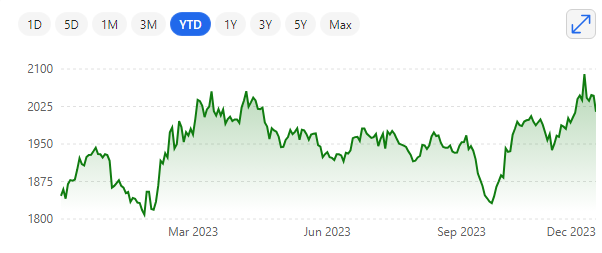
The precious metal broke through $2,100 per ounce on Monday 4th December 2023 in intra-day trading, before moderating slightly. Spot gold prices were hovering at around $2,030 per ounce Friday 8th December 2023.
Gold price year to date chart
What is the World Gold Council
The World Gold Council (WGC) is a market development organization for the gold industry. It works across all parts of the industry, from gold mining to investment, with the aim of stimulating and sustaining demand for gold. The council sets standards, strengthens markets, and shapes the global conversation about gold. It was established to promote the use of and demand for gold through marketing, research, and lobbying.
The council includes 33 members, many of which are gold mining companies.
The world’s richest 1% of people are responsible for around the same percentage of global carbon emissions as the 5 billion people who represent the 66% poorest, according to a report published by Oxfam.
In the report he wealthiest 10% were responsible for 50% of global emissions, it found, while the bottom 50% were responsible for just 8%.
The top 1% represents 77 million people and is defined in the report as having an estimated income threshold of $140,000 per year, and an average income of $310,000.
The report states that personal consumption varies depending on factors such as location, use of renewable energy and transport where the very wealthiest contribute significantly more due to the use of private jets and yachts.
It also includes between 50% and 70% of emissions by the 1% coming through investments in companies, measured by taking firms’ reported emissions and distributing that proportionate to shareholder ownership of those firms by the 1%.
Water is a precious Earth resource. It is becoming increasingly scarce due to climate change, population growth, pollution and waste. Without water we are nothing.
According to some sources, Big Tech and AI are contributing to the water crisis by using large amounts of water to cool their data systems and AI computations.
Researchers estimate that Microsoft used 1.7 billion gallons of water for AI alone in 2022, a 34% increase from 2021. Google also reported a 20% increase in water usage, mostly due to its AI work. One of the most water-intensive AI models is ChatGPT, which is estimated to use half a litre of water for every series of prompts.
These numbers are alarming, considering that water is a finite and vital resource for humans and ecosystems.
ChatGPT is estimated to use the equivalent of one 16-ounce bottle of water (approx’ half a litre) for every 20-50 queries according to a study by Shaolei Ren, an associate professor of electrical and computer engineering at the University of California.
BIG Tech aware of environmental impact
Some tech companies are aware of the environmental impact of their AI activities and are trying to find ways to reduce their water consumption and carbon footprint. For example, Microsoft has pledged to become water positive, carbon negative, and waste-free by 2030.
Is there a water crisis looming and could BIG Tech make things worse?
Google has also set a goal to operate on 24/7 carbon-free energy by 2030. OpenAI, the creator of ChatGPT, has stated that it is working on improving the efficiency of its AI models. Some possible solutions include using renewable energy sources, developing better algorithms and hardware, and locating data centres in colder climates.
Too much
Some argue that Big Tech and AI are using too much water, and that they should be regulated. They should be held accountable for their environmental impact.
Others may contend that Big Tech and AI are providing valuable services and innovations and they are taking steps to mitigate their water usage and become more sustainable.
Iceberg A23-A is the world’s biggest iceberg that has been stuck to the ocean floor for more than 30 years.
Scientists believe the A23-A’s breakaway from Antarctica was a natural occurrence, but say it provides a stark reminder of the potentially disastrous implications as global sea levels rise.
It split away from the Antarctic coastline in 1986 and became an ice island in the Weddell Sea. It is about 4,000 sq km (1,500 sq miles) in area, which is more than twice the size of Greater London, and 400m (1,312 ft) thick, which is taller than the London Shard.
On the move
Recently, it has started to move at a faster pace and is now about to leave the Antarctic waters. Scientists believe it has lost its grip on the sea floor and is being pushed by winds and currents. It is likely to follow the path of other icebergs from the Weddell Sea and head towards the South Atlantic, where it will eventually melt and break apart.
Map of Antartica showing Weddell Sea
A23-A Iceberg moving through the Weddell Sea
Ecosystem
Icebergs are important for the ocean ecosystem, as they carry fresh water and nutrients that support marine life. They also affect the climate, as they reflect sunlight and cool the air. Iceberg A23-A is a remarkable natural phenomenon that has been observed for decades by researchers and satellites.
This is not happening because of climate change – it is a natural process of nature.
The first transatlantic flight using 100% sustainable aviation fuel (SAF) is scheduled to take off on Tuesday, 28th November 2023.
UK Government funded project
The flight is operated by Virgin Atlantic and will fly from London’s Heathrow to New York’s JFK airport. The flight is part of a UK government-funded project to demonstrate the feasibility and benefits of using SAF as an alternative to conventional jet fuel. SAF can reduce carbon emissions by over 70% compared to fossil jet fuel.
The flight will also use biochar credits to offset any remaining emissions and achieve net zero.
Biochar is the lightweight black residue, made of carbon and ashes, remaining after the pyrolysis of biomass, and is a form of charcoal.
Support
The flight is supported by a consortium of companies, including Boeing, Rolls-Royce, BP, Imperial College London, University of Sheffield, Rocky Mountain Institute, and ICF. The transatlantic flight has received a permit to fly from the UK Civil Aviation Authority, after undergoing technical assessments and ground testing.
The flight will use a Boeing 787 Dreamliner powered by Rolls-Royce Trent 1000 engines. The SAF used will be made primarily from waste oils and fats, such as used cooking oil.
The flight is not the first transatlantic flight to use SAF, but it is the first to use 100% SAF. In 2019, Gulfstream flew a G600 aircraft from Georgia to the UK using a 30/70 blend of SAF and jet fuel.
The Virgin Atlantic flight will be the first to use pure SAF on a commercial airliner.
Update 29th November 2023 – History made
The first transatlantic flight by a large passenger aeroplane, fueled by ‘greener fuel’ was a success.Operated by Virgin Atlantic, it flew from London’s Heathrow to New York’s JFK airport.
Lilium is a German start-up that is developed a five-seater electric jet that can take off and land vertically. It is a flying taxi.
The company aims to offer sustainable, high-speed air mobility through its aircraft, vertiports and digital service. Lilium successfully tested its prototype in 2019 and 2021 and plans to launch its services in multiple cities by 2025.
eVTOL market
Lilium is one of the leading companies in the emerging eVTOL market, which faces challenges such as regulation, infrastructure, safety and public opinion. Lilium claims that its jet is faster, quieter and more efficient than its competitors, and that it can travel up to 300 km in just 60 minutes.
Lilium has been granted EU approval to design and operate its electric vertical takeoff and landing vehicles globally.
Lilium is a German start-up that is developed a five-seater electric jet that can take off and land vertically.
It’s a key milestone for the industry. Lilium has been working for several years to get such vehicles ready for commercial market.
Binance is still open for business and is now being run by, Richard Teng. But who is the new boss of Binance?
Mr Teng, from Singapore joined Binance just over two years ago as the chief executive of the Singapore business. That was the year when Binance came under a Justice Department investigation, and as regulatory scrutiny of the company and Zhao intensified. Richard Teng was rapidly climbing the ranks in the background.
He only stayed in his original position as the Singapore CEO for five months, according to his LinkedIn page, before he was promoted to regional head of Europe, Asia and the Middle East and North Africa in April 2023.
Mr Teng later moved to become head of regional markets in May 2023 before he was appointed to the top job on Tuesday 21st November 2023.
In announcing his successor, Mr Zhao called Mr Teng a ‘highly qualified leader‘, adding that ‘with over three decades of financial services and regulatory experience, he will navigate the company through its next period of growth’.
Traditional financial background
Prior to joining Binance, Mr Teng worked in the more traditional financial sectors as a director of corporate finance at the Monetary Authority of Singapore (MAS) and a chief regulatory officer of the Singapore Exchange (SGX). He then moved on to the become chief executive of the Abu Dhabi Global Market (ADGM), an international financial centre in the United Arab Emirates, where he stayed for six years. The ADGM regulates the trading of digital assets.
In a statement on Wednesday 22nd November 2023, Mr Teng said he was honoured to take this position, adding that he would focus on reassuring Binance’s 150 million users about ‘the financial strength, security and safety of the company’.
Despite this, Mr Teng has reiterated that Binance is ‘here to stay‘, adding that company’s foundation stands ‘stronger than ever’.
At the speed of AI, the story at OpenAI moves at lightning speed.
Hundreds of OpenAI employees signed a letter demanding the OpenAI board resign or face an employee exodus to Sam Altman’s new venture at Microsoft ‘imminently‘.
The board then attempted to negotiate Altman’s return, but those talks were unsuccessful.
At the touch of a button – resignation letter sent to the OpenAI board of directors
To the Board of Directors at OpenAI
OpenAI is the world’s leading AI company. We, the employees of OpenAI, have developed the best models and pushed the field to new frontiers. Our work on AI safety and governance shapes global norms. The products we built are used by millions of people around the world. Until now, the company we work for and cherish has never been in a stronger position.
The process through which you terminated Sam Altman and removed Greg Brockman from the board has jeopardized all of this work and undermined our mission and company. Your conduct has made it clear you did not have the competence to oversee OpenAI.
When we all unexpectedly learned of your decision, the leadership team of OpenAI acted swiftly to stabilize the company. They carefully listened to your concerns and tried to cooperate with you on all grounds. Despite many requests for specific facts for your allegations, you have never provided any written evidence. They also increasingly realized you were not capable of carrying out your duties, and were negotiating in bad faith.
The leadership team suggested that the most stabilizing path forward – the one that would best serve our mission, company, stakeholders, employees and the public – would be for you to resign and put in place a qualified board that could lead the company forward in stability. Leadership worked with you around the clock to find a mutually agreeable outcome. Yet within two days of your initial decision, you again replaced interim CEO Mira Murati against the best interests of the company. You also informed the leadership team that allowing the company to be destroyed “would be consistent with the mission.”
Your actions have made it obvious that you are incapable of overseeing OpenAI. We are unable to work for or with people that lack competence, judgement and care for our mission and employees. We, the undersigned, may choose to resign from OpenAI and join the newly announced Microsoft subsidiary run by Sam Altman and Greg Brockman. Microsoft has assured us that there are positions for all OpenAI employees at this new subsidiary should we choose to join. We will take this step imminently, unless all current board members resign, and the board appoints two new lead independent directors, such as Bret Taylor and Will Hurd, and reinstates Sam Altman and Greg Brockman.”
In just 5 days
Sam Altman sacked from OpenAI.
Altman appears to move to Microsoft.
OpenAI staff revolt.
No confidence in OpenAI board.
Space for staff to move to Microsoft and create new AI company under Altman’s leadership.
OpenAI mass employee resignation letter emerges.
Microsoft CEO Nadella says OpenAI governance needs to change no matter where Altman ends up.
Altman back at OpenAI after board changes.
Now, Altman is back after getting the sack.
So, is all OK at OpenAI? I asked CHATGPT the question, here is the answer…
Microsoft is working on its own artificial intelligence chip, code-named Athena, that could compete with Nvidia’s products.
The company introduced two new microchips.
The first, its Maia 100 artificial intelligence chip, could compete with Nvidia’s highly sought-after AI graphics processing units.
The second, a Cobalt 100 Arm chip, is aimed at general computing tasks and could compete with Intel processors.
The chip is designed for training large language models (LLM’s) like ChatGPT and powering AI applications. Microsoft has been developing the chip since 2019 using Taiwan Semiconductor’s 5-nanometer process. The chip is currently being tested by a small select group of Microsoft and OpenAI employees.
Long-term objective
Microsoft’s objective is to reduce its dependency on third-party hardware providers and to customize its AI infrastructure for its own projects.
Microsoft has invested billions in OpenAI, which makes ChatGPT, to enhance its position in the AI field. The Athena chip could also enable Microsoft to add AI capabilities to its Office products and GitHub, but it has already achieved this using the OpenAI system.
Microsoft has not announced when the chip will be available to the public or to its Azure cloud customers.
IMF’s Kristalina Georgieva reportedly said that the public sector should keep preparing to deploy central bank digital currencies (CBDC’s) and related payment platforms in the future.
But according to data from the Atlantic Council, only 11 countries have adopted CDBC’s thus far.
Alternative to cash
Central bank digital currencies (CBDC’s) have the potential to replace cash. But adoption could take time, said Kristalina Georgieva, managing director of the International Monetary Fund on Wednesday 15th November 2023.
‘CBDC’s can replace cash which is costly to distribute”, she is reported to have said at the Singapore FinTech event. ‘They can offer resilience in more advanced economies. And they can improve financial inclusion where few hold bank accounts’.
‘CBDC’s would offer a safe and low-cost alternative to cash. They would also offer a bridge between private monies and a yardstick to measure their value, just like cash today which we can withdraw from our banks’, the IMF chief reportedly said.
Fiat currency
CBDC’s are the digital form of a country’s fiat currency, which are regulated by the country’s central bank. They are powered by blockchain technology, allowing central banks to channelgovernment payments directly to households.
Central Bank digital money to replace cash. IMF’s Kristalina Georgieva reportedly said that the public sector should keep preparing to deploy central bank digital currencies (CBDC’s) and related payment platforms in the future.
‘The level of global interest in CBDCs is unprecedented. Several central banks have already launched pilots or even issued a CBDC’, the IMF said in a September 2023 report.
According to a 2022 survey conducted by the Bank for International Settlements, of the 86 central banks surveyed, 93% said they were exploring CBDCs, while 58% said they were likely to or may possibly issue a retail CBDC in either the short or medium term.
But as of June 2023, only 11 countries had adopted CBDC’s, with an additional 53 in advanced planning stages and 46 researching, according to data from the Atlantic Council.
Nvidia has recently announced its latest high-end chip, the GH200 Grace Hopper Superchip, which is designed for training AI models at giant scale.
The GH200 is a breakthrough accelerated CPU that combines the NVIDIA Grace™ and Hopper™ architectures using NVIDIA® NVLink®-C2C to deliver a CPU+GPU coherent memory model for AI and HPC applications. The superchip delivers up to 10X higher performance for applications running terabytes of data, enabling scientists and researchers to reach unprecedented solutions for the world’s most complex problems.
The technical bit
The GH200 features 72 cores of Grace CPU outfitted with 480 GB of ECC LPDDR5X memory, as well as the GH100 compute GPU that is paired with 141 GB of HBM3E memory that comes in six 24 GB stacks and uses a 6,144-bit memory interface.
The GH200 also has a new 900 gigabytes per second (GB/s) coherent interface, which is 7X faster than PCIe Gen5, and supercharges accelerated computing and generative AI with HBM3 and HBM3e GPU memory. The GH200 can run all NVIDIA software stacks and platforms, including NVIDIA AI Enterprise, HPC SDK, and Omniverse™.
Nvidia unveils its newest GH200 high-end AI Superchip.
The GH200 is available as part of the NVIDIA DGX GH200, a massive memory supercomputer that fully connects 256 GH200 Superchips into a singular GPU. The DGX GH200 offers 144 terabytes (TB) of shared memory with linear scalability for giant AI models.
The DGX GH200 is a turnkey data centre-class solution that includes integrated software and white-glove services from NVIDIA, from design to deployment, to speed the ROI of AI.
The DGX GH200 is the only AI supercomputer that offers a massive, shared memory space of 144TB across 256 NVIDIA Grace Hopper Superchips, providing developers with nearly 500X more memory to build giant models.
In a world first, it was recently reported that artificial intelligence (AI) demonstrated the ability to negotiate a contract autonomously with another artificial intelligence without any human involvement.
Luminance at its London headquarters, demonstrated its AI, called Autopilot, negotiating a non-disclosure agreement in a matter of minutes.
It marks the first time AI has ever negotiated a contract with another AI, with no human involvement.
The only input from a human that is still required, is the signing of the contract.
In a world first, artificial intelligence (AI) demonstrated the ability to negotiate a contract autonomously.
An old well established and trusted tech brand pivoting to AI that has a high dividend yield is IBM, which has been around for more than a century and is known for both its hardware and software products.
IBM is investing heavily in AI, cloud computing, and quantum computing, and has recently acquired several AI start-ups, such as Instana, Turbonomic, and Waeg.
IBM also has a partnership with OpenAI, one of the leading AI research organizations, to provide cloud infrastructure for its AI models.
Investors who love IBM expect the company to grow its earnings by around 10% annually over the next five years. Investors were also impressed with IBM’s dividend yield, which is currently around 4.5%. Dividends are a great way to generate passive income.
IBM is not the only tech company that is pivoting to AI. Google, Microsoft, and Anthropic are competing in the field of generative AI, which can create text, images, music, and more from natural language prompts.
Integrate generative AI
These companies are attempting to integrate generative AI into their products and services, such as search engines, maps, word processors, office applications, chatbots, and more. Generative AI is seen as a game-changer for many industries and applications, and could potentially disrupt the dominance of Big Tech.
Legacy companies can pivot to a platform model, which is a business strategy that connects producers and consumers of value through a digital interface. Platform companies like Facebook, Amazon, Google, and Tencent have created value at stunning rates, and have grown rapidly and own large market shares.
IBM mainframe from the 1970’s
Legacy companies can leverage their existing systems, such as customer relationships, data, and brand recognition, to create platforms that offer impressive and immersive products and services.
Other successful platform pivots are Disney+, which transformed Disney from a media producer to a media platform; Nike+, which connected Nike’s physical products with digital services; and John Deere, which created a platform for precision agriculture.
Elon Musk is one of the most influential and visionary leaders in the field of AI.
He has recently shared his views on how AI will eventually create a situation where no job is needed, and how humans will have to find meaning in life.
Disruptive or force for good?
Elon Musk recently reportedly said that AI will have the potential to become the ‘most disruptive force in history’ and that it will be smarter than the smartest human.
He compared AI to a ‘magic genie’ that would grant unlimited wishes to its owners. He also said that AI will be able to do everything, and that people will not need to work for money, but only for personal satisfaction.
‘AI genie is out of the bottle!’
This is a very optimistic and futuristic vision of AI, but it also raises some important questions and challenges.
How will humans cope with the loss of work and purpose?
How will society and economy function without jobs and income?
How will humans ensure that AI is aligned with their values and interests?
How will humans prevent AI from becoming a threat or a tyrant?
UK AI summit
These are some of the issues that were discussed at the AI Safety Summit 2023 at Bletchley Park in England, where world leaders agreed to a global communique on AI that recognized the potential risks associated with AI.
The summit was attended by, Prime Minister Rishi Sunak, U.S. Vice President Kamala Harris and other tech and business executives, including Elon Musk himself.
Benefit or a disaster waiting to happen?
AI is a powerful technology that can bring many benefits and opportunities to humanity, but it also requires careful and responsible development and regulation. It can bring ‘disaster’ too if not managed constructively.
It is hoped humans and AI can coexist peacefully and harmoniously in the future.
Sam Bankman-Fried, founder of the world’s biggest cryptocurrency exchange, has been found guilty of fraud and money laundering at the end of a month-long trial in New York.
He was accused of lying to investors and customers and stealing billions of dollars from FTX, which went bankrupt in November 2022. He now faces up to 115 years in prison. The jury delivered its verdict after less than five hours of deliberations. His sentencing has been set for 28th March 2024.
Month long trial
The verdict was delivered after a month-long trial that saw three of his former associates, including his ex-girlfriend, testify against him as part of a plea deal. They revealed that Bankman-Fried used customer deposits from FTX to fund his other company, Alameda Research, as well as to buy property and make political donations. He denied the charges and claimed that he acted in good faith and made mistakes due to being overwhelmed by the rapid growth of his businesses.
It concludes a dramatic fall from grace for the 31-year-old former billionaire and one of the most public faces of the crypto industry.
The case has been seen as a major blow to the crypto industry, which has been struggling to recover from the market crash and regulatory scrutiny that followed the FTX collapse. Bankman-Fried was once one of the most prominent and influential figures in the sector, known for his philanthropy and crypto industry innovation.
His downfall has been described as the industry’s greatest cautionary tale.
Verdict
‘Sam Bankman-Fried perpetrated one of the biggest financial frauds in American history – a multibillion-dollar scheme designed to make him the king of crypto’, U.S. attorney Damian Williams said in a statement after the verdict. ‘This case has always been about lying, cheating and stealing, and we have no patience for it’.
Sam Bankman-Fried, founder of the world’s biggest cryptocurrency exchange, has been found guilty of fraud and money laundering at the end of a month-long trial in New York.
Prosecutors had accused Bankman-Fried of lying to investors and lenders and stealing billions of dollars from cryptocurrency exchange FTX, helping to precipitate its collapse. They charged him with seven counts of fraud and money laundering.
He had pleaded not guilty to all the charges, maintaining that, while he had made mistakes, he had acted in good faith.
After the verdict Bankman-Fried’s lawyer Mark Cohen said: ‘We respect the jury’s decision. But we are very disappointed with the result’.
Mr Bankman-Fried reportedly maintains his innocence and will continue to vigorously fight the charges against him.
The Bank of England (BoE) announced its latest interest rate decision on Thursday, 2nd November 2023 to hold the bank rate at 5.25%.
The Bank of England’s (BoE) Monetary Policy Committee (MPC) voted by a majority of 5-4 to maintain Bank Rate at 5.25%, the highest level in 15 years. However, four members preferred to increase the bank rate, to 5.5%.
The MPC also voted unanimously to reduce the stock of UK government bond purchases held for monetary policy purposes by £100 billion over the next twelve months, to a total of £658 billion.
The BoE’s decision was influenced by the weak economic outlook, the high inflation rate, and the uncertainty surrounding the Covid-19 pandemic and the Brexit saga.
The BoE said that the UK economy was likely to contract by 0.5% in Q3 2023, and that underlying growth in the second half of 2023 was also likely to be weaker than expected. The BoE also warned that there was a 50% chance of a recession in the next year (50/50). I think even I could guess with odds at 50/50.
2% target inflation to be hit by Q2 2025
The BoE also said that inflation, which was 6.7% in September 2023, was expected to peak at around 7% in Q4 2023, before falling back to the 2% target by 2025 Q2. The BoE said that the inflation spike was largely driven by temporary factors, such as higher energy and food prices, and that it would not respond to it.
The Bank of England was behind the curve calling it transitory. Can we trust any future forecasts?
The BoE’s decision was in line with the market expectations, as most analysts and investors had predicted that the BoE would keep rates on hold.
The UK supercomputer project is a major initiative by the UK government to boost the country’s capabilities in artificial intelligence, weather forecasting, climate research and other highly important scientific research projects.
The project involves building and connecting two new supercomputers across the UK: Isambard-AI and Dawn.
Dawn will be a new supercomputer cluster at the University of Cambridge, delivered by a partnership with Dell and UK SME StackHPC. It will be powered by over 1,000 Intel chips that use water-cooling to reduce power consumption. It will target breakthroughs in fusion energy, healthcare and climate modelling.
The UK supercomputer project is part of a £300 million investment from the government to create a new national Artificial Intelligence Research Resource for the country. The project is expected to be completed by summer 2024.
The investment comes as the UK hosts an AI safety summit in Bletchley Park, home of World War II codebreakers.
These announcements are all part of the £1 billion supercomputer plan launched in May 2023.
The White House has announced what it is calling ‘the most significant actions ever taken by any government to advance the field of AI safety’.
Oh really! Coincidence or deliberate attempt to undermine the UK AI safety drive?
This news comes as the UK draws attention hosting a UK led AI summit. The U.S. wants to police and control the AI arena too as it does most other aspects of our life.
Biden order
An executive order from President Biden requires Artificial Intelligence AI developers to share safety results with the U.S. government. It is an attempt to place the U.S, at the centre of the global debate on AI governance.
However, this is a position the UK government has already engineered as the UK AI safety summit gets underway this week. The UK desires to place itself at the centre of AI governance.
U.S. executive order
The U.S. executive order from Biden suggests the U.S. fancies itself as the leader of global AI governance in terms of how to address such threats or does it simply want to stamp its authority in the AI world. It tried to do the same with cryptocurrencies but fundamentally failed.
U.S. measures include
Creating new safety and security standards for AI, including measures that require AI companies to share safety test results with the federal government.
Protecting consumer privacy, by creating guidelines that agencies can use to evaluate privacy techniques used in AI.
Helping to stop AI algorithms discriminate and creating best practices on the appropriate role of AI in the justice system.
Creating a program to evaluate potentially harmful AI related healthcare practices and creating resources on how educators can responsibly use AI tools
Working with international partners to implement AI standards around the world.
UK AI summit
The UK summit is referenced in the executive order. But it’s mentioned under the heading of ‘advancing American leadership abroad’ – indicating that the U.S. very clearly knows that it is the big player here alongside China.
The UK is determined to position itself as a global leader in the space of trying to minimise the risks posed by this powerful technology.
However, U.S. Vice President Kamala Harris and top executives from the U.S. tech giants are arriving in the UK this week to discuss AI safety at the UK government’s AI Summit, which it has billed as a ‘world first’.
The summit, hosted by UK Prime Minister Rishi Sunak, will focus on the growing fears about the implications of so-called frontier AI. President of the EU Commission Ursula von der Leyen and UN Secretary-General Antonio Guterres will also be in attendance.
The UK is determined to position itself as a global leader in the space of trying to minimise the risks posed by this powerful technology.
But the U.S. as usual, will want to be in control…