Stocks dropped on Tuesday 13th February 2024 after hotter-than-expected inflation data for January caused Treasury yields to spike
The new inflation figure raised doubts that the Federal Reserve would be able to cut rates several times this year, a key part of the equity market bull run case.
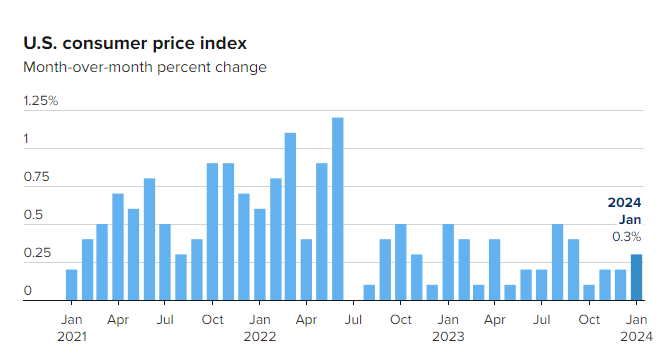
The consumer price index rose 0.3% in January 2024 from December 2023. CPI was up 3.1% year-to-year. Economists expected CPI to have increased by 0.2% month over month in January and 2.9% from a year earlier.
U.S. inflation ticks back up in January 2024 figures
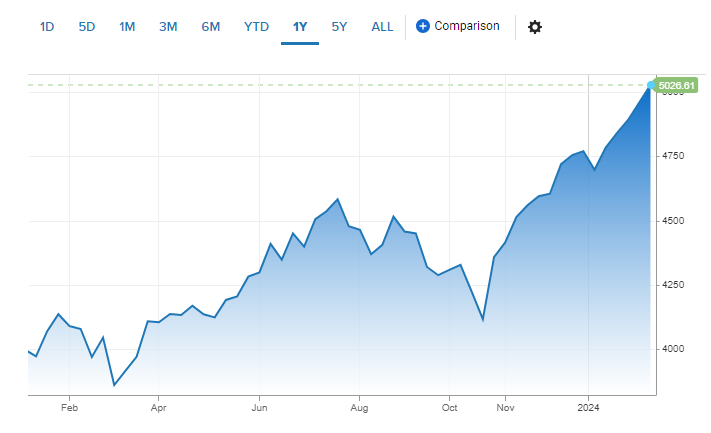
The S&P 500 climbed to a new all-time high of 5026 on 9th February 2024
Stocks rose on Friday 9th February 2024 after December’s revised inflation reading came in lower than first reported, and the S&P 500 closed above the key 5,000 level as strong earnings and economic news came in.
A solid earnings season, easing inflation data and a resilient economy have charged 2024′s market rally. It propelled the S&P 500 to close above the 5,000 level after first touching the milestone during the trading week. The index first crossed 4,000 in April 2021.
We are enjoying good news at an economic and earnings level, and the market is reacting positively. The longer the good news story plays out, the more likely it will be that the market will hold from here.
But it won’t take much to spoil the party, right now I don’t know what that might be…?
S&P 500 1-year chart 9th February 2024 – new all-time high of 5026
S&P 500 1 year chart 9th February 2024 – new all-time high of 5026
FOMO or the fear of missing out is likely playing its part here too.
After a decade-long bull run throughout the 1980’s, the Nikkei 225 index reached an all-time high of 38,915 on December 29, 1989, the last trading day of the year.
Few could have imagined, on New Year’s Eve of 1989, that the index would be lower 34 years later. As the New Year arrived, the bubble burst.
And now, Japan’s stock markets are on a tear and closing in on that elusive 38195 high of 1989 – but there’s a catch – the Zombies are coming.
Zombie companies
Zombie firms are businesses that are unprofitable and struggling to keep afloat. They don’t have excess capital to invest and grow the business, or to pay down the loan capital.
Concerns about zombie firms are coming into focus as the Bank of Japan is tipped to raise interest rates in 2024 for the first time since 2007.
It comes as the Nikkei 225 rises to its highest point in almost 34 years
Japan’s stock markets have been on a meteoric run since the start of 2023, repeatedly breaching 33-year highs and outperforming the rest of Asia.
However, there are rising concerns that so called ‘zombie’ firms, which are unprofitable and struggling to keep afloat, could cut short that rally. The Bank of Japan is widely expected to raise interest rates this year, and that could easily tip many of these firms into bankruptcy, which could have a broader impact on the economy and stock market,
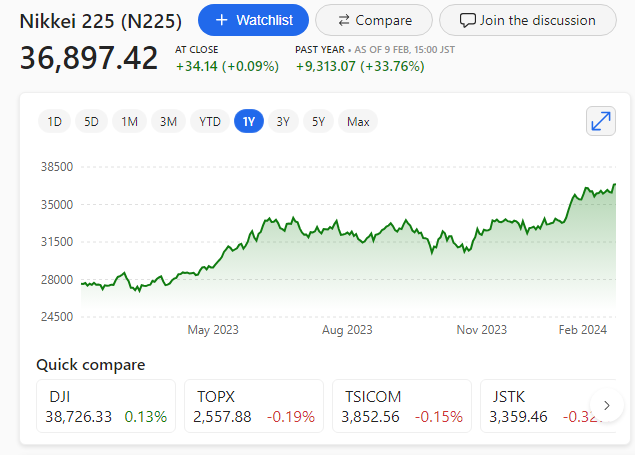
Nikkei 225 1-year chart 9th February 2024
Nikkei 225 1-year chart 9th February 2024
Bankrupt businesses
Zombie firms are nothing new in Japan. They first emerged after the stock ‘bubble’ and subsequent crash of the 1990s, when banks continued to support companies that would have otherwise gone bankrupt.
The pandemic of 2020 accelerated the problem of zombie businesses, with the number of zombie firms in Japan reportedly jumping by around 33% between 2021 and 2022.
At the end of 2023, Japan reportedly had around 250,000 companies that are technically zombie businesses
Some experts argue that zombie firms are a drag on Japan’s productivity, innovation, and growth, as they occupy resources and crowd out more efficient firms. The debate on how to deal with zombie firms is ongoing and may have implications for Japan’s economic recovery and future prospects.
Others suggest that zombie firms may have a positive effect, such as preserving employment, social stability, and industrial diversity.
Surely, there is no room for inefficiently run businesses making little or no profit in any economy.
U.S. stocks have had a good year in 2023, and a great start to 2024 with new record highs being set.
Many major indices have recorded double-digit gains. However, some analysts have warned that the rally may not last, as it has been driven by a few large-cap technology and growth stocks, while many other sectors and regions have lagged behind.
A stock market rally is a broad and rapid rise in share prices, often defined as a 20% increase from a recent low.
This could indicate a lack of breadth and sustainability in the rally, and potentially signal a market pullback, correction or even a crash in the future.
Bull bear, bull?
Chartists with their technical analysis might see a pattern that points to a substantial upside, but they should not get too carried away with their own observations, right now would be a sensible time for markets to find level ground, if only temporarily.
The bullish view is that the ‘laggards’ should catch up the ‘mega cap’ stalwarts once again. The bearish view is that the ‘mega cap’ stocks’ will realise they’ve gone too far and need to ride back to the rest of the market. Too few stocks in the same sector hold the balance of power – go check out the Magnificent 7 or even the old FANG stocks.
Catch-up
Either way, there ought to be an opportunity for underrepresented sectors and industries to gain lost ground.
The question is, will there be a pause to allow laggards to catch-up, or will the mega caps simply continue on their march?
The S&P 500 climbed again Wednesday 7th February 2024 and edged ever closer to the 5,000 level.
S&P 500 hit a new high of 4995
S&P 500 hit a new high of 4995 on 7th February 2024
The index, which first breached the 4,000 level in April 2021, added around 0.82% to close at 4,995.06. During session highs, the S&P hit 4,999.89. Quarterly results signalled a thriving U.S. economy.
The Nasdaq 100 jumped to a new high of 15,755
The Nasdaq 100 jumped to a new high of 15,755 on 7th February 2024
The Dow Jones Industrial Average rallied 156 points to close at 38,677 and an all-time high
DJIA closes at new high of 38677on 7th February 2024
Euphoric
Are investors getting swept away with the latest wave of AI related tech results? Quite possibly, as some of what we’re seeing could be based on FOMO (fear of missing out) as traders/investors don’t want to be left behind like they were last year.
However, one undeniable fact is that the U.S. economy isn’t facing as recession any time soon as predicted by many.
Job creation in the U.S. surged in January 2024, as the economy continued to defy predictions of a slowdown
The U.S. economy added 353,000 jobs and average hourly pay jumped, while the unemployment rate held steady at 3.7%, the Labour Department said.
The report extended more job gains that has surprised economists, who have expected a jump in interest rates since 2022 to slow the economy. It hasn’t. No recession or slowdown in the economy so far.
Early rate cut less likely according to these figures
Average hourly earnings increased 0.6%. Year-on-year basis, wages jumped 4.5%, above the 4.1% forecast.
Non-farm payrolls expanded by 353,000 for the month, well above the 185,000 estimate. The unemployment rate held at 3.7%.
Job growth was widespread in January 2024. Professional and business services 74,000. Other sectors included health care 70,000 and retail trade 45,000.
Analysts now say the job market gain and strength make an early interest rate cut less likely.
The U.S. employment data delivered quite a shock, easily beating expectations, with earnings much higher than expected. Stock markets gained and are at elevated levels for the Dow, Nasdaq and the S&P 500. Record highs have been set – are the highs?
Market analysts said these numbers show the U.S. economy is strong and will change the mindsets of those expecting an early interest rate cut.
Expectations of a recession are off the table too, for now.
The world is looking at a debt crisis that will span the rest of this decade and well into the next
$307.4 trillion of world debt!
It’s not going to end well; economists warn with global borrowings hitting a record of $307.4 trillion in September 2023.
Debt at this level is unsustainable.
Both emerging markets and high-income countries have seen a substantial rise in their debt levels. These levels have grown by a some $100 trillion from 10 years ago. The debt has been fueled in part by a higher interest rate environment.
Initially, with borrowing costs at historic lows, countries have benefitted from very low interest rate for the debt. That’s changed.
The next 10 years will likely become known as the ‘Decade of Debt.’
Debt globally is coming to a head.
As a share of the global gross domestic product, debt has risen to 336%. This compares to an average debt-to-GDP ratio of 110% in 2012 for advanced economies, and 35% for emerging economies.It was 334% in the fourth quarter of 2022, according to the most recent global debt monitor report by the Institute of International Finance.
To meet debt payments, it is estimated that around 100 countries will have to cut spending on critical infrastructure including health, education and social projects.
Countries that manage to improve their fiscal situation could benefit by attracting capital, labour and investment. However, those that do not could lose talent and revenue and further increase their debt burden.
In January 2024, inflation logged its biggest monthly jump since August with a 6.7% rise from December 2023.
Year-on-year inflation hit nearly 65%, according to the Turkish Central Bank’s figures released Monday 5th January 2024
The consumer price index (CPI) for the country of 85 million people increased by 64.86% annually, up slightly from the 64.77% of December.
Sectors with the largest monthly price rises were health at 17.7%, hotels, cafes and restaurants at 12%, and miscellaneous goods and services at just over 10%. Clothing and footwear were the only sectors showing a monthly price decrease, with -1.61%.
Food, beverages and tobacco, as well as transportation, all increased between roughly 5% and 7% month-on-month, while housing was up 7.4% since December 2024.
Federal Reserve Chair Jerome Powell said in a U.S. TV interview on Sunday 4th January 2024 that the central bank will proceed carefully with interest rate cuts this year and likely will move at a considerably slower pace than the market expects.
Election year rate cuts?
In the interview and after last week’s Federal Open Market Committee meeting (FOMC), Powell expressed confidence in the economy. However, he promised he wouldn’t be swayed by this year’s presidential election and said the pain he feared from rate hikes never really materialised.
“With the economy strong like that, we feel like we can approach the question of when to begin to reduce interest rates carefully,” he reportedly said.
“We want to see more evidence that inflation is moving sustainably down to 2%,” Powell added. “Our confidence is rising. We just want some more confidence before we take that very important step of beginning to cut interest rates.”
Powell indicated that it was unlikely the FOMC will make that first move in March 2024, which markets have been anticipating.
Gold demand hit record highs in 2023 on the back of persistent geopolitical tensions and continued weakness in some world economies, particularly China according to the World Gold Council.
Total gold demand stood at 4,899 tons in 2023 compared to 4,741 tons in 2022. Gold purchases from central banks led to last year’s surge, with purchases exceeding 1,000 tons for two consecutive years.
Prices reached an all-time high of around $2,135 an ounce in December 2023 as central banks and retail buyers increased their gold investments.
Carats at Costco
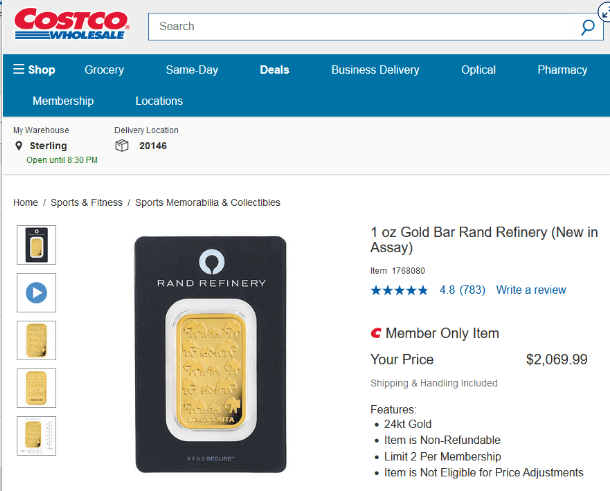
Buyers have many outlets from which to make their gold purchases. Costco recently reported selling over $100 million worth of gold bars in the final quarter of December 2023. Weird to think that we can now buy carats with carrots.
Gold bars for sale at Costco
Gold demand in 2024?
According to some analysts’ gold purchases this year are unlikely to meet 2023 levels, but a fall in inflation could prevent a drastic drop in demand.
When inflation drops significantly, consumers will start to feel ‘better-off’, and this could mitigate some of the drop in demand.
Gold carat
A Gold carat is a unit used to measure the purity of gold, with a carat representing 1/24th part of the whole.
Pure gold is 24 carats, meaning that it is 100% gold with no other metals added. However, gold used for jewellery and other applications is rarely pure, and its purity is measured in carats to determine its value.
UK interest rates have been left unchanged at 5.25% by the Bank of England as widely expected by commentators.
It is the fourth time in a row the Bank has held rates at 5.25%.
The Bank of England had previously raised rates 14 times in a row to curb inflation, leading to increases in mortgage rates but also creating better rates for savers.
Interest rate chart from 2007 to January 2024 demonstrates just how low interest were between 2009 and 2022
Interest rate chart from 2007 to January 2024 demonstrates just how low interest were between 2009 and 2022
Attitude shift
There is a noticeable shift in opinion as the committee entertained the possibility of discussing the feasibility of cuts.
There was a three-way split, with two members of the Monetary Policy Committee (MPC) voting to increase the bank rate to 5.5%; one to reduce it to 5%; and six were in favour of sticking with 5.25%.
With inflation falling it is very likely the interest rates will be reduced by 0.25% by March 2024. Just take a look at the reduction in savers rates that have already occurred.
The anticipation is for a rate reduction soon.
The clue is that savers rates are being cut.
But
The Bank of England Governor, Andrew Bailey, has made clear that for him the key question is: ‘For how long should we keep rates at the current level?’
There may be disappointment ahead then – but a rate cut is next and I still expect it by Easter.
HSBC fined £57.4m by the Bank of England for ‘serious failings’ to protect customer deposits.
The bank failed to accurately identify deposits eligible for the UK’s Financial Services Compensation Scheme, the Bank’s Prudential Regulation Authority (PRA) announced.
HSBC was fined by the Bank of England’s Prudential Regulation Authority (PRA) for failing to properly implement the depositor protection rules, which are meant to safeguard customer deposits in case of a bank collapse.
Serious concerns
The PRA said the failings were ‘serious‘ and ‘materially undermined the firm’s readiness for resolution’. HSBC reportedly said it was pleased to have resolved the ‘historic matter’ and cooperated with the investigation. The ‘failings’ occurred between 2015 and 2022. The fine is the second highest to date imposed by the regulator.
Protected up to £85,000 per person per institution
Under the scheme, customer deposits are protected up to the value of £85,000.
Under depositor protection rules, banks must have systems and controls in place to make sure that financial information is logged correctly. This information is needed if the FSCS has to make payments to customers upon a bank collapse.
However, the PRA said HSBC Bank incorrectly marked 99% of its eligible beneficiary deposits as ‘ineligible’ for FSCS protection.
Unfortunately this episode doesn’t give me much faith in the banking system that is supposed to protect the ‘saver’. At least the PRA discovered the failings.
The Federal Open Market Committee (FOMC) held interest rates steady and indicated a willingness stop raising interest rates.
But a cut anytime soon is unlikely until inflation is brought fully under control and nearer to the Fed’s 2% inflation target.
The Federal Reserve sent a signal that it is finished with raising interest rates but made it clear that it is not ready to start cutting, just yet. It also said there are no plans yet to cut rates with inflation still running above the central bank’s target.
Federal Reserve interest targets and increases since 2022 to January 2024
The U.S. economy grew at a much faster pace than expected in the final three months of 2023.
The U.S. easily avoided a recession that many had forecast as inevitable, the U.S. Commerce Department reported Thursday 25th January 2024.
Gross domestic product (GDP), a measure of all the goods and services produced, increased at a 3.3% annualised rate in the final quarter of 2023, according to data from the Commerce Department.
Core prices for personal consumption expenditures (PCE), a preferred measure by the Federal Reserve as a longer-term inflation calculation, rose 2% for the period, while the rate was 1.7%.
On an annual basis, the PCE price index rose 2.7%, down from 5.9% a year ago, while the core figure excluding food and energy posted a 3.2% increase annually, compared with 5.1%.
Good news
Inflation falling, GDP rising, stabilizing interest rates and no recession thus far the U.S. economy is looking rock-solid despite all the negativity.
Turkey’s central bank on Thursday 25th January 2024 hiked its key interest rate to 45%.
It comes amid an ongoing struggle against double-digit inflation for Turkey’s policymakers, with the rate hike the latest step in that ongoing fight.
30 Turkish Lira to 1 U.S. dollar
Inflation in Turkey increased nearly 65% year-on-year in December 2023, up from 62% in November, and the country’s currency, the lira, hit a new record low against the U.S. dollar earlier in January 2024 at 30 Lira to $1.
Analysts predict this will be the last hike for some time, especially with local elections approaching in March 2024
Spinning the benefits of a tax cut scenario as Chancellor Jeremy Hunt hints at further tax cuts
The Chancellor, Jeremy Hunt, has given strong hints that he wants to cut taxes in the spring Budget.
Mr Hunt reportedly said that countries with lower taxes have more ‘dynamic, faster growing economies.‘ Didn’t Liz Truss say something like that too? But of course, she didn’t ‘cost it out’ in her mini budget apparently – but she also wanted lower taxes for growth none-the-less.
Autumn statement
In the Autumn Statement, the chancellor reduced national insurance for workers by 2% and announced tax relief for businesses. If inflation falls, followed by lower interest rates, Mr Hunt may consider he has scope for further tax cuts.
At the World Economic Forum, in Davos, Switzerland – he was also reported to have said that the: ‘direction of travel’ indicates that economies growing faster than the UK, in North America and Asia tend to have lower taxes. ‘I believe fundamentally that low-tax economies are more dynamic, more competitive and generate more money for public services like the NHS,’ he reportedly said.
It is widely expected that the chancellor will focus on income tax in the upcoming Budget due on 6th March 2024
Lower than expected government borrowing last month has increased the possibility of tax cuts in the Budget, analysts say.
UK Borrowing fell to £7.8bn in December 2023, the Office for National Statistics (ONS) indicated. Interest payments dropped sharply due to a faster than expected decline in inflation. Analysts said the latest figures could give the chancellor more wiggle room for tax cuts.
December’s borrowing figure was £8.4bn less than a year earlier, and the lowest figure for the month since 2019.
Interest payments on government debt fell to £4bn, down by £14.1bn from December 2022.
The S&P 500 index reached a new all-time high of 4,839.81 on Friday, January 19, 2024.
This was the first time the index closed above its previous high set January 3rd 2022. The rally was driven by strong earnings from the magnificent 7 tech giants such as Nvidia and Microsoft.
The expectation of a Fed interest rate cut later this year also helped the S&P500 break new ground.
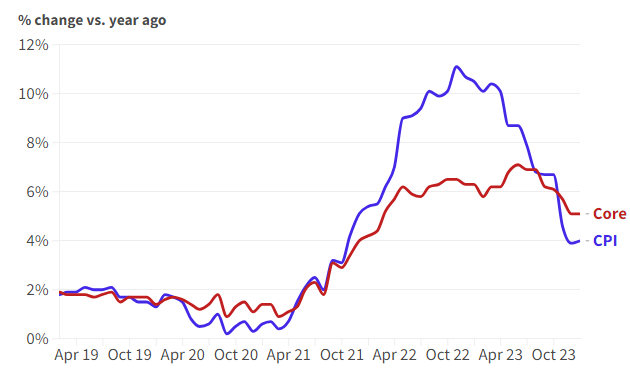
Inflation, rose marginally to 4% in December, up from 3.9% in November 2023.
Economists had forecast a slight fall but unexpected rises in alcohol and tobacco prices were behind the surprise rise.
However, with energy bills predicted to come down in 2024, there are still expectations of interest rate cuts later this year.
On target still for 2%?
As we have seen in the Germany, the U.S., and France, inflation does not fall in a straight line, ‘but our plan is working and we should stick to it,‘ Jeremy Hunt reportedly said in a statement.
UK inflation from April 2019 to December 2023
UK inflation from April 2019 to December 2023
Unprepared for both the start and the end of the pandemic
Increases in the cost of energy and food costs, started by pandemic lockdowns ending exasperated further by Russia’s invasion of Ukraine and more recently the conflict in Israel have put household finances under extreme pressure.
The UK and other countries were woefully underprepared for all of these events as they ‘began’ and at the ‘end’. We did not prepare to come out of them – there was no exit plan!
Markets and traders are still expecting BoE to cut its base rate in 2024 due to the fast-falling inflation rate. It peaked at 11.1% in October 2022 – and now sits at 4%.
The question is: will the economic recovery be good enough to allow the Bank of England to start cutting rates?
The UK interest rate currently sits at 5.25%.
‘What’s inflation?’ ‘Dunno, but my beer’s gone up!’
Stocks moved lower Thursday 11th January 2024, reflecting the higher-than-expected December 2023 inflation data.
The S&P 500 in early trade edged lower by around 0.7%, while the Nasdaq Composite dropped nearly 0.8%. The Dow Jones Industrial Average dropped by 0.6%. The S&P 500 briefly touched 4800 after climbing above its record high of 4,796.
Higher than expected
December’s consumer price index figure came out slightly higher-than-expected, reflecting a 0.3% increase in consumer prices for the month, pushing the annual rate to 3.4%.
Core CPI, excluding volatile food and energy prices, came out in line with expectations, however, pointing to persistent, but easing inflation pressures. The new inflation data figures suggests that future interest rate cuts may be slower to come.
This move up in CPI is an absolute reminder of the unpredictable nature of economic recovery.
According the High Pay Centre, a thinktank that campaigns for fairer pay, the average pay of FTSE 100 chief executives is 103 times the £33,000 average salary for full-time UK workers.
This means that by lunchtime on the third working day of 2024, a FTSE 100 company boss will have been paid more than a UK worker’s full annual salary.
So, this means that it takes approximately just three working days for a CEO to earn the FULL years pay of an average worker in the UK.
The study also shows that the pay gap between bosses and workers has increased since 2020, as executive pay has risen by 9.5% while worker pay has risen by only 6%.
Shocking inequality
This is a disturbing example of inequality in the UK workplace, which has been exacerbated by the cost-of-living crisis and the strike action by many low-paid workers.
Some economists have called for UK government to intervene and reduce the unfair pay gap, such as putting workers on company boards, taxing wealth more fairly, and working with employers and unions to create better living standards.
Wealth creators
There is a place for wealth creators but not for greedy wealth takers. We need businesses to be successful to maintain good levels of employment. But unnecessary wealth greed has no place in our modern society.
The U.S. labour market accumulated strong gains as the pace of hiring was greater than expected, dampening the chance of an early rate cut.
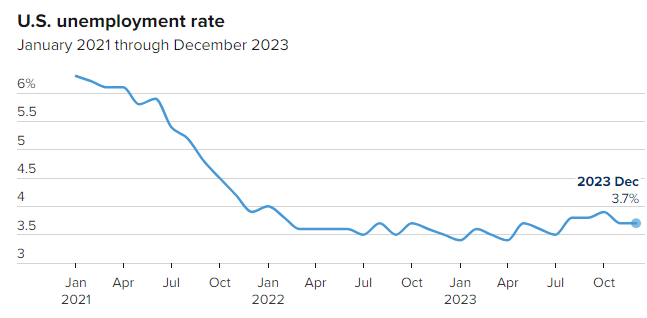
December’s jobs report showed that 216,000 jobs were added for the month while the unemployment rate remained steady at 3.7%. Estimates were in the region of 170,000 as analysts were looking for their ‘goldilocks figure.
Job boost from U.S. government
The hiring boost came from a gain of 52,000 in government jobs and another 38,000 in health care-related occupations.
Average hourly earnings rose 0.4% on the month and were up 4.1% from the same period 2023, both higher than the respective estimates for 0.3% and 3.9%.
U.S. unemployment chart Jan 2021 – December 2023
S&P500 and Nasdaq
The S&P500 and Nasdaq recovered some early 2024 losses as the fresh data encouraged the debate and chance of a rate cut again. Later however, the strong U.S. jobs growth dampened the likelihood of rate a cut anytime soon. Yields were on the rise again.
Strong streak
Government hiring drove the gains, which extended one of the strongest streaks of job creation on record. The job growth has confounded forecasters expecting job losses as higher borrowing costs slowed the economy.
Mortgage lenders have started 2024 by cutting interest rates.
The UK’s biggest lender, the Halifax, has cut some interest rates by nearly a full 1%, with other lenders expected to follow suit. HSBC has announced it will also make cuts in January.
Halifax is reducing its rates, with interest on a two-year fixed deal being cut by up to 0.83%. HSBC is due to reduce rates on its two-year fixed rate for remortgages (for someone with at least 40% equity in their home) falling below 4.5% for the first time since early June last year.
Mortgage rate chart October 2021 – January 2024
The Bank of England’s (BoE) benchmark interest rate has been held three times at 5.25%, analysts now expect the next move to be down.
House prices have ended the year 1.8% lower in the UK, according to Nationwide Building Society
The Nationwide forecasts no growth or a further fall in 2024.
The lender said the average house price across the UK was £257,443 in December 2023. This was flat compared to November 2023 but down compared to December 2022.
The lender reportedly said that consumer confidence ‘remains weak’, despite some mortgage rates falling in anticipation for Bank of England (BoE) to cut borrowing costs in the months ahead.
The number of housing transactions has been running at around 10% below pre-Covid levels, Nationwide reported. The fall was more pronounced for those buying a house using a mortgage – down 20% compared to before the pandemic.
However, the volume of cash deals continues to run above the levels recorded before Covid hit.
The UK is at risk of recession after revised figures indicate the economy shrank between July and September 2023.
A recession is defined as when the economy shrinks for two three-month periods in a row.
Gross Domestic Product (GDP), which measures the health of the economy, contracted by 0.1% after previous estimates suggested growth has been flat. There was no growth between April and June 2023, after it was first calculated to have risen by 0.2%.
There have been concerns over the UK’s weak economic growth for a while now, but the UK has managed to avoid a recession so far. Whether or not there is a small recession, the bigger picture for analysts is that they expect real GDP growth to remain subdued throughout 2024. However, bear in mind that projections and forecasts do change, as already demonstrated.
Earlier this week, data showed that inflation, which measures the rate of price rises, slowed by more than expected to 3.9% in the year to November 2023, down from 4.6% in the previous month.