

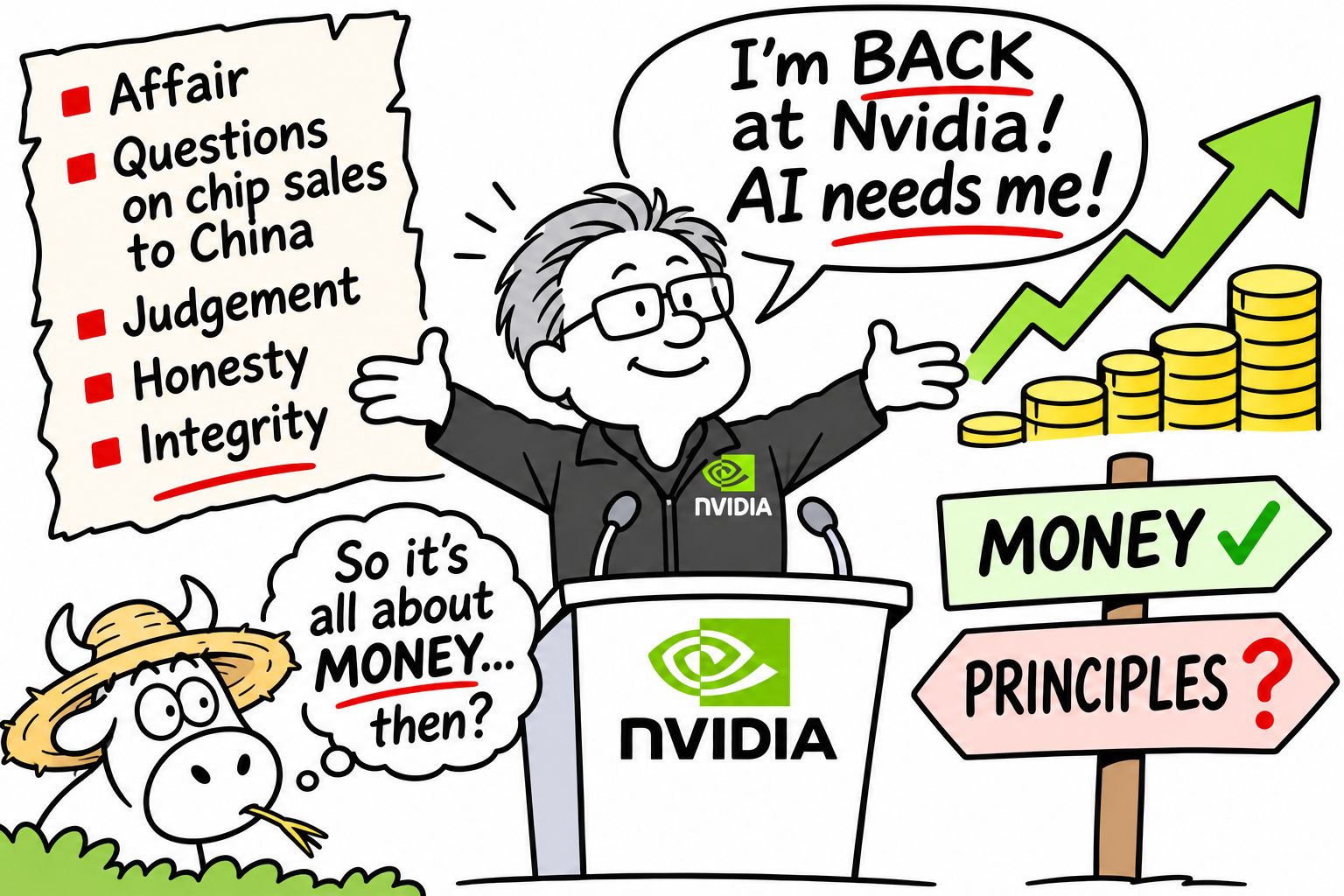
The decision by Nvidia to reinstate founder Jensen Huang as chief executive raises a question that goes well beyond one man’s personal conduct.
Has the extraordinary financial power of artificial intelligence created a business environment in which commercial success matters more than corporate responsibility?
Huang’s departure followed revelations about extramarital relationships, including one involving Chinese businesswoman Alice Huang, whom U.S. intelligence officials suspect of having links to Chinese espionage.
Those allegations have not been independently established. There are also serious questions surrounding Nvidia’s business relationships and the movement of its advanced chips into China.
Reports have suggested that a network of companies connected to Alice Huang helped facilitate billions of dollars in Nvidia chip shipments.
Reports suggest that U.S. authorities are seeking further answers about the company’s export controls and compliance procedures.
Yet, despite the controversy, Nvidia’s board has now unanimously reinstated Huang. The company’s extraordinary commercial success, his importance to its development and the support of influential figures have clearly weighed heavily in the decision.
But what message does this send?
Should a chief executive’s commercial achievements outweigh questions about personal conduct, corporate governance and potential national security implications?
Where does accountability begin and end when a company becomes worth trillions of dollars and its technology is central to the global AI race?
The argument is that Huang built Nvidia into an extraordinary business and remains uniquely capable of leading it.
Shareholders want results, customers want chips and investors want profits. From that perspective, bringing him back may appear commercially logical.
However, there is another side. If extraordinary profits provide sufficient protection from the consequences of questionable behaviour, what incentive remains for companies to uphold the standards they publicly promote?
Is the AI trade itself becoming morally compromised?
Or is making money so psychologically ingrained in the stock market now – nothing else matters!
The AI investment boom has been driven by enormous expectations, huge capital expenditure and an almost insatiable appetite for computing power.
Nvidia sits at the centre of this financial ecosystem. Its success has become synonymous with the success of AI itself.
But technology, however revolutionary, cannot be separated from the conduct of the businesses developing and supplying it.
Perhaps the biggest risk to the AI trade is not that artificial intelligence fails to deliver, but that investors become so blinded by the prospect of profit that they stop asking difficult questions.
When commercial success becomes the overriding consideration, principles can quickly become negotiable.
And that may be a far more troubling development than any short-term movement in Nvidia’s share price.
NOTE: the alleged espionage connection remains under investigation; it should not be read as proven.
What does it say about Huang as a person?
I think it raises some very serious questions about Jensen Huang’s character, particularly around judgement, honesty, personal responsibility and the boundaries between business and private life.
But I would distinguish between what we know and what remains alleged.
Aspects that concern me
1. Personal integrity
Huang has acknowledged being unfaithful to his wife and apologised for disappointing his family and Nvidia.
That is a personal failing, but it becomes more significant when the individual concerned is one of the most influential business leaders in the world.
2. Honesty and transparency
It was reported that Huang had described his interactions with Alice Huang to senior Nvidia executives as ordinary business dealings, rather than disclosing the intimate relationship.
If that reporting is accurate, the issue moves beyond infidelity into questions about professional honesty and judgement.
3. Judgement and responsibility
Entering an intimate relationship with someone who was connected to a major Nvidia customer, while that customer’s business was under scrutiny over suspected transfers of restricted chips to China, raises serious questions about professional boundaries.
It does not establish that Huang knowingly compromised national security or participated in wrongdoing. Those are separate questions still requiring evidence.
4. The return to power
Perhaps the most revealing aspect is the speed with which the situation has been reversed. Nvidia initially accepted his resignation and subsequently reinstated him.
The board says it is satisfied with his candour and leadership. Really!?
That raises an uncomfortable question: would an ordinary employee receive the same opportunity to return after comparable conduct?
My overall assessment (for what it’s worth)
I wouldn’t pretend to know Jensen Huang as a ‘person’ from news reports. He has built an extraordinary technology business, created enormous shareholder value and demonstrated considerable entrepreneurial ability.
But business brilliance and personal integrity are not interchangeable qualities.
What concerns me most is the apparent willingness of the corporate world to separate the two whenever enough money is involved.
There is a difference between forgiving somebody who makes a mistake and overlooking behaviour that raises legitimate questions about their honesty and judgement.
And perhaps that is the real story here
If Nvidia is so dependent on one individual that it cannot contemplate life without him, has the company become bigger than its own standards?
And if commercial success is sufficient to restore someone to the top, what exactly are corporate codes of conduct worth?
That is a question Nvidia’s shareholders, employees and customers should be asking.
Too big to fire!
And Trump says it’s OK too!