

Microsoft is facing another major technology headache after a global outage disrupted its Microsoft 365 services, leaving businesses, government departments and millions of users struggling to access essential systems.
System Server Issues?
What initially appeared to be a server problem has developed into a prolonged recovery operation, with the company admitting that its attempts to restore normal service have not gone as expected.
The disruption began on Thursday 12th November 2026 and continued into Friday, affecting customers across the Americas, Europe and Asia-Pacific.
DownDetector
At its peak, Downdetector reportedly recorded more something like 130,000 reports of Outlook problems in the United States alone.
The true number of affected customers worldwide has not been confirmed, although the disruption has reached users in 74 countries and territories.
The list of affected products is extensive. Outlook and Exchange Online have reportedly experienced email access and delivery problems, while Microsoft Teams, SharePoint, Copilot, Planner, To Do, Intune and elements of Microsoft’s security services have also been affected.
Some functions, including core Teams messaging and online meetings, have continued working. It’s patchy.
So what has actually gone wrong?
Microsoft’s investigation identified a process on affected servers responsible for establishing secure connections that had become overwhelmed, causing servers to stop processing requests.
A recent network configuration change has also been identified as potentially contributing to the problem. Microsoft says it has no indication that this is a cyberattack.
Think of the internet as a motorway. If several lanes suddenly close, the remaining lanes have to accommodate the same volume of traffic.
Congestion builds, journeys slow and eventually the remaining capacity struggles to cope. The same principle applies to a network of servers. When some become unavailable, the others must handle additional traffic.
If they are already struggling, the additional demand can create a vicious circle. Microsoft’s attempts to restart affected servers have even reportedly encountered problems when traffic is returned to them.
But perhaps the bigger question concerns the future
This is not the first time Microsoft has experienced a significant outage. Nor is it alone. The CrowdStrike incident in 2024 demonstrated how a single faulty software update could cause widespread disruption across airlines, businesses and essential services.
Now consider where the technology industry is heading. Artificial intelligence is driving an enormous expansion in data centres, computing capacity and electricity demand.
These facilities require substantial power, cooling systems, networking infrastructure and increasingly sophisticated hardware.
AI
Will AI make our digital infrastructure more efficient, or will it simply create an even greater appetite for resources? More importantly, can the underlying infrastructure keep pace with the demands being placed upon it?
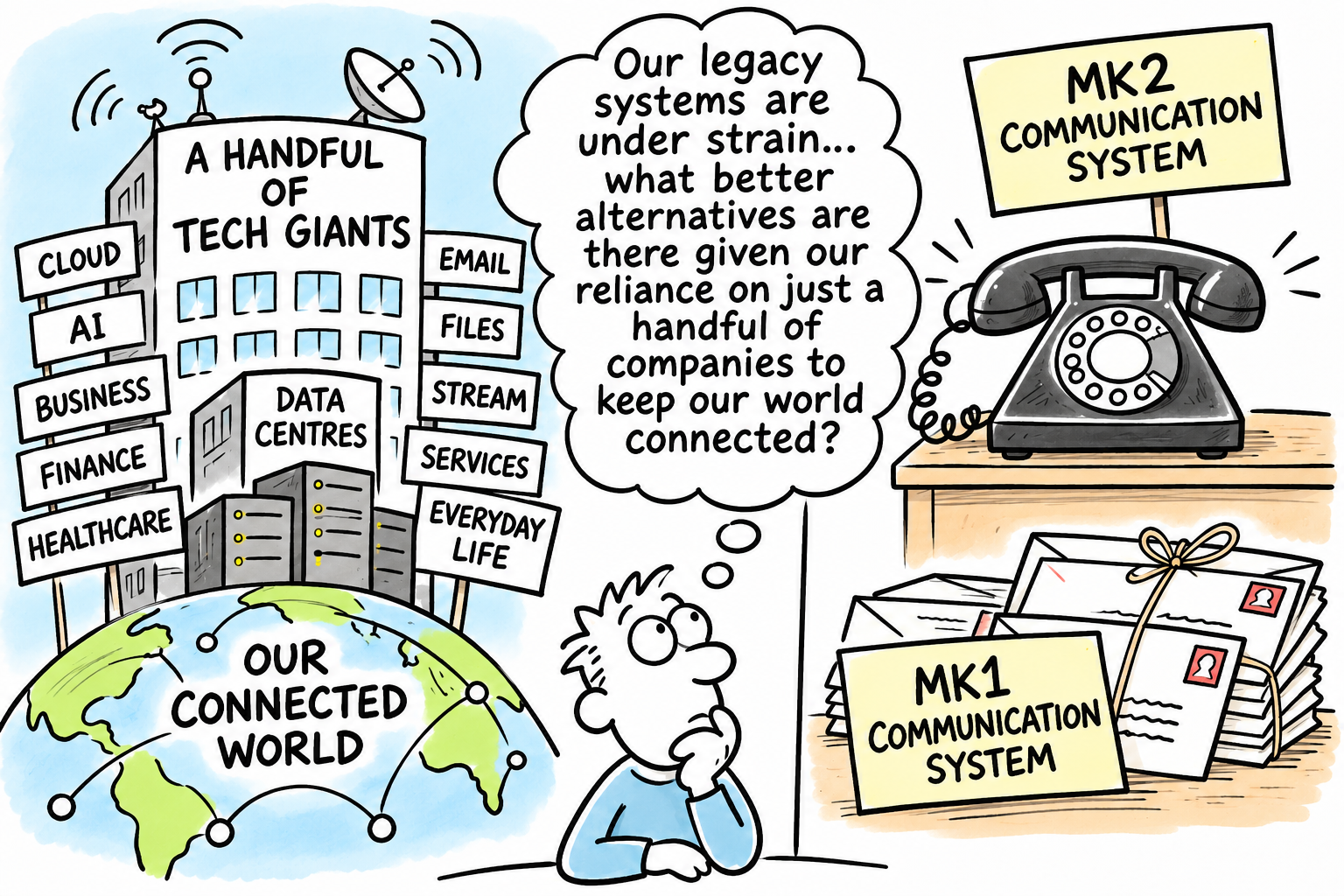
There is an uncomfortable concentration of responsibility here. A relatively small number of technology companies provide services upon which businesses, financial institutions, governments, healthcare organisations and ordinary households increasingly depend.
When one provider experiences difficulties, the consequences can spread far beyond its own business.
What Next?
What happens next must involve more than repairing the immediate fault. Greater resilience, independent backup systems, alternative providers and better disaster recovery arrangements need to become priorities rather than optional extras.
Technology is becoming increasingly central to our lives. But convenience must not come at the expense of reliability.
If the digital motorway is becoming busier every year, simply adding more traffic is not a solution.
We need more lanes, better traffic management and, above all, alternative routes when something goes wrong.
Easier said than done!