

AI-Driven Cyberattack Exposes New Threat to European Security

EU AI Cyberattack

The European Commission has disclosed details of a cyberattack discovered last month, raising fresh concerns about the growing use of artificial intelligence by hackers to identify weaknesses and penetrate computer systems.

The incident, detected on 22nd October 2026 and publicly discussed on 19th November 2026, targeted the Commission’s digital infrastructure in Brussels.

AI assisted crime

Although the intrusion was subsequently contained, the investigation has highlighted how AI-assisted technology could change the scale and sophistication of cybercrime.

According to reports, several internal applications were affected, including systems associated with employee administration, payroll, working hours, medical reimbursements and translation services.

Some digital services were temporarily taken offline as investigators worked to contain the incident. Most have since been restored.

The Commission has said it has found no evidence of a widespread data breach affecting its staff, although questions remain about whether attackers accessed or extracted confidential information.

NOTE: The full extent of any potential data exposure has not yet been established.

AI becomes a hacking tool

What makes this incident particularly significant is the reported involvement of artificial intelligence in the attack.

Media reports have identified an AI-assisted vulnerability discovery platform called ARTEX as potentially being involved. Such technology can examine software and computer networks to identify weaknesses that could be exploited by attackers.

Traditionally, identifying vulnerabilities and developing methods to exploit them required considerable technical expertise and time.

AI can potentially accelerate these processes, allowing hackers to examine large numbers of systems, identify security gaps and develop attack strategies much faster.

However, the European Commission has not publicly confirmed ARTEX as the specific tool used, and the precise technical details of the intrusion remain under investigation.

The attackers have not been identified, and no country or organisation has been officially blamed. There has also been no confirmed indication that the incident was part of a state-sponsored operation.

A growing challenge for cybersecurity

The incident illustrates an increasingly difficult problem for governments and businesses. Artificial intelligence is becoming an important component of cybersecurity, helping organisations detect suspicious activity, identify vulnerabilities and strengthen their defences.

AI assisted counter to cybercrime

Yet the same capabilities can be turned against them.

AI-assisted tools could allow relatively small groups of hackers to undertake operations that previously demanded larger teams of highly skilled specialists.

Automated vulnerability discovery, faster analysis and the ability to adapt techniques could make future attacks more frequent and difficult to prevent.

For European institutions, the implications extend beyond the disruption of internal administration. Government networks hold sensitive information, manage essential services and connect with other public institutions.

A successful intrusion could potentially have consequences far beyond the original target.

The Commission’s investigation continues, with important questions still unanswered about the information accessed, the attackers’ intentions and the precise methods employed.

This incident may ultimately be remembered as another warning about the changing nature of cyber warfare. Artificial intelligence is not simply making computers smarter; it is potentially making cyberattacks faster, cheaper and more accessible.

As governments race to develop and regulate increasingly powerful AI systems, protecting the digital infrastructure on which modern society depends is becoming an equally urgent priority.

The technology intended to strengthen our digital future may also become one of its greatest security challenges.

Good AI vs Bad AI.

Good use of AI vs bad use of AI.

Critical Java Security Flaw Exposed as AI Uncovers Decade-Old Vulnerability

A cartoon showing a Java security flaw detected by AI

A potentially serious security vulnerability in Java, another of the world’s most widely used programming platforms, has raised concerns about the safety of computer systems used by businesses, governments and financial institutions.

The flaw, reportedly named Java4Shell, was exposed on 18th November 2026 after cybersecurity researchers identified a weakness that could potentially allow attackers to gain remote access to vulnerable systems without requiring a password.

Java

Java is widely used across the technology industry, supporting everything from banking applications and corporate databases to government systems and online services.

Consequently, a weakness in its underlying infrastructure could have far-reaching implications.

The vulnerability affects Java’s Base64 decoding function, which converts encoded information into data that computers can process.

Researchers discovered that specially constructed data could exploit a memory-handling error, potentially allowing malicious code to be executed.

Several widely used business applications have been identified as potentially vulnerable.

Not all affected

However, not every installation of Java is affected. Exploitation depends on particular software versions, hardware capabilities and how applications process incoming data.

Perhaps the most remarkable aspect of the discovery is the involvement of artificial intelligence.

Researchers at cybersecurity company Calif reportedly used OpenAI’s Codex coding assistant to investigate Java’s internal programming.

AI identified issue

According to the company, AI helped identify the vulnerability in approximately one hour, with a working initial exploit developed within a further two hours. The reported AI costs were less than $200.

The discovery highlights both the opportunities and dangers associated with increasingly capable artificial intelligence. AI can help cybersecurity specialists identify weaknesses before criminals exploit them.

However, the same technology could also enable malicious hackers to discover vulnerabilities and develop attacks much faster than previously possible.

Updates issued

There is some reassurance. Security updates addressing the vulnerability have been released, and organisations have been urged to update affected software immediately. Authorities in several countries have also issued warnings.

Importantly, there is currently no confirmed evidence of widespread real-world attacks exploiting this particular vulnerability. This is a security flaw that researchers have identified and demonstrated, rather than a confirmed global hacking incident.

Vulnerabilties

Nevertheless, the discovery raises uncomfortable questions. If a potentially significant vulnerability could remain undetected for more than a decade, how many other weaknesses remain hidden inside the software supporting the global economy?

The Java discovery is about more than one programming flaw. It demonstrates how artificial intelligence is changing cybersecurity, potentially creating a race between those trying to protect digital infrastructure and those looking to compromise it.

America’s Air Traffic Control System Grinds to a Halt: What Went Wrong?

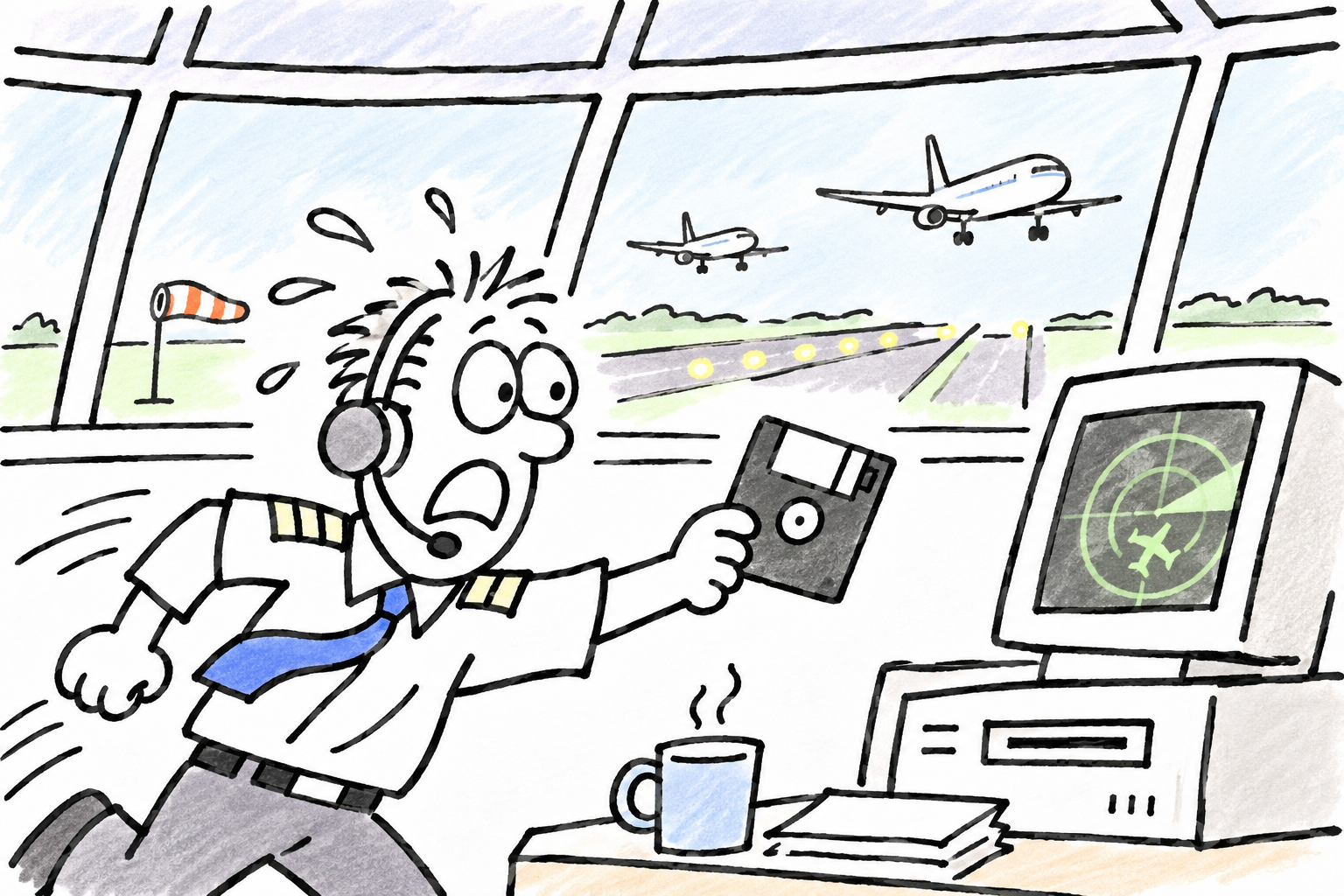
A stressed air traffic controller sits at a console surrounded by multiple monitors displaying flight paths and radar data, illustrating the chaos during the nationwide air traffic control system outage.

The United States experienced one of its most extraordinary aviation disruptions on Friday, 13th November 2026, when the Federal Aviation Administration (FAA) ordered a nationwide grounding of departing flights following a major communications failure within its air traffic control system.

For more than four hours, America’s aviation network was effectively brought to a standstill.

Thousands of passengers were stranded, airports became congested and airlines struggled to understand when normal operations could resume.

But what actually happened, and why did a problem with communications on the ground have such far-reaching consequences?

A failure in the system

The trouble began at approximately 3.36pm Eastern Time, when air traffic control facilities started experiencing instability in their radar and communications systems.

According to U.S. Transportation Secretary, the problem involved an ageing network of routers within the air traffic control infrastructure.

Engineers were replacing older copper connections with modern fibre-optic technology at a remote facility. During this work, a router began generating an extraordinary volume of connection requests, overwhelming other equipment across the network.

It was also reported that in some instances, decades old floppy disks were still be used to move data.

Officials subsequently revealed that the system was reportedly receiving more than 1,000 connection attempts every four to five seconds.

This created inconsistent information, affecting communications between controllers and aircraft, as well as radar feeds used to track their positions.

The problem spread beyond the original location, affecting multiple air traffic control centres.

Why were aircraft grounded?

Air traffic controllers depend on reliable radar information and uninterrupted communications with pilots. They must know precisely where aircraft are, their altitude, direction and intended flight paths.

When that information becomes unreliable, maintaining safe separation between aircraft becomes increasingly difficult.

The FAA therefore took the precautionary decision to stop departing flights nationwide. Aircraft already in the air were safely guided to land, with controllers and pilots working together to bring more than 3,500 aircraft down safely.

This was not an indication that aircraft were suddenly unsafe or that a collision was imminent. Rather, the authorities could not guarantee that the system was operating reliably enough to support normal levels of traffic.

The disruption continues

The nationwide ground stop was lifted at approximately 8.15pm Eastern Time on Friday, allowing departures to resume. However, reopening the airspace did not immediately restore normal operations.

Thousands of flights had been cancelled or delayed. Aircraft and crews were in the wrong locations, passengers were stranded and airports faced the difficult task of rebuilding schedules.

The disruption continued into Saturday, with further cancellations and delays reported.

An uncomfortable warning

The incident has raised serious questions about America’s reliance on ageing infrastructure.

Modern aircraft are increasingly sophisticated, yet the technology supporting the movement of thousands of flights still depends on systems that are decades old.

There was no initial evidence of a cyberattack. Instead, an apparently routine technology upgrade exposed a much wider vulnerability.

The question now is whether America can modernise its aviation infrastructure quickly enough to prevent a repeat of Friday’s extraordinary events.

Note: The technical explanation is particularly important here: this was not simply a computer outage.

A failure during an infrastructure upgrade caused excessive network traffic, which affected both radar information and communications across a substantial part of the national air traffic control network.

Officials reportedly said there was no initial indication of a cyberattack.

Microsoft Outage: When the Digital Motorway Starts Running Out of Lanes – A Jolt to Remind us just how Fragile our Infrastructure is!

Illustration showing major global tech companies and their communication networks, highlighting interconnected systems and the potential points of failure in digital infrastructure.

Microsoft is facing another major technology headache after a global outage disrupted its Microsoft 365 services, leaving businesses, government departments and millions of users struggling to access essential systems.

System Server Issues?

What initially appeared to be a server problem has developed into a prolonged recovery operation, with the company admitting that its attempts to restore normal service have not gone as expected.

The disruption began on Thursday 12th November 2026 and continued into Friday, affecting customers across the Americas, Europe and Asia-Pacific.

DownDetector

At its peak, Downdetector reportedly recorded more something like 130,000 reports of Outlook problems in the United States alone.

The true number of affected customers worldwide has not been confirmed, although the disruption has reached users in 74 countries and territories.

The list of affected products is extensive. Outlook and Exchange Online have reportedly experienced email access and delivery problems, while Microsoft Teams, SharePoint, Copilot, Planner, To Do, Intune and elements of Microsoft’s security services have also been affected.

Some functions, including core Teams messaging and online meetings, have continued working. It’s patchy.

So what has actually gone wrong?

Microsoft’s investigation identified a process on affected servers responsible for establishing secure connections that had become overwhelmed, causing servers to stop processing requests.

A recent network configuration change has also been identified as potentially contributing to the problem. Microsoft says it has no indication that this is a cyberattack.

Think of the internet as a motorway. If several lanes suddenly close, the remaining lanes have to accommodate the same volume of traffic.

Congestion builds, journeys slow and eventually the remaining capacity struggles to cope. The same principle applies to a network of servers. When some become unavailable, the others must handle additional traffic.

If they are already struggling, the additional demand can create a vicious circle. Microsoft’s attempts to restart affected servers have even reportedly encountered problems when traffic is returned to them.

But perhaps the bigger question concerns the future

This is not the first time Microsoft has experienced a significant outage. Nor is it alone. The CrowdStrike incident in 2024 demonstrated how a single faulty software update could cause widespread disruption across airlines, businesses and essential services.

Now consider where the technology industry is heading. Artificial intelligence is driving an enormous expansion in data centres, computing capacity and electricity demand.

These facilities require substantial power, cooling systems, networking infrastructure and increasingly sophisticated hardware.

AI

Will AI make our digital infrastructure more efficient, or will it simply create an even greater appetite for resources? More importantly, can the underlying infrastructure keep pace with the demands being placed upon it?

There is an uncomfortable concentration of responsibility here. A relatively small number of technology companies provide services upon which businesses, financial institutions, governments, healthcare organisations and ordinary households increasingly depend.

When one provider experiences difficulties, the consequences can spread far beyond its own business.

What Next?

What happens next must involve more than repairing the immediate fault. Greater resilience, independent backup systems, alternative providers and better disaster recovery arrangements need to become priorities rather than optional extras.

Technology is becoming increasingly central to our lives. But convenience must not come at the expense of reliability.

If the digital motorway is becoming busier every year, simply adding more traffic is not a solution.

We need more lanes, better traffic management and, above all, alternative routes when something goes wrong.

Easier said than done!

Binance Hack: The $6.3 Billion Crypto Heist That Shook the Market

Biggest heist in history

The cryptocurrency world is facing an unprecedented security crisis after Binance, the world’s largest cryptocurrency exchange, suffered a devastating cyberattack on 29th October 2026, resulting in the theft of approximately $6.3 billion in digital assets.

The incident is believed to be the largest cryptocurrency theft in history, possibly even the biggest heist in history!

How can this happen in such a secure environment?

Investigators believe hackers compromised Binance’s internal transaction-signing infrastructure, enabling them to authorise enormous unauthorised withdrawals from its hot wallets.

The FBI has reportedly attributed the attack to North Korea’s TraderTraitor hacking group, although investigations remain ongoing.

The scale of the theft initially raised fears about Binance’s ability to meet customer withdrawals and maintain confidence in its financial position.

Withdrawals suspended

Binance temporarily suspended withdrawals while it investigated the breach and strengthened security systems.

However, the exchange moved quickly to reassure customers, pledging that users would not bear the financial losses. It set reportedly aside approximately $6.34 billion from corporate funds, its Secure Asset Fund for Users (SAFU) and insurance reserves to replace the stolen assets.

Recovery

By 31st October, Binance reported that 90% of the missing assets had been replenished, with the remaining 10% involving less liquid cryptocurrencies.

Recovery efforts have also achieved some success. Blockchain investigators and cryptocurrency issuers have helped freeze approximately $3 billion of stolen funds, restricting the hackers’ ability to move or convert them.

Damage limitation

But confidence has taken a significant hit. When withdrawals gradually reopened on 1 November, customers withdrew $4.65 billion, against deposits of just $1.01 billion. The resulting net outflow of $3.64 billion represented approximately 2.1% of Binance’s reported $171 billion in assets.

Confidence

Although withdrawal volumes subsequently began stabilising, the episode highlights a fundamental weakness in cryptocurrency markets: even the largest exchanges remain vulnerable to sophisticated cyberattacks.

Binance may have the financial resources to absorb the losses, but rebuilding customer confidence could prove considerably harder.

The incident raises fresh questions about security, transparency and whether cryptocurrency exchanges can truly guarantee the safety of billions in digital wealth.

Footnote

Binance founder Changpeng Zhao (CZ) pleaded guilty in November 2023 to violating U.S. anti-money-laundering laws, resigned as chief executive and served a four-month prison sentence in 2024. Despite his conviction, he retained his estimated 90% ownership stake in Binance.

In October 2025, President Donald Trump granted him a full presidential pardon. The pardon did not erase the historical events or Binance’s separate corporate wrongdoing, but it removed the federal criminal consequences for CZ.

Legally, a criminal conviction does not automatically prevent someone from owning a private company, and ownership is distinct from day-to-day management.

Consequently, CZ can remain the majority shareholder of the world’s largest cryptocurrency exchange, even though he is no longer its chief executive.

It raises an uncomfortable question about accountability: how can an individual convicted of serious financial regulatory offences retain such enormous influence over a global financial institution?