

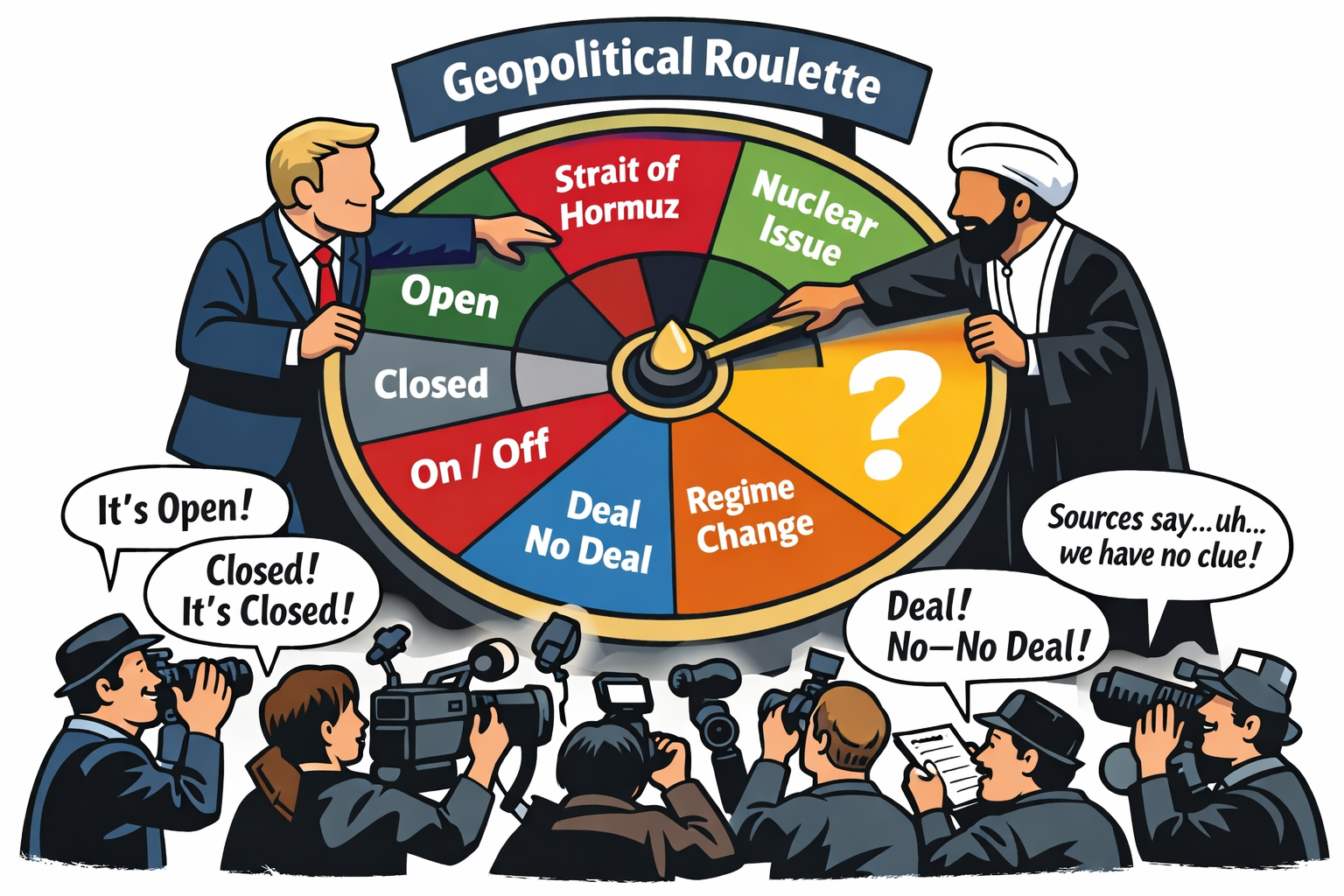
If you step back from the headlines and strip away the diplomatic theatre, the current U.S.–Iran “negotiation” looks less like a triumph and more like a clumsy attempt to repackage failure as progress.
Strait of Hormuz – an open and shut case
The public is being told that Washington has secured major achievements: the Strait of Hormuz reopening, tensions easing, and Iran’s nuclear ambitions supposedly contained. But look closer and the narrative collapses under its own contradictions.
Start with the Strait of Hormuz. It was not closed because of some spontaneous regional flare‑up; it was closed because a U.S. administration attempted, and largely failed, to force regime change in Tehran.
That failure triggered retaliation, escalation, and a strategic choke point being shut down. Now, after months of chaos, the U.S. is celebrating the Strait reopening (or is it?) — essentially applauding itself for returning the region to the status quo that existed before it destabilised it. It isn’t open… is it?
It is the geopolitical equivalent of setting your own kitchen on fire, putting it out, and then demanding praise for your firefighting skills.
Nuclear problem
The nuclear issue is no less farcical. The media narrative implies that Iran’s nuclear ambitions have been “addressed”, “contained”, or “rolled back”. Yet nothing in the public domain suggests any meaningful rollback at all.
Iran has not dismantled centrifuges, surrendered stockpiles, or accepted intrusive inspections as far as we are being told. In fact, the regime appears to have conceded almost nothing of strategic value.
Regime change or spin?
The U.S. has simply stopped trying to remove them from power and is now negotiating with the very government regime it previously sought to topple. That is not a diplomatic victory; it is an admission of strategic defeat dressed up as pragmatism.
And yet the stock market — ever eager to reward the appearance of stability, however artificial — rallies on cue. Investors do not care whether the underlying policy is coherent, honest, or even remotely successful. Watch the ‘weekend’ timings.
They care only that the headlines signal “reduced risk”. If the White House can spin a failed regime‑change attempt into a “peace process”, markets will happily play along.
The absurdity is that the worse the original policy was, the more dramatic the rebound looks when the U.S. quietly abandons it.
Media’s ‘predictability’
The media’s role in this is depressingly predictable. Rather than interrogating the contradictions, they amplify the official line: progress, diplomacy, de‑escalation.
Little attention is given to the fact that the U.S. is negotiating from a position of weakness created by its own miscalculations.
Even less attention is given to the reality that Iran has emerged from the crisis with its regime intact, its nuclear programme largely untouched, and its regional leverage arguably strengthened.
Toxic
So why is it being sold like this? Because admitting the truth — that a major U.S. foreign‑policy gambit backfired and is now being quietly reversed — is politically toxic.
It is far easier to rebrand failure as maturity, escalation as diplomacy, and retreat as statesmanship. Politics!
The public deserves better than this theatre. What we are witnessing is not a breakthrough but a reset, not a triumph but a cover‑up, and not a solution but a return to the very conditions that existed before the U.S. “messed up” in the first place.
It’s farcical.
And the markets move on every whimsical social media post amplified by the hungry media to fill white space.
And who suffers the most through all these ill-judged actions – you and me.
But is there an argument in favour of preventing nuclear weapons falling into the arms of potentially ‘bad’ actors.
Yes, of course,
But is that what this is about?
Let’s hope so.