

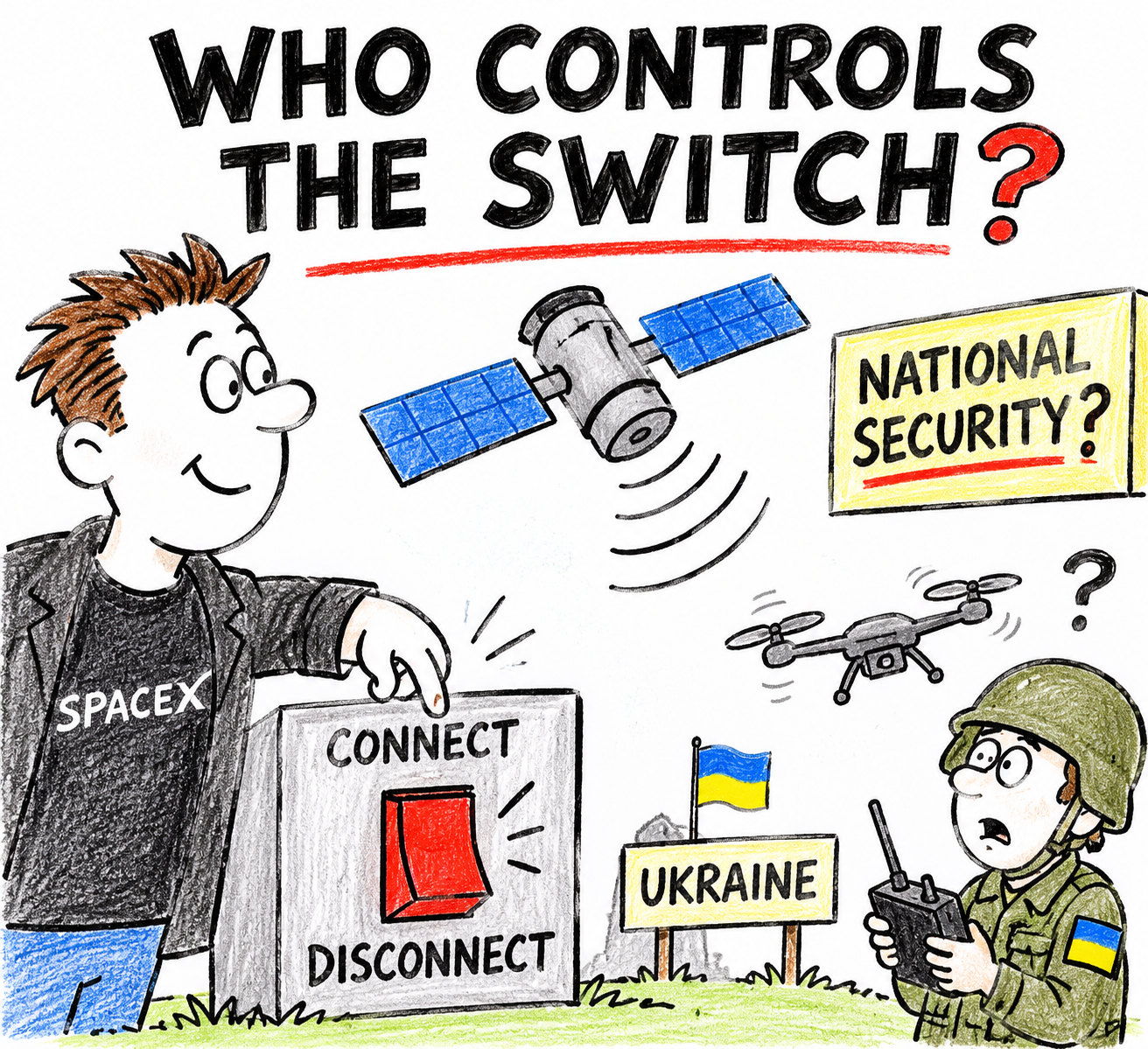
Have Elon Musk, Donald Trump and the control of critical technology exposed a dangerous weakness in modern warfare.
Remote control decision
Imagine fighting a war for your country’s survival, only to discover that some of your most important military capabilities can be weakened by a decision taken thousands of miles away, in a boardroom or a government or by the White House for instance.
That is the unsettling question raised by the latest controversy surrounding Elon Musk’s SpaceX satellite technology, Donald Trump and Ukraine.
In October 2026, Ukrainian forces widely reported restrictions on their access to Starshield, the military-focused satellite communications service developed by SpaceX for the U.S. government and national-security customers.
The restrictions reportedly affected fast-moving drones, complicating Ukrainian operations against Russian forces and the interception of incoming attack drones.
Ukrainian officials reported that connectivity problems were partly resolved, but a speed restriction remained an issue.
The episode has exposed a fundamental vulnerability in modern warfare: what happens when a nation depends on technology that it does not ultimately control?
How did this happen?
Since Russia’s full-scale invasion in 2022, Starlink has become an important part of Ukraine’s communications infrastructure.
Its satellites have helped military units communicate across a battlefield where conventional infrastructure has been destroyed or disrupted.
Starshield is a separate, security-focused service, developed for government and military purposes. Although distinct from ordinary Starlink, it uses the same underlying satellite network technology.
This distinction matters because the latest controversy concerns restrictions on military-grade connectivity, not simply an ordinary household internet service being switched off.
Reports in October 2026 reportedly said that restrictions affecting terminals on fast-moving platforms disrupted Ukrainian drone operations.
A speed limit of approximately 160 kilometres per hour was reported, a significant problem for drones designed to travel faster. Ukraine said the limitations affected operations, including efforts to intercept Russian attack drones.
The question of responsibility remains contested
Reuters reported on 15th October 2026 that U.S. officials and a Western official had traced the order to limit Starshield to within the White House – this however is conjecture and unproven.
Ukrainian officials were reportedly told that the decision came from there. However, a senior U.S. official reportedly said President Trump had not requested the restriction.
Musk reportedly argued that Starshield was owned and controlled by the U.S. government, with decisions about its use resting with the American military and ultimately the president. On 16th October, Trump reportedly may have denied that he or Musk was responsible for Ukraine losing access.
Subsequent reporting, including a Wall Street Journal account cited by a U.S. Senator reportedly pointed towards Musk’s involvement and discussions with Trump and administration officials.
The precise chain of decision-making, however, has not been established publicly beyond dispute.
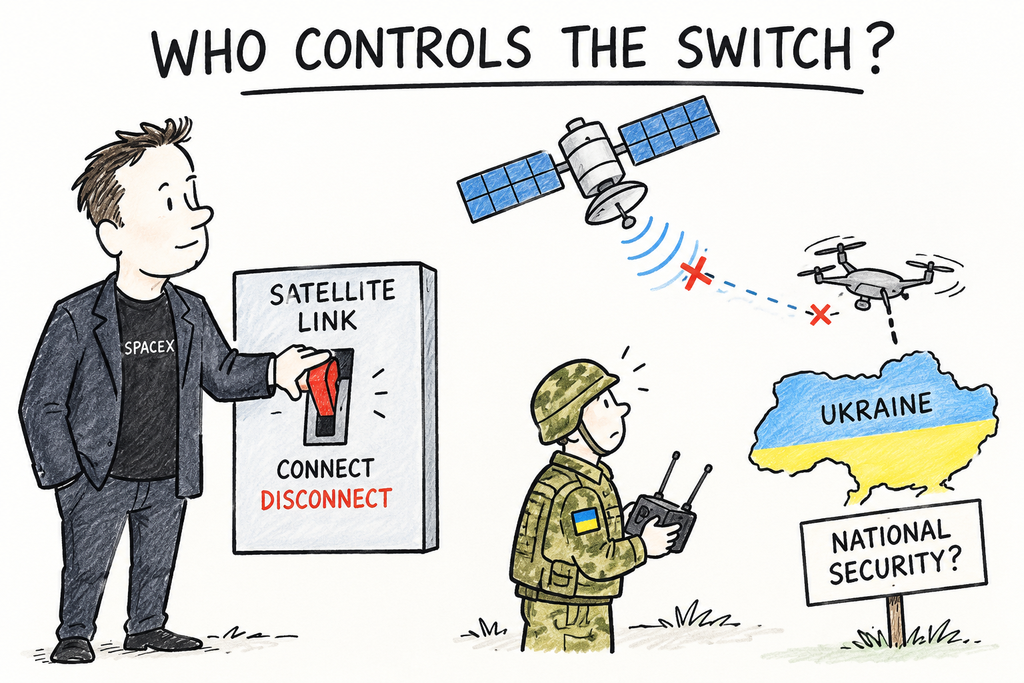
The important point is not to assume that one individual has been conclusively shown to have pressed a particular button. It is that the system can be restricted, and that the ability to make or authorise such a decision is concentrated in very few hands.
Why does one company have so much power?
The answer is infrastructure
SpaceX has built a vast satellite network that is difficult and expensive to replicate. Its low-Earth-orbit satellites provide connectivity in places where conventional communications networks are unavailable, damaged or vulnerable to attack.
For Ukraine, this has meant access to a capability that would otherwise have been extremely difficult to establish during wartime.
But dependence creates leverage.
A country can possess tanks, aircraft, missiles and trained soldiers while remaining dependent on an outside provider for the communications that make those assets effective.
If that connection is interrupted, the equipment may still exist, but its usefulness can diminish.
This is the distinction between owning the weapons and controlling part of the system that enables them to operate.
Musk does not personally need to command Ukrainian troops or decide which targets they attack. The ability to influence a critical communications service can itself confer considerable strategic power.
Nor does the system necessarily require a dramatic, total shutdown. A restriction on speed, coverage, access or functionality may be sufficient to undermine a particular military operation.
A technical adjustment can have consequences far beyond the software setting that produced it.
Where does Donald Trump fit into this?
The controversy also illustrates the power of the American presidency.
The United States is a major customer of SpaceX’s national-security services, and Starshield operates within a government defence framework.
Washington therefore has an important role in determining how those capabilities are supplied and used.
Trump’s administration also has substantial influence over American military assistance, intelligence sharing and the wider relationship with Ukraine.
At a time of deteriorating relations between Washington and Kyiv, the reported restrictions raised questions about whether technology access could become part of the political leverage exerted over Ukraine.
The timing is notable, but timing alone does not prove the motive behind the decision.
There are two distinct forms of power here.
Musk and SpaceX possess technical expertise, infrastructure and the ability to implement changes to services they operate.
The U.S. government possesses contractual, military and political authority over the government-controlled elements of the arrangement.
Where these powers intersect, the practical consequences for Ukraine can be immediate, even if the formal decision-making process remains opaque.
That is the real concern: a nation’s battlefield capabilities may be affected by a handful of decisions made outside its borders, without the nation itself having an effective veto.
Is this democratic accountability?
In a democracy, decisions about war and peace are supposed to be subject to public scrutiny, institutional checks and political accountability.
Yet critical digital infrastructure increasingly sits between governments and the people they serve.
A private company may be accountable to its shareholders, its contractual obligations and the laws of the country in which it operates. A president is accountable through political and constitutional institutions.
But neither arrangement automatically ensures that an allied nation dependent on the technology will receive adequate warning, consultation or protection against sudden disruption.
The problem is not simply whether Musk or Trump has acted appropriately. It is whether the safeguards are sufficient when the consequences extend to another country’s soldiers and civilians.
If an allied military depends on a commercial or government-controlled system, who decides when access can be restricted? What emergency procedures apply?
Must the affected country be notified? Can a single executive decision override established military planning? And who is accountable if the consequences are disastrous?
These are questions of governance, not merely technology.
People die!
What happens if the switch is turned off?
Ukraine cannot instantly build a replacement for a sophisticated satellite network. Alternative providers, including Europe’s OneWeb and developing satellite services from other companies, may offer options, but integrating them into military operations requires time, equipment, money and testing.
A robust defence therefore requires more than finding another supplier after a crisis begins.
Governments must consider redundancy, alternative communications systems, interoperable equipment and contingency plans. They must also examine the terms under which private companies provide services essential to national security.
The United States faces a related problem of its own. If American forces become heavily dependent on one provider, the same concentration of control could create vulnerabilities for U.S. operations in a future conflict.
This is why the episode has prompted scrutiny in Washington, including a congressional inquiry into SpaceX’s role and the government’s dependence on its technology.
The lesson extends far beyond Ukraine
Satellite communications are only one example. Similar questions arise wherever essential services depend on concentrated technological control: cloud computing, artificial intelligence, digital payment systems, communications networks and critical software.
The more indispensable a system becomes, the greater the potential influence of whoever controls access to it.
That influence need not be exercised maliciously. A legitimate security decision, a contractual dispute, a technical failure or a change in political priorities could all have serious consequences.
The danger lies in building national capabilities around a system that can be altered without sufficient safeguards. Any country could be affected.
Ukraine’s experience raises a difficult question for every government: can a nation genuinely be sovereign if essential elements of its defence depend on decisions made by a small number of people outside its control?
The answer cannot simply be to abandon private technology. Such systems can provide extraordinary capabilities that governments would struggle to develop independently.
But convenience and efficiency must be balanced against resilience and accountability.
The Power is ALL in one hand
In modern warfare, power no longer rests solely with those who possess the weapons. It can also rest with those who control the networks, software and infrastructure that make those weapons effective.
These too could be deemed part of the weapons network.
And sometimes, the most consequential weapon is not a missile or a tank.
It is the ability to decide who remains connected — and who does not.