

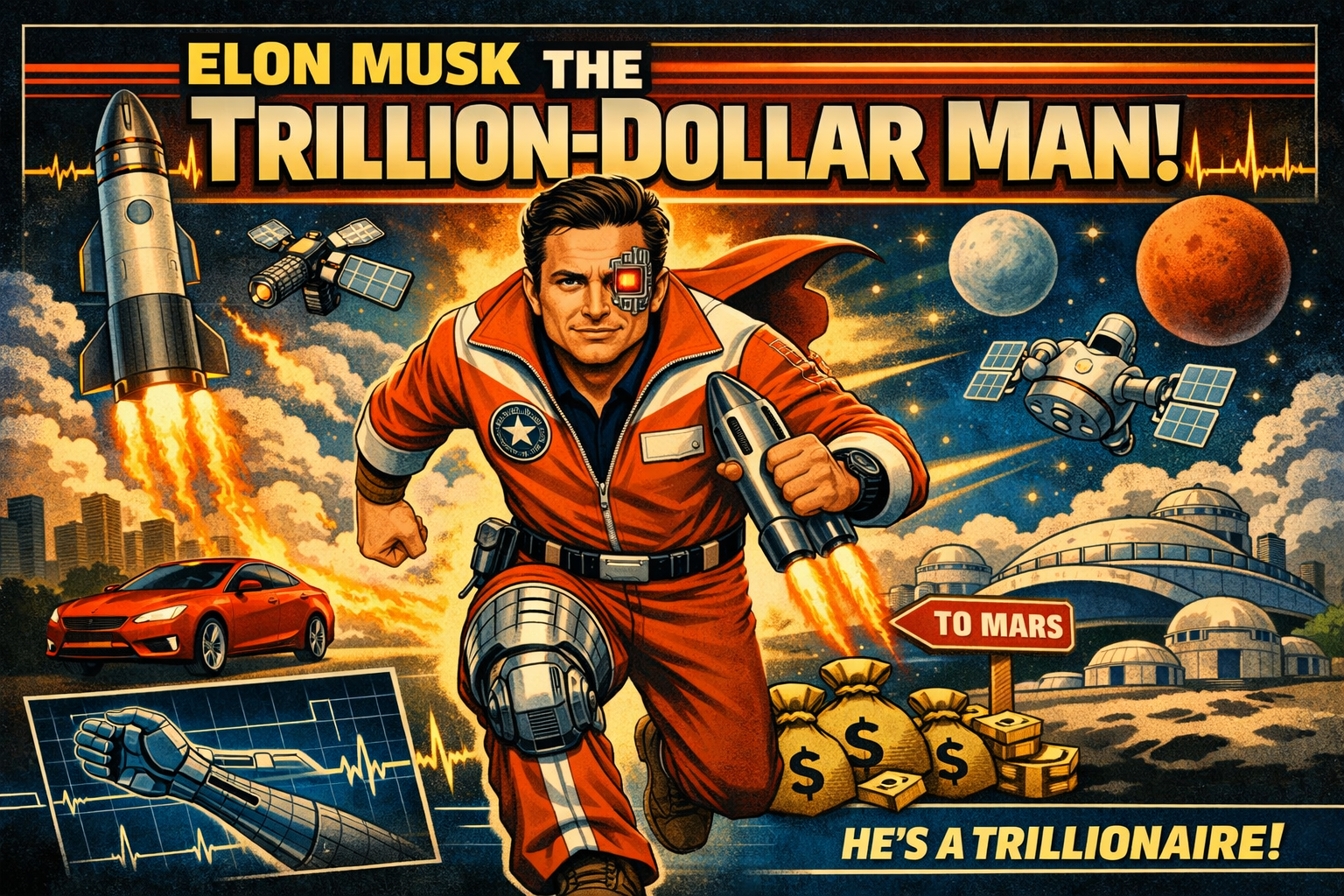
Elon Musk: The Trillion‑Dollar Man

Elon Musk has spent two decades bending entire industries around his will, but the past year has pushed him into a category previously reserved for myth.

With the SpaceX IPO igniting global markets and sending shockwaves through the aerospace and technology sectors, Musk has become the first individual in history to be calculated as worth $1 trillion.

Empire buidling

It is a milestone that reflects not only personal wealth, but the scale of the industrial empires he has built — and the future investors believe he is about to unlock.

SpaceX’s long‑anticipated public listing has been the catalyst. The company’s valuation surged as soon as trading began, propelled by overwhelming demand for exposure to the world’s dominant launch provider and the backbone of the modern satellite economy.

Starlink

Starlink’s global footprint, the Falcon and Starship programmes, and SpaceX’s near‑monopoly on commercial and government launches have created a business with both extraordinary cash flow and unmatched strategic importance.

Investors are effectively betting on Musk’s ability to commercialise space in the same way he electrified the car industry.

Tesla, Neuralink, X.ai, X, The Boring Company, Solar City & SpaceX

The IPO has also crystallised the value of Musk’s wider ecosystem. Tesla, despite its volatility, remains the world’s most recognisable electric‑vehicle brand.

Neuralink and The Boring Company, though smaller, contribute to the perception of a founder whose ventures consistently reshape their sectors.

But it is SpaceX — with its blend of infrastructure, defence relevance, and global communications — that has propelled Musk into trillion‑dollar territory.

Speculative

Critics argue that such valuations are speculative, driven by hype rather than fundamentals. Yet SpaceX’s track record is unusually concrete: reusable rockets, profitable satellite services, and a launch cadence unmatched by any nation, let alone any company.

We can make the future
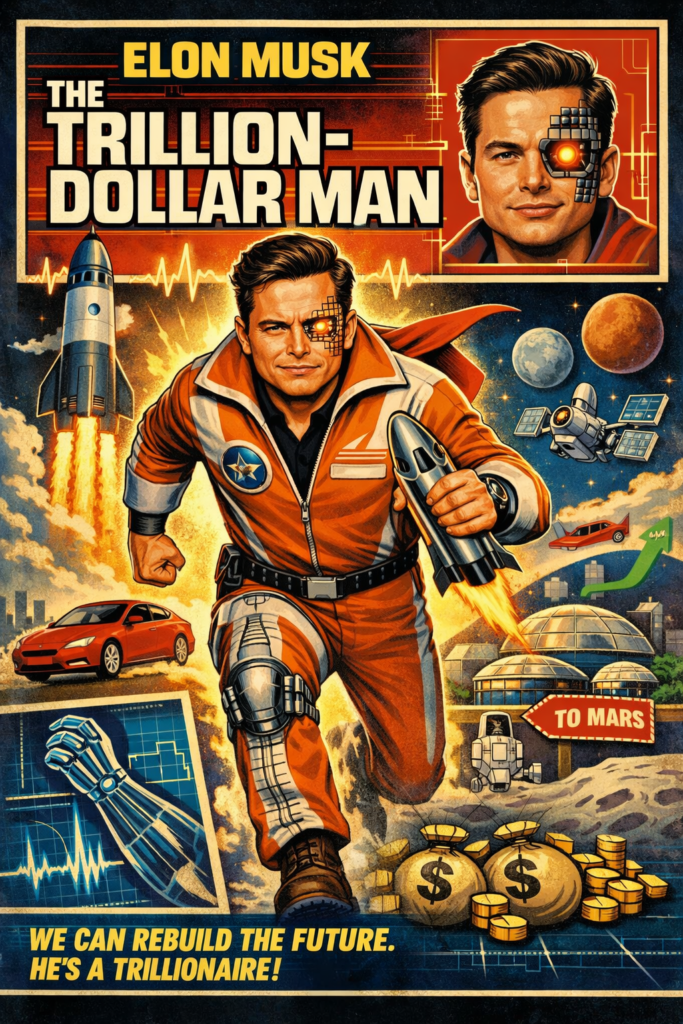
The market is effectively pricing in a future where SpaceX becomes the backbone of off‑planet logistics, lunar infrastructure, and perhaps even the first commercial missions to Mars.

Trillion Dollar Man

For Musk, the symbolism is obvious. Becoming the world’s first trillion‑dollar individual cements his status as the defining industrialist of the 21st century.

A figure whose ambitions stretch far beyond Earth, and whose companies now command the kind of economic gravity once associated only with nation‑states.

Context: Countries With GDP ≥ $1 Trillion (Nominal USD, 2026) – Approx’ indication only

United States — 29.0
China — 18.5
Germany — 4.6
Japan — 4.3
India — 4.0
United Kingdom — 3.4
France — 3.2
Italy — 2.3
Canada — 2.2
Brazil — 2.1
Russia — 2.0
South Korea — 1.9
Australia — 1.8
Mexico — 1.7
Spain — 1.6
Indonesia — 1.5
Netherlands — 1.2
Saudi Arabia — 1.1
Turkey — 1.0
Switzerland — 1.0
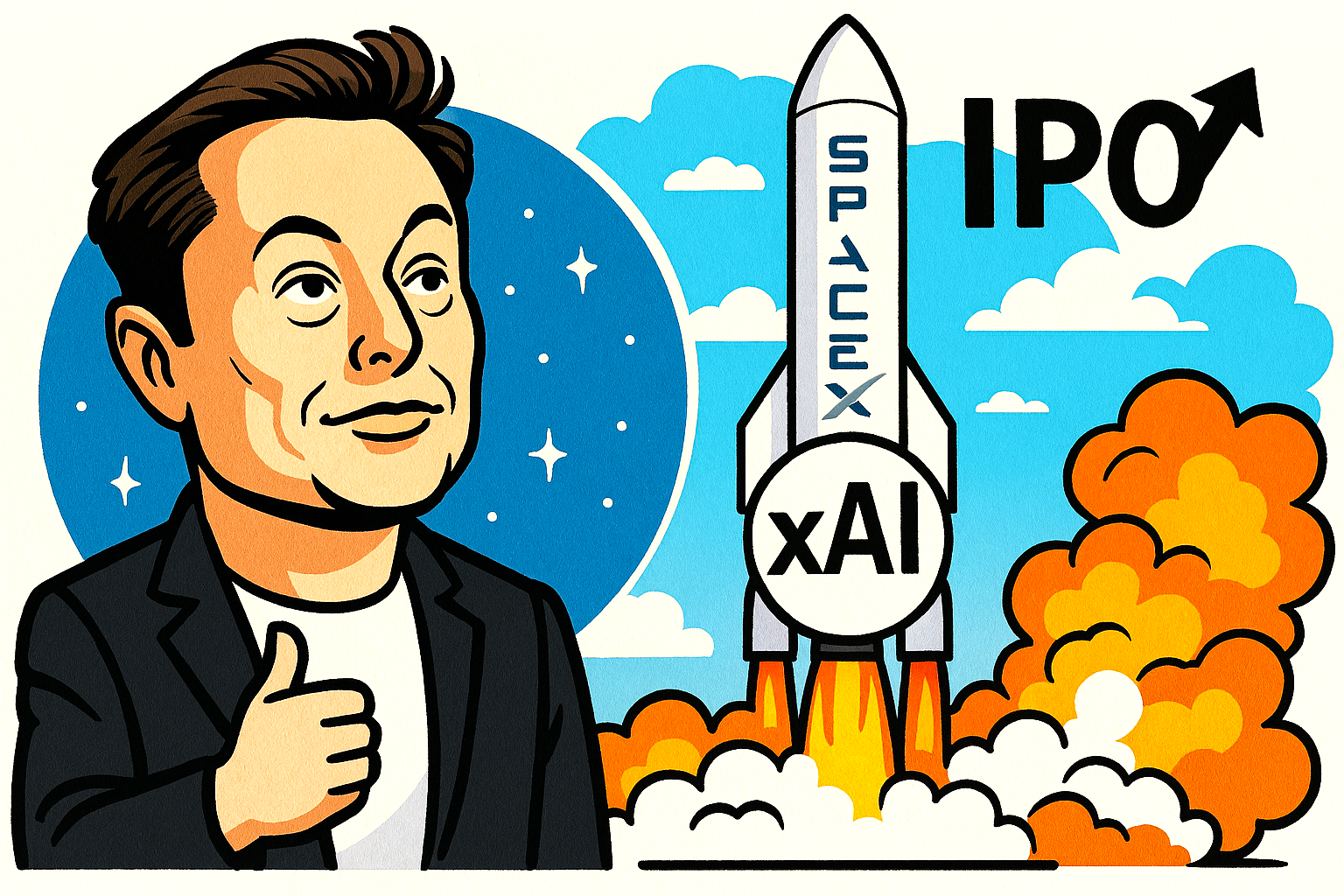
SpaceX–xAI: A New Age Industrial Giant

IPO for SpaceX and xAI

Elon Musk’s decision to fold xAI into SpaceX has set the stage for what could become one of the largest and most closely watched IPOs in market history.

The move signals a bold attempt to fuse advanced artificial intelligence with orbital infrastructure, satellite communications, and Musk’s wider technological ecosystem.

Elon Musk’s merger of SpaceX with his artificial intelligence venture xAI marks a decisive shift in the trajectory of both companies.

Integrated power

The combined entity is now positioned as a vertically integrated powerhouse spanning rockets, space‑based internet, direct‑to‑mobile communications, and frontier AI research.

Musk has described the unified structure as an ‘innovation engine’ capable of accelerating progress both on Earth and beyond.

The strategic logic is clear: AI requires immense computational resources, and Musk believes space‑based compute will become the most cost‑effective solution within a few years.

By bringing xAI under SpaceX’s umbrella, he gains the ability to scale AI training using satellite infrastructure while consolidating governance, data flows, and long‑term capital planning.

A Trillion‑Dollar Listing on the Horizon

The merged company is expected to pursue an IPO valued at roughly $1.25 trillion, with share pricing estimates placing it among the most valuable listings ever attempted.

Early reports suggest the offering could raise as much as $50 billion, instantly making it one of the largest capital‑market events in history.

Such a valuation reflects not only SpaceX’s dominance in commercial launch and satellite internet, but also the rapid rise of xAI’s Grok chatbot and its integration with Musk’s social platform, X.

The consolidation also concentrates financial scrutiny, with analysts noting that the new structure brings unprecedented transparency demands for a company that has historically operated privately.

Innovation

One of the most radical implications of SpaceX absorbing xAI is the potential to relocate data centres into orbit.

Musk has long argued that space-based compute could dramatically reduce cooling costs, thanks to the natural vacuum and thermal dissipation of low Earth orbit.

By leveraging Starlink’s satellite mesh and SpaceX’s launch cadence, the merged entity could deploy AI training clusters above the atmosphere—sidestepping terrestrial energy constraints and redefining the economics of large-scale artificial intelligence.

This vision, while technically ambitious, aligns with Musk’s broader strategy of vertical integration and frontier infrastructure.

The Stakes

If successful, the IPO will redefine the market landscape for both aerospace and artificial intelligence.

It represents a bet that the future of AI will be built not just in data centres, but in orbit—an audacious vision even by Musk’s standards.

China’s rival to Elon Musk’s Starlink internet launches satellites to low Earth orbit

Internet satellites

On Tuesday 6th August 2024, China launched its inaugural batch of internet satellites, which are expected to be part of a constellation designed to compete with SpaceX’s Starlink.

The constellation, named “Thousand Sails,” comprises over 15,000 satellites in low-Earth orbit that are anticipated to provide worldwide internet coverage.

China plans to have 648 satellites in orbit by 2025 as part of the first phase of the constellation’s deployment, aiming to establish a global internet network, as reported by state media CCTV.

The satellite system will be in direct competition with Elon Musk’s Starlink.