

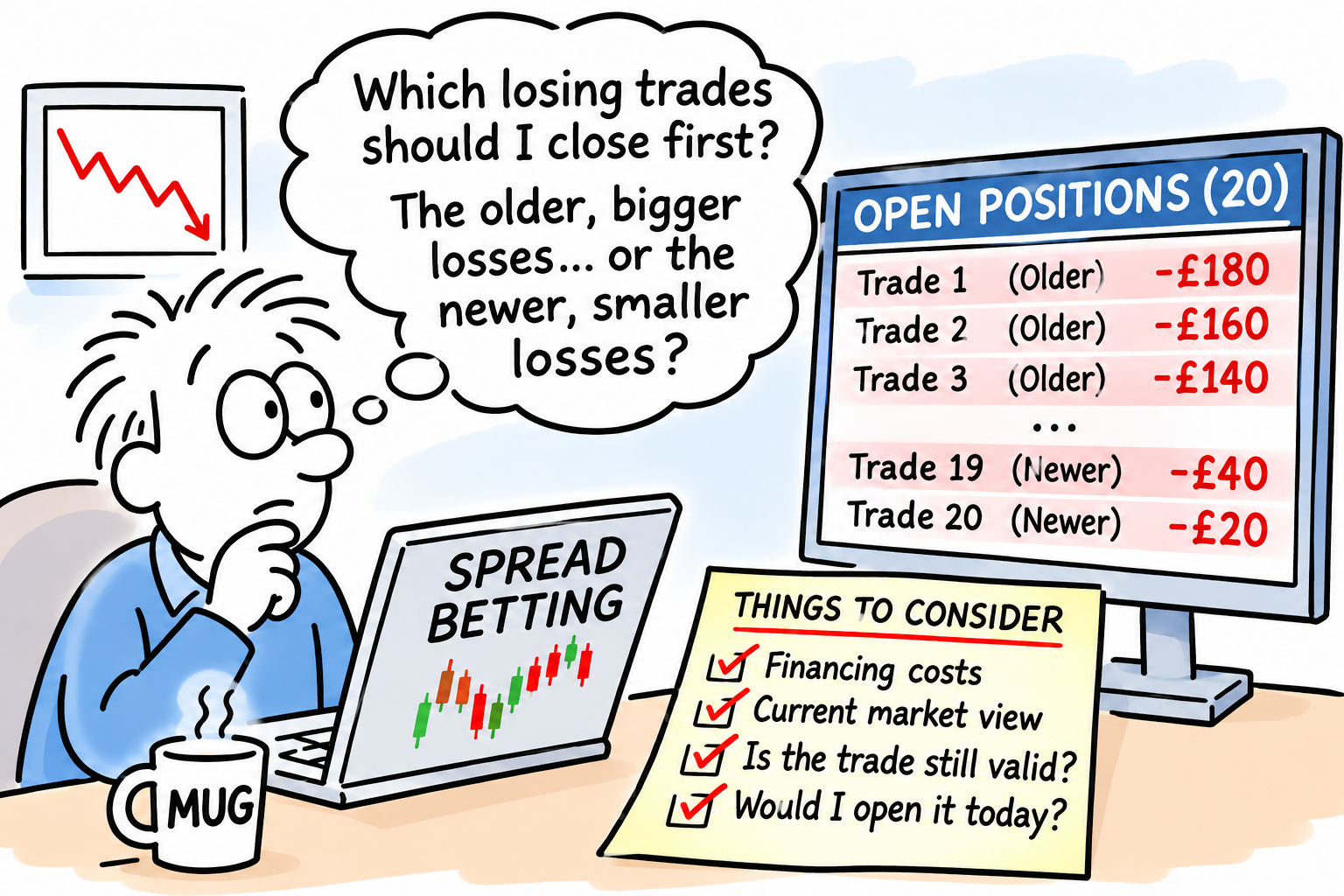
Retail traders using spread betting platforms can sometimes find themselves accumulating a growing number of losing positions.
One trade becomes several, several become ten, and before long a portfolio might contain 20 or more open positions, all showing red.
Old or New?
Assuming each trade was opened with exactly the same financial exposure, an interesting question arises: when it is time to reduce the number of positions, is it better to close the older trades, which have accumulated larger losses, or the newer trades, which have smaller losses?
There is a reasonable argument for closing the older positions first.
Older spread bet trades have generally been exposed to adverse market movements for longer. They may also have accumulated considerable overnight financing charges, depending on the platform and instrument.
Every additional day they remain open can add to the cost of maintaining them.
Psychology
There is also a psychological problem. Traders can become attached to older losing positions, convincing themselves that the market will eventually turn around and return to their original entry price.
This can result in capital and margin remaining tied up in trades that no longer make sense.
Closing the older, more heavily loss-making positions could therefore be a useful way of clearing out historical trading decisions, reducing financing costs and giving the trader a cleaner slate.
Stop losses
However, there is an important financial consideration. A loss is already reflected in the account’s equity, whether the position is closed or left open.
Closing an older trade does not magically improve the overall financial position.
Nor does closing a newer trade necessarily make more sense simply because its loss is smaller.
If all positions have identical exposure to the same underlying market, their future gains and losses will be driven by subsequent market movements, not their opening dates.
Perhaps the most sensible approach is to examine the older positions first, particularly those with the largest accumulated losses and financing costs, and ask whether they remain worth holding.
Test
There is a simple test every trader should consider: if the position did not already exist, would you open that same trade today?
If the answer is no, why keep it open?
The lesson is that yesterday’s trading decisions should not dictate tomorrow’s financial exposure.
Sometimes closing the oldest losing positions is not an admission of defeat, but a sensible step towards regaining control of a trading account.