Latest U.S. job data indicates that job growth accelerated by 199,000

Work

The latest U.S. job data indicates that job growth accelerated in November 2023, with seasonally adjusted non-farm payrolls increasing by 199,000. 

The unemployment rate has dropped to 3.7%, even as more workers entered the labour market. This points to underlying strength in the labour market and is a positive sign for the U.S. economy. 

U.S. job creation chart January 2022 – November 2023

U.S. job creation chart January 2022 – November 2023

Stocks had risen as investors awaited these latest employment figures, which are closely watched as an indicator of potential moves by the central bank on interest rates.

Mixed reaction

Markets showed a mixed reaction to the report, with stock market futures modestly negative while Treasury yields surged. Job creation showed little signs of slowing as payrolls grew even faster than expected and the unemployment rate fell despite signs of a weakening economy.

Good news for the U.S. economy but Treasury yields are on the up again.

If profit growth accelerates over the next two quarters – is it wise to buy the dip now?

Stocks roller coaster

Some analysts say yes!

Buying the dip means purchasing an asset, usually a stock, when its price has dropped. The expectation is that the drop is a short-term anomaly, and the asset’s price will soon go back up. It is a strategy that some traders and investors use to take advantage of price fluctuations and profit from market rebounds. 

However, buying the dip can also be risky, as there is no guarantee that the price will recover or that the asset is not in a long-term downtrend. Therefore, it is important to do your research, use indicators, and have a risk management plan before buying the dip.

Current market situation and general ‘readout’

The S&P 500 is still ‘buy the dip’ for the next six months,’ some analysts suggest.

In some reports, it is expected that the profit cycle will be positive over the next six months and for data to improve before a consumer-spending led downturn leads to a selloff in U.S. stocks! That’s the ‘general’ readout.

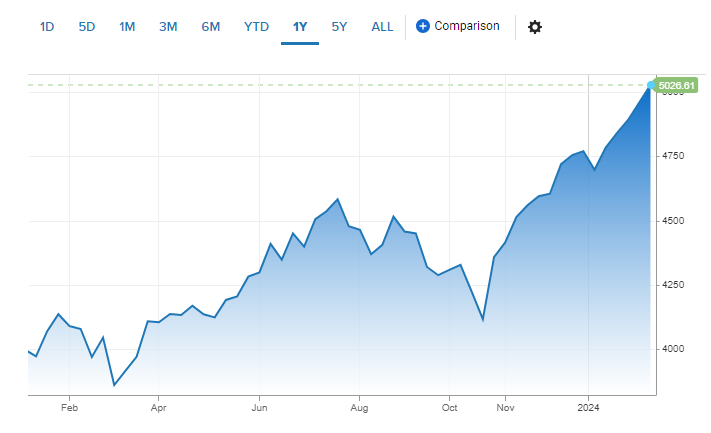
Corporate profit expectations are behind much of that forecast for stocks. Analysts expect profit growth to accelerate over the next two quarters and see the S&P 500 in a range of 4,050 to 4,750. A mild recession in early or middle 2024 should lead to a higher risk premium, pushing the S&P 500 back close to 3,800. This is all conjecture.

Other analysts doubt the earnings uplift potential and anticipate stocks to fall back sooner as PE ratios sit at an already high level.

Take your pick

My view, for what it’s worth, is for stocks to climb for the time being through into the New Year and then to face pullback.

Truth is, no one knows. We can all make educated guesses.

Just watch the markets and be ready for the fall – that is coming for sure!

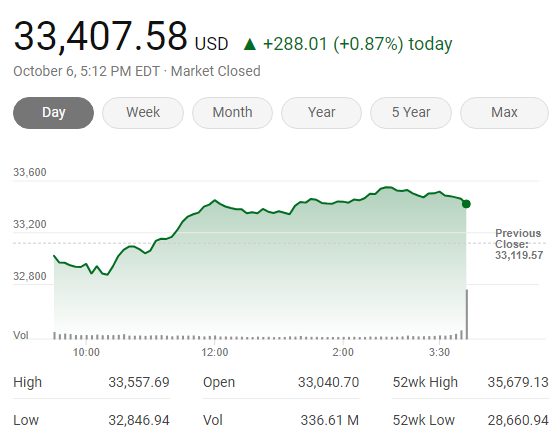
Dow up 300 points Friday, 6th October 2023 as stocks reverse sharp losses

Nasdaq

Stocks rallied Friday 6th October 2023 even after the release of stronger-than-expected U.S. jobs data and an increase in Treasury yields.

The U.S. economy added 336,000 jobs in September 2023, the Labour Department said. Economists expected 170,000 jobs. 

Confused?

Stocks posted a surprise turnaround on Friday, 6th October 2023 after initially falling on a hotter-than-expected jobs report. At its session low, the Dow had fallen some 270 points, then surged by more than 400 points at in intraday trading. The Nasdaq and the S&P 500 also lost ground too only but then quickly recovered the losses.

Unclear

Traders were unclear as to the reason for the intraday reversal. Some noted it could be the softer wage number in the jobs report that made investors rethink their earlier bearish stance. Others noted the pullback in yields from the day’s highs.

Rally

The rally may just be because the market had been extremely oversold with the S&P 500 at one point in the week down more than 8% from its high earlier this year.

Yields initially surged after the report, with the 10-year Treasury rate trading near its highest level in 16 years. The benchmark rate later eased from those levels, but was still up around 6 basis points at 4.78%.

Extreme market movements maybe here for a while yet.

U.S. stock market volatility continues

Yields

The stock market has been experiencing some volatility and uncertainty in September and October 2023, as investors fret about inflation, interest rates, and the possibility of a U.S. recession.

Main facts affecting the current stock market

The month of October has produced some severe stock market crashes over the past century, such as the Bank Panic of 1907, the Wall Street Crash of 1929, and Black Monday 1987.

October has also marked the start of several major long-term stock market rallies, such as Black Monday itself and the 2002 nadir of the Nasdaq-100 after the bursting of the dot-com bubble.

The S&P 500 dropped 4.5% in September 2023 and finished the third quarter in the red.

The U.S. Treasury yield curve has been inverted for months – which is a historically strong recession indicator.

The Fed maintained interest rates at the current target range of between 5.25% and 5.5% in September 2023, but signalled that it may need to raise rates again to combat inflation.

The consumer price index gained 3.7% year-over-year in August 2023, down from peak inflation levels of 9.1% in June 2022 but still well above the Fed’s 2% long-term target.

The bond market is currently pricing in an 81.7% chance the Fed will choose not to raise rates again on 1st November 2023.

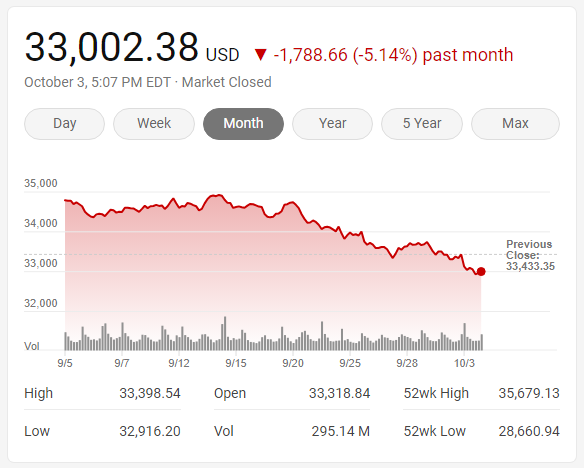
Wall Street closed down on 3rd October 2023 as the yield on the U.S. 10-year treasury rose to 4.80%, reaching its highest level since 2007.

The Dow Jones Industrial Average was down at 33002, Tuesday 3rd October 2023.

Stocks fell as investors pulled money from equities and moved it to the hot bond market.

International markets also faced significant turmoil, sending mini shockwaves through global financial centres, which reverberated in equities.

The dollar rose to the highest since December and is heading towards the twelfth positive week in a row.

Uncertainty

Uncertainty in the U.S. political system is having a major affect too. Especially with the ousting of the speaker and the real fear of a government shutdown looming large.


An August U.S. stock market stumble, or more?

Eurozone interest rates

August typically a rocky month

The U.S. stock market has experienced a 5.6% slide for the S&P 500 index over 15 trading sessions through 17th August 2023 and levelling off in the last trading day of that week. 

This is about as bad as August typically gets, as August is a rocky month with low volume and high volatility. Some of the reasons for the pullback include the rise in the 10-year Treasury yield, the strengthening of the U.S. dollar, and the signs of a slowing Chinese economy.

Pullback temporary for August?

However, some analysts argue that the pullback will likely prove to be temporary and not turn into a serious market rout. It has been suggested that the bull run isn’t quite over just yet, and that a 10% ‘pullback’ was on the cards.

Analysts also suggest that the rise in yields would need to threaten a serious shift or there would need to be an additional shock to cause a larger selloff. 

NASDAQ

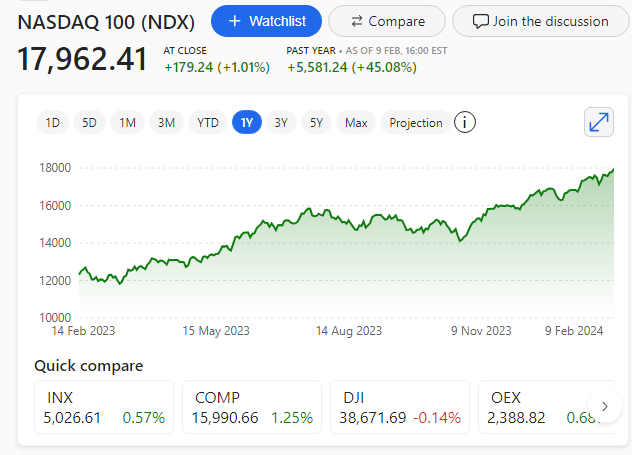
NASDAQ drops some 7% in one month from 19th July – 18th August 2023

However, some suggest that the market is showing signs of stability, as the speed of the surge in the 10-year yield often occurs near the end of a selling cycle for equities. Investors should watch for indicators such as oil prices, wage pressures, and inflation expectations to gauge the market sentiment.

The S&P 500 and the Dow levelled off the week at the close of trading Friday 18th August 2023.

The NASDAQ did score its best first half of the trading year since 1983 January to June 2023 so a pullback was likely to happen.