

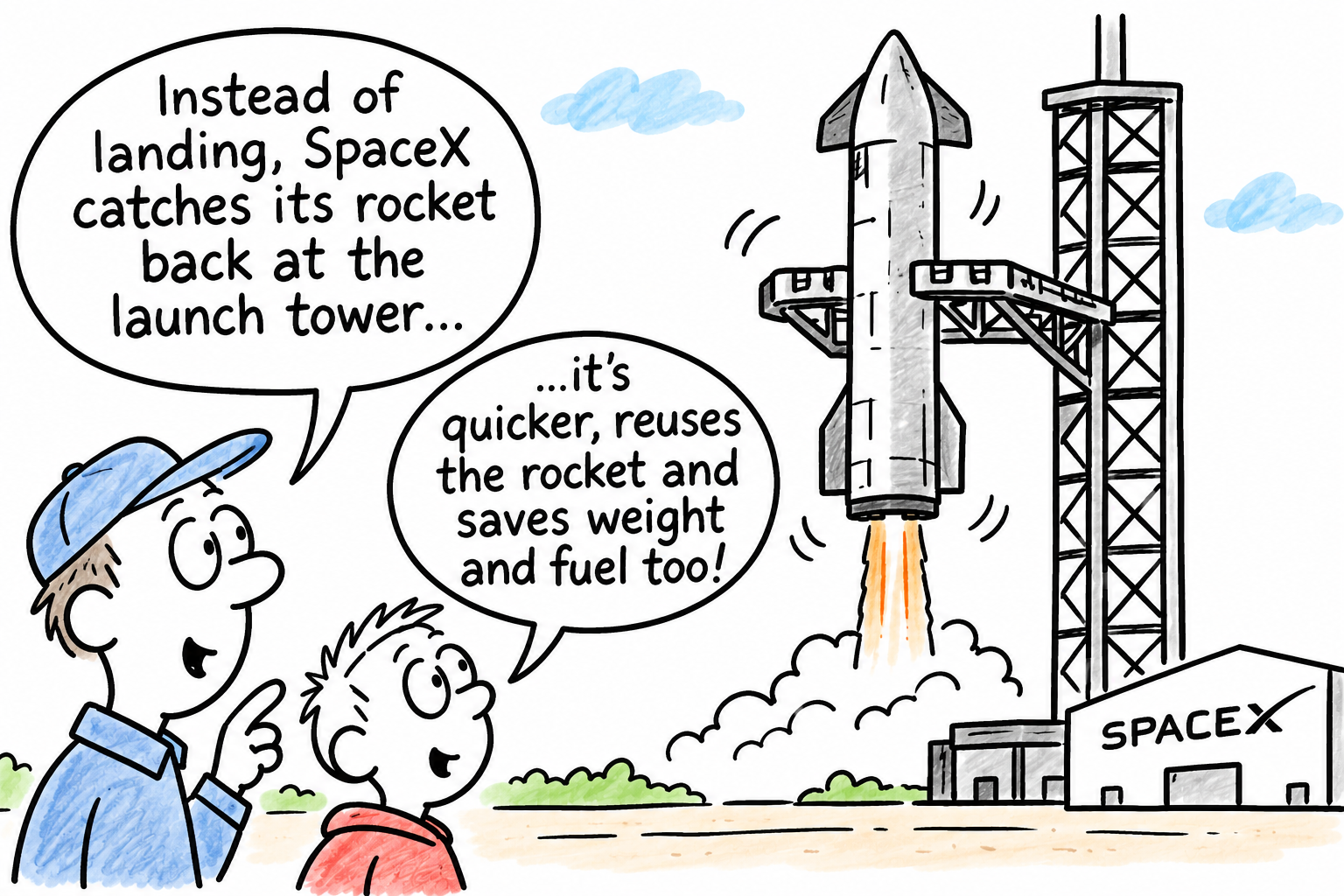
SpaceX has taken another significant step towards revolutionising space travel, successfully catching its giant Starship spacecraft using the enormous mechanical arms of its launch tower in Texas.
The extraordinary manoeuvre, which took place on 14th November 2026, marks the first successful recovery of the Starship upper stage following a return from orbit.
But why go to all this trouble? Why doesn’t SpaceX simply land its spacecraft on the ground, as conventional aircraft or even its smaller Falcon 9 rockets do?
The answer lies in weight, engineering and the economics of reusable space travel
Starship consists of two separate sections. The first is the Super Heavy booster, which provides the enormous thrust required to lift the spacecraft away from Earth.
Once sufficient altitude and speed have been achieved, the two sections separate. The upper Starship continues its journey into space, while the booster turns around and attempts to return to its launch site.
Both sections are designed to be recovered and reused
SpaceX has developed a giant launch tower, nicknamed Mechazilla, fitted with two enormous mechanical arms, often called chopsticks.
These arms are designed to catch the returning rockets as they descend towards the launch pad.
So why not fit landing legs?
The main consideration is weight. Landing legs would need to be exceptionally strong to support a rocket of this enormous size.
Every additional kilogram carried into space requires additional fuel and reduces the potential payload capacity.
There is also the question of speed and efficiency. Landing legs would need to be deployed, inspected and maintained.
In position for the next flight
Catching the vehicle directly at the launch tower potentially removes several handling and transportation operations, allowing SpaceX to prepare the rocket for another flight much more quickly.
The spacecraft does, in fact, use its engines to control its descent. It re-enters Earth’s atmosphere, uses its heat shield to withstand extraordinary temperatures, manoeuvres towards the launch site and performs a controlled engine-powered flip before the tower arms catch it.
Successful
The latest flight demonstrated that this approach can work. Starship was successfully caught, although the Super Heavy booster failed to complete its planned return and was lost after an automatic abort.
Ultimately, SpaceX wants to make space travel resemble commercial aviation, with rockets capable of flying repeatedly rather than being discarded after every launch.
It is an ambitious engineering challenge, but if successful, catching rockets could prove just as important to the future of space exploration as the rockets themselves.