

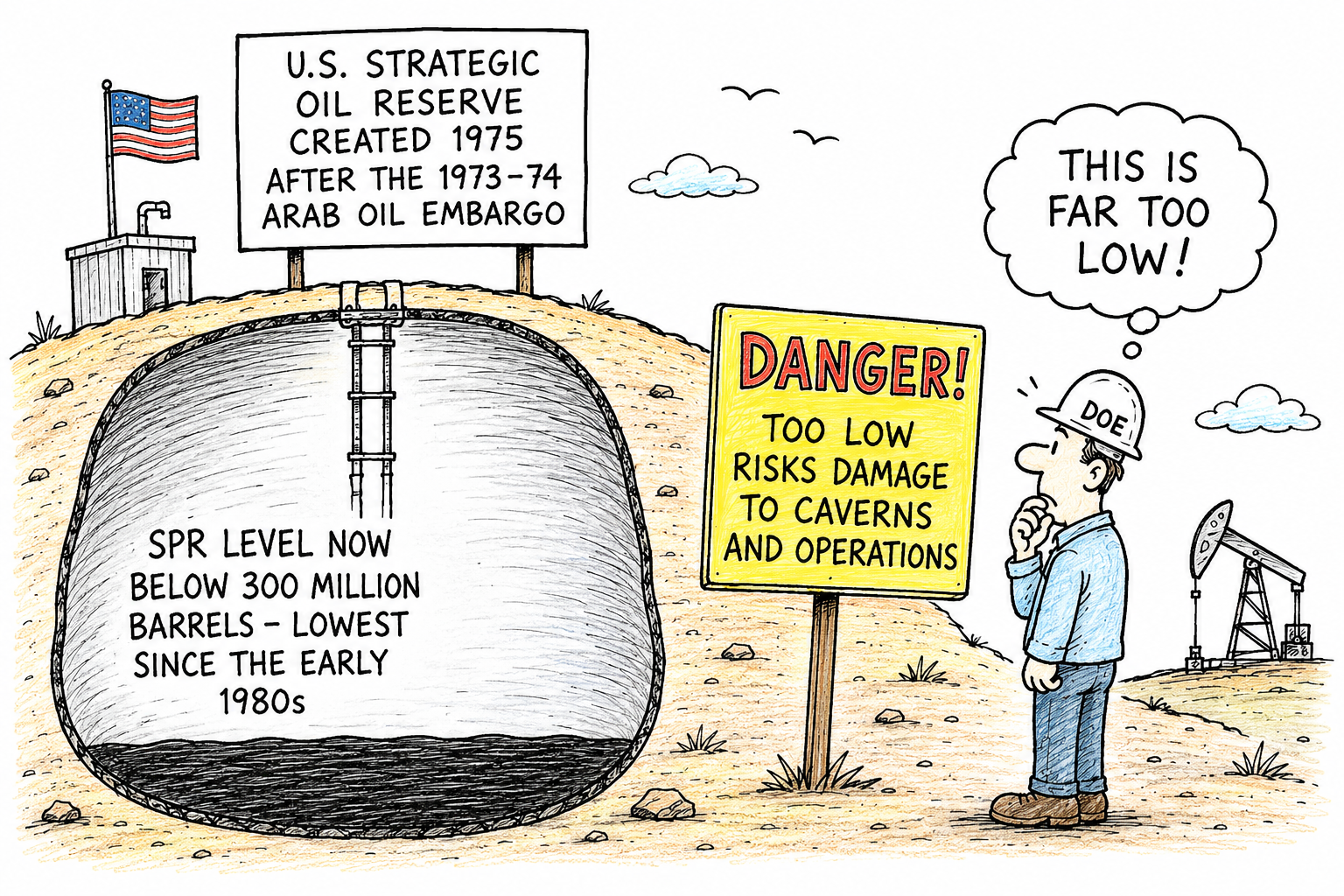
America’s Strategic Petroleum Reserve (SPR) was created in 1975, in the aftermath of the 1973–74 Arab oil embargo, when an oil supply shock exposed America’s vulnerability to disruptions in foreign energy supplies.
Its purpose was straightforward: provide the United States with an emergency stockpile of crude oil that could be released if supplies were suddenly threatened.
More than 50 years later, that safety net is looking increasingly fragile.
Depleted levels
The SPR has fallen to around, and now below, 300 million barrels — its lowest level since the early 1980s. The decline follows a succession of major releases, including the huge drawdown ordered in 2022 to help counter the surge in oil prices following Russia’s invasion of Ukraine.
The problem is not simply that America has less oil available during an emergency. The crude is stored deep underground in enormous salt caverns, and repeatedly removing and replacing large quantities of oil creates additional engineering and operational challenges.
Concerns have been raised that allowing inventories to fall too far could complicate the safe and efficient operation of some caverns.
Collapse
That does not mean the underground storage sites are on the verge of collapse. The SPR was specifically designed around the properties of salt formations, and the facilities are subject to extensive monitoring and maintenance.
But the reserve was never intended to be routinely used as a tool for managing ordinary fluctuations in oil prices.
Rebuilding it is also a slow process. Buying hundreds of millions of barrels requires money, suitable crude and sufficient time to inject it back into the caverns. The infrastructure itself must also remain operational.
That leaves Washington facing an uncomfortable dilemma. The SPR exists precisely to be used during an energy crisis.
But if it is drawn down too aggressively, America risks weakening the very emergency insurance policy created in 1975 to protect it.
The strategic question is no longer simply how much oil America has — but how much of its emergency reserve it can safely afford to use.