
The Ed Miliband energy paradox: how Britain ended up paying France to take its power

UK energy paradox

If you are anything like me, you’re not wrong to feel that this is insane. On the face of it, Britain has:

  • Among the highest electricity prices in the developed world, especially for industry.
  • Growing periods of negative wholesale prices, where generators pay others to take power.

That combination is not just a glitch; it’s the product of how the UK has chosen to do net zero—through a tangle of subsidies, rigid contracts and a grid that was never upgraded to match the political ambition.

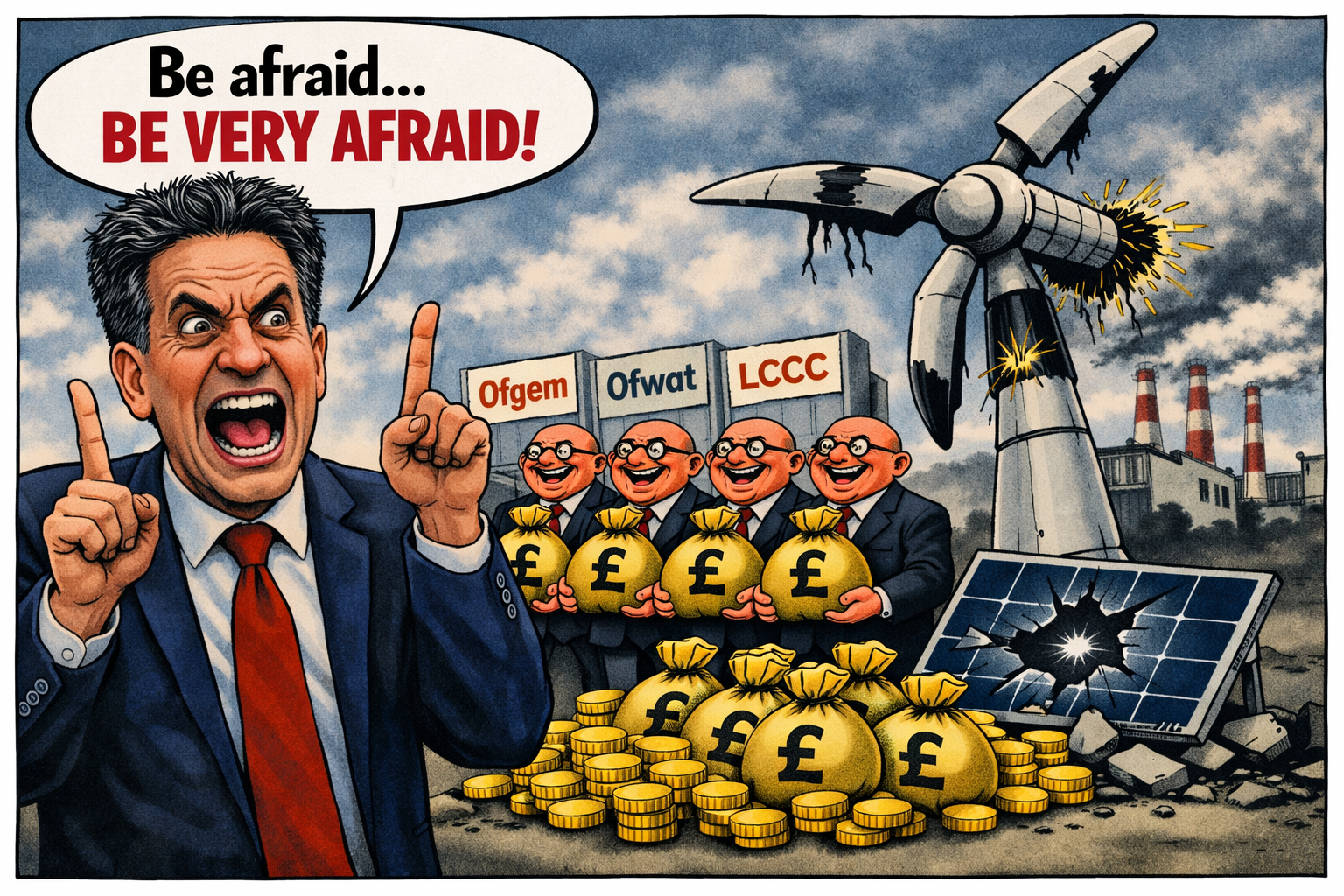
This is the Ed Miliband paradox: a “cheap renewables” story that somehow delivers some of the world’s most expensive power, and then occasionally becomes so oversupplied that we literally pay France and others to take it away.

What is actually happening when prices go negative?

Negative prices are not a metaphor. For several dozen hours already this year, the wholesale price of electricity in Britain has dropped below zero.

Generators effectively pay the system to keep running, and interconnectors export that surplus to countries like France, Holland and Belgium—sometimes with a “chunky payment” attached.

This happens when:

  • Supply massively exceeds demand—typically on windy, sunny, mild days when heating and cooling demand is low.
  • Certain generators cannot or will not switch off—because of technical constraints (nuclear, some gas) or because their subsidy contracts reward them for generating regardless of price.
  • The grid cannot move or store the surplus—limited storage, constrained transmission, and slow grid reinforcement mean power piles up in the wrong place at the wrong time.

In that moment, electricity stops being a valuable commodity and becomes a waste product that must be disposed of. Interconnectors to France and others are the “sewer pipe” for that surplus.

Why the UK is uniquely bad at this

Negative prices are not just a British phenomenon—Germany, Spain, the Netherlands and others have also seen record hours of sub‑zero prices as renewables surge. But the UK has managed to combine:

  • High average prices, especially for industry;
  • Frequent negative prices at the margin;
  • Huge policy costs loaded onto bills rather than general taxation.

That cocktail is the result of several design choices.

1. Subsidy structures that pay to generate, not to be useful

A big chunk of UK renewables is supported by:

In a negative price event, the market is screaming “stop generating”. But if your contract still pays you based on output, you have every incentive to keep going. The cost of paying someone else to take the power can be less than the subsidy you’d lose by switching off.

So the system ends up doing something perverse: it pays generators to keep producing power that nobody wants, and then pays other countries to take it away.

2. A grid built for yesterday, not for a renewables surge

The UK has poured money into generation capacity—offshore wind, solar, interconnectors—but has been slow, bureaucratic and under‑invested on:

  • Transmission upgrades—moving power from windy Scotland and the North Sea to demand centres in England.
  • Storage—batteries, pumped hydro, demand‑side response at scale.
  • Flexible backup—fast‑ramping gas, smart tariffs, and industrial load‑shifting.

When you bolt a 21st‑century renewables fleet onto a 20th‑century grid, you get congestion, curtailment and waste.

The system then has to pay wind farms not to generate in some regions, while importing power elsewhere. Negative prices are just the most visible symptom of that mismatch.

3. Political obsession with “headline capacity” over system design

Net zero politics has been sold as a race to headline numbers:

  • X gigawatts of offshore wind by year Y
  • Z per cent of power from renewables
  • “Clean power by 2030”

What has not been sold—or properly designed—is the system architecture that makes that capacity economically coherent: locational pricing, flexible demand, storage, and a planning regime that can actually deliver grid reinforcement on time.

Ed Miliband’s own Electricity Market Review explicitly rejected zonal pricing in favour of a reformed national price, arguing that a single price is “fairest” and better for investment. That sounds nice politically, but it hides the real cost of congestion and mis‑location.

Instead of prices signalling “don’t build another wind farm here until the grid is upgraded”, the system socialises the pain across everyone’s bills.

Why are we paying France?

Interconnectors are not inherently stupid. In a rational system, they:

  • Smooth out volatility—import when you’re short, export when you’re long.
  • Share capacity—you don’t need to build as much domestic backup if you can lean on neighbours.

The problem is that the UK has created a structure where:

  • We over‑generate at certain times because of rigid contracts and inflexible plant.
  • We lack storage and flexible demand to soak up that surplus domestically.
  • We then use interconnectors as a dumping ground, paying others to take power that our own consumers have already funded through subsidies and levies.

France, with its large nuclear fleet and different cost structure, can happily take that cheap or even “paid‑to-take” power, displacing its own generation and lowering its average costs.

Meanwhile, UK industry is paying power prices around 60 per cent higher than in France on average.

So, we (the UK) socialise the cost of building and subsidising the capacity, then export the benefit at a discount.

How did this policy architecture even get created?

This isn’t one bad decision; it’s a stack of incentives and political choices that line up in the worst possible way.

1. Short‑term politics, long‑term contracts

Governments of all colours wanted:

  • Quick, visible progress on renewables.
  • Private capital to fund it, not the state balance sheet.
  • Minimal upfront tax rises.

The answer was long‑term, legally binding contracts (RO, CfDs, capacity market) that shifted risk onto consumers via bills. Once signed, these contracts are hard to change without spooking investors or triggering compensation claims.

So ministers get the photo‑ops—“world‑leading offshore wind”, “clean power by 2030”—while the structural costs and distortions are baked in for decades.

2. Ideological framing: net zero as a moral crusade, not an engineering project

Net zero has been framed as a moral imperative first, an engineering challenge second. That has consequences:

  • Questioning the design is painted as questioning the goal.
  • Complex system trade‑offs are reduced to slogans about “cheap renewables” and “green jobs”.
  • Uncomfortable truths—like the need for gas backup, storage, and grid reform—are pushed into the technical long grass.

The result is a policy environment where it is easier to announce another offshore wind auction than to confront the messy, expensive business of rewiring the grid and redesigning market signals.

3. Regulatory fragmentation and institutional cowardice

Ofgem, National Grid ESO, the Department for Energy Security and Net Zero, the Treasury—each has a slice of the problem, but no one owns the whole system outcome.

  • Ofgem focuses on consumer protection and network costs, often slowing investment.
  • Treasury resists big upfront public spending on grid and storage, preferring “market‑based” fixes.
  • Ministers chase announcements that look good in manifestos.

No one is politically rewarded for saying: “We need to spend billions on grid reinforcement and storage now, or we’ll be paying France to take our power in five years.” So it doesn’t happen at the necessary scale.

Is this fixable, or are we stuck paying others to take our power?

It is fixable—but not with more of the same.

An honest, grown‑up approach would mean:

  • Rewriting incentives so generators are paid for being useful to the system, not just for raw output. That means tighter rules on when subsidies are paid during negative prices, and contracts that reward flexibility.
  • Accelerating grid and storage investment as national infrastructure, not an afterthought. That likely means more state involvement and faster planning, not just hoping private investors will do it.
  • Introducing stronger locational signals—whether full zonal pricing or something close to it—so that the cost of building in the wrong place is visible, not smeared across everyone’s bills.
  • Using interconnectors intelligently, not as a dumping ground: export surplus when it’s genuinely cheap, but don’t subsidise over‑generation just to keep contracts happy.

So how stupid is this policy?

On a technical level, the engineers keeping the lights on are doing miracles with the system they’ve been given. The stupidity sits higher up:

  • Designing a net zero pathway around rigid subsidies and under‑built infrastructure.
  • Refusing to confront the trade‑offs, then acting surprised when the physics bites back.
  • Allowing a political narrative of “cheap green power” to coexist with some of the highest industrial prices in the world and growing episodes of negative pricing.

The real scandal isn’t just that we pay France to take our power. It’s that British households and firms have already paid once—through levies and high tariffs—to build that surplus, and then pay again when the system has to bribe someone else to use it.

Work that one out…!

Google Goes Nuclear: Part 1 Powering the AI Revolution with Atomic Energy

Google nuclear power ambitions

In a bold move that signals the escalating energy demands of artificial intelligence, Google has announced plans to invest heavily in nuclear power to fuel its data centres.

As AI models grow more complex and compute-intensive, the tech giant is turning to atomic energy as a stable, carbon-free solution to meet its insatiable appetite for electricity.

The shift comes amid mounting scrutiny over the environmental impact of AI. Training large language models and running real-time inference across billions of queries requires vast amounts of energy—often sourced from fossil fuels.

Google’s pivot to nuclear is both a strategic and symbolic gesture: a commitment to sustainability, but also a recognition that the AI era demands a fundamentally different energy paradigm.

SMR’s

At the heart of this initiative is Google’s partnership with advanced nuclear startups exploring small modular reactors (SMRs) and next-generation fission technologies.

Unlike traditional nuclear plants, SMRs are designed to be safer, more scalable, and quicker to deploy—making them ideal for powering decentralised data infrastructure.

Google’s goal is to integrate these reactors directly into its cloud and AI campuses, creating a closed-loop ecosystem where clean energy powers the very machines shaping the future.

Critics, however, warn of the risks. Nuclear waste, regulatory hurdles, and public perception remain significant barriers.

Some environmentalists argue that the urgency of the climate crisis demands faster, more proven solutions like solar and wind. Yet others see nuclear as a necessary complement—especially as AI accelerates demand beyond what renewables alone can supply.

This isn’t Google’s first foray into atomic ambition. In 2022, it backed nuclear fusion research through its DeepMind subsidiary, applying AI to optimise plasma control.

Now, with fission in focus, the company appears determined to lead not just in AI innovation, but in the infrastructure that sustains it.

The implications are profound. If successful, Google’s nuclear strategy could set a precedent for the entire tech industry, reshaping how data is powered in the 21st century.

It also raises deeper questions: Can the tools of the future be truly sustainable? And what does it mean when the intelligence we build begins to reshape the energy systems that built us?

One thing is clear—AI isn’t just changing how we think. It’s changing what we power, and how we power it.

With all the new AI tech arriving in the new AI data centres – what is happening to the old tech it is presumably replacing?

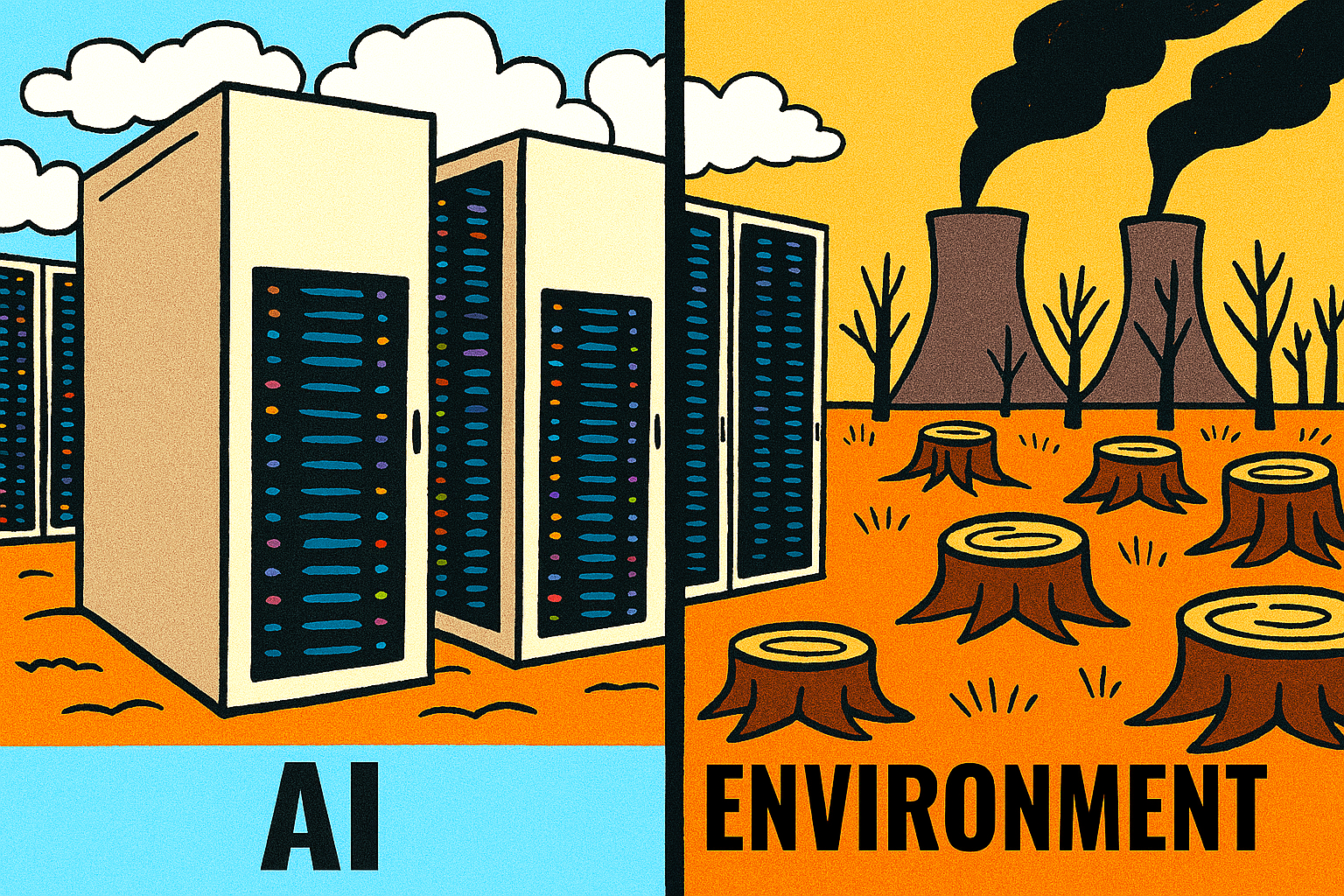
AI - dirty little secret or clean?

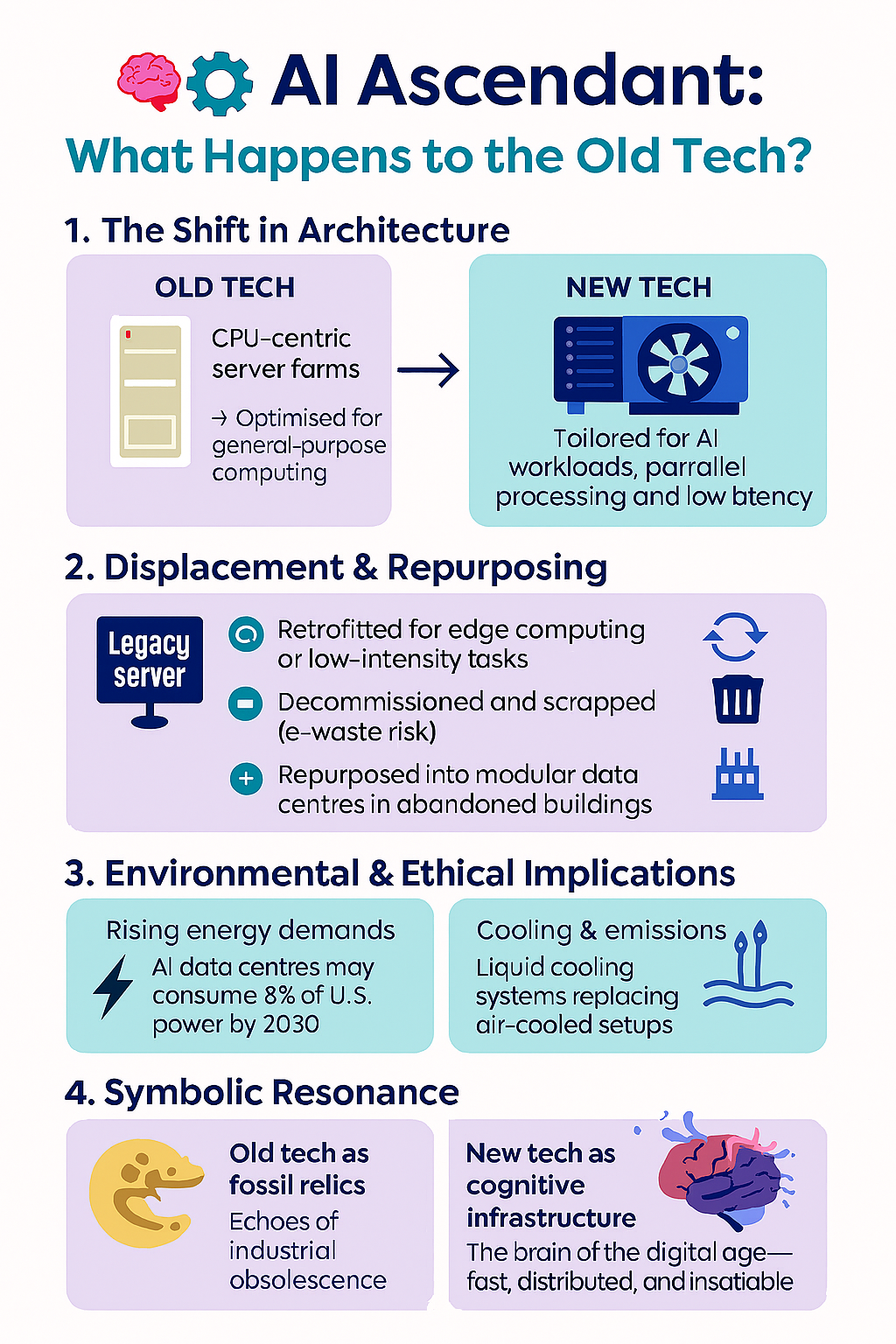
🧠 What’s Happening to the Old Tech?

Shadow in the cloud

🔄 Repurposing and Retrofitting

  • Many traditional CPU-centric server farms are being retrofitted to support GPU-heavy or heterogeneous architectures.
  • Some legacy racks are adapted for edge computing, non-AI workloads, or low-latency services that don’t require massive AI computing power.

🧹 Decommissioning and Disposal

  • Obsolete hardware—especially older CPUs and low-density racks—is being decommissioned.
  • Disposal is a growing concern: e-waste regulations are tightening, and sustainability targets mean companies must recycle or repurpose responsibly.

🏭 Secondary Markets and Resale

  • Some older servers are sold into secondary markets—used by smaller firms, educational institutions, or regions with less AI demand.
  • There’s also a niche for refurbished hardware, especially in countries where AI infrastructure is still nascent.

🧊 Cold Storage and Archival Use

  • Legacy systems are sometimes shifted to cold storage roles—archiving data that doesn’t require real-time access.
  • These setups are less power-intensive and can extend the life of older tech without compromising performance.

⚠️ Obsolescence Risk

  • The pace of AI innovation is so fast that even new data centres risk early obsolescence if they’re not designed with future workloads in mind.
  • Rack densities are climbing—from 36kW to 80kW+—and cooling systems are shifting from air to liquid, meaning older infrastructure simply can’t keep up.

🧭 A Symbolic Shift

This isn’t just about servers—it’s about sovereignty, sustainability, and the philosophy of obsolescence. The old tech isn’t just being replaced; it’s being relegated, repurposed, or ritually retired.

There’s a tech history lesson unfolding about digital mortality, and how each new AI cluster buries a generation of silicon ancestors.

Infographic: ‘New’ AI tech replacing ‘Old’ tech in data centres

🌍 The Green Cost of the AI Boom

Energy Consumption

  • AI data centres are power-hungry beasts. In 2023, they consumed around 2% of global electricity—a figure expected to rise by 80% by 2026.
  • Nvidia’s H100 GPUs, widely used for AI workloads, draw 700 watts each. With millions deployed, the cumulative demand is staggering.

💧 Water Usage

  • Cooling these high-density clusters often requires millions of litres of water annually. In drought-prone regions, this is sparking local backlash.

🧱 Material Extraction

  • AI infrastructure depends on critical minerals—lithium, cobalt, rare earths—often mined in ecologically fragile zones.
  • These supply chains are tied to geopolitical tensions and labour exploitation, especially in the Global South.

🗑️ E-Waste and Obsolescence

  • As new AI chips replace older hardware, legacy servers are decommissioned—but not always responsibly.
  • Without strict recycling protocols, this leads to mountains of e-waste, much of which ends up in landfills or exported to countries with lax regulations.

The Cloud Has a Shadow

This isn’t just about silicon—it’s about digital colonialism, resource extraction, and the invisible costs of intelligence. AI may promise smarter sustainability, but its infrastructure is anything but green unless radically reimagined.

⚡ The Energy Cost of Intelligence

🔋 Surging Power Demand

  • AI data centres are projected to drive a 165% increase in global electricity consumption by 2030, compared to 2023 levels.
  • In the U.S. alone, data centres could account for 11–12% of total power demand by 2030—up from 3–4% today.
  • A single hyperscale facility can draw 100 megawatts or more, equivalent to powering 350,000–400,000 electric vehicles annually.
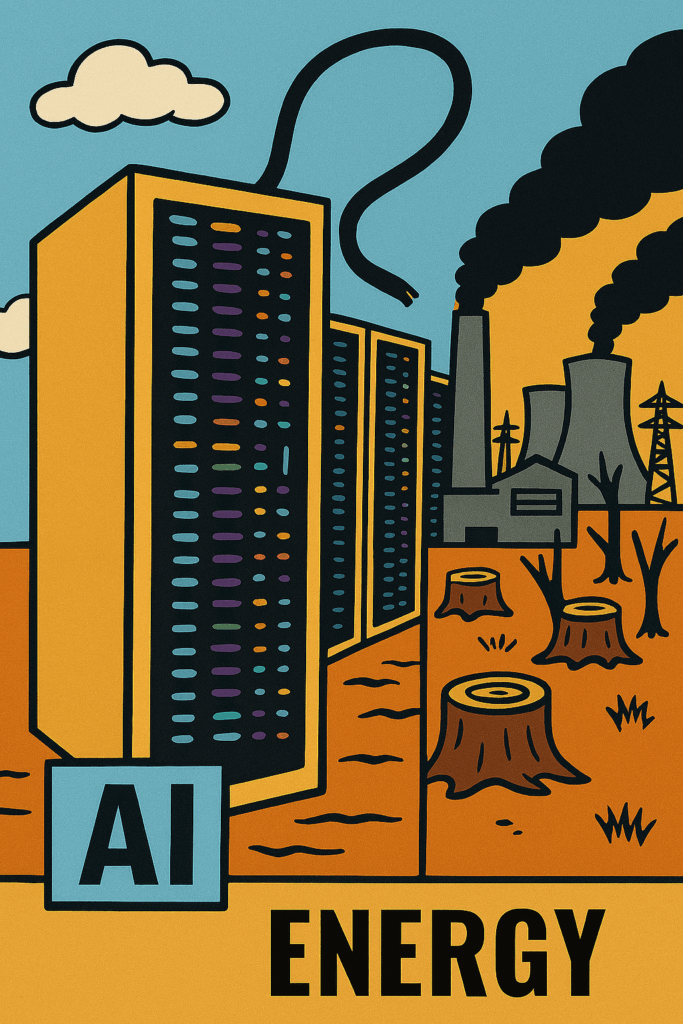
AI and Energy supply

🧠 Why AI Is So Power-Hungry

  • Training large models like OpenAI Chat GPT or DeepSeek requires massive parallel processing, often using thousands of GPUs.
  • Each AI query can consume 10× the energy of a Google search, according to the International Energy Agency.
  • Power density is rising—from 162 kW per square foot today to 176 kW by 2027, meaning more heat, more cooling, and more infrastructure.

🌍 Environmental Fallout

  • Cooling systems often rely on millions of litres of water annually. For example, in Wisconsin, two AI data centres will consume 3.9 gigawatts of power, more than the state’s nuclear plant.
  • Without renewable energy sources, this surge risks locking regions into fossil fuel dependency, raising emissions and household energy costs. We are not ready for this massive increase in AI energy production.

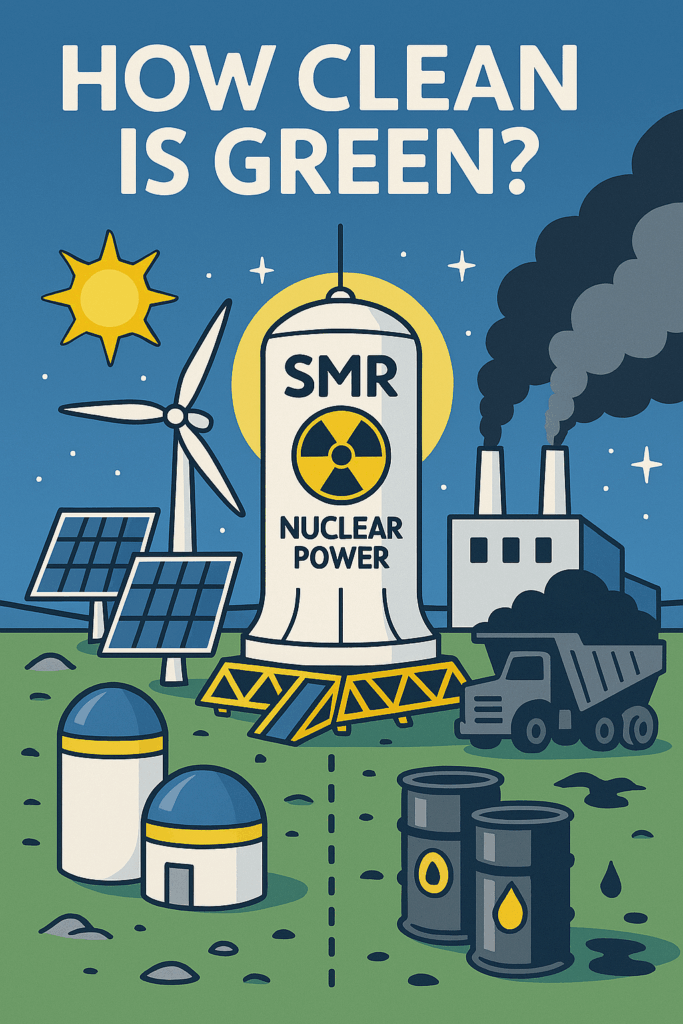
Just how clean is green?

The Intelligence Tax

This isn’t just about tech—it’s about who pays for progress. AI promises smarter cities, medicine, and governance, but its infrastructure demands a hidden tax: on grids, ecosystems, and communities.

AI is a hungry beast, and it needs feeding. The genie is out of the bottle!

AI power – the energy hunger game!

Powering AI will not be clean...?

As artificial intelligence surges into every corner of modern life—from predictive finance to generative art—the question isn’t just what AI can do, but what it consumes to do it.

The energy appetite of large-scale AI models is no longer a footnote; it’s the headline.

Training a single frontier model can devour as much electricity as hundreds of UK homes use in a year. And once deployed, these systems don’t slim down—they scale up.

Every query, every image generation, every chatbot exchange draws from vast data centres, many powered by fossil fuels or water-intensive cooling systems.

The irony? AI is often pitched as a tool for climate modelling, yet its own carbon footprint is ballooning.

This isn’t just a technical dilemma—it’s a moral one. The race to build smarter, faster, more responsive AI has become a kind of energy arms race. Tech giants tout efficiency gains, but the underlying logic remains extractive: more data, more compute, more power.

Meanwhile, communities near data centres face water shortages, grid strain, and rising costs—all for services they may never use.

Future direction

Where is this heading? On one side, we’ll see ‘greenwashed’ AI—models marketed as sustainable thanks to token offsets or renewable pledges. On the other, a growing movement for ‘degrowth AI’: systems designed to be lean, local, and ethically constrained. Think smaller models trained on curated datasets, prioritising transparency over scale.

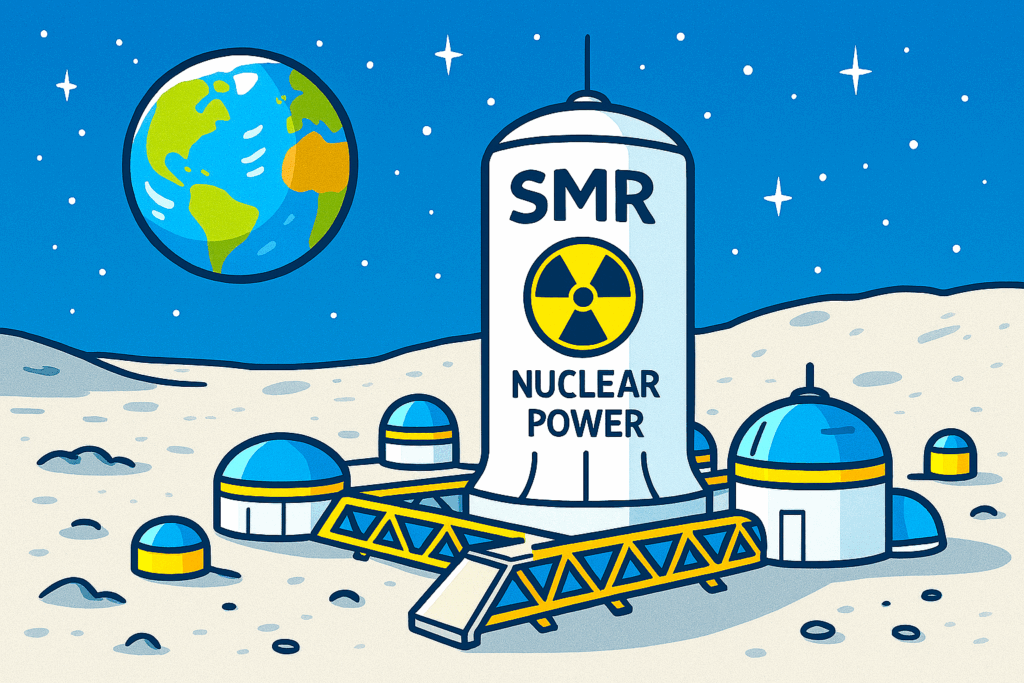
AI power – the energy hunger game! NASA’s ambition is to place nuclear power on the moon

Governments are waking up, too. The EU and UK are exploring energy disclosure mandates for AI firms, while some U.S. states are scrutinising water usage and land rights around data infrastructure. But regulation lags behind innovation—and behind marketing.

Ultimately, the energy hunger game isn’t just about watts and emissions. It’s about values. Do we want AI that mirrors our extractive habits, or one that challenges them? Can intelligence be decoupled from excess?

The next frontier isn’t smarter models—it’s wiser ones. And wisdom, unlike raw compute, doesn’t need a megawatt to shine.

Why Nuclear Is Back on the Table

  • Global Momentum: Thirty-one countries have pledged to triple nuclear capacity by 2050, framing it as a cornerstone of clean energy strategy.
  • AI’s Power Problem: With data centres projected to consume more energy than Japan by 2026, nuclear is being pitched as the only scalable, low-carbon solution that can deliver round-the-clock power.
  • Baseload Reliability: Unlike solar and wind, nuclear doesn’t flinch at nightfall or cloudy skies. That makes it ideal for powering critical infrastructure—especially AI, which can’t afford downtime.

🧪 Next-Gen Tech on the Horizon

  • Small Modular Reactors (SMRs): These compact units promise faster deployment, lower costs, and safer operation. China and Russia already have some online.
  • Fusion Dreams: Still experimental, but if cracked, fusion could offer near-limitless clean energy. It’s the holy grail—though still more sci-fi than supply chain.

⚖️ The Catch? Cost, Waste, and Public Trust

  • Nuclear remains expensive to build and politically fraught. Waste disposal and safety concerns haven’t vanished, and public opinion is split—especially in the UK.
  • Even with advanced designs, the spectres of Chernobyl and Fukushima linger in the cultural memory. That’s a narrative hurdle as much as a technical one.

🛰️ Moonshots and Geopolitics

  • NASA’s push to deploy a nuclear reactor on the moon by 2029 underscores how strategic this tech has become—not just for Earth, but for space dominance.
  • The U.S.–China race isn’t just about chips anymore. It’s about who controls the energy to power them.

Nuclear is staging a comeback—not as a relic of the past, but as a potential backbone of the future.

Whether it becomes the dominant force or a transitional ally depends on how fast we can build, how safely we can operate, and how wisely we choose to deploy.

🌍 How ‘clean’ is green?

According to MIT’s Climate Portal, no energy source is perfectly clean. Even solar panels, wind turbines, and nuclear plants come with embedded emissions—from mining rare metals to manufacturing components and transporting them.

So, while they don’t emit greenhouse gases during operation, their setup and maintenance do leave a footprint.

How CLEAN is GREEN? Explainers | MIT Climate Portal

⚖️ Lifecycle Emissions Comparison

Here’s how different sources stack up in terms of CO₂ emissions per kilowatt hour:

Energy SourceCO₂ Emissions (g/kWh)Notes
Coal~1,000Highest emissions, plus toxic byproducts
Natural Gas~500Cleaner than coal, but still fossil-based
Solar<50Mostly from manufacturing panels
Wind~10Lowest emissions, mostly from materials
Nuclear (SMR/SNR)~12–20Low emissions, but waste and safety debates linger

Source: MIT Climate Portal

Clean energy gold rush for natural hydrogen

Natural hydrogen

The natural hydrogen gold rush is captivating attention worldwide as a potential game-changer in the quest for cost-effective, low-carbon energy sources.

Countries such as the U.S., Canada, Australia, France, Spain, Colombia, and South Korea are actively engaged in exploratory efforts for geological hydrogen.

What Is Natural Hydrogen?

Natural hydrogen, also referred to as white or gold hydrogen, is hydrogen gas that occurs naturally beneath the Earth’s surface. It is thought to form from high-temperature reactions between water and minerals rich in iron.

Unlike current hydrogen production, which is mainly produced using fossil fuel, natural hydrogen holds promise as a cleaner option.

Why the Hype?

Hydrogen is often reported as a potential energy source for transitioning away from fossil fuels. Yet, the methods used to produce it frequently result in substantial greenhouse gas emissions.

Green hydrogen, produced by splitting water into hydrogen and oxygen using renewable electricity, is an exception. Unfortunately, its development has been hindered by high costs and economic challenges.

Geologic hydrogen is a ‘natural’ hydrogen. Companies are now actively exploring this untapped resource. Countries like Australia, France, Spain, U.S., Canada, Colombia, and South Korea.

Research by Rystad Energy reportedly suggests that forty companies were actively searching for geologic hydrogen deposits by the end 2023. That’s up from just 10 in 2020. The term ‘white gold rush’ has emerged from this surge in interest.

Potential Impact

Advocates hope that natural hydrogen could be a gamechanger in the clean energy transition.

Although it’s not an entirely novel concept, interest in geologic hydrogen is gaining traction. Both researchers and corporations are eager to explore its possibilities.

As the exploration unfolds, the world looks on with eager anticipation. Hopefully natural hydrogen will play a significant role in shaping a more sustainable energy future.

The natural hydrogen will have to be mined and that in itself may bring environmental issues. Remember the concerns fracking created?

Wind power is being wasted adding £40 to household energy bills, according to think tank

Wind turbine and battery

Wasted wind power will add £40 to the average UK household’s electricity bill in 2023, according to a think tank.

That figure could increase to £150 in 2026, Carbon Tracker has estimated.

When it is very windy, the grid cannot handle the extra power generated. So, wind farms are paid to switch off and gas-powered stations are paid to fire up. The cost is passed on to consumers.

The government said major reforms will halve the time it takes to build energy networks to cope with extra wind power. Energy regulator Ofgem announced new rules in November 2023, which it said would speed up grid connections.

Bottleneck

Most of the UK’s offshore wind farms are in England. Dogger Bank, off the coast of Yorkshire is the largest in the world. Meanwhile, around half of onshore wind farms are in Scotland but most electricity is used in south-east England.

Carbon Tracker said the main problem in getting electricity to where it is needed is a bottleneck in transmission.

Wind curtailment

The practice of switching off wind farms and ramping up power stations is known as wind curtailment. This cost is passed on to consumers, it said. Carbon Tracker researches the impact of climate change on financial markets. It said since the start of 2023, wind curtailment payments cost £590m, adding £40 to the average consumer bill.

It warned the costs were set to increase adding £180 per year to bills by 2030. Wind farms are being built faster than the power cabling needed to carry the electricity.

Cable issue

‘The problem is, there are not enough cables. The logical solution would be to build more grid infrastructure,‘ said an analyst at Carbon Tracker. ‘It’s not even that expensive,’ he added, compared with mounting wind curtailment costs.

Industry group RenewableUK reportedly said that grid constraints, ‘reflect a chronic lack of investment in the grid.’

We need to move from a grid which is wasteful, to one that’s fit for purpose as fast as possible.’

However, historically it has taken between 10 and 15 years for new transmission cables to be approved.

Maybe more battery storage plants around the UK would help reduce the bottlenecks? As renewable power continues to expand, this would enable the extra power to be stored to use later.

This would be better than firing up antiquated fossil fuel power plants.

Western EV makers look to tech to compete in the world’s top EV market, China

Electric Car

Leader

China has been leading the global electric vehicle (EV) market for years, thanks to its large domestic demand, generous government subsidies, and well-established battery and electronics industry. However, the west is not giving up on the race to electrify the transport sector and reduce greenhouse gas emissions.

Europe reportedly surpassed China in terms of new EV registrations in 2020, driven by stricter emission regulations, higher consumer awareness, and more diverse and affordable models. The United States also saw a growth in EV sales, despite the Covid-19 pandemic and lower fuel prices. How are western countries and companies now competing with China in the EV market?

Global automakers such are using advanced tech such as driver-assist software to compete in the world’s largest EV market – China. ‘China’s domestic brands are leading the market in the development and implementation of advanced assisted driving systems, capitalizing on their early-entry advantages in the electric and intelligent vehicle sector‘, a recent report suggests.

BofA reportedly said it expects China to still be the world’s largest EV market in 2025, standing at 40%-45% market share.

Strategy

One of the strategies is to invest more in research and development, innovation, and collaboration. Western automakers are trying to improve the performance, efficiency, and cost of their EVs by developing new technologies and designs, such as advanced batteries, smart and autonomous features, and sustainable materials. They are also partnering with other players in the EV ecosystem, such as battery suppliers, charging network operators, software developers, and regulators, to create synergies and overcome challenges.

EV

Another strategy is to adapt to local market conditions and consumer preferences. Western automakers are aware that China is not a homogeneous market, but rather a complex and dynamic one with different regional characteristics, customer segments, and competitive landscapes. They are tailoring their products and services to meet the specific needs and expectations of Chinese consumers, such as offering more connectivity options, longer driving ranges, and lower prices. They are also leveraging their global brand reputation, quality standards, and customer loyalty to differentiate themselves from local competitors.

Niche markets

A third strategy is to diversify their portfolio and target niche markets. Western automakers are not only focusing on passenger cars, but also exploring other types of EVs, such as commercial vehicles, motorcycles, scooters, and buses. They are also targeting niche markets that have high growth potential or specific demands, such as luxury cars, sports cars, or green cars. By doing so, they can tap into new customer segments and create more opportunities.

The EV market is expected to grow rapidly in the coming years, as more countries and regions adopt policies and measures to support the transition to low-carbon mobility. China will remain a dominant player in the global EV scene, but the west will not lag behind.

How do EV’s compare to traditional vehicles?

Electric vehicles (EVs) are becoming more popular and competitive with traditional cars in terms of performance and cost. Here are some of the main differences and similarities between EVs and traditional cars:

Performance: EVs have a faster acceleration and are more efficient than traditional cars. They can reach high speeds in a short time, thanks to their instant torque rovided by the electric motor. They also have a smoother and quieter ride, as they do not have gears or transmissions. However, traditional cars perform better at high speeds and have a longer driving range than EVs. They can also handle different terrains and weather conditions better than EVs, as they have more power and stability.

Cost: EVs have a higher retail price than traditional cars, on average. But EVs may be a better financial deal for consumers over the long term. That’s because maintenance, repair and fuel costs tend to be lower than those for fossil fuel cars. EVs have fewer moving parts and fluids, which means they require less servicing and repairs. They also run on electricity, which is cheaper and cleaner than fossil derived fuels. However, traditional cars have lower upfront costs and more financing options than EVs. They also have a higher resale value and more availability than EVs, as they are more common and therefore familiar to buyers.

Environmental impact: EVs are more environmentally friendly than traditional cars, as they do not emit greenhouse gases or pollutants that contribute to air quality problems. They can also use renewable energy sources, such as solar or wind power, to charge their batteries and use fossil derived energy too.

However, EVs are not completely carbon-neutral, as they still depend on the electricity grid, which still uses fossil fuels to generate power. They also produce emissions during their manufacture and disposal processes.

Traditional cars, on the other hand, are a major source of carbon emissions and environmental damage, as they burn fossil fuels and release harmful substances into the atmosphere such as carbon monoxide and carbon dioxide. They also consume natural resources and create waste during their production and operation.

Energy generation
Fossil fuels generate power for the electric vehicle

As the EV population grows, so too will the energy requirement – and it will most likely be met moreso by fossil fuels in the short term as well as by renewables.

According to various sources, electric cars are generally cheaper to run than petrol cars in terms of fuel, road tax, maintenance, and insurance. However, the initial purchase price of electric cars is usually higher than petrol cars, so the overall cost of ownership may depend on how long you plan to keep the car and how much you drive it.

Running cost examples of electric cars vs petrol cars – (Spring 2023 data)

  • According to British Gas – fully charging a typical 60kW electric car at home costs £15.10 and gives you a 200-mile range, whereas filling up a petrol car with a similar range costs over £104. Electric cars also pay zero road tax, while petrol cars pay between £30 to £2,365 per year depending on their CO2 emissions. Electric cars also tend to have lower maintenance and insurance costs than petrol cars.
  • According to Regit – charging an electric car like the Vauxhall Corsa-E costs roughly £9.50 in electricity for a 200-mile range, while fuelling a petrol car with a similar range costs £41.63 in petrol. Electric cars also save money on road tax, maintenance, and congestion charges compared to petrol cars.
  • According to Which? – the electric Mini Cooper SE costs £8,000 more to buy than the petrol Mini One, but it costs £2,591 less to run over three years, mainly due to fuel savings. The electric car also pays no road tax or congestion charges, while the petrol car pays £155 and £11.50 per day respectively.
  • According to Auto Express – the annual running costs of an electric car are 21% less than those of a petrol car, excluding the purchase price. The average annual running cost for an electric car is £1,742, compared to £2,205 for a petrol car.
  • According to RAC – the annual running costs of an electric car like the Nissan Leaf are £1,233 less than those of a petrol car like the Ford Focus, excluding the purchase price. The electric car costs £1,062 per year to run, while the petrol car costs £2,295

Conclusion

There are many factors that affect the running costs of electric cars vs petrol cars, and different sources may have different assumptions and methods of calculation. However, the general trend is that electric cars are cheaper to run than petrol cars in most cases.

Hydrogen and hybrids are fast becoming future contenders. Watch this space…