

Nvidia has revealed its latest generation of AI chips, coming just months after the release of its preceding model.
This rapid succession underscores the intense competition within the AI chip market and Nvidia’s relentless effort to maintain its leading position.
CEO Jensen Huang has now committed to unveiling new AI chip technology annually, accelerating the company’s prior biannual pace. The latest AI chip architecture, named ‘Rubin,’ is set to follow the ‘Blackwell’ model announced in March 2024, which is currently in production and anticipated to be delivered to customers the latter part of 2024.
Huang’s unveiling of the Rubin has seemingly hastened Nvidia’s already rapid AI chip development.
Nvidia has committed to launching new AI chip designs annually, a cadence Huang reportedly referred to as a ‘one-year rhythm‘ during his Sunday 2nd June 2024 announcement. Previously, the company was committed to updating its chips every two years. But such is the speed and fierce competition of AI development, that original decision has become quickly out-dated.
The swift transition from Blackwell to Rubin, taking less than three months, highlights the intense competition in the AI chip market and Nvidia’s race to maintain its leading position.
AMD and Intel are two major competitors playing catch-up in the AI race.
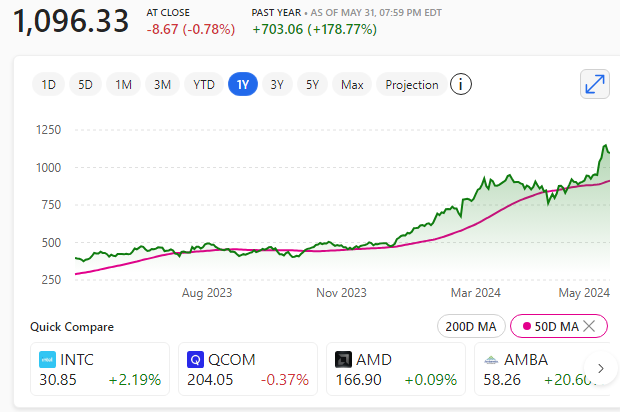
NVIDIA Corporation (NVDA) has experienced remarkable growth over the past decade.
Historical stock price trends
As of 10th May 2024, NVIDIA’s closing stock price stood at: $898.78
NVIDIA’s stock reached an all-time high of $950.02 on 25th March 2024. The 52-week high stands at $974.00, which is 9.7% higher than the current share price. Conversely, the 52-week low was $280.46, which is considerably below the current price.
Annual percentage changes
In 2024, the average stock price reached $763.29, marking a year-to-date rise of 79.30%.
In 2023, NVIDIA’s stock price experienced a remarkable surge of 239.02%.
Conversely, in 2022, the stock price witnessed a decline of 50.27%.
Throughout the past decade, the stock has undergone considerable volatility, exhibiting both notable gains and significant losses.
Focus
NVIDIA began as a pioneer in PC graphics and has since expanded its focus to artificial intelligence (AI) solutions. Its GPUs (graphics processing units) are pivotal in AI, high-performance computing (HPC), gaming, and virtual reality (VR) platforms.
The company’s parallel processing capabilities, powered by thousands of computing cores, are vital for executing deep learning algorithms. Additionally, NVIDIA is active in emerging markets such as robotics and autonomous vehicles.
Market position
NVIDIA holds a dominant position in the Data Centre, professional visualization, and gaming markets. Its success is bolstered by strategic partnerships with leading cloud service providers and server vendors.
Financial performance
NVIDIA’s revenue and profit have seen substantial growth over time. Its emphasis on AI and new technologies suggests a strong potential for further expansion. In summary, despite NVIDIA’s stock achieving impressive gains, it is still influenced by market trends and technological changes.
Its peak status hinges on multiple elements such as industry movements, competitive landscape, and upcoming innovations. Investors are advised to meticulously assess these factors when determining the stock’s future prospects.
Considering a long-term investment yet expecting a downturn, it might be prudent to realise some profits now, given the enormous 20,000% surge in stock value.
Arm, with a 90% holding by SoftBank, is reportedly set to establish an AI chip unit with the goal of developing a prototype by spring 2025.
This initiative is aimed at catching up with the booming AI market, currently dominated by Nvidia.
Arm, alongside competitors such as AMD, Intel, and Qualcomm, is accelerating efforts to gain position in the AI sector.
SoftBank is negotiating with contract manufacturers, including Taiwan’s TSMC, to produce the AI chips. Mass production is expected to commence in autumn 2025.
Arm’s shares have surged by nearly 45% this year, bringing its market capitalization to over $113 billion.
The chip designer based in the U.K., plans to create an AI chip unit to develop a prototype by spring 2025.
Discussions are reportedly ongoing with contract manufacturers like Taiwan’s TSMC for the production of the AI chips. It was reported that production is anticipated to start in fall 2025.
Arm is responsible for designing the core architecture for these chips. The company licences its designs to companies including Qualcomm and Nvidia and earning royalty fees from each sale. The company asserts that 99% of high-end smartphones utilize Arm technology.
Ambition
Established by Japanese billionaire Masayoshi Son, SoftBank is heavily investing in AI. The company has new plans to allocate $960 million by the following year to enhance its generative AI computing capabilities. In June 2023, Son expressed SoftBank’s ambition to occupy a leading role in the AI revolution.
Reportedly, SoftBank aims to establish AI data centres equipped with proprietary chips throughout the U.S., Europe, Asia, and the Middle East by 2026.
For the fiscal year concluding in March 2024, SoftBank recorded a 7.24 billion Japanese Yen ($4.6 billion) profit in its Vision Fund.
This was the first profitable year for the principal tech investment division since 2021.
UK chip designer Arm’s shares fell on Thursday 9th May 2024, subdued by revenue forecasts despite a strong sales quarter fueled by demand for AI applications.
Arm announced a 47% increase in fiscal Q4 revenue to $928 million on Wednesday.
This surge was propelled by its licensing business, which saw a 60% increase to $414 million for the quarter, attributed to several high-value licencing deals for AI chips.
Additionally, Arm’s royalty revenues rose 37% to $514 million year-over-year, thanks to the growing adoption of its new Armv9-based chips, which offer higher margins.
However, Arm’s revenue projection for 2025, estimated between $3.8 billion and $4.1 billion, did not meet investor expectations, with analysts anticipating $3.99 billion for the year.
What is Arm?
Contrary to chipmakers like Nvidia, which manufacture and market their own products, Arm creates the ‘architectures’ that form the foundation of chips.
These designs are then licenced to various chip manufacturers, including Qualcomm and Nvidia, with Arm earning royalties on each unit sold.
Originally founded in Cambridge, England, in 1990, Arm was an independent company listed in London until 2016, when it was acquired by Japanese tech investor SoftBank for $32 billion.
In September 2023, SoftBank listed Arm on the Nasdaq. Since its initial public offering, Arm’s share value has more than doubled, driven by the explosive demand for chips that power advanced generative AI applications, such as ChatGPT.
But this recent revenue forecast had a negative effect on its share price
Arm Holdings one year chart to 9th May 2024
The recent revenue forecast had a negative effect on its share price
Intel shares fall after company provides weak forecast for earnings, but disappoints with sales.
The stock fell 8% in extended trading.
Monthly stock price chart for Intel Corp. March to April 2024
Intel actual versus consensus expectations for the quarter ended in March 2024:
Earnings per share: 18 cents vs. 14 cents expected
Revenue: $12.72 billion vs. $12.78 billion expected
For the second quarter, Intel anticipates earnings of 10 cents per share with a projected revenue of $13 billion. This projection is in contrast to analysts’ expectations, which predict earnings of 25 cents per share on sales amounting to $13.57 billion.
In the first quarter, Intel disclosed a net loss of $400 million, equivalent to 9 cents per share, as opposed to the previous year’s net loss of $2.8 billion, 66 cents per share.
Revenue was $12.7 billion versus $11.7 billion a year ago, a 9% year-over-year increase.
Samsung Electronics anticipates its profits for the first quarter of 2024 to surge more than tenfold compared to the previous year.
This projection is due to the recovery in chip prices following a post-pandemic decline and a surge in demand for artificial intelligence (AI) related products.
As the world’s leading manufacturer of memory microchips, smartphones, and televisions, the South Korea-based Samsung reportedly plans to publish a comprehensive financial report on 30th April 2024.
Projected profit
The tech giant has projected that its operating profit for the January-March 2024 quarter soared to 6.6 trillion won ($4.9bn; £3.9bn), marking a 931% increase from the same period in 2023, surpassing analysts’ forecasts of approximately 5.7 trillion won.
Rebound in microchip prices
A rebound in global semiconductor prices, following a significant downturn the previous year, is expected to bolster its earnings. Over the past year, global memory microchip prices have reportedly increased by about 20%. The semiconductor division of Samsung typically generates the most revenue for the company.
The demand for semiconductors is projected to stay robust throughout the year, fueled by the expansion in AI technologies. Furthermore, the earthquake that struck Taiwan on 3rd April 2024 could potentially constrict the worldwide chip supply, possibly enabling Samsung to further elevate its prices.
Taiwan a key player
Taiwan houses several key chipmakers, including TSMC, which supplies Apple and Nvidia. Despite TSMC reporting minimal impact on its production from the earthquake, it did experience some operational disruptions.
Additionally, Samsung is poised to benefit from the sales of its newly launched flagship Galaxy S24 smartphones, introduced in January.
Intel’s stock dropped by 4% during extended trading on Tuesday 2nd April 2024, following the disclosure of long-anticipated financial details for its semiconductor manufacturing division, often referred to as the foundry business, in a filing with the SEC.
The company reportedly disclosed that its foundry business incurred an operating loss of $7 billion in 2023, against sales of $18.9 billion. This represents a greater loss compared to the $5.2 billion operating loss reported by Intel for its foundry business in 2022, which had sales of $27.5 billion.
This is the first time that Intel has disclosed revenue totals for its foundry business separately. Historically, Intel has both designed its own chips as well as its own manufacturing and reported microchip sales to investors.
Other American semiconductor companies such as Nvidia and AMD design their microchips but send them off to Asian factories such as Taiwan’s TSMC for manufacturing.
China has reportedly prohibited the use of U.S. processors from both AMD and Intel in government computers and servers. The directive is designed to encourage the use of domestic alternatives.
Chinese government agencies are now required to choose ‘safe and reliable’ domestic alternatives for these chips. The sanctioned list features processors from Huawei and the state supported firm Phytium, both of which face bans in the U.S.
In addition to processors, China is now also restricting Microsoft Windows on government devices, opting instead for domestically produced operating systems.
These guidelines are part of a broader tech trade battles between China and the U.S. While the impact on Intel and AMD remains to be seen, it’s clear that China is taking aggressive steps to reduce reliance on U.S. built technology.
The global tech landscape continues to evolve, and these decisions have far-reaching implications for both countries and the industry as a whole.
U.S. and China trade tensions are unlikely to recede anytime soon.
Water scarcity is a pressing global issue and has far-reaching consequences across various industries. One sector significantly affected is semiconductor manufacturing.
How does water scarcity pose a threat to the production of essential microchips.
Water in Semiconductor Manufacturing
Ultra-pure water is a critical resource in semiconductor fabrication plants (fabs). It is used for cleaning, cooling, and various processing steps during chip production.
Microchips power our devices—computers, smartphones, sensors, and LEDs—all of which rely on water-intensive manufacturing processes.
Global Water Scarcity
Freshwater availability is unevenly distributed worldwide. While oceans contain 97% of water (mostly saline), accessible freshwater constitutes only a small fraction.
Approximately four billion people experience severe water scarcity for at least one month annually, and half a billion face it year-round.
Taiwan’s Drought and Chip Production
Taiwan, a semiconductor manufacturing hub, faces a severe drought. Over 20% of global microchips are produced there.
Water shortages threaten supply chains, potentially impacting chip production.
Cost and Sustainability
Creating fully self-sufficient local supply chains would cost $1 trillion. Such self-reliance could increase semiconductor costs by up to 65%.
Urgent action is needed to ensure sustainable water management in fabs, as chips control everything from cars to appliances.
In conclusion, water scarcity poses a real danger to semiconductor production. Addressing this challenge requires strategic planning, conservation efforts, and global cooperation.
AI a problem or a solution?
Will the problem of water scarcity exacerbate the uneven distribution of water around the world as the rich have easier access to the precious resource.
Will the explosion of AI tech push the imbalance – water is a basic necessity to maintain human life. Will AI have a hand in controlling the distribution of water – even for its own needs?
The excitement surrounding artificial intelligence (AI) technology appears to show few signs of abating
The technology company at the heart of the AI chip boom reported its Q4 earnings after the stock market’s close on Wednesday 21st February 2024, beating expectations for both earnings and sales. The company’s total revenue is up 265% from a year ago.
Investors are looking to Nvidia’s latest quarterly earnings report to see whether the company’s meteoric growth can last.
Nvidia one year share price as at 22nd February 2024
AI chips
Nvidia makes powerful computer chips that power popular AI tools like OpenAI’s ChatGPT and Microsoft’s Copilot. High demand for those chips has propelled the company into the exclusive trillion-dollar club.
As of market close on 21st February 2024 the company’s market cap sat at $1.667 trillion, putting it behind Alphabet’s $1.779 trillion market cap. It’s also behind Microsoft and Apple, which hold market caps of $2.988 trillion and $2.819 trillion, respectively.
Nvidia’s stock price has been on an upward trajectory so far this year. Shares have gained by nearly 40% since the beginning of 2024. On top of that, they’ve soared by over 225% in the last 12 months.
Although short-term demand for Nvidia’s AI chips has been strong, major companies such as Microsoft and Meta have indicated interest in buying them from other companies.
If you had invested $1,000 in Nvidia
If you had invested $1,000 in Nvidia five, 10 or 24 years ago, here’s how much your investment would be worth now.
$1,000 in Nvidia five years ago, your investment would have increased by an eye-watering 1,015% and be worth around $17,542 as of 20th February 2024.
If you had invested $1,000 in Nvidia 10 years ago, your investment would have soared by about 22,340% and be worth around $148,226 as of 20th February 2024.
But, if you had invested $1,000 in Nvidia in January 1999, when Nvidia first went public, your investment would have grown by around 277,708% and be worth close to $2,784,065 as of 20th February 2024.
Nvidia stock closes at all-time high, a day before earnings
Shares of Nvidia closed up 2.3% at an all-time high of $504 on Monday 20th November 2023. The record comes ahead of the company’s Q3 results due Tuesday 21st November 2023, when analysts are expecting to see revenue growth of over 170%.
And, if that’s not enough, the forecast for Q4, according to some analysts, is likely to show a number close to 200% growth.
Nvidia is still by far the market leader in GPUs for AI, but high prices and competition are fast becoming an issue.
Can Nvidia continue the AI ride and hold this remarkable market share position?
The curbs are aimed at closing loopholes that became apparent after the U.S. announced export curbs on microchips in October 2022. The restrictions are designed to prevent China’s military from importing advanced semiconductors or equipment.
Nvidia has said in a filing that the new export restrictions will block sales of two high-end artificial intelligence chips it created for the Chinese market – A800 and H800. It said that one of its gaming chips will also be blocked.
Nvidia Corp one month chart – closed at 439.38 17th October 2023
Although the curbs also affect other chip makers, analysts believe Nvidia will be hit the hardest because China accounts for up to 25% of its revenues from data centre chip sales. Nvidia’s shares, which are considered a star stock, fell by as much as 4.7% in the wake of the announcement.
Semiconductor Industry Association
The Semiconductor Industry Association, which represents 99% of the U.S. semiconductor industry by revenue, said in a statement that the new measures are ‘overly broad‘ and ‘risk harmingthe U.S. semiconductor structure without advancing national security as they encourage overseas customers to source elsewhere’.
China reacts
A spokesperson for the Chinese embassy also said that it ‘firmly opposes‘ the new restrictions, which also target Iran and Russia and go into effect in 30 days.
Nvidia stock falls after restrictions on AI chip exports from U.S. to China
Two months ago, China retaliated by restricting exports of two materials, gallium and germanium, which are key to the semiconductor industry.
The materials are ‘minor metals‘, meaning that they are not usually found on their own in nature, and are often the by-product of other processes. It’s not only the U.S., Japan and the Netherlands – which is home to key chip equipment maker ASML – have also imposed chip technology export restrictions on China.
Fallout
The constant ‘fall-out’ between the world’s two biggest economies has raised concerns over the rise of so-called ‘resource nationalism‘ – a practice where governments hoard critical materials to exert influence over other countries.
Nvidia shares rose 4.2% Tuesday 29th August 2023 to close at a record high, after the company announced a partnership with Google that could expand distribution of its artificial intelligence technology (AI).
The stock’s bountiful run continued, now up 234% in 2023, making it by far the best performer in the S&P 500. Facebook parent Meta is second in the index, up 148% so far this year.
The record close comes less than a week after the company said quarterly revenue doubled from a year earlier and gave a forecast indicating that sales this period could rise 170% on an annual basis. The day after the better-than-expected earnings report, the stock climbed to a record intraday high of $502.66 before declining later in the afternoon.
Nvidia’s business is booming because its graphics processing (GPU’s) are being gobbled up by cloud companies, government agencies and startups to train and deploy generative AI models like the technology deployed in OpenAI’s ChatGPT as fasta as Nvidia can make them.
NVIDIA stock chart
Nvidia announcment
On Tuesday 29th August 2023, Nvidia CEO Jensen Huang appeared at a Google conference to announce an AI agreement between the two companies.
Through the partnership, Google’s cloud customers will have greater access to technology powered by Nvidia’s powerful H100 GPUs.
‘Our expanded collaboration with Google Cloud will help developers accelerate their work with infrastructure, software and services that supercharge energy efficiency and reduce costs’, the Nvidia CEO reportedly said in a blog post.
Nvidia’s GPUs are also available on competing cloud platforms from Amazon and Microsoft.
Technology giant Nvidia reports its sales have hit a record after more than doubling as demand for its artificial intelligence (AI) chips take off!
It figures
The company says revenue jumped to above $13.5bn (£10.6bn) for the three months to the end of June. Nvidia also expects sales to perform very well in the current quarter and plans to buy back $25bn of its stock. The firm’s shares rose by more than 6.5% in extended trading in New York, adding to their huge gains this year. Nvidia also said it expects revenue of around $16bn for the three months to the end of September 2023.
That is substantially higher than Wall Street expected and would equate to a rise of around 170%, compared to the same time last year.
Even before 23rd August’s figures, Nvidia’s stock price had more than tripled for the year, making it the top performer in the S&P 500. It’s share price jumped to around $500 after hours, a level that would mark a record if it closes there on 24th August 2023. Its prior closing high was $474.94 on 18th July 2023.
‘A new computing era has begun’, Nvidia’s chief executive, Jensen Huang, said in a statement. ‘Companies worldwide are transitioning from general-purpose to accelerated computing and generative AI’, he reportedly added.
Strong performance
The strong performance was driven by Nvidia’s data centre business, which includes AI chips.
The power of Nvidia’s AI microchips
Revenue for that unit came in at more $10.3bn, a rise of more than 170% from year ago, as cloud computing service providers and large consumer internet companies snapped up its next-generation processors.
This year, Nvidia’s stock market value has jumped to more than $1 trillion as its shares more than tripled in value, mking it the fifth publicly traded U.S. company to join the so-called ‘Trillion dollar club’, along with Apple, Amazon, Alphabet and Microsoft.
AI ‘mania’ helps Nvidia
Nvidia have been making micro chips for a long time and it’s only really been in the last couple of years that the market has caught on.
Nvidia was originally known for making the type of computer chips that process graphics, particularly for computer games. They have been making chips for a long time and have now become the leader in AI chip design and manufacture.
Now Nvidia’s hardware is the foundation for most AI applications, with one report suggesting it had cornered 95% of the market for machine learning.
ChatGPT which generates human-like responses to user queries within seconds was trained using 10,000 of Nvidia’s graphics processing units clustered together in a supercomputer belonging to Microsoft.
AI products are expected to dramatically change how we use computers and the role they play in our lives.
Amazon is one of the leading companies in the field of artificial intelligence (AI) and has been developing its own custom chips to power its AI applications and services.
Amazon’s AI chips are designed to perform tasks such as natural language processing, computer vision, speech recognition, and machine learning inference and training.
AI chips created by Amazon
AZ2: This is a processor built into the Echo Show 15 smart display and powers artificial intelligence tasks like understanding your voice commands and figuring out who is issuing those commands. The AZ2 chip also enables features such as visual ID, which can recognize faces and display personalized information on the screen.
Inferentia: This is a high-performance chip that Amazon launched to deliver low-cost and high-throughput inference for deep learning applications. Inferentia powers Amazon Elastic Compute Cloud (EC2) Inf1 instances, which are optimized for running inference workloads on AWS. Inferentia also powers some of Amazon’s own services, such as Alexa, Rekognition, and SageMaker Neo.
Trainium: This is a chip that Amazon designed to provide high-performance and low-cost training for machine learning models. Trainium will power Amazon EC2 Inf2 instances, which are designed to train increasingly complex models, such as large language models and vision transformers. Trainium will also support scale-out distributed training with ultra-high-speed connectivity between accelerators.
Despite advancements is Amazon chasing to keep up?
Amazon is racing to catch up with Microsoft and Google in the field of generative AI, which is a branch of AI that can create new content or data from existing data. Generative AI can be used for applications such as natural language generation, image and video synthesis, text summarization, and personalization.
AI models from Amazon
Titan: This is a family of large language models (LLMs). Titan models can generate natural language texts for various domains and tasks, such as conversational agents, document summarization, product reviews, and more. Titan models are trained on a large and diverse corpus of text data from various sources, such as books, news articles, social media posts, and product descriptions.
Powerful chips for artificial intelligence (AI)
Bedrock: This is a service that Amazon created to help developers enhance their software using generative AI. Bedrock provides access to pre-trained Titan models and tools to customize them for specific use cases. Bedrock also allows developers to deploy their generative AI applications on AWS using Inferentia or Trainium chips.
Generative AI
Amazon’s CEO, Andy Jassy in the past said he thought of generative AI as having three macro layers: the compute, the models, and the applications. He said that Amazon is investing heavily in all three layers and that its custom chips are a key part of its strategy to provide high-performance and low-cost compute for generative AI. He also said that Amazon is not used to chasing markets but creating them, and that he believes Amazon has the best platform for generative AI in the world.
Inferentia and Trainium, offer AWS customers an alternative to training their large language models on Nvidia GPUs, which have been getting difficult and expensive to procure.
‘The entire world would like more chips for doing generative AI, whether that’s GPUs or whether that’s Amazon’s own chips that we’re designing’, Amazon Web Services CEO Adam Selipsky is reported to have said. ‘I think that we’re in a better position than anybody else on Earth to supply the capacity that our customers collectively are going to want’.
Fast actors
Yet others have acted faster, and invested more, to capture business from the generative AI boom. When OpenAI launched ChatGPT in November 2022, Microsoft gained widespread attention for hosting the chatbot, and investing a reportedly whopping $13 billion in OpenAI. It was quick to add the generative AI models to its own products, incorporating them into Bing in February 2023.
That same month, Google launched its own large language model, Bard, followed by a $300 million investment in OpenAI rival Anthropic.
AI Chat Bot robot
It wasn’t until April 2023 that Amazon announced its own family of large language models, called Titan, along with a service called Bedrock to help developers enhance software using generative AI.
Amazon is not used to chasing markets. Amazon is used to creating markets. And for the first time for some time, they find themselves on the back foot and working to play catch up.
And Meta?
Meta also recently released its own LLM, Llama 2. The open-source ChatGPT rival is now available for people to test on Microsoft’s Azure public cloud.