

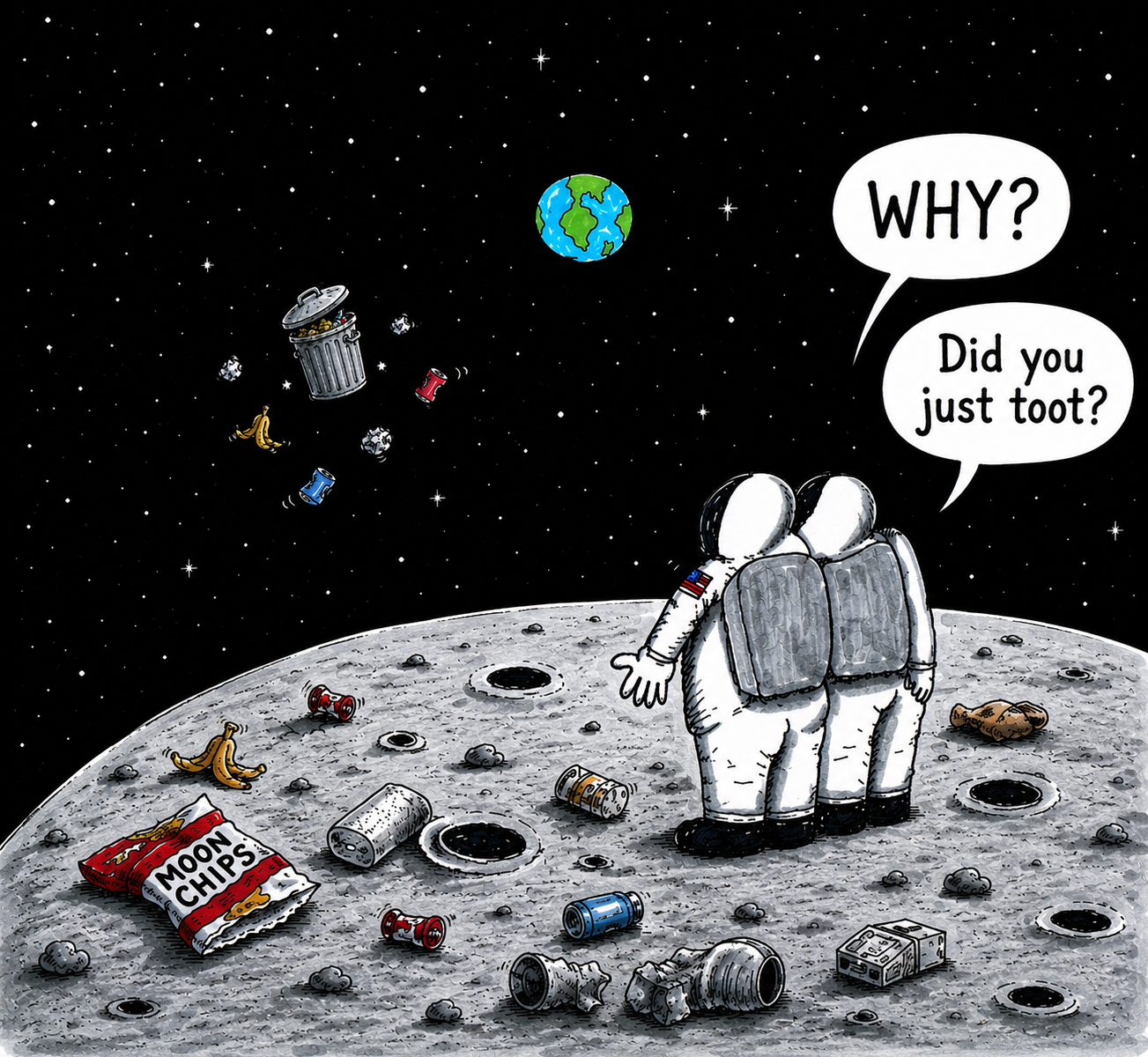
Why is Man soiling the Moon and Space? The Space Race to Waste.

The space race to waste

Space has long represented humanity’s greatest frontier—a place of wonder, mystery and scientific discovery. Yet, as our presence beyond Earth has expanded, so too has something far less inspiring: our rubbish.

It seems that wherever humans travel, waste is never far behind.

Once Pristine

The Moon, once an untouched and pristine landscape, now bears the unmistakable fingerprints of human activity. During the Apollo missions of the 1960s and 1970s, astronauts famously left behind equipment to save weight for the return journey.

Among the discarded items were scientific instruments, landing hardware, cameras, boots, empty containers and, perhaps most surprisingly, dozens of bags containing human waste.

These decisions made practical sense at the time, but decades later they remain scattered across the lunar surface, silent reminders that even our greatest achievements came with unwanted leftovers.

Extended problem

The problem extends far beyond the Moon itself. Earth’s orbit has become increasingly cluttered with discarded rocket stages, defunct satellites, broken fragments from collisions and countless pieces of debris travelling at astonishing speeds.

Even tiny fragments can damage operational spacecraft or threaten astronauts aboard the International Space Station.

Every new launch adds to an already crowded environment, increasing the risk of further collisions and creating yet more debris in an ever-growing cycle.

Invisible pollution

Modern spaceflight also leaves behind invisible pollution. Rocket launches release exhaust gases high into the atmosphere, while spacecraft vent fuel residues, gases and other materials into space during operations.

Small leaks of oxygen, carbon dioxide and propellants may seem insignificant individually, but collectively they contribute to an expanding human footprint beyond our planet.

Space may be unimaginably vast, but that should not become an excuse for careless behaviour.

Impact

Recent events have highlighted the issue once again. A spacecraft associated with SpaceX ended its mission by impacting the Moon, adding another artificial object to a celestial body already littered with relics from previous decades.

Although such impacts are often planned and scientifically useful, they also reinforce an uncomfortable truth: humanity rarely leaves a place exactly as it found it.

As commercial spaceflight accelerates and more nations enter the space race, the challenge will only grow.

Clean it up

Without international standards for orbital clean-up, debris removal and responsible lunar exploration, future generations may inherit a polluted space environment that becomes increasingly hazardous and expensive to manage.

Exploration should never come at the expense of stewardship. We rightly encourage people to recycle, reduce waste and protect fragile environments on Earth.

Surely the same principles should apply beyond our atmosphere. Space was once untouched by human hands.

As we venture further into the cosmos, perhaps the greatest mark of an advanced civilisation will not be how far it travels, but how carefully it treats the places it visits.

SpaceX Stumbles as AI Spending Clouds the IPO Glow

SpaceX Shares Drop from IPO Value

In June 2026 – SpaceX seemed unstoppable. Its long-awaited stock market debut was hailed as one of the biggest public offerings in years, helping lift investor confidence and fuelling another wave of enthusiasm for technology shares.

The company’s arrival on public markets was viewed as confirmation that the AI revolution, combined with space technology, would continue to power the next leg of the bull market.

That optimism has now been tempered.

Sharp fall

SpaceX shares fell sharply after investors reacted to the company’s latest results, with soaring artificial intelligence spending becoming the chief concern.

While management argued that massive investment in AI infrastructure and advanced computing would strengthen the company’s long-term competitive position, many shareholders focused instead on the near-term impact on profits and cash flow.

The sell-off highlights an increasingly familiar dilemma across the technology sector. Investors remain excited by the promise of artificial intelligence, but they are becoming more selective about how much they are willing to finance before seeing meaningful returns.

Massive Investment

Building cutting-edge AI systems requires enormous investment in data centres, specialised chips and energy-hungry computing infrastructure, all of which place pressure on corporate earnings.

Yet despite the decline in SpaceX shares, broader market sentiment has remained remarkably resilient.

Investors have largely shrugged off the weakness, instead turning their attention to fresh AI announcements, semiconductor developments and upbeat economic data.

Focus

The enthusiasm that once surrounded the SpaceX IPO has not disappeared; it has simply migrated elsewhere.

This shifting focus demonstrates just how rapidly today’s markets move. Yesterday’s headline can quickly become today’s footnote as investors chase the next technological breakthrough or market narrative.

From vision to achievement

For SpaceX, the challenge now is clear. Investors have already bought into the vision. The next step is proving that billions spent on artificial intelligence can eventually translate into stronger revenues, higher margins and sustainable shareholder returns.

In today’s market, bold ambition alone is no longer enough. Investors increasingly want evidence that the AI race will deliver profits as well as promises.

Artemis II Lifts Off: A New Era in Crewed Lunar Exploration

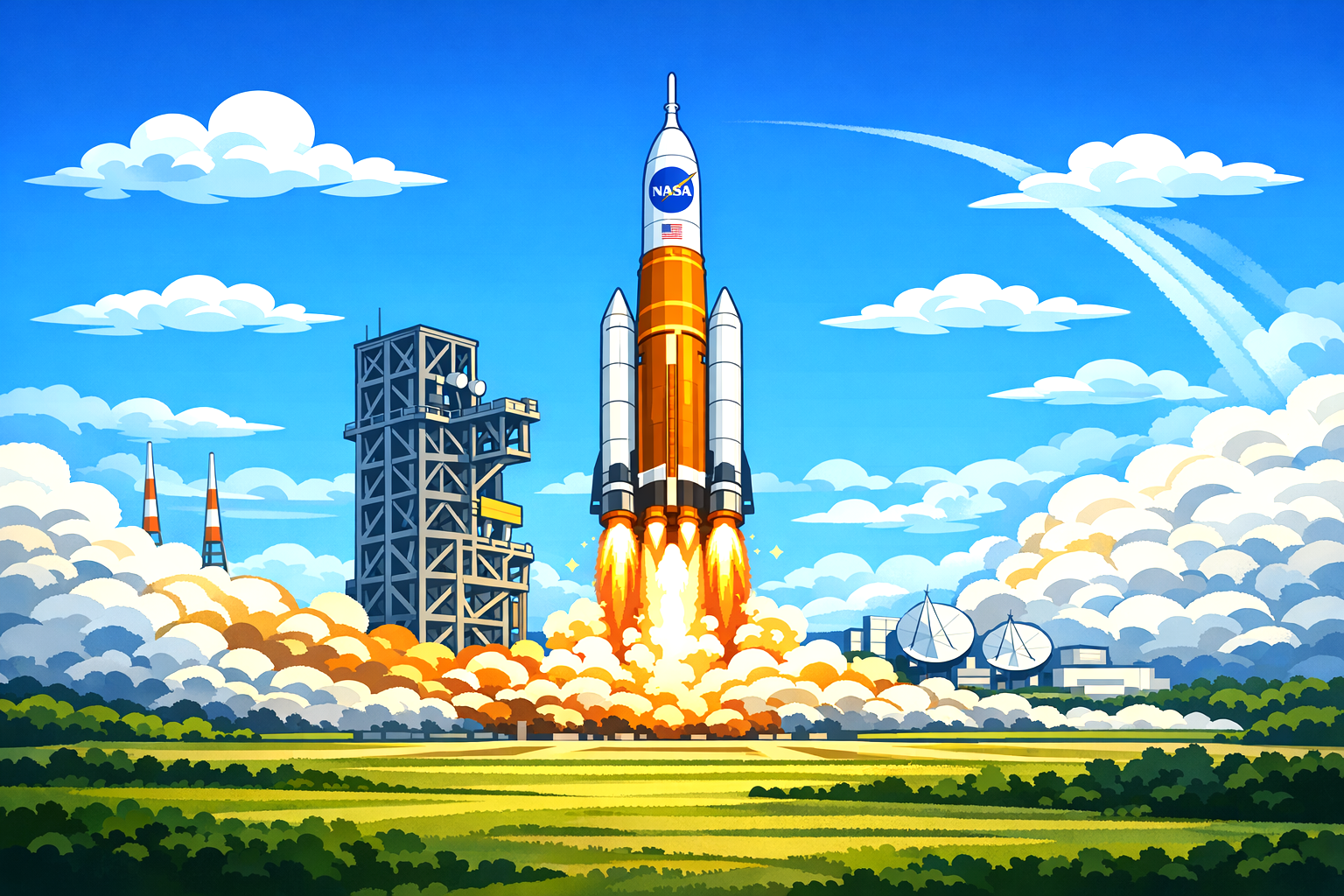
Artemi II launch 1st April 2026

NASA’s Artemis II mission roared into the sky on 1st April 2026, marking the first crewed journey toward the Moon in more than half a century and signalling a decisive shift in humanity’s return to deep‑space exploration.

The launch, conducted from Kennedy Space Center’s historic Pad 39B, sent the four‑person crew on a sweeping lunar flyby designed to test every system required for future landings.

The Space Launch System (SLS), now the world’s most powerful operational rocket, delivered a controlled, thunderous ascent that placed the Orion spacecraft precisely on its translunar trajectory. For NASA, this mission is far more than a symbolic milestone.

It is the critical proving ground for life‑support systems, navigation, communications, and the human factors that will underpin Artemis IV’s planned lunar landing.

Crew

The crew — Reid Wiseman, Victor Glover, Christina Koch, and Canadian astronaut Jeremy Hansen — represent a deliberately international and diverse team, reflecting NASA’s intent to build a long‑term, collaborative presence beyond Earth orbit.

Over the coming days, they will conduct a series of manoeuvres around the Moon, pushing Orion to operational limits while maintaining constant evaluation of onboard systems.

Although Artemis II will not touch the lunar surface, its significance is unmistakable. The mission bridges the gap between decades of conceptual planning and the practical reality of returning humans to the Moon.

It also serves as a reminder that deep‑space exploration remains a complex, high‑risk endeavour requiring meticulous engineering and political commitment.

Future missions

If successful, Artemis II will validate the architecture for a sustained lunar programme — including the Lunar Gateway, surface habitats, and commercial landers — and re‑establish the Moon as a stepping stone for future missions to Mars.

For now, the world watches as the crew embarks on the most ambitious human spaceflight in a generation, carrying with them the renewed ambition of a species determined to explore.