

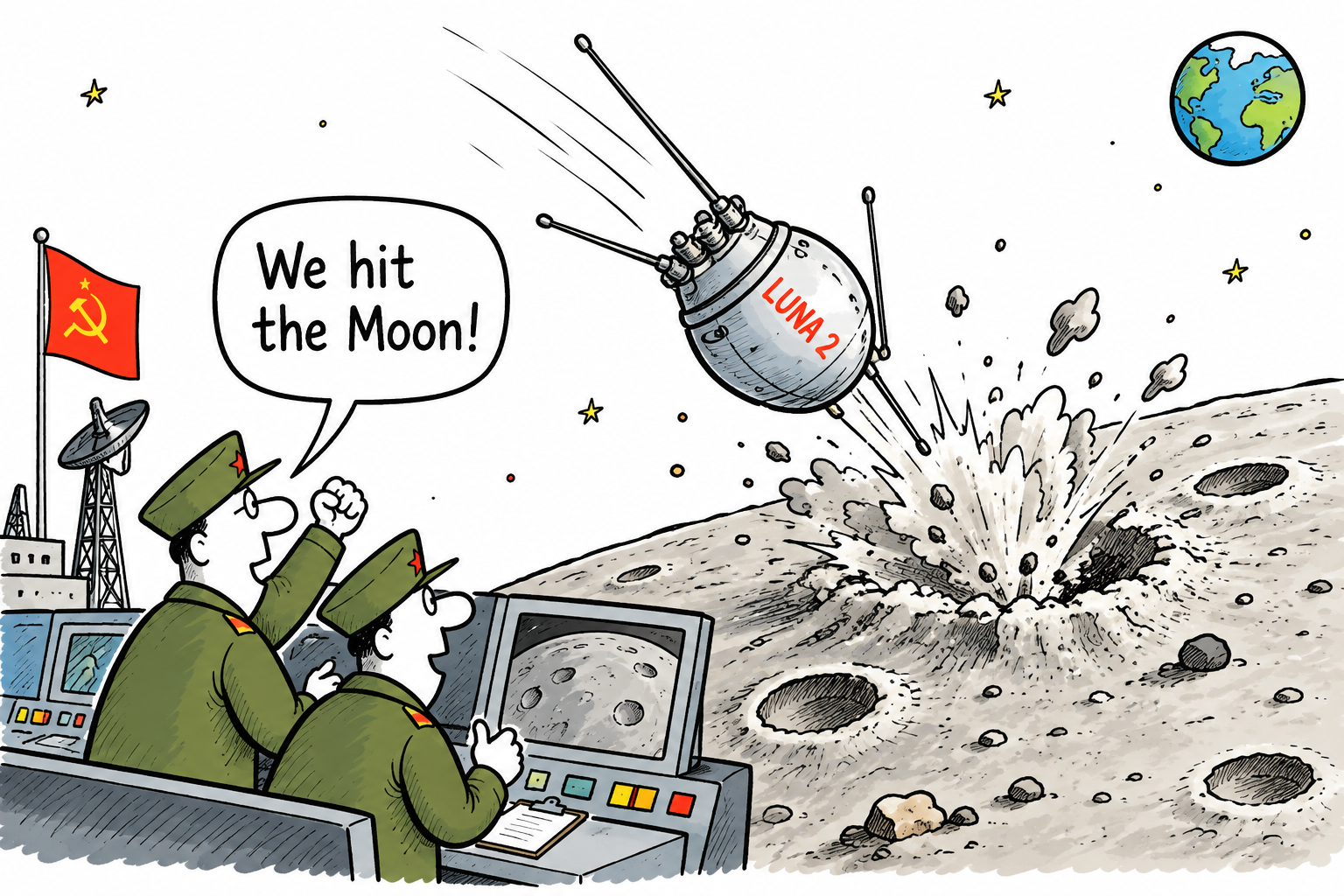
On 13th September 1959, the Soviet Union achieved a remarkable milestone in the Space Race when Luna 2 became the first human-made object to reach the Moon.
Controlled crash
There was, however, no gentle landing. Luna 2 was designed to crash into the lunar surface.
Launched on 12th September 1959, the spacecraft travelled roughly 385,000 kilometres from Earth towards the Moon. Its mission was to prove that a spacecraft could successfully travel beyond Earth and reach another celestial body.
The following day, Luna 2 slammed into the Moon at an estimated speed of around 12,000 kilometres per hour, probably creating a small crater on impact. Soviet scientists subsequently confirmed that the spacecraft had reached the lunar surface.
The achievement was hugely significant. Until Luna 2, the Moon had only been observed from Earth. Now, humanity had physically reached it.
Mission
The mission also helped settle a scientific question. Experiments aboard Luna 2 provided evidence that the Moon did not possess a significant magnetic field and detected no substantial lunar radiation belt.
Luna 2 was primitive by today’s standards, but its deliberate collision represented a giant leap for space exploration — proving that the Moon was no longer an unreachable destination.
The Mission That Missed the Moon
Luna 1 was the Soviet Union’s first serious attempt to reach the Moon, launched on 2 January 1959. The spacecraft was intended to crash into the lunar surface, but a guidance error meant it missed the Moon by around 5,995 kilometres.
Rather than being a complete failure, Luna 1 became the first spacecraft to reach the vicinity of the Moon and the first human-made object to enter a heliocentric orbit around the Sun.
The mission also made important scientific observations, detecting the solar wind and showing that the Moon did not possess a significant magnetic field.
Although Luna 1 had failed to hit its target, its unexpected journey was an important step towards Luna 2’s successful lunar impact just eight months later.
Is Luna 1 still in space?
Yes.
After missing the Moon in January 1959, Luna 1 did not return to Earth. Instead, it entered an independent orbit around the Sun, travelling between the orbits of Earth and Mars.
It is therefore still orbiting the Sun today, more than 67 years after its launch. It has no functioning systems and is essentially a piece of space hardware continuing along its solar orbit.
Interestingly, Luna 1 was the first human-made object to escape Earth’s immediate gravitational neighbourhood and enter a heliocentric orbit — making its accidental journey a historic success in its own right.