

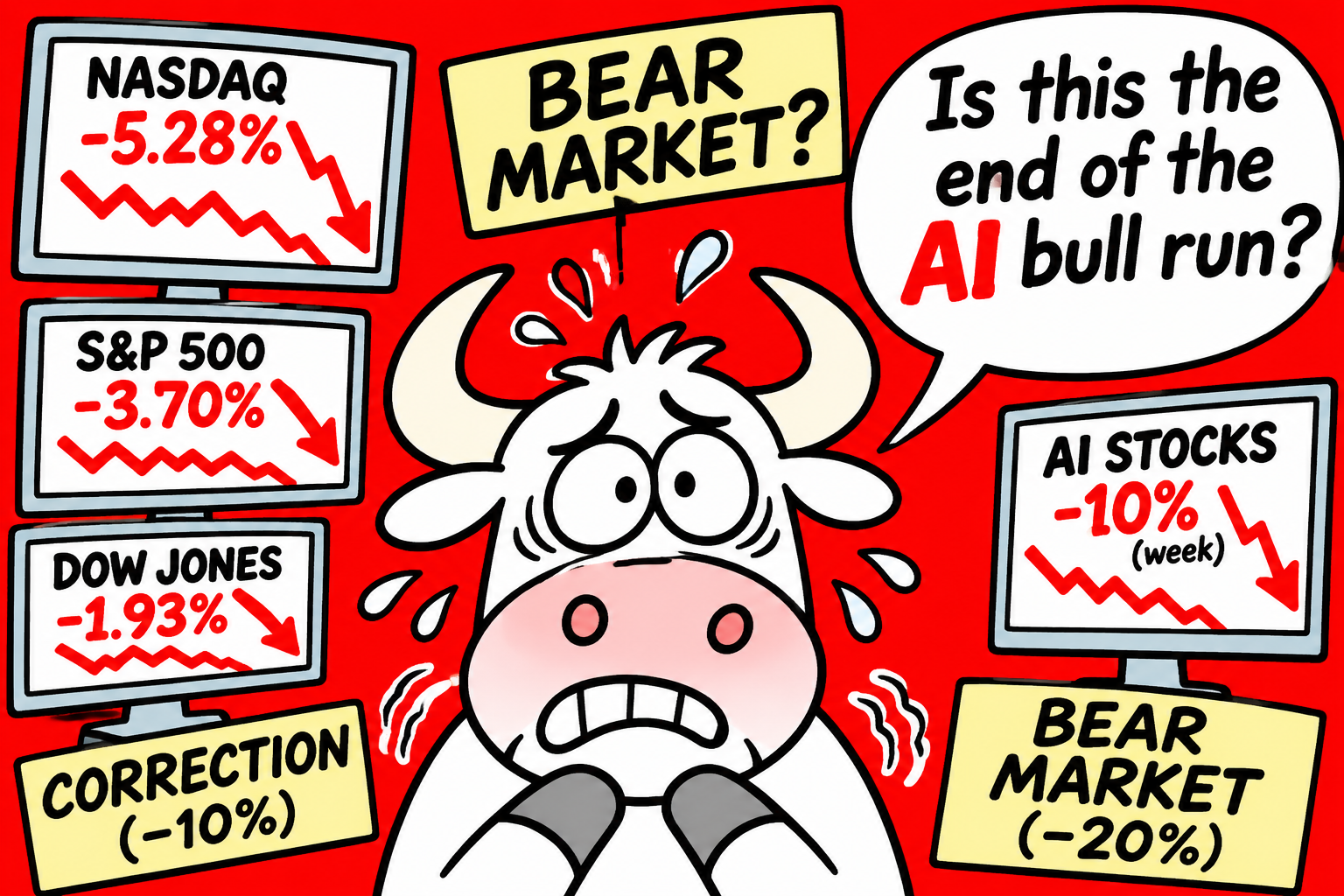
Wall Street has endured one of its most brutal weeks in years, as a spectacular sell-off in technology shares has wiped out all the Nasdaq’s gains for 2026 and raised serious questions about the sustainability of the artificial intelligence investment boom.
The Nasdaq Composite plunged 5.28% on Friday, 20th November 2026, closing at 22,617.73. That completed a weekly decline of approximately 10%, its worst weekly performance since March 2020.
Negative territory
The index has now slipped into negative territory for the year, reversing months of gains and leaving investors questioning whether the technology rally has finally run out of momentum.
The Nasdaq’s losses since its October record have brought it dangerously close to a bear market, traditionally defined as a fall of 20% from a recent high.
The Nasdaq-100, which tracks the largest non-financial companies listed on Nasdaq, actually crossed that threshold briefly during Friday’s trading before recovering to finish approximately 19.8% below its October 2026 peak.
It has therefore not officially closed in bear-market territory, but the warning could hardly be clearer.
The correction spreads across Wall Street
The sell-off has not been confined to technology. The S&P 500 fell 3.70% on Friday, closing at 6,910.39, while the Dow Jones Industrial Average lost 949.73 points, or 1.93%, to finish at 48,147.33.
Both indices have now officially entered correction territory, meaning they have fallen more than 10% from their recent record closing highs.
For the week, the S&P 500 declined 8.6% and the Dow lost 8%. This is increasingly looking like a wider reassessment of American stock market valuations rather than a temporary bout of profit-taking in technology shares.
Nvidia and Anthropic lose their shine
At the centre of the turmoil is Nvidia, the semiconductor giant that has become the principal symbol of the AI revolution.
Its shares plunged approximately 13.8% on Friday 20th November 2026, despite the company having recently reported exceptionally strong quarterly results.
The decline was accompanied by reports that U.S. Securities and Exchange Commission enforcement staff were examining potential accounting issues at the company.
An investigation is not evidence of wrongdoing, but the news added to an already nervous market.
Other chipmakers also suffered substantial losses as investors reassessed the extraordinary valuations attached to the semiconductor industry.
Anthropic’s record-breaking stock market debut has provided little reassurance. After initially closing 17.1% above its $83 IPO price on Thursday 19th November 2026, shares in the Claude developer fell approximately 9.1% on Friday, closing at around $88.30.
The contrast between the excitement surrounding its flotation and the immediate selling pressure illustrates just how quickly investor sentiment is changing.
Where is the real value in AI?
The fundamental question facing investors is whether the enormous sums being invested in artificial intelligence can generate sufficient commercial returns to justify current valuations.
Technology companies are committing hundreds of billions of dollars to data centres, advanced processors, electricity infrastructure and AI development. Yet the revenue and profits required to justify this spending remain uncertain for many businesses.
The market has rewarded anticipated growth rather than simply existing earnings. That approach works while confidence remains high, but becomes extremely vulnerable when investors begin questioning the assumptions underpinning those valuations.
AI itself is unlikely to disappear. Its potential to transform business, industry and everyday life remains enormous.
However, not every company associated with the technology will necessarily become a financial winner.
December 2026 could bring another shock
Investors now have another important date approaching: 9th December, when the Federal Reserve is scheduled to announce its next interest-rate decision.
With inflation concerns persisting and markets anticipating the possibility of another rate increase, the announcement could become a further catalyst for volatility.
Higher interest rates would make borrowing more expensive, increase the discount applied to future corporate earnings and potentially place further pressure on highly valued technology companies.
Conversely, any indication that interest rates are likely to stabilise could help restore confidence and encourage investors back into equities.
A temporary adjustment or the beginning of a bear market?
The immediate question is whether markets have fallen far enough to attract bargain hunters or whether further adjustments are necessary.
There is a strong argument that valuations have become stretched and that a period of consolidation is overdue.
Equally, if corporate earnings disappoint (they haven’t thus far), investment spending slows or borrowing costs rise, the current losses could prove to be only the beginning.
The AI revolution may still be in its early stages, but the stock market is discovering that technological progress and investment returns are two very different things.
For now, Wall Street is asking a question that investors have largely ignored during the AI boom: not how big artificial intelligence might become, but how much it is actually worth.
Source notes and factual qualifications summary
- Nasdaq: 5.28% Friday fall; 10% weekly fall; worst week since March 2020.
- Nasdaq-100: 19.8% below its October 2026 record at Friday’s (20th November 2026) close, having briefly crossed the 20% threshold intraday.
- Anthropic: 9.1% Friday fall, closing at approximately $88.30. live
- Federal Reserve: Meeting on 8–9 December 2026, with the announcement scheduled for the 9th. Calendar: December 2026