

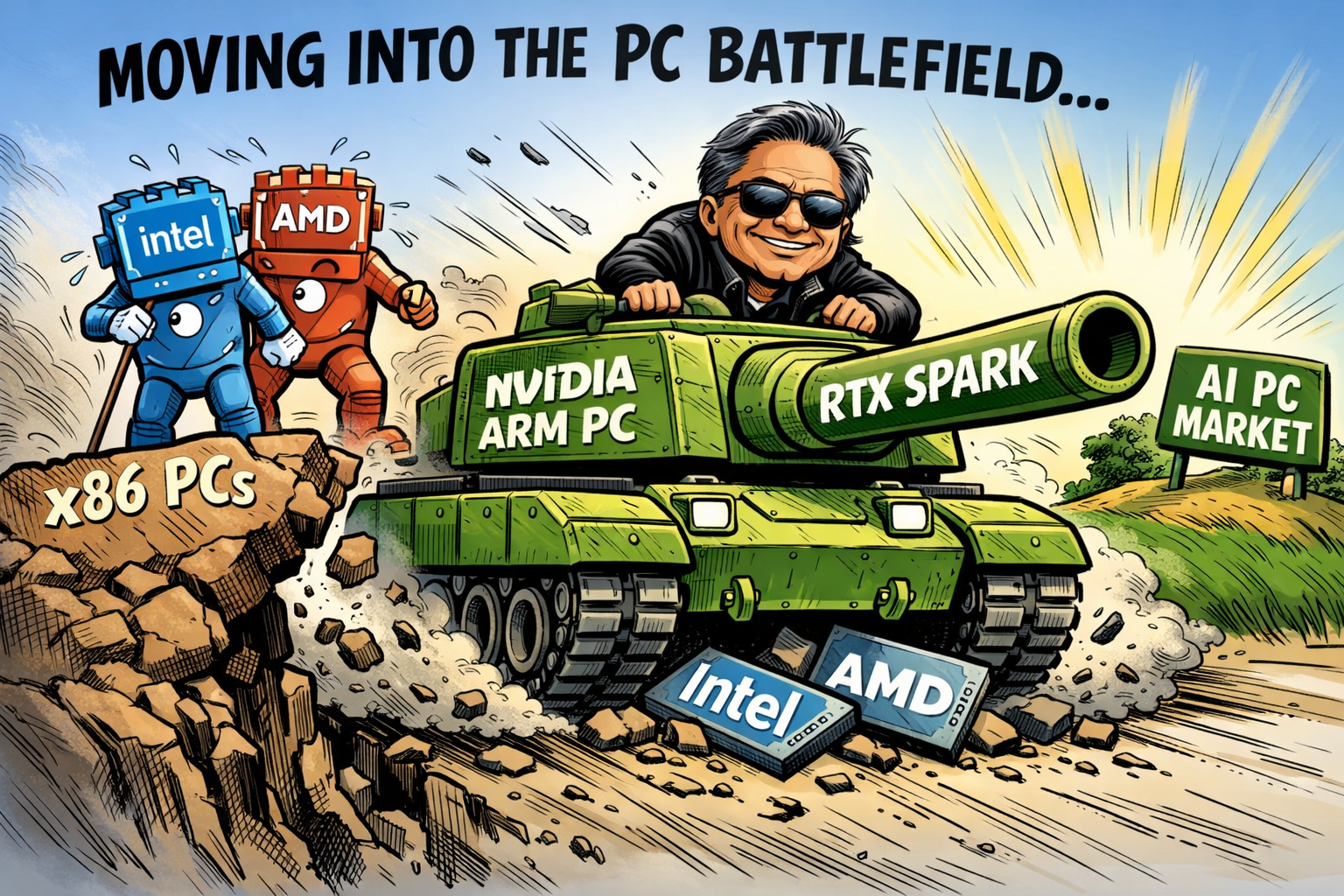
Nvidia moves into PCs – All hail Nvidia!

New AI PC chips from Nvidia

Nvidia’s long‑anticipated push into the PC market has finally materialised — and it marks the company’s most aggressive attempt yet to extend its dominance beyond the data centre.

At Computex in Taipei, Jensen Huang unveiled the N1X, an Arm‑based CPU fused with a Blackwell‑class GPU into a new RTX Spark superchip, set to appear this autumn in premium Windows laptops from Microsoft, Dell, HP, ASUS, Lenovo and MSI .

The move is strategically significant. For decades, the PC’s central processor has been the guarded territory of Intel and AMD, with Apple’s M‑series proving the only major Arm‑based disruption.

Nvidia is now entering that arena with a design built explicitly for the age of agentic AI — machines that run multiple AI processes simultaneously, shifting huge volumes of data between GPU and CPU.

Nvidia has argued for months that CPUs have become the bottleneck in modern AI workflows, and the N1X is its answer: a custom Arm design, co‑developed with Microsoft and manufactured on TSMC’s 3‑nanometre process, paired with 128GB of unified memory for high‑bandwidth compute.

Huang framed the launch as a generational reset: “the first completely re‑engineered, reinvented line of PCs in 40 years.” It’s hyperbole with intent.

Nvidia wants to define the AI PC in the same way it defined the AI data centre — not as an incremental upgrade, but as a new category.

More than 30 laptops and 10 desktops are reportedly planned over time, with early models aimed at creators, AI developers and high‑end gamers seeking thin, light machines with workstation‑level capability.

The competitive implications are profound. Arm‑based computing is accelerating across the industry, and Nvidia’s arrival puts direct pressure on Intel and AMD just as both are scrambling to articulate their own AI‑centric roadmaps.

If RTX Spark delivers the performance uplift Nvidia promises, the centre of gravity in the PC market could shift rapidly — from x86 incumbents to a company that has already rewritten the rules of modern computing once.

All hail Nvidia.

Microsoft announces new PCs with AI chips

AI art

Microsoft is promoting new computers equipped with advanced chips, engineered to operate the new artificial intelligence (AI) capabilities embedded in the Windows operating system.

On Monday 20th May 2024, Microsoft unveiled a Surface Laptop and a Surface Pro tablet, both featuring a Qualcomm chip capable of executing AI tasks both online and offline.

The new Microsoft Copilot+ PCs feature chips designed by ARM and are powered by Qualcomm’s Snapdragon X Elite and X Plus chips, which are also based on ARM architecture. These Snapdragon-powered PCs represent the initial series of devices under the Copilot+ PC brand, introducing over 20 models from various manufacturers, such as Acer.

The partnership between Microsoft, Qualcomm, and PC manufacturers is focused on providing superior processing and quick response times, with these ARM-based chips being integral to the new AI designs.

In addition, manufacturers like Lenovo, Dell, HP, Asus, Acer, and Samsung are launching AI-ready PCs featuring Qualcomm’s Snapdragon X Elite and X Plus processors. These processors offer extended battery life and compatibility with Microsoft’s Copilot AI chatbot.

Microsoft’s powerful AI vision – some tech information

Windows PCs designed for AI, known as Copilot+ PCs, are fitted with new, powerful chips capable of an astounding 40+ TOPS, ensuring all-day battery life and access to cutting-edge AI models.

Promoted as the fastest and most intelligent Windows PCs ever created, they boast features like Recall, Cocreator, and Live Captions, which can translate audio from over 40 languages into English.

These devices include sleek, lightweight, and elegantly designed models from Microsoft Surface and OEM partners such as Acer, ASUS, Dell, HP, Lenovo, and Samsung. Pre-orders are now open, with availability starting on June 18 and prices reportedly beginning at $999. This represents a major shift in the Windows platform, placing AI at the forefront of PC architecture.

This progress is a big part of Microsoft’s wider initiative to drive AI innovation onto devices, enhancing the AI capabilities that are already present in the cloud through Copilot.

This is a massive development in the deployment of AI to the masses.