

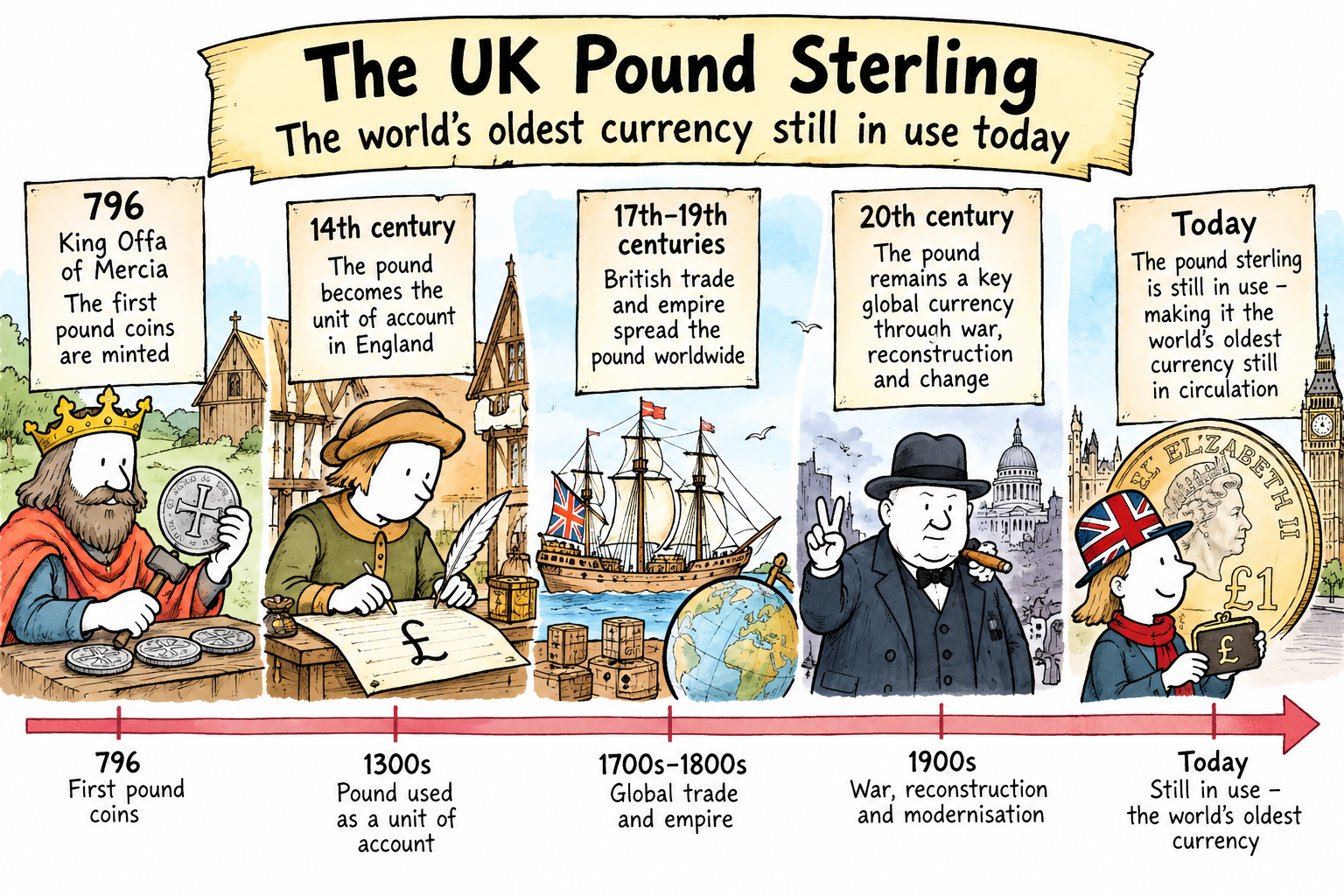
The British pound, or pound sterling, has one of the longest histories of any currency still in use today.
Its story can be traced back more than 1,200 years, to Anglo-Saxon England in the eighth century.
Pounds & Pennies
The word “pound” originally referred to a unit of weight rather than a particular coin. The early English monetary system was based on the silver penny, and 240 pennies were eventually regarded as equivalent to one pound of silver.
This helped establish the connection between the pound and the precious metal that gave sterling its value.
Silver
Silver pennies were introduced in England during the reign of King Offa of Mercia, around the late eighth century.
Offa’s reforms created a more organised monetary system, influenced partly by the coinage being used across Europe.
These small silver coins became the foundation of English currency for centuries.
Sterling
The word “sterling” has a less certain origin. One popular explanation is that it came from the Old Norman French term “esterlin”, associated with silver pennies of reliable quality. Another theory connects it with the “little star” symbols that appeared on some early coins.
Over the centuries, the pound changed considerably. Gold coins became increasingly important, particularly from the Tudor period onwards, while paper money eventually emerged in the form of banknotes.
Bank of England established in 1694
In 1694, the Bank of England was established, helping to develop a more sophisticated national banking system.
The pound has survived wars, political upheavals, financial crises and enormous changes in Britain itself.
Despite its ancient roots, sterling remains a major international currency — making it a remarkable link between medieval England and the modern financial world.
