
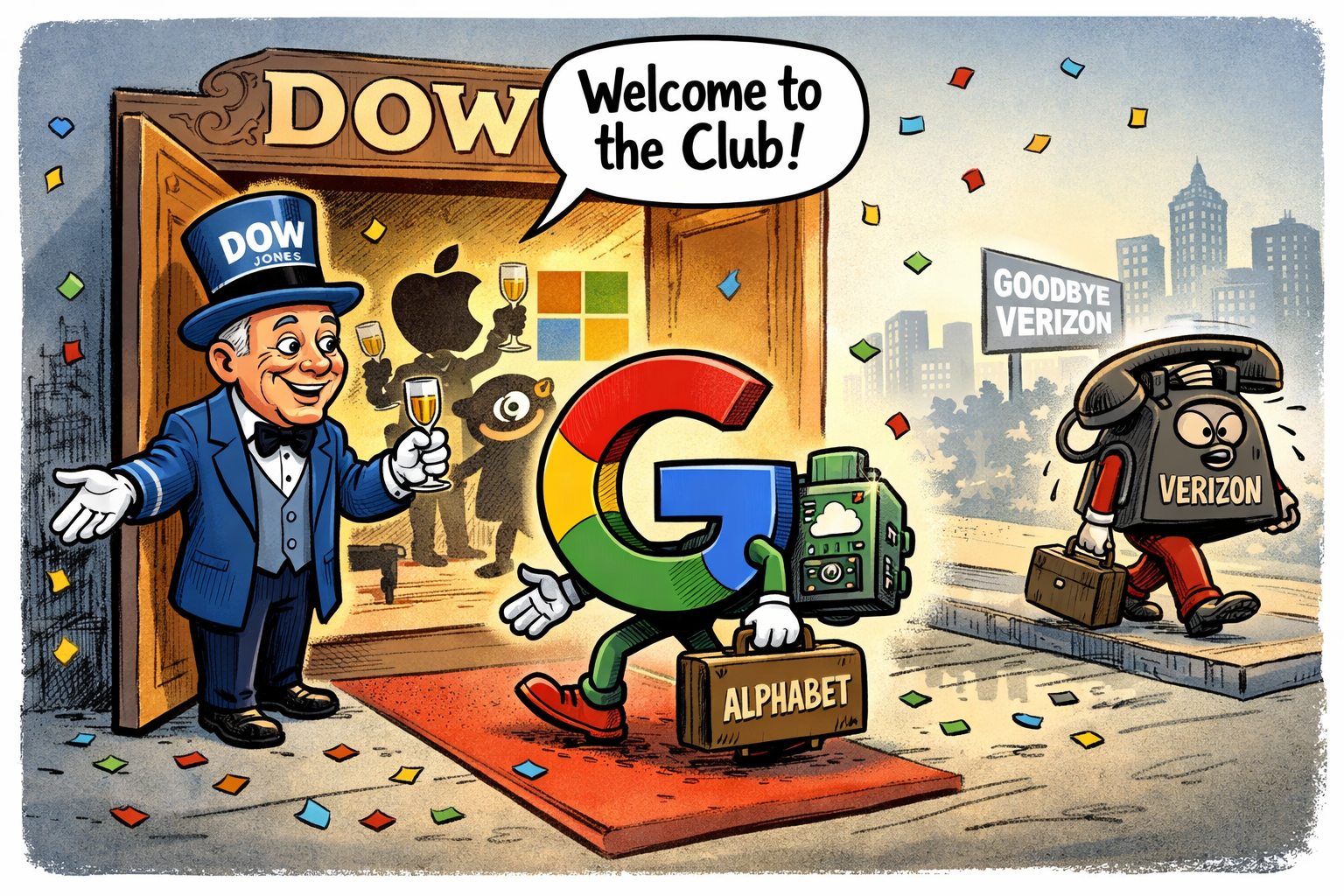
Alphabet’s arrival in the Dow marks a decisive shift in America’s most famous index

Alphabet in club Dow

Alphabet’s entry into the Dow Jones Industrial Average this week is more than a routine reshuffle; it is a symbolic acknowledgement that the modern U.S. economy is now defined by data, cloud infrastructure and artificial intelligence rather than legacy telecommunications.

The change took effect on 29 June 2026, placing Google’s parent company among the 30 blue‑chip names that represent the industrial and corporate backbone of the United States.

Keeping up with the Joneses

Alphabet replaces Verizon, which leaves the index after more than two decades. The Dow is a price‑weighted index, meaning companies with higher share prices exert greater influence on its movements.

Verizon’s comparatively low share price had steadily reduced its mechanical impact, while Alphabet’s share price—hovering around $350—immediately makes it one of the Dow’s most consequential components.

This weighting logic, rather than any judgement on business quality, is the primary reason behind the switch.

The inclusion also reflects a broader structural shift. Alphabet brings significant exposure to AI, cloud computing, digital advertising and autonomous systems, areas that now dominate corporate investment and market leadership.

Five of the Mag Seven now in club Dow – 9 of the Dow are Tech related Companies

Its arrival means the Dow now contains five members of the so‑called Magnificent Seven, aligning the index more closely with the forces driving U.S. equity performance.

Verizon’s departure underscores how the Dow evolves to remain representative of the economy it tracks.

Alphabet’s addition signals that the digital era is not merely influencing markets—it is now embedded at the heart of America’s oldest stock benchmark.

But does this spell potential danger for the Dow in the future as the balance of power is weighted more towards tech?

Should the markets crash because of the overreach of AI tech’ then the Dow will fall hard.

SectorCompanies
TechnologyApple, Microsoft, Amazon, Alphabet, Nvidia, Cisco Systems, Intel, IBM, Salesforce
FinancialsGoldman Sachs, JPMorgan Chase, American Express, Travelers, Visa
IndustrialsBoeing, Caterpillar, Honeywell, 3M, UnitedHealth Group
ConsumerMcDonald’s, Coca‑Cola, Procter & Gamble, Nike, Walmart
HealthcareJohnson & Johnson, Merck, Amgen
EnergyChevron
CommunicationsWalt Disney
MaterialsDow Inc.

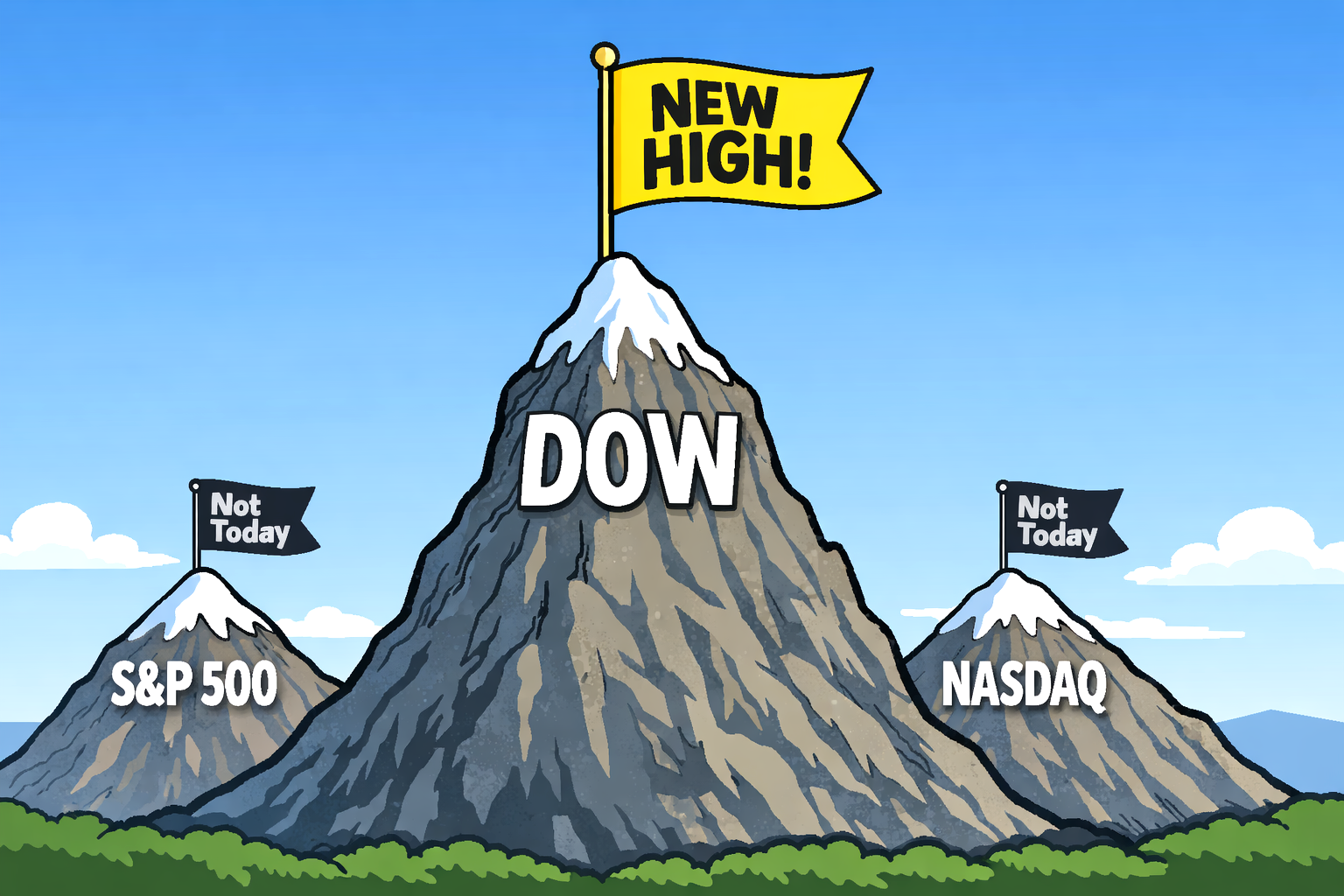
Dow breaks to a fresh record – with more to come?

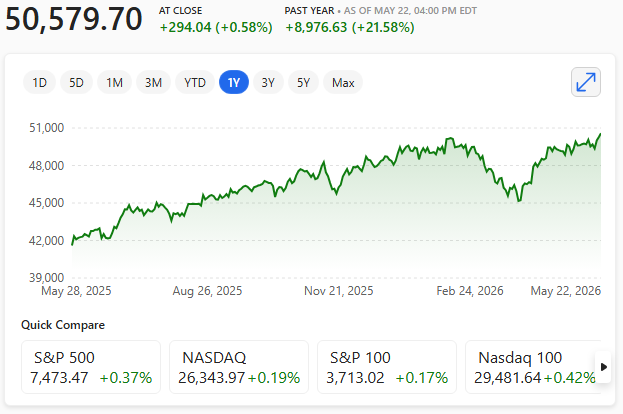
The Dow Jones Industrial Average pushed into uncharted territory on Friday 22nd May 2026, closing at a new all‑time high as investors leaned into the resilience of the U.S. economy.

The Dow Jones Industrial Average last finished at 50,579.70 — the closing level from Friday, 22nd May 2026, which was the most recent trading day.

U.S. markets closed but futures reacted

U.S. markets were closed yesterday (Monday 25th May) for Memorial Day, so there was no new closing price, but futures pushed the Dow higher still as news broke of a potential ‘deal’ between the U.S. and Iran.

Blue‑chip names led the advance, with cyclical stocks extending their spring momentum despite lingering questions over inflation and the Federal Reserve’s next move and of the U.S. Iran conflict.

The milestone capped a week of uneven trading across Wall Street, where the S&P 500 and Nasdaq both eased back from recent peaks.

The Dow’s climb now feels less like conviction and more like reflex — a market that rises almost by habit, indifferent to headlines or logic.

The narrative

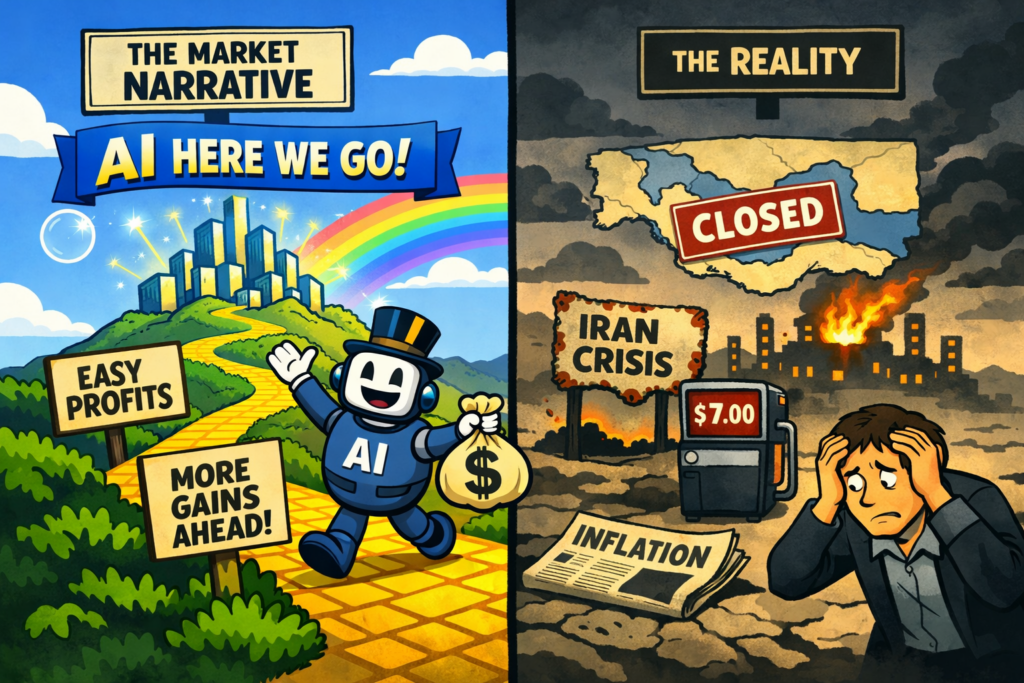
The Dow’s latest record owes less to fundamentals than to a market enthralled by its own narrative.

Trump’s posts in general keep stoking the expectation of effortless gains, while blind faith in AI provides a convenient intellectual gloss. The Nasdaq and S&P 500 reacted to the ‘weekend’ news too.

Meanwhile, the real geopolitical risks — including the crisis the U.S. helped shape in Iran — barely register.

The index keeps rising as if none of it matters, as though the story of perpetual upside has become more important than the world it’s built on.

A money-making machine, regardless of reason.

S&P 500, Nasdaq 100 and Dow all hit new highs!

S&P 500, Nasdaq 100 and Dow all up at new highs!

The S&P 500 climbed again Wednesday 7th February 2024 and edged ever closer to the 5,000 level.

S&P 500 hit a new high of 4995

S&P 500 hit a new high of 4995 on 7th February 2024

The index, which first breached the 4,000 level in April 2021, added around 0.82% to close at 4,995.06. During session highs, the S&P hit 4,999.89. Quarterly results signalled a thriving U.S. economy.

The Nasdaq 100 jumped to a new high of 15,755

The Nasdaq 100 jumped to a new high of 15,755 on 7th February 2024

The Dow Jones Industrial Average rallied 156 points to close at 38,677 and an all-time high

DJIA closes at new high of 38677 on 7th February 2024

Euphoric

Are investors getting swept away with the latest wave of AI related tech results? Quite possibly, as some of what we’re seeing could be based on FOMO (fear of missing out) as traders/investors don’t want to be left behind like they were last year.

However, one undeniable fact is that the U.S. economy isn’t facing as recession any time soon as predicted by many.

Dow hits new record high breaching 38000 for the first time ever

Dow Jones index up

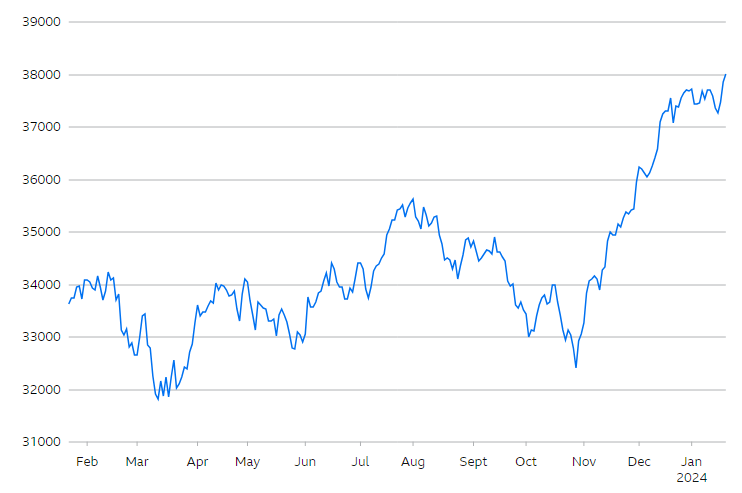
The Dow Jones Industrial Average (DJIA) reached a new high on 22nd January 2024, closing at 38,001.81 points

One year chart for the Dow Jones Industrial Average (DJIA)

The Dow Jones Industrial Average (DJIA) reached a new high on 22nd January 2024, closing at 38,001.81 points

The index reached 38109.20 points in intraday trading. Recently the S&P500 and the Nasdaq set new highs.

The Dow

The Dow Jones is a market index that tracks the performance of 30 large US companies. It is also known as the Dow Jones Industrial Average (DJIA) or simply ‘the Dow’.

The DJIA is one of the oldest and most widely followed stock market indicators in the world. It reflects the health and sentiment of the U.S. economy and business sector.

The index was created in 1896 by Charles Dow and Edward Jones, who were journalists at The Wall Street Journal. The first calculation was done on 30th June 1896, with a base value of 40.

Some 128 years later, the index has a value of 38001 – a record high!