Borge Brende, the president of the World Economic Forum (WEF), recently issued a stark warning about global debt levels.
Speaking at the ‘Special Meeting on Global Collaboration, Growth and Energy for Development‘ in Riyadh, Saudi Arabia, (see WEF website), he highlighted that global debt ratios are approaching levels not seen since the 1820s.
The WEF president also reportedly emphasized the risk of ‘stagflation‘ for advanced economies. He cautioned that without appropriate economic measures, the world could face a decade of low growth.
The current global growth estimate stands at around 3.2%, down from the 4% trend growth seen for decades. Brende urged governments to address the mounting debt situation and implement prudent fiscal measures to avoid triggering a global recession.
He also noted the persistence of inflationary pressures and suggested that generative artificial intelligence could offer opportunities for developing nations. The International Monetary Fund (IMF) concurs with this concern, reporting that global public debt reached 93% of GDP last year, still9% higherthan pre-pandemic levels.
The IMF projects that global public debt could approach 100% of GDP by the end of the decade.
The U.S. national debt has been growing more quickly in recent months, increasing about $1 trillion nearly every 100 days.
U.S. debt permanently crossed over $34 trillion on 4th January 2024 according to data from the U.S. Department of the Treasury.
It reached $33 trillion on 15th September 2023, and $32 trillion on 15th June 2023. Before that, the $1 trillion move higher from $31 trillion took about eight months.
The U.S. national debt is the total amount of money that the federal government owes to its creditors. That can include, individuals, other countries and corporation. It is composed of two main components: federal debt held by the public and federal governmental debt.
The national debt has grown over time due to various factors, such as recessions, defense spending, and tax cuts. The debt-to-GDP ratio gives insight into whether the US has the ability to cover all of its debt. It also shows how it affects economic growth.
U.S. national debt pile is growing
U.S. national debt is piling up
The national debt increased by 13.3% under President Biden. Up from $27.77 trillion as of 1st March 2020 to $31.46 trillion as of 1st March 2023. The debt also grew by $1.5 trillion, or 5.6%, between the end of 2020 and the end of 2021.
The gross domestic product (GDP) measures the annual economic output of the entire country. The national debt exceeds this amount, which is very high.
As of the end of February 2024, the U.S. debt is almost $34.4 billion. This is the money that the federal government has to borrow to pay for its operating expenses.
The World Bank found that if the debt-to-GDP ratio exceeded 77% for an extended period, it slowed economic growth.
The world is looking at a debt crisis that will span the rest of this decade and well into the next
$307.4 trillion of world debt!
It’s not going to end well; economists warn with global borrowings hitting a record of $307.4 trillion in September 2023.
Debt at this level is unsustainable.
Both emerging markets and high-income countries have seen a substantial rise in their debt levels. These levels have grown by a some $100 trillion from 10 years ago. The debt has been fueled in part by a higher interest rate environment.
Initially, with borrowing costs at historic lows, countries have benefitted from very low interest rate for the debt. That’s changed.
The next 10 years will likely become known as the ‘Decade of Debt.’
Debt globally is coming to a head.
As a share of the global gross domestic product, debt has risen to 336%. This compares to an average debt-to-GDP ratio of 110% in 2012 for advanced economies, and 35% for emerging economies.It was 334% in the fourth quarter of 2022, according to the most recent global debt monitor report by the Institute of International Finance.
To meet debt payments, it is estimated that around 100 countries will have to cut spending on critical infrastructure including health, education and social projects.
Countries that manage to improve their fiscal situation could benefit by attracting capital, labour and investment. However, those that do not could lose talent and revenue and further increase their debt burden.
In a significant development that has raised concerns among investors and policymakers worldwide, China’s debt outlook has been downgraded as the country grapples with a slowing economy. This move reflects growing apprehensions about the sustainability of China’s economic growth and its ability to manage its burgeoning debt.
Moody’s issued the warning as it cut its outlook on the government’s debt to negative, from stable. China said it was disappointed by the move, calling the economy resilient. China also reported to have said it is unnecessary for Moody’s to worry about China’s economic growth prospects and fiscal sustainability.
Rapid Expansion
For years, China’s rapid economic expansion has been the engine of global growth, but recent trends indicate a deceleration. The once double-digit growth rates have now tapered, with projections suggesting a further slowdown in the coming years.
China exports
This deceleration is attributed to various factors, including trade tensions, demographic shifts, and a maturing economy.
Downgrade
The downgrade, announced by a prominent credit rating agency recently, underscores the risks associated with China’s increasing debt levels. The country’s total debt, which includes government, household, and corporate debt, has climbed to around 85%* of its GDP. This debt accumulation is partly due to the government’s efforts to stimulate the economy through infrastructure spending and lending to state-owned enterprises.
Property Sector
The property sector, a significant pillar of China’s economy, has also shown signs of strain. High-profile defaults and a cooling housing market have added to the concerns, prompting fears of a ripple effect across the economy. The government’s crackdown on excessive borrowing and speculative investments has further tightened liquidity, impacting developers and homeowners alike.
The burden of debt sits heavy in China’s property sector.
Response
In response to the downgrade, China’s finance ministry has expressed confidence in the country’s economic resilience. Officials argue that the fundamentals of the Chinese economy remain strong, with continued efforts towards high-quality development and structural reforms. They assert that the concerns raised by the credit agencies are overstated and that China’s fiscal position remains robust.
Warning signal
Nevertheless, the downgrade should serve as a warning signal. It highlights the need for careful fiscal management and policy adjustments to navigate the challenges ahead. As the global economy faces uncertainty, the world will be closely watching how China addresses its debt dilemma and maintains its trajectory of growth.
This situation presents a complex puzzle for China’s leadership, balancing the goals of economic stability and sustainable development. The outcome will have far-reaching implications, not just for China but for the entire global economy.
The world awaits to see how China will write the next chapter in its remarkable economic story. If this goes wrong – it will go wrong in a big way.
Update Friday 8th December 2023
China’s top decision-making body of the ruling Communist Party on Friday said that the country’s fiscal policy ‘must be moderately strengthened’ to stimulate economic recovery, according to state-run news outlet.
85%* debt to GDP ratio
China’s debt-to-GDP ratio was recorded at around 77% of the country’s Gross Domestic Product in 2022. This ratio is an important indicator of a country’s economic health, reflecting its ability to pay back its debts. This ratio has been on the rise in recent years, indicating an increase in national debt relative to the GDP. For instance, the ratio was around 23% in 2000 and grew to 34% in 2012, with a significant jump to the current level.
China’s projected debt to GDP ration
Forecasts suggest that China’s debt-to-GDP ratio could reach 104% by 2028
It’s important to note that such figures can vary and should be interpreted within the context of each country’s economic structure and policies.
U.S. citizens have accumulated a record-breaking $1 trillion in credit card debt.
The Federal Reserve’s interest rate hikes through 2023 have caused average interest rates for credit cards to spike to more than 22%. Rates on retail credit cards are even higher, nearing 29% on average.
Despite rising costs and higher borrowing rates, a record number of consumers shopped over the Thanksgiving holiday weekend. The National Retail Federation found that more than 200 million consumers went shopping that weekend, more than the 196.7 million shoppers who turned out in 2022.
Retailers Macy’s and other larger retailers have issued warnings about a slowdown in repayments on their credit cards, highlighting a potential risk to retail revenue this holiday season.
The resilience of the American consumer will continue to be tested by the still-rising costs of groceries, fuel, energy and housing.
Interesting fact
The U.S. credit card debt is approximately equal to the size of Apple’s market cap of $1 trillion.
Moody’s, a credit rating agency, lowered its ratings outlook on the United States to negative from stable.
This means that Moody’s sees a higher risk of a downgrade in the future, which could affect the borrowing costs and confidence of the U.S. government.
Moody’s actions
The main reasons for Moody’s action are the rising deficits and debt levels of the U.S., as well as the continued political polarization that hampers effective policymaking. Moody’s also cited the impact of the Covid-19 pandemic and the recent failures of some U.S. banks as factors that have worsened the environment for the U.S. government and the banking system in general.
Warning!
Moody’s warned that the U.S.’s deficits are likely to remain ‘very large’. It also warned that ‘continued political turmoil or polarization’ in Congress further increases the risk the U.S. will not be able to reach consensus on a fiscal plan to slow the decline in debt affordability‘.
Moody’s still maintains a triple ‘A’ (AAA) credit rating on the U.S. government debt, which is the highest possible rating, but warns of the challenges and uncertainties that the U.S. faces in restoring its fiscal strength and stability.
The ‘AAA‘ rating is at risk.
U.S. government on brink of shutdown, again
The federal government is on the brink of another shutdown, with just a week left for the Republican-led House, Democratic-led Senate and Biden White House to reach a breakthrough on funding.
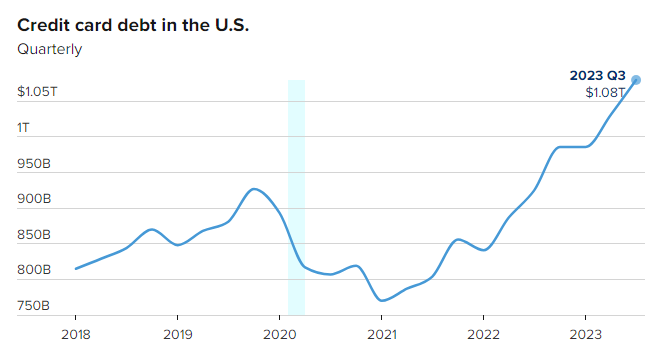
U.S. citizens now owe $1.08 trillion on their credit cards, according to a new report on household debtfrom the Federal Reserve Bank of New York.
U.S. Household Debt Rises to $17.29 Trillion Led by Mortgage, Credit Card, and Student Loan Balances
Total household debt rose by 1.3% to reach $17.29 trillion in the third quarter of 2023, according to the latest Quarterly Report on Household Debt and Credit.
Mortgage balances increased to $12.14 trillion, credit card balances to $1.08 trillion, and student loan balances to $1.6 trillion.
Auto loan balances increased to $1.6 trillion, continuing the upward trajectory seen since 2011. Other balances, which include retail credit cards and other consumer loans, were effectively flat at $0.53 trillion. Delinquency transition rates increased for most debt types, except for student loans.
The amount of U.S. debt is a complex and controversial topic that has different perspectives, implications and opinion.
According to the U.S. Treasury Fiscal Data, the national debt of the United States was $33.52 trillion as of 23rd October 2023.
This includes both the debt held by the public, which is the amount the federal government owes to outside entities such as foreign governments, corporations, and individuals, and the debt held by federal government accounts, which is the amount the federal government owes to itself, such as trust funds and special funds.
Is U.S. debt a problem?
Some argue that the U.S. debt is a problem because it increases the risk of a fiscal crisis, reduces the government’s ability to respond to emergencies, imposes a burden on future generations, and lowers the nation’s creditworthiness.
Others contend that the U.S. debt is not a problem because the U.S. can always print more money, (isn’t this why there is so much debt already)? Borrow at low interest rates, (not easy in the current climate), stimulate economic growth, and benefit from its status as the world’s reserve currency.
So, is U.S. debt a problem or not? It depends on various factors such as the size, composition, and sustainability of the debt, as well as the economic and political context in which it operates.
Most analysts and policymakers agree that the U.S. debt is projected to grow faster than the economy in the long-term, which could pose significant challenges for fiscal policy and economic stability. Therefore, it is important to understand the causes and consequences of the U.S. debt and to find solutions that balance the trade-offs between spending and income.
Debt in relation to GDP
The U.S. debt of GDP was estimated to be around 120% to 130% in 2023.
The U.S. debt of GDP is the ratio of the total public debt of the United States to its gross domestic product (GDP), which measures the size of the economy.
The interest the government pays on national debt has reached a 20-year high as the rate on 30-year bonds touches 5.05%.
A rise in the cost of borrowing comes at a difficult time for the chancellor, Jeremy Hunt, as he prepares for the autumn statement on 22nd November 2023. The chancellor has already made clear that tax cuts will not be announced in the autumn statement.
National debt £2,590,000,000,000
The total amount the UK government owes is called the national debt and it is currently about £2.59 trillion – £2,590,000,000,000.
The government borrows money by selling financial products called bonds. A bond is a promise to pay money in the future. Most require the borrower to make regular interest payments over the bond’s lifetime.
UK government bonds – known as ‘gilts’ – are normally considered very safe, with little risk the money will not be repaid. Gilts are mainly bought by financial institutions in the UK and abroad, such as pension funds, investment funds, banks and insurance companies.
QE
The Bank of England (BoE) has also bought hundreds of billions of pounds’ worth of government bonds in the past to support the economy, through a process called quantitative easing or QE.
A higher rate of interest on government debt will mean the chancellor will have to set aside more cash, to the tune of £23 billion to meet interest payments to the owners of bonds. This in-turn means the UK government may choose to spend less money on public services like healthcare and schools at a time when workers in key industries are demanding pay rises to match the cost of living.
Double debt
The current level of debt is more than double what was seen from the 1980s through to the financial crisis of 2008. The combination of the financial crash in 2007/8 and the Covid pandemic pushed the UK’s debt up from those historic lows to where it stands now. However, in relation to the size of the economy, today’s debt is still low compared with much of the last century.
UK debt £2,590,000,000,000
The U.S, German and Italian borrowing costs also hit their highest levels for more than a decade as markets adjusted to the prospect of a long period of high interest rates and the need for governments around the world to borrow.
It follows an indication from global central banks, including the United States Federal Reserve and the Bank of England (BoE), that interest rates will stay ‘higher for longer’ to continue their jobs of bringing down inflation.
£111billion on debt interest in a year
During the last financial year, the government spent £111 billion on debt interest – more than it spent on education. Some economists fear the government is borrowing too much, at too great a cost. Others argue extra borrowing helps the economy grow faster – generating more tax revenue in the long run.
The Office for Budget Responsibility (OBR), has warned that public debt could soar as the population ages and tax income falls. In an ageing population, the proportion of people of working age drops, meaning the government takes less in tax while paying out more in pensions, welfare and healthcare services.
Credit card losses in the U.S. are rising at the fastest pace since the Great Financial Crisis of 2008.
Goldman Sachs reportedly predicts that credit card losses will continue to climb through the end of 2024 or early 2025 for most issuers. This is unusual because the losses are accelerating outside of an economic downturn.
Unusual trend
The main factors behind this trend are higher interest rates from the Federal Reserve and a surge in spending since the pandemic.
U.S. citizens owe more than $1 trillion on credit cards, a record high, according to the Federal Reserve Bank of New York. Credit card defaults, which occur when a borrower fails to repay debt and the lender writes it off, are also projected to increase by 20% year-over-year in 2023.
This could have negative implications for the economy and consumers’ financial well-being.
The value of UK mortgage arrears jumped by almost a third in April to June 2023 compared with the same period last year, according to the Bank of England (BoE).
Outstanding mortgage debt is now £16.9bn, the highest since 2016, it said.
Mortgage costs have risen for millions as the Bank has repeatedly hiked interest rates to slow soaring prices.
Some experts warn defaults will rise, but others say the number unable to repay remains relatively low.
According to the BoE, in April-June 16% of mortgages in arrears were new cases, which it said ‘was little changed compared to the previous quarter’.
It added that the proportion of mortgages in arrears was the highest since 2018.
Slow-Growing UK Faces Over £2.6 Trillion Debt Pile
£2,600,000,000,000 in debt
The amount the UK owes exceeds GDP for first time since 1961. Inflation-linked bonds mean the UK is paying more than its peers.
From the financial crisis to Russia’s invasion of Ukraine, the UK has borrowed and spent its way out of every jam. The bill for that is becoming a massive concern for the UK treasury and for the economy.
£2.6 trillion public debt
The UK’s public debt has soared by more than 40% to almost £2.6 trillion ($3.3 trillion) since the pandemic struck, leaving the country owing more than its entire annual economic output for the first time since 1961. A heavy reliance on index-linked bonds, at a time of high inflation, also means Britain will pay more to service the debt.
The high level of debt poses a risk to the UK’s credit rating, which could affect its borrowing costs and fiscal credibility. The three main credit-rating firms are due to update their assessments of the UK over the next four months in 2023, and some analysts are concerned that the UK could face a downgrade, especially after the U.S. lost its AAA status from Fitch.
A downgrade could undermine Prime Minister Rishi Sunak’s effort to rebuild Britain’s fiscal reputation after his predecessor, Liz Truss, triggered a bond-market crash in 2022 by promising huge unfunded tax cuts.
Bond sell-off pressure
The pressure on the UK’s finances is also being compounded by a selloff in bonds amid aggressive rate hikes by the Bank of England to quell inflation. The yield on the 10-year benchmark this week rose above 4.70% to its highest since 2008.
UK debt higher than UK GDP March 2023
The UK bond market is among the developed world’s worst performers this year. The rise in yields could increase the cost of servicing the debt, which is already high due to the UK’s heavy reliance on index-linked bonds that adjust with inflation.
The UK’s economic growth is forecast to remain flat through next year, which limits the scope for reducing the debt through higher revenues or lower spending. The National Health Service is stretched to breaking point and the tax burden is already at a 70-year high. The ONS warned that debt could balloon to more than three times GDP over the next half century without action.
ONS data
According to the latest data from the Office for National Statistics (ONS), the UK’s gross domestic product (GDP) grew by 0.2% in the second quarter of 2023 (April to June), following a revised growth of 0.1% in the first quarter of 2023 (January to March). This means that the UK’s GDP growth rate for the whole year of 2023 is estimated to be 0.3%, which is lower than the previous forecast of 0.5%.
ONS data to March 2023
The main factors that contributed to the weak GDP growth in the second quarter were the slowdown in consumer spending, the decline in business investment, and the negative impact of the additional bank holiday in May due to the King’s Coronation. The services sector, which accounts for about 80% of the UK’s economy, grew by only 0.1% in the second quarter, while the production sector grew by 0.7%, and the construction sector fell by 0.2%.
Uncertain outlook in uncertain times
The outlook for the UK’s economy remains uncertain, as it faces several challenges such as high inflation, rising interest rates, a slowing global economy, and the ongoing effects of Brexit and the effects of the war in Ukraine.
ONS data for EU countries
Some economists have warned that the UK faces a ‘very real risk’ of recession due to higher interest rates, which could dampen consumer and business confidence and increase the cost of servicing the debt.
The OECD has projected that the UK’s GDP growth will improve moderately to 1.0% in 2024, but still remain below its pre-pandemic level.
Americans are using their credit cards more than ever, pushing the total balance to over $1 trillion for the first time in history, according to a report from the New York Federal Reserve.
The report, released August 2023, showed that credit card balances rose by $45 billion to $1.03 trillion in the second quarter of 2023, reflecting robust consumer spending as well as higher prices due to inflation. The increase was the largest quarterly gain since 2008 and surpassed the previous record of $1.02 trillion set in 2019.
The rise in credit card debt also coincided with a higher payment failure rate, which measures the share of borrowers who are at least 30 days behind on their payments. The failure measure climbed to 7.2% in the second quarter, up from 6.5% in the first quarter and the highest level since 2012.
The New York Fed reportedly said that the increase in failure rates may reflect a normalization to pre-pandemic levels, as many lenders offered relief programs and forbearance options to borrowers during the Covid-19 crisis. However, some analysts warned that the high level of credit card debt could pose a risk to the financial stability of households and the economy if interest rates rise or incomes fall.
Expensive debt
Credit card debt is one of the most expensive forms of debt, and it can quickly spiral out of control if not managed. ‘Consumers should aim to pay off their balances in full every month, or at least pay more than the minimum due, to avoid paying unnecessary interest and fees.
The burden of debt is all to consuming!
Interest rates and fees on credit cards are one of the highest payable and if you fall into the debt spiral it can be almost impossible to liberate yourself from that consuming debt.
Younger users
The New York Fed also noted that credit card usage has become more widespread among Americans, especially among younger and lower-income borrowers. The share of adults with at least one credit card increased from 76% in 2019 to 79% in 2021, while the share of those with four or more cards rose from 18% to 21% over the same period.
Tool
The report suggested that credit cards have become an essential tool for many consumers to access credit and smooth purchases over time, especially during periods of economic uncertainty and volatility. However, it also cautioned that credit cards can also lead to overborrowing and financial distress if not used responsibly.
It is one of the most expensive ways to borrow money and far too easy to access.