
Bank busting figures as profits pile up!

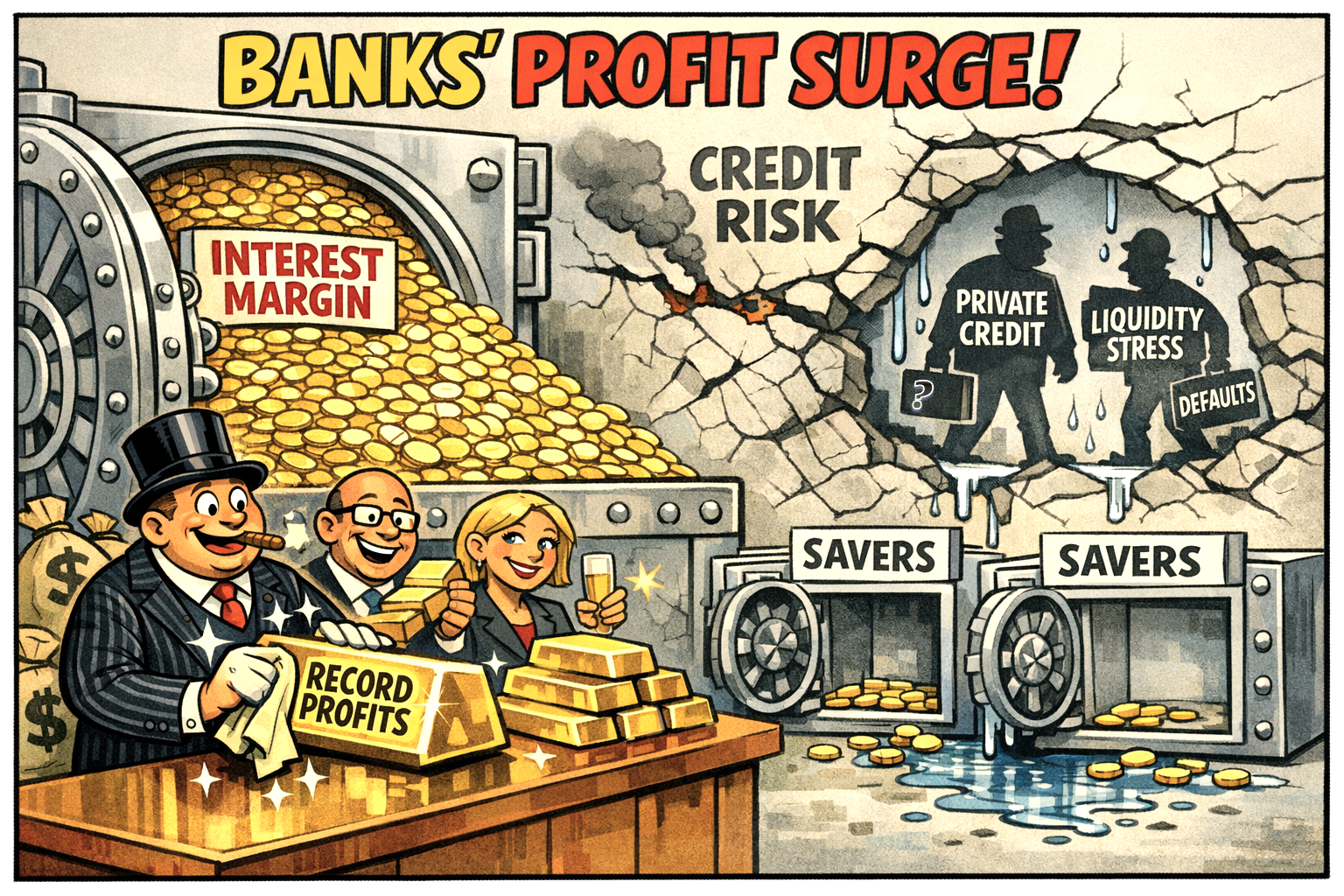
Banks' profits surge

Banks are reporting unusually strong profits because higher interest rates have widened margins, while slow pass‑through to savers, cost‑cutting, and capital optimisation have amplified returns — even as credit risks begin to rise.

Why profits are so high

The latest figures show that UK banks are still benefiting from the long tail of the interest‑rate cycle.

Even though the Bank of England has not raised rates since August 2023, the base rate remains at 4.5%, allowing lenders to earn significantly more on mortgages and credit than they pay out on deposits.

This margin expansion has been the single biggest driver of profit growth. Research from recently highlighted from Positive Money shows that the UK’s four largest banks have generated £136.8 billion in pre‑tax profits since rate rises began in December 2021, and are on track to exceed their record £45.9 billion made in 2024 by around 14% in 2025.

A second factor is the government’s interest payments on central bank reserves. Because commercial banks are paid the base rate on their risk‑free deposits at the Bank of England, they stand to receive around £30 billion a year in transfers through to 2030 — effectively a public subsidy that boosts earnings without requiring additional lending.

Banks have also been aggressively returning capital to shareholders. Between 2022 and 2024, the big four spent £42 billion on dividends and £32 billion on share buybacks, reinforcing the perception that profits are being harvested rather than reinvested.

How banks are sustaining these profits

The profitability story is not just about rates. Structural shifts are helping banks defend margins even as the rate cycle turns.

1. Slow deposit repricing High Street banks have been reluctant to raise savings rates in line with market levels. As consumers move deposits to specialist lenders offering better returns, the big banks still retain a large, low‑cost funding base.

KPMG reportedly notes that high street banks’ share of deposits has only slipped from 84% in 2019 to 80% in 2024 — still dominant enough to preserve cheap funding.

2. Capital optimisation through securitisation Banks are increasingly using Significant Risk Transfer (SRT) securitisations to free up capital and improve return on equity. Securitised loan volumes have grown at a 4% CAGR between 2022 and 2025, allowing banks to recycle capital into higher‑yielding assets.

3. Cost discipline and digital transformation With margins expected to compress as rates eventually fall, banks are pushing cost‑cutting, automation, and AI‑driven process redesign.

KPMG reportedly forecasts sector‑wide returns on equity could fall from 18% in 2023 to 10% by 2027 without structural change — making efficiency programmes essential to sustaining profitability.

The emerging risk: impairments

Barclays’ latest results show rising credit impairment charges, including an £823 million provision linked to mortgage‑market stress and fraud‑related losses.

This raises the question of whether the credit cycle is turning. If impairments rise across the sector, the profit boom could fade.

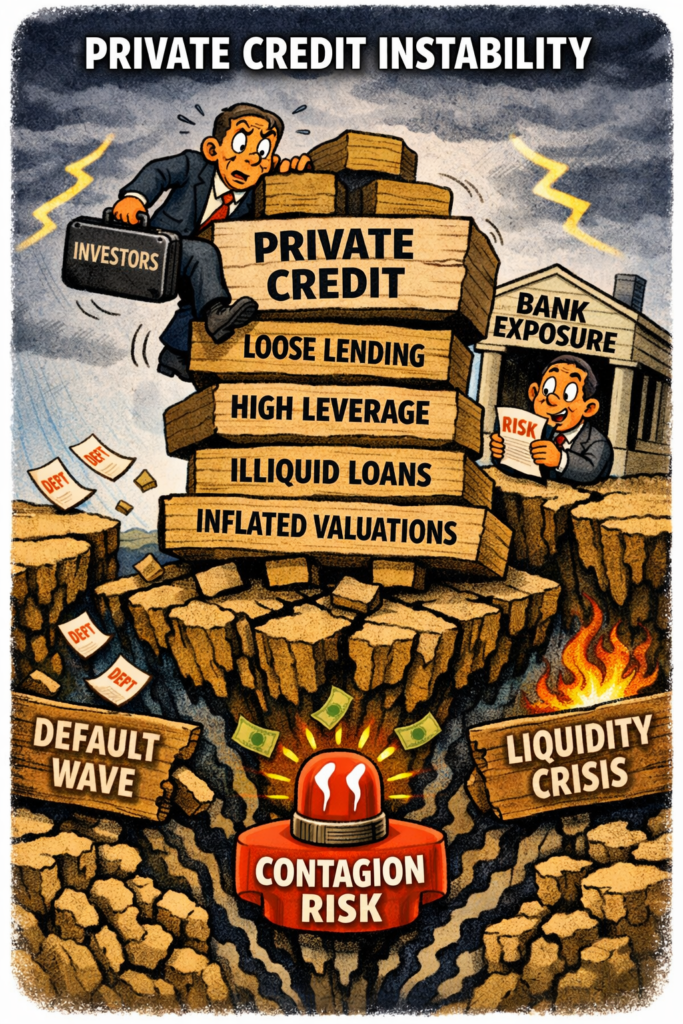
The biggest emerging credit risks sit outside the banking system and that is private credit, leveraged borrowers, and liquidity mismatches that could spill back into banks.

Private credit is now large, interconnected, and showing signs of strain. Rising defaults, deteriorating loan quality, and withdrawal caps at major funds point to mounting stress. Defaults could climb sharply, with Morgan Stanley reportedly warning they may reach 8%, far above historical norms.

A second risk is liquidity pressure. Funds are restricting redemptions as investors rush for the exit, exposing the fragility of semi‑liquid structures.

Finally, contagion risk is growing because banks finance private‑credit funds and pipelines. As analysts note, deeper interconnections mean a downturn could transmit stress back into the regulated system.

Conclusion

Banks are reporting strong profits because the rate environment, public transfers, and capital strategies have created a uniquely favourable backdrop.

But the model is fragile: as impairments rise and rates eventually fall, the sector may be approaching the end of its profit‑supercycle.
Private credit – Banks Say “Contained” — Markets Aren’t So Sure

Private credit concerns

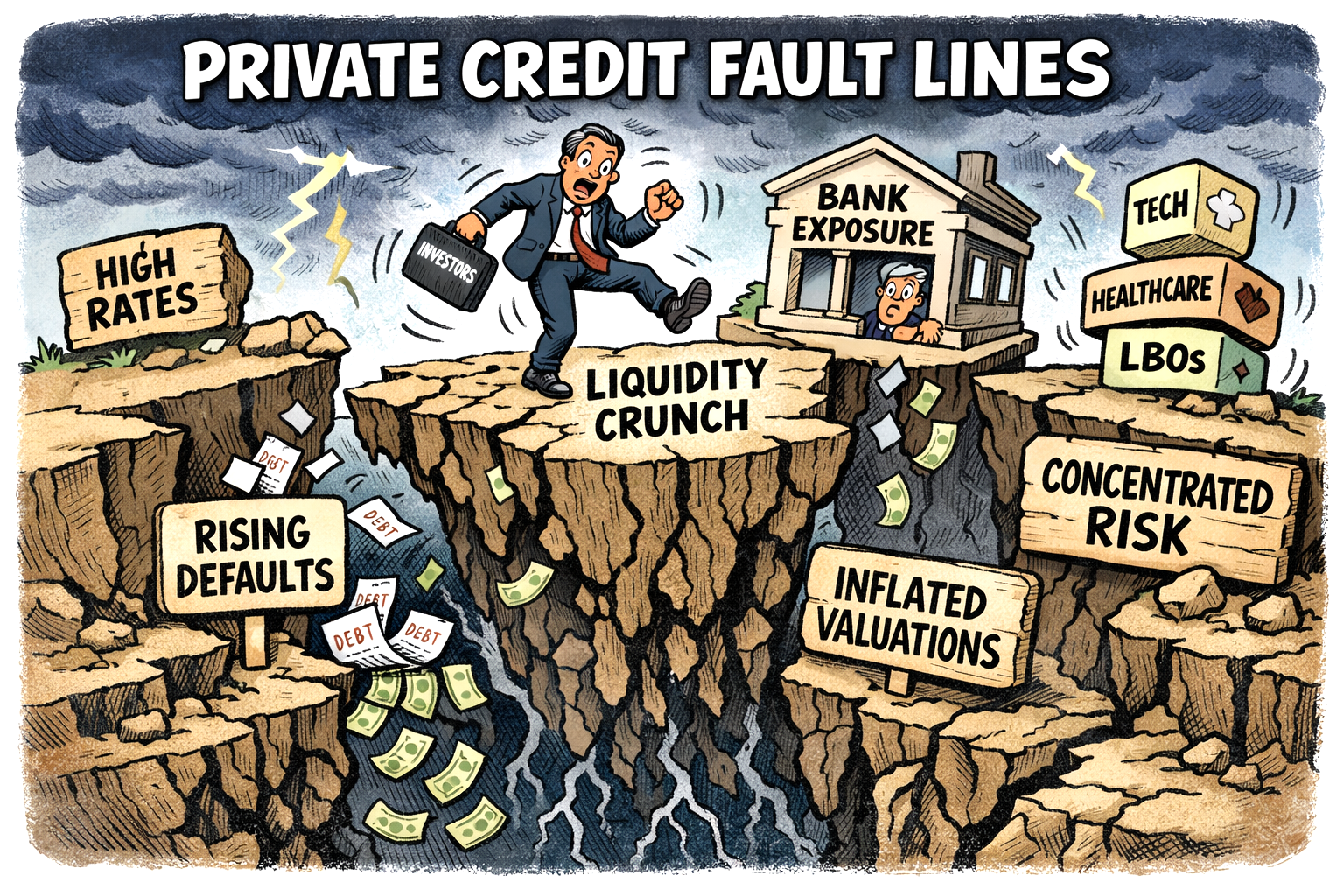
Private credit has become the fault line running beneath the banking system. And it’s now large enough to matter, opaque enough to worry investors, and now visible enough that banks can’t wave it away.

Complicated picture

European lenders spent this earnings season insisting their exposures are “well diversified” or “immaterial”, yet the numbers tell a more complicated story.

Barclays alone reportedly disclosed £15 billion of private‑credit exposure, part of a much larger £66 billion book tied to non‑bank financial intermediaries.

Its hit from the collapse of Market Financial Solutions — a specialist lender undone by alleged fraud — was small in accounting terms, but symbolically important. One cockroach rarely travels alone.

Structural

The deeper issue is structural. Private credit has ballooned into a parallel lending system, lightly regulated and increasingly interconnected with banks through financing lines, securitisations, and business‑development companies.

When these semi‑liquid vehicles face redemption pressure — as several have this year — the stress ricochets back into the banking system. UBS and Deutsche Bank both reportedly emphasised their underwriting standards, but neither disputed that liquidity strains are real.

What unnerves investors is not a wave of defaults — yet — but opacity. Bank of America’s latest survey shows investment‑grade investors are uneasy because they simply cannot see where the risks sit.

Software lending in the U.S., chemicals in Europe, and China‑driven price pressure all add sector‑specific fragility. High‑yield specialists, closer to the coalface, are oddly calmer; they know where the bodies usually fall.

Contained?

The banking system’s official line is that everything is contained. But containment depends on liquidity holding, valuations staying stable, and no further MFS‑style surprises emerging.

Private credit has grown faster than transparency, and faster than the regulatory perimeter. That mismatch — not any single default — is what now shadows the banks.

The issue

The central concern with private credit is simple: it has grown faster than the safeguards designed to contain it.

What was once a niche corner of finance is now a multi‑trillion‑pound shadow banking system whose risks are only partially visible to regulators, banks, or investors. That opacity is now becoming a problem.

Expansion

Private‑credit funds have expanded aggressively by offering speed, flexibility, and looser covenants than traditional banks. In a low‑rate world, that model looked benign. In a high‑rate world, it looks fragile.

Many borrowers were underwritten on assumptions that no longer hold: stable cashflows, cheap refinancing, and buoyant valuations. As rates stay elevated, those assumptions are breaking down.

Defaults

Defaults are rising, and recovery values are uncertain because loans are bespoke, illiquid, and rarely traded.

Liquidity

Liquidity is the second fault line. Private‑credit vehicles promise semi‑liquid access to investors while holding assets that cannot be sold quickly without taking a loss.

When redemptions pick up, funds resort to withdrawal gates, side pockets, or emergency financing lines from banks.

That is where the contagion risk emerges. Banks insist their exposures are modest, but they provide leverage, subscription lines, and warehousing facilities to the very funds now under pressure.

A liquidity squeeze in private credit can therefore boomerang back into the regulated system.

Valuation

Valuation risk is the third issue. Because loans are marked to model rather than market, losses can be slow to surface.

That delays recognition, masks stress, and encourages complacency. When reality finally intrudes — through a default, a refinancing failure, or a forced sale — the adjustment can be abrupt.

The final concern is concentration. Private credit is heavily exposed to software, healthcare, and sponsor‑backed roll‑ups. If one of these sectors turns, the losses will not be isolated.

Private credit is not about to collapse as such. But it is large, opaque, and increasingly interconnected — and that combination is rarely harmless.

Blue Owl’s Redemption Freeze Sends Shockwaves Through Private Credit

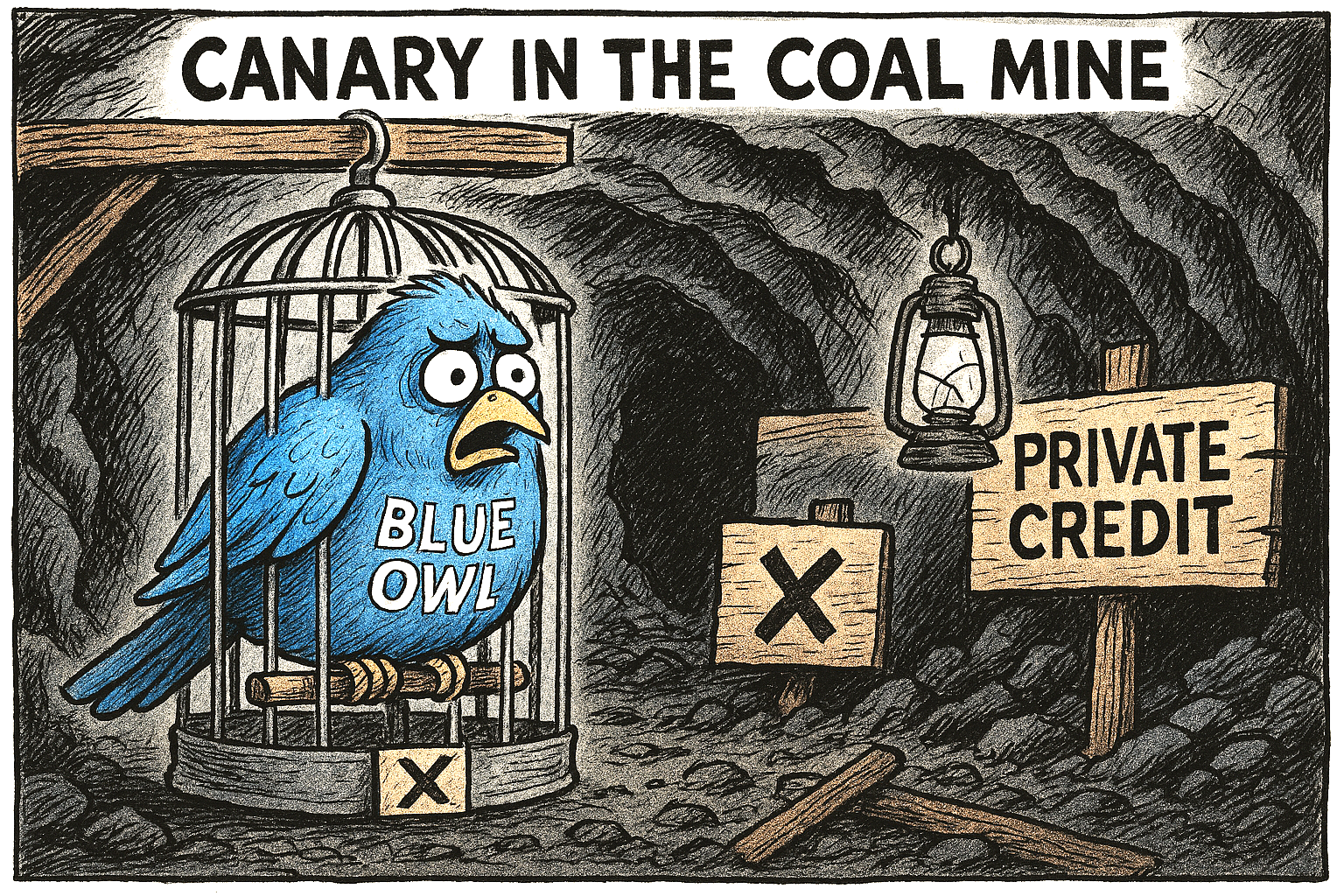
Canary in a coal mine - possible credit crunch warning

Blue Owl’s decision to halt investor withdrawals at one of its flagship retail‑focused private credit vehicles has sent a jolt through a market long celebrated for its resilience.

The move, centred on Blue Owl Capital Corporation II (OBDC II), marks one of the most significant stress signals yet in the rapidly expanding private credit sector.

Redemption

The firm confirmed that investors in OBDC II will no longer be able to redeem shares on a quarterly basis, ending a mechanism that previously allowed withdrawals of up to 5% of net asset value each quarter.

The redemption facility had already been paused in November 2025 as withdrawal requests accelerated, but the permanent halt represents a decisive shift.

To meet liquidity needs and prepare for a partial return of capital, Blue Owl has sold a substantial portion of its loan book.

Reportedly around $600 million of assets were offloaded from OBDC II as part of a wider $1.4 billion sale across three funds, with the firm planning to return 30% of the fund’s value to investors by the end of March.

Reaction

Markets reacted swiftly. Shares in Blue Owl fell between 6% and 10% across recent trading sessions, touching their lowest levels in more than two years.

The sell‑off was fuelled not only by the redemption freeze but also by broader concerns about the firm’s exposure to software‑sector borrowers — an area facing valuation pressure and heightened sensitivity to disruption from artificial intelligence.

The episode has reignited debate about the structural vulnerabilities of private credit, a market now estimated at $1.8 trillion.

The model relies on illiquid loans packaged into vehicles that promise periodic liquidity to investors — a mismatch that works only as long as redemption requests remain manageable.

Blue Owl’s move suggests that, under stress, even well‑established managers may be forced into asset sales or wind‑down scenarios.

Contagion?

Contagion fears quickly spread across the sector. Shares of major alternative‑asset managers, including Apollo, Blackstone and TPG, all declined sharply as investors reassessed liquidity risks in retail‑facing credit products.

For now, Blue Owl insists that capital will continue to be returned through loan repayments and asset sales.

But the permanent closure of redemptions at OBDC II stands as a stark reminder: the private credit boom is entering a more volatile phase, and liquidity — once taken for granted — is becoming the industry’s most fragile commodity.

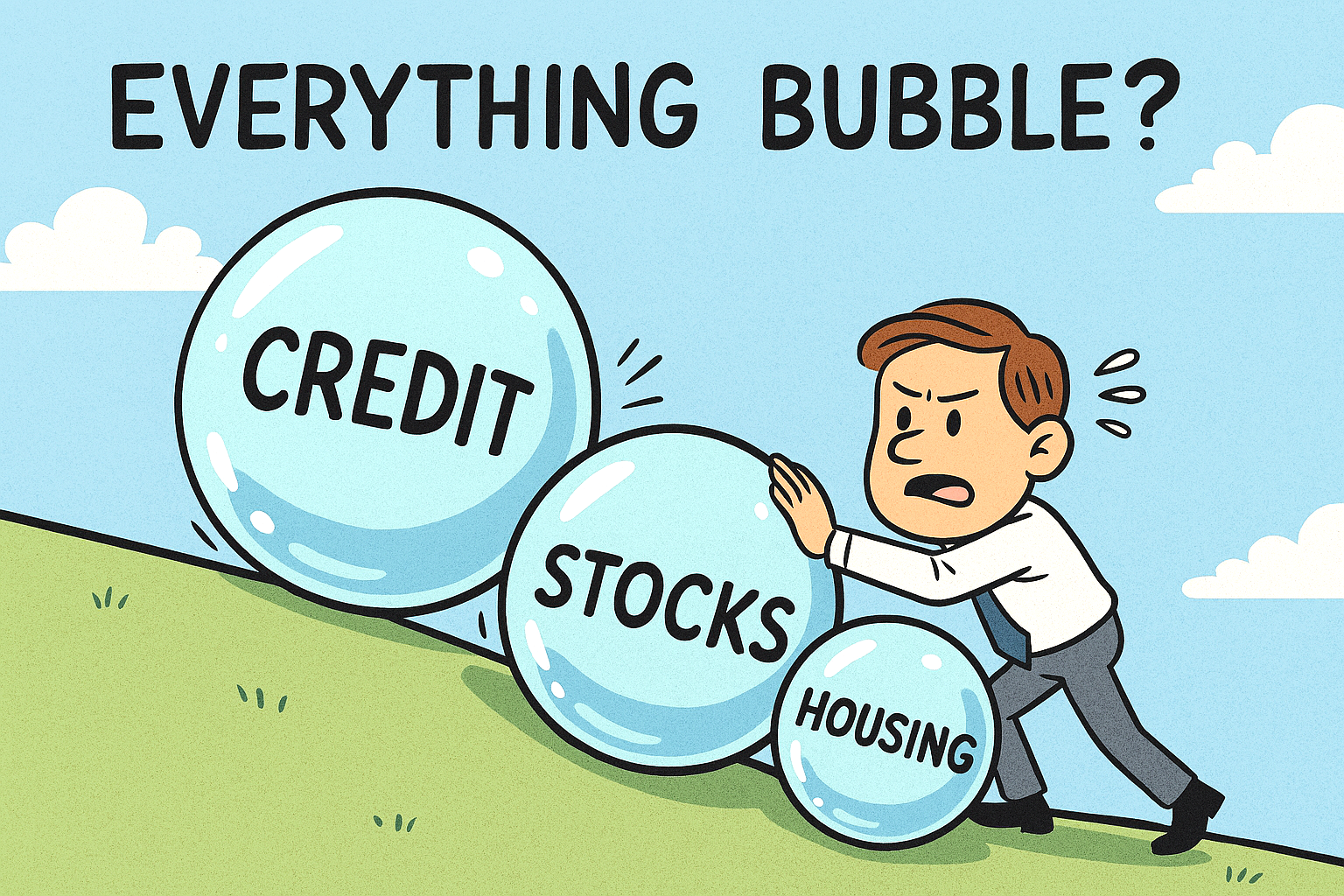
Are U.S. Markets in an ‘Everything Bubble’?

U.S. Stock Everything Bubble?

The phrase ‘everything bubble‘ has gained traction among investors and commentators who fear that multiple asset classes in the United States are simultaneously overvalued.

Unlike past episodes where excess was concentrated in one sector—such as technology in the late 1990s or housing in the mid‑2000s—the current concern is that equities, property, and credit markets are all inflated together, leaving little room for error.

Equities are the most visible part of the story. Major U.S. indices have surged to record highs, driven by enthusiasm for artificial intelligence, cloud computing, and digital infrastructure.

Valuations in leading technology firms are stretched, with price‑to‑earnings ratios far above historical averages. Critics argue that investors are extrapolating future growth too aggressively, while ignoring the risks of higher interest rates and slowing global demand.

Market breadth has also narrowed, with a handful of companies accounting for most of the gains, a pattern often seen before corrections.

Housing

Housing provides another layer of concern. Despite higher mortgage rates, U.S. home prices remain elevated, supported by limited supply and strong demand in metropolitan areas.

This resilience has surprised analysts, but it also raises the question of sustainability. If borrowing costs remain high, affordability pressures could eventually weigh on the market, exposing households to financial stress.

Credit markets

Credit markets add a third dimension. Corporate debt issuance has slowed, and investors have become more selective, demanding higher yields to compensate for risk. Some deals have been pulled altogether, signalling caution beneath the surface.

When credit tightens, it often foreshadows broader economic weakness, as companies struggle to refinance or fund expansion.

Yet it would be simplistic to declare that everything is a bubble. The rapid adoption of AI and accelerated computing reflects genuine structural change, not mere speculation.

Demand for advanced chips and data centres is tangible, and some firms are generating real cash flows from these trends. Similarly, housing shortages are rooted in years of under‑building, suggesting that supply constraints, rather than speculative mania, are keeping prices high.

The truth may lie in between. U.S. markets are undeniably expensive, and vulnerabilities are widespread.

But not all sectors are equally fragile, and some are underpinned by lasting shifts in technology and demographics.

Investors should therefore resist blanket labels and instead distinguish between genuine transformation and speculative excess.

In doing so, they can navigate a landscape that is frothy in places, but not uniformly illusory.

Concerns about credit contagion are back as troubles in U.S. regional banks shake global markets

U.S. Bank Credit Woes!

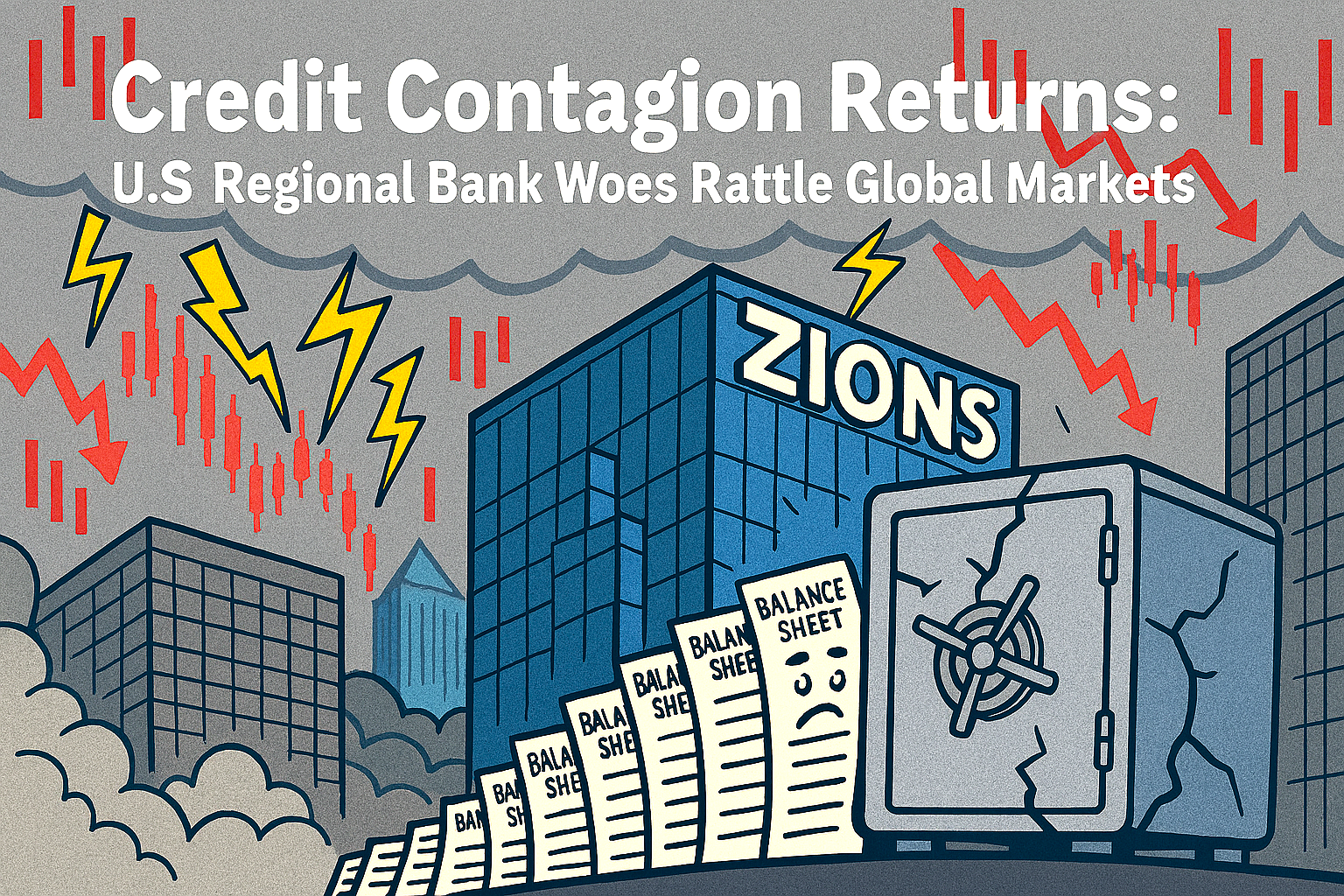
On Friday 17th October 2025, a fresh wave of credit concerns erupted across financial markets, triggered by troubling disclosures from U.S. regional lenders Zions Bancorporation and Western Alliance.

Both banks revealed significant exposure to deteriorating commercial real estate loans, reigniting fears of systemic fragility just months after the collapse of Silicon Valley Bank and Signature Bank.

The revelations sent shockwaves through Wall Street. Shares in Zions plunged over 11% in early trading, while Western Alliance dropped nearly 9%.

Larger institutions weren’t spared either—JP Morgan, Bank of America, and Citigroup all saw declines, as investors reassessed the health of the broader banking sector.

Volatile

The CBOE Volatility Index (VIX), often dubbed Wall Street’s ‘fear gauge’, spiked to its highest level since April, signalling a sharp uptick in investor anxiety.

The panic quickly spread across the Atlantic. UK lenders bore the brunt of the fallout, with Barclays tumbling 6.2%, Standard Chartered down 5.4%, and NatWest shedding 4.8%.

£13 billion loss to UK banks

In total, nearly £13 billion was reportedly wiped off the value of British banks in a single trading session. The FTSE 100 closed down 1.5%, its worst performance in over a month.

At the heart of the crisis lies commercial real estate—a sector battered by high interest rates, remote working trends, and declining occupancy. U.S. regional banks, which often hold concentrated portfolios of property loans, are particularly vulnerable.

Analysts warn that rising defaults could trigger a domino effect, undermining confidence in institutions previously deemed stable.

The Bank of England’s Financial Stability Report had already flagged elevated risks from global fragmentation and sovereign debt pressures. As did the IMF Financial Stability Report.

Credit outlook review

The events of Friday 17th October 2025 appear to validate those concerns, with Moody’s and other agencies now reviewing credit outlooks for multiple institutions.

While some commentators view the sell-off as a temporary overreaction, others see it as a harbinger of deeper trouble.

The symbolic resonance is hard to ignore: vaults cracking, balance sheets buckling, and trust—once again—on the brink. Why?

For editorial observers, the moment invites reflection. Is this merely a cyclical tremor, or the start of a structural reckoning?

Either way, the illusion of resilience has been punctured. And as markets brace for further disclosures, the spectre of contagion looms large.

Remember the sub-prime loans fiasco?

I thought banks were ‘funded and ring-fenced’ more now to prevent this from happening again.

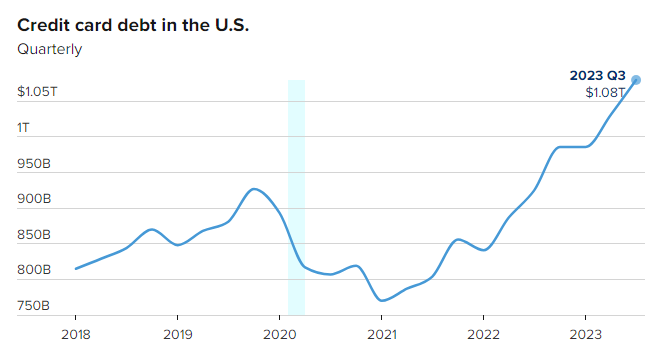
U.S. credit card balances climbed to a $1.08 trillion record in Q3 2023

U.S. credit card debt

U.S. citizens now owe $1.08 trillion on their credit cards, according to a new report on household debt from the Federal Reserve Bank of New York.

U.S. Household Debt Rises to $17.29 Trillion Led by Mortgage, Credit Card, and Student Loan Balances

Total household debt rose by 1.3% to reach $17.29 trillion in the third quarter of 2023, according to the latest Quarterly Report on Household Debt and Credit.

Mortgage balances increased to $12.14 trillion, credit card balances to $1.08 trillion, and student loan balances to $1.6 trillion.

Auto loan balances increased to $1.6 trillion, continuing the upward trajectory seen since 2011. Other balances, which include retail credit cards and other consumer loans, were effectively flat at $0.53 trillion. Delinquency transition rates increased for most debt types, except for student loans.

See analysis: new report on household debt

Moody credit agency upgrades UK

UK credit worthiness improves

Moody’s is a credit rating agency that evaluates the creditworthiness of countries, companies, and other entities. 

It recently upgraded the UK’s credit outlook from negative to stable, citing policy predictability, softer EU trade stance, and tax reversals.

This means that Moody’s expects the UK to have a lower risk of defaulting on its debts and to have a more stable economic outlook. Moody’s also noted some challenges for the UK, such as low growth prospects, high inflation, and the need for large investments in water and energy sectors.

It follows S&P, which dropped its negative outlook in April this year.

Credit card debt in the U.S. reaches new high of $1 trillion

Credit cards

Problem?

Americans are using their credit cards more than ever, pushing the total balance to over $1 trillion for the first time in history, according to a report from the New York Federal Reserve.

The report, released August 2023, showed that credit card balances rose by $45 billion to $1.03 trillion in the second quarter of 2023, reflecting robust consumer spending as well as higher prices due to inflation. The increase was the largest quarterly gain since 2008 and surpassed the previous record of $1.02 trillion set in 2019.

The rise in credit card debt also coincided with a higher payment failure rate, which measures the share of borrowers who are at least 30 days behind on their payments. The failure measure climbed to 7.2% in the second quarter, up from 6.5% in the first quarter and the highest level since 2012.

The New York Fed reportedly said that the increase in failure rates may reflect a normalization to pre-pandemic levels, as many lenders offered relief programs and forbearance options to borrowers during the Covid-19 crisis. However, some analysts warned that the high level of credit card debt could pose a risk to the financial stability of households and the economy if interest rates rise or incomes fall.

Expensive debt

Credit card debt is one of the most expensive forms of debt, and it can quickly spiral out of control if not managed. ‘Consumers should aim to pay off their balances in full every month, or at least pay more than the minimum due, to avoid paying unnecessary interest and fees.

The burden of debt is all to consuming!

Interest rates and fees on credit cards are one of the highest payable and if you fall into the debt spiral it can be almost impossible to liberate yourself from that consuming debt.

Younger users

The New York Fed also noted that credit card usage has become more widespread among Americans, especially among younger and lower-income borrowers. The share of adults with at least one credit card increased from 76% in 2019 to 79% in 2021, while the share of those with four or more cards rose from 18% to 21% over the same period.

Tool

The report suggested that credit cards have become an essential tool for many consumers to access credit and smooth purchases over time, especially during periods of economic uncertainty and volatility. However, it also cautioned that credit cards can also lead to overborrowing and financial distress if not used responsibly.

It is one of the most expensive ways to borrow money and far too easy to access.