

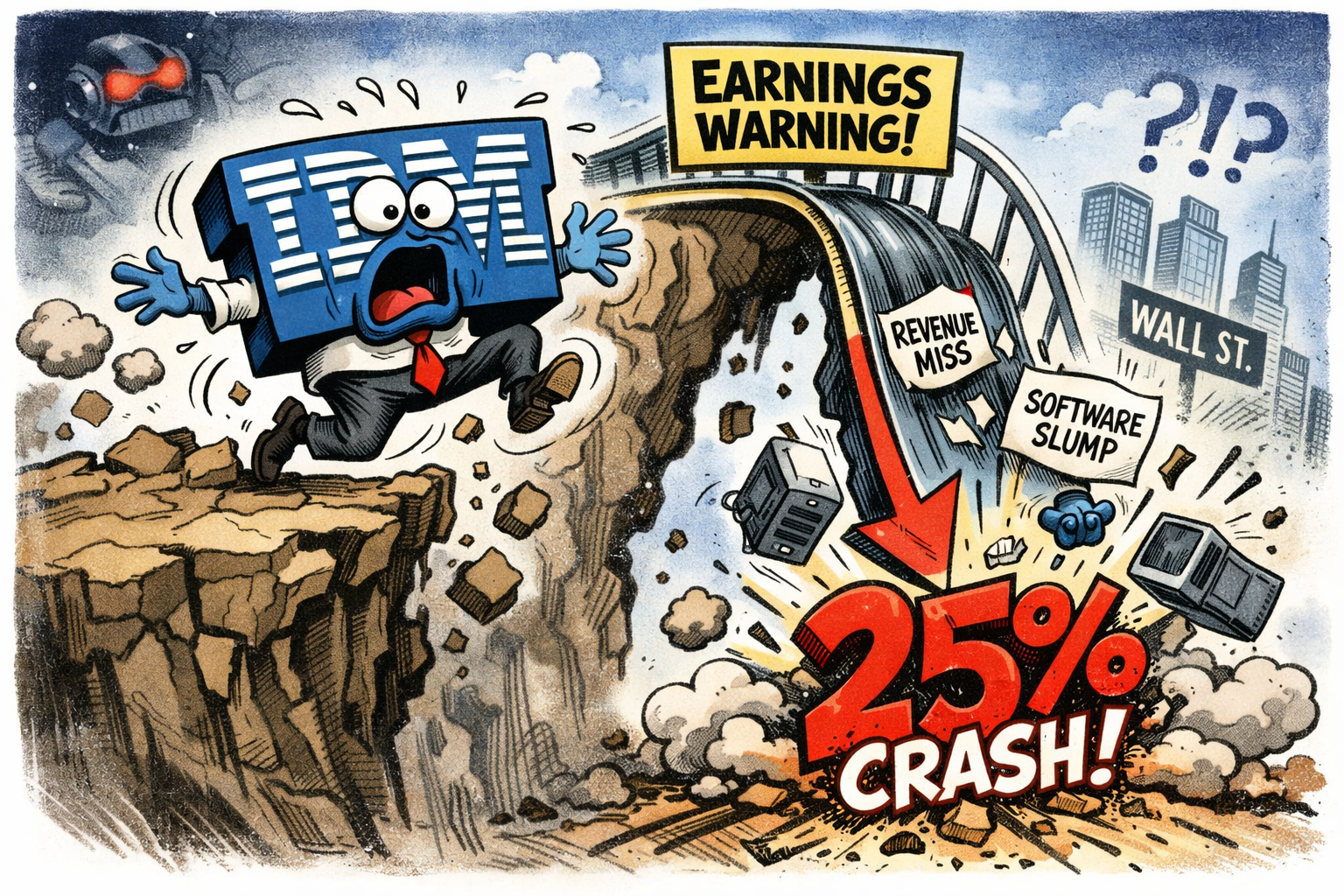
IBM stock sinks 25% – its worst day on record

IBM stocks tanks

IBM’s share price suffered a dramatic fall this week (14th July 2026) – plunging 25% after the company issued an unexpected warning on second‑quarter earnings.

The drop marked IBM’s worst single trading day on record, eclipsing even the infamous market turmoil of October 1987.

Reaction

Investors reacted sharply to preliminary results showing both revenue and adjusted earnings coming in below analysts’ expectations.

The shortfall was driven largely by weakness in IBM’s software and infrastructure divisions. According to CEO Arvind Krishna, many enterprise clients abruptly shifted their spending towards hardware—particularly servers, storage systems and memory chips—as they moved to secure supply‑constrained components ahead of anticipated price rises.

This late‑quarter pivot left several major software deals delayed, creating a sizeable gap between IBM’s forecasts and its actual performance.

Implications

The sell‑off also reflects wider market anxiety about how rapidly evolving AI tools may reshape the software landscape. While Krishna insisted IBM’s own software is not at risk of disruption, the pause in customer decision‑making—especially around cybersecurity—has added to investor unease.

For a company that had recently posted strong first‑quarter growth, the sudden reversal underscores how sensitive IBM remains to shifts in enterprise spending priorities.

Markets will now be watching closely to see whether the company can regain momentum in the second half of the year.

Intel unveils new AI chips as it seeks to reclaim market share

Ai microchip

Intel announced its new Xeon 6 processors at the Computex tech conference in Taiwan on Tuesday 4th June 2024.

This announcement coincides with the recent launches of new artificial intelligence chips by rivals Nvidia and AMD on Sunday and Monday 2nd and 3rd June 2024 – as they compete for dominance in the rapidly growing industry.

Intel is making efforts to catch up with Nvidia and AMD, having been relatively absent from the AI surge that led tech giants such as Meta, Microsoft, and Google to purchase a significant number of Nvidia chips.

This comes half a year after Intel’s release of its 5th Gen Intel Xeon processors for data centre workloads and a couple of months following the announcement of the Gaudi 3 processor for AI model training and deployment.

Intel also disclosed that the Gaudi 2 and Gaudi 3 AI accelerators are priced lower than those of its competitors.

Furthermore, Intel shared architectural details of its forthcoming Lunar Lake processors, aimed at expanding the AI PC category. These processors, slated for release in the third quarter, are set to rival Nvidia’s and AMD’s offerings tailored for AI PCs.

While Nvidia and AMD focus on chip design, Intel stands out by both designing and manufacturing its chips. Nevertheless, Intel’s foundry business has faced challenges, with its operating loss widening to $7 billion in 2023 compared to the previous year.