
Space has long represented humanity’s greatest frontier—a place of wonder, mystery and scientific discovery. Yet, as our presence beyond Earth has expanded, so too has something far less inspiring: our rubbish.
It seems that wherever humans travel, waste is never far behind.
Once Pristine
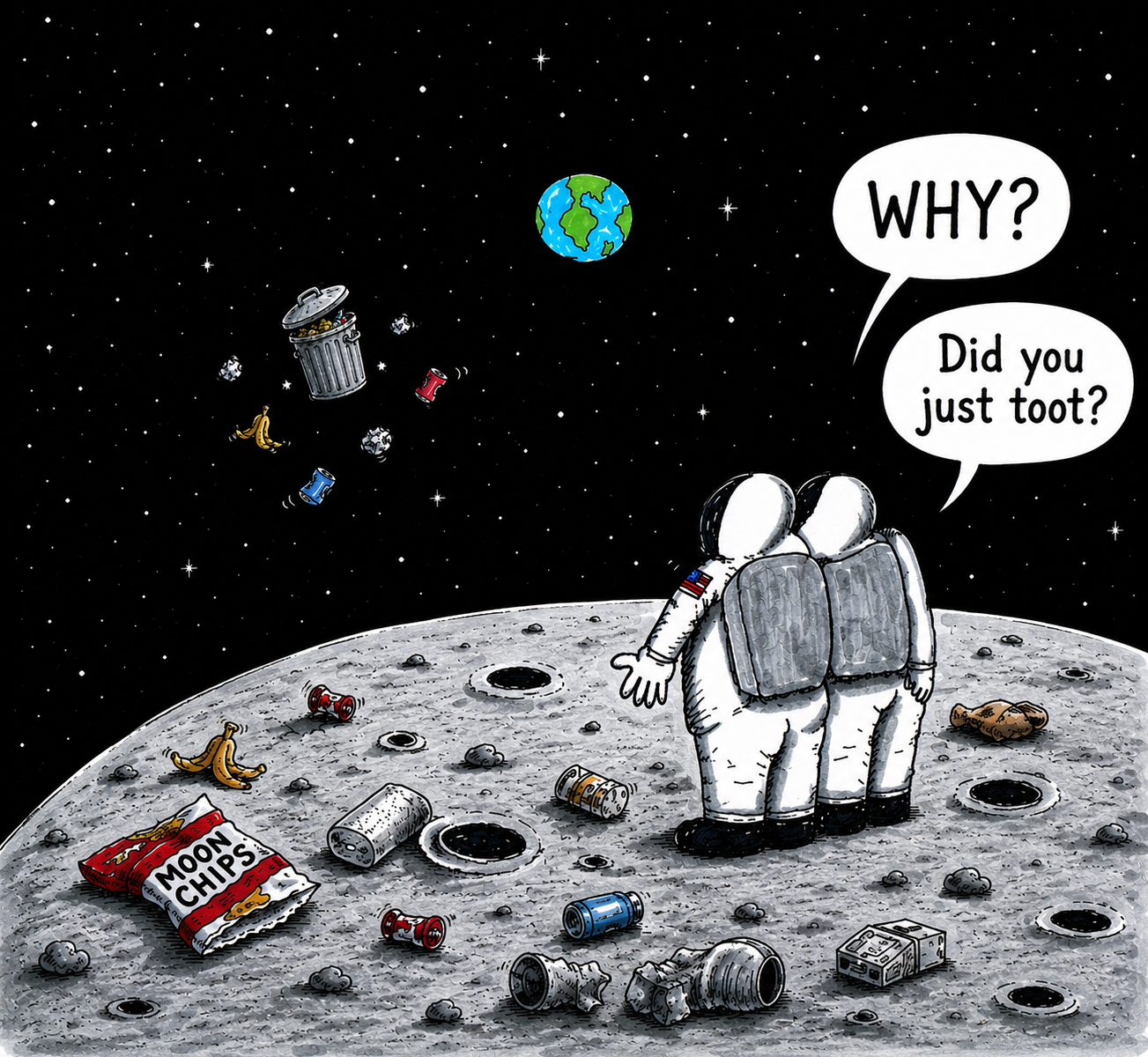
The Moon, once an untouched and pristine landscape, now bears the unmistakable fingerprints of human activity. During the Apollo missions of the 1960s and 1970s, astronauts famously left behind equipment to save weight for the return journey.
Among the discarded items were scientific instruments, landing hardware, cameras, boots, empty containers and, perhaps most surprisingly, dozens of bags containing human waste.
These decisions made practical sense at the time, but decades later they remain scattered across the lunar surface, silent reminders that even our greatest achievements came with unwanted leftovers.
Extended problem
The problem extends far beyond the Moon itself. Earth’s orbit has become increasingly cluttered with discarded rocket stages, defunct satellites, broken fragments from collisions and countless pieces of debris travelling at astonishing speeds.
Even tiny fragments can damage operational spacecraft or threaten astronauts aboard the International Space Station.
Every new launch adds to an already crowded environment, increasing the risk of further collisions and creating yet more debris in an ever-growing cycle.
Invisible pollution
Modern spaceflight also leaves behind invisible pollution. Rocket launches release exhaust gases high into the atmosphere, while spacecraft vent fuel residues, gases and other materials into space during operations.
Small leaks of oxygen, carbon dioxide and propellants may seem insignificant individually, but collectively they contribute to an expanding human footprint beyond our planet.
Space may be unimaginably vast, but that should not become an excuse for careless behaviour.
Impact
Recent events have highlighted the issue once again. A spacecraft associated with SpaceX ended its mission by impacting the Moon, adding another artificial object to a celestial body already littered with relics from previous decades.
Although such impacts are often planned and scientifically useful, they also reinforce an uncomfortable truth: humanity rarely leaves a place exactly as it found it.
As commercial spaceflight accelerates and more nations enter the space race, the challenge will only grow.
Clean it up
Without international standards for orbital clean-up, debris removal and responsible lunar exploration, future generations may inherit a polluted space environment that becomes increasingly hazardous and expensive to manage.
Exploration should never come at the expense of stewardship. We rightly encourage people to recycle, reduce waste and protect fragile environments on Earth.
Surely the same principles should apply beyond our atmosphere. Space was once untouched by human hands.
As we venture further into the cosmos, perhaps the greatest mark of an advanced civilisation will not be how far it travels, but how carefully it treats the places it visits.