

The United States experienced one of its most extraordinary aviation disruptions on Friday, 13th November 2026, when the Federal Aviation Administration (FAA) ordered a nationwide grounding of departing flights following a major communications failure within its air traffic control system.
For more than four hours, America’s aviation network was effectively brought to a standstill.
Thousands of passengers were stranded, airports became congested and airlines struggled to understand when normal operations could resume.
But what actually happened, and why did a problem with communications on the ground have such far-reaching consequences?
A failure in the system
The trouble began at approximately 3.36pm Eastern Time, when air traffic control facilities started experiencing instability in their radar and communications systems.
According to U.S. Transportation Secretary, the problem involved an ageing network of routers within the air traffic control infrastructure.
Engineers were replacing older copper connections with modern fibre-optic technology at a remote facility. During this work, a router began generating an extraordinary volume of connection requests, overwhelming other equipment across the network.
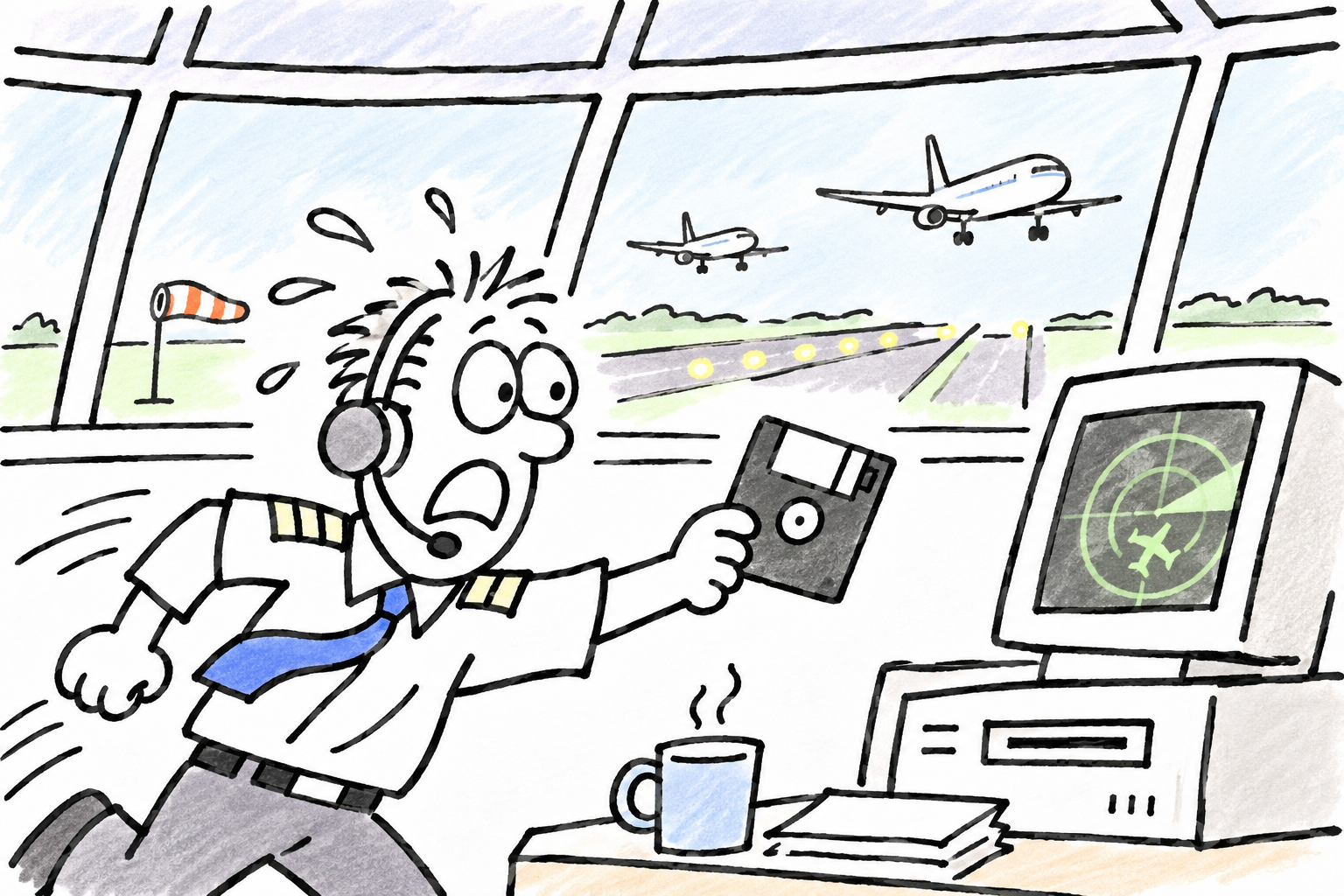
It was also reported that in some instances, decades old floppy disks were still be used to move data.
Officials subsequently revealed that the system was reportedly receiving more than 1,000 connection attempts every four to five seconds.
This created inconsistent information, affecting communications between controllers and aircraft, as well as radar feeds used to track their positions.
The problem spread beyond the original location, affecting multiple air traffic control centres.
Why were aircraft grounded?
Air traffic controllers depend on reliable radar information and uninterrupted communications with pilots. They must know precisely where aircraft are, their altitude, direction and intended flight paths.
When that information becomes unreliable, maintaining safe separation between aircraft becomes increasingly difficult.
The FAA therefore took the precautionary decision to stop departing flights nationwide. Aircraft already in the air were safely guided to land, with controllers and pilots working together to bring more than 3,500 aircraft down safely.
This was not an indication that aircraft were suddenly unsafe or that a collision was imminent. Rather, the authorities could not guarantee that the system was operating reliably enough to support normal levels of traffic.
The disruption continues
The nationwide ground stop was lifted at approximately 8.15pm Eastern Time on Friday, allowing departures to resume. However, reopening the airspace did not immediately restore normal operations.
Thousands of flights had been cancelled or delayed. Aircraft and crews were in the wrong locations, passengers were stranded and airports faced the difficult task of rebuilding schedules.
The disruption continued into Saturday, with further cancellations and delays reported.
An uncomfortable warning
The incident has raised serious questions about America’s reliance on ageing infrastructure.
Modern aircraft are increasingly sophisticated, yet the technology supporting the movement of thousands of flights still depends on systems that are decades old.
There was no initial evidence of a cyberattack. Instead, an apparently routine technology upgrade exposed a much wider vulnerability.
The question now is whether America can modernise its aviation infrastructure quickly enough to prevent a repeat of Friday’s extraordinary events.
Note: The technical explanation is particularly important here: this was not simply a computer outage.
A failure during an infrastructure upgrade caused excessive network traffic, which affected both radar information and communications across a substantial part of the national air traffic control network.
Officials reportedly said there was no initial indication of a cyberattack.