The inflation rate in Argentina is extremely high and has surpassed 100% for the first time since the early 1990’s. The inflation rate for consumer prices in Argentina was 138.28% in September 2023, based on the CPI values for the last 12 months.
This means that the prices of many goods and services have more than doubled since 2022. The main factors that contributed to this increase were the rise in food prices, especially meat, due to adverse weather conditions and a drought, as well as the economic difficulties and policy divisions that have plagued the country for years.
Argentina has been receiving bailout funds from the International Monetary Fund (IMF), but it has not been able to contain inflation, which has eroded the purchasing power of many people and pushed them into poverty.
The inflation rate in Argentina is one of the highest in the world and has a negative impact on its economic growth and social stability.
Map of Argentina
Map of Argentina
Argentina is the second largest country in South America, the fourth largest in the Americas, and the eighth largest in the world.
The amount of U.S. debt is a complex and controversial topic that has different perspectives, implications and opinion.
According to the U.S. Treasury Fiscal Data, the national debt of the United States was $33.52 trillion as of 23rd October 2023.
This includes both the debt held by the public, which is the amount the federal government owes to outside entities such as foreign governments, corporations, and individuals, and the debt held by federal government accounts, which is the amount the federal government owes to itself, such as trust funds and special funds.
Is U.S. debt a problem?
Some argue that the U.S. debt is a problem because it increases the risk of a fiscal crisis, reduces the government’s ability to respond to emergencies, imposes a burden on future generations, and lowers the nation’s creditworthiness.
Others contend that the U.S. debt is not a problem because the U.S. can always print more money, (isn’t this why there is so much debt already)? Borrow at low interest rates, (not easy in the current climate), stimulate economic growth, and benefit from its status as the world’s reserve currency.
So, is U.S. debt a problem or not? It depends on various factors such as the size, composition, and sustainability of the debt, as well as the economic and political context in which it operates.
Most analysts and policymakers agree that the U.S. debt is projected to grow faster than the economy in the long-term, which could pose significant challenges for fiscal policy and economic stability. Therefore, it is important to understand the causes and consequences of the U.S. debt and to find solutions that balance the trade-offs between spending and income.
Debt in relation to GDP
The U.S. debt of GDP was estimated to be around 120% to 130% in 2023.
The U.S. debt of GDP is the ratio of the total public debt of the United States to its gross domestic product (GDP), which measures the size of the economy.
The U.S. Treasury yields are the interest rates that the U.S. government pays to borrow money for different periods of time.
The 10-year Treasury yield is one of the most important indicators of the state of the economy and the expectations of inflation and growth. On 23rd October 2023, the 10-year Treasury yield rose above 5% for the first time since 2007, as investors increasingly accepted that interest rates will stay higher for longer and that the U.S. government will further increase its borrowing to cover its deficits.
Significant
This is a significant milestone, as it reflects the market’s view that the Federal Reserve will maintain elevated interest rates to control inflation and that the U.S. economy will remain resilient despite the challenges posed by the Covid-19 pandemic, geopolitical tensions and environmental issues.
The higher yield also means that the government will have to pay more to service its debt, which could affect its fiscal policy and spending priorities. The higher yield also affects other borrowing costs, such as mortgages, student loans, and corporate bonds, which could have implications for consumers and businesses.
10 Year Yield
The 10-year Treasury yield is influenced by many factors, such as supply and demand, inflation expectations, economic growth, monetary policy, and global events. The yield has been rising steadily since it hit a record low of 0.5% in March 2020, when the pandemic triggered a flight to safety and a massive stimulus from the Fed. Since then, the yield has been driven by the recovery of the economy, the surge in inflation, the reversal of the Fed’s bond-buying program, and the increase in the government’s borrowing needs.
Yield curve
The ten-year yield is closely watched by investors, analysts and policymakers as it provides a benchmark for valuing other assets and assessing the outlook for the economy. The yield is also used to calculate the yield curve, which is the difference between short-term and long-term Treasury yields.
The shape of the yield curve can indicate the market’s expectations of future interest rates and economic activity.
Artwork impression of computer screen: U.S. ten-year treasury yield breaches 5% for the first time since 2007
A steep yield curve means that long-term yields are much higher than short-term yields, which suggests that investors expect higher inflation and growth in the future. A flat or inverted yield curve means that long-term yields are lower than or equal to short-term yields, which implies that investors expect lower inflation and growth or even a recession.
The current yield curve is steepening, as long-term yields are rising faster than short-term yields. This indicates that investors are anticipating higher inflation and growth in the long run, but also that they are concerned about the sustainability of the government’s fiscal position and the impact of higher interest rates on the economy.
Indicators
The 10-year Treasury yield is an important indicator of the state of the economy and the expectations of inflation and growth. It has reached a level that has not been seen since before the global financial crisis of 2008-2009. This reflects the market’s view that interest rates will stay higher for longer and that the government will increase its borrowing to cover its deficits. The higher yield also affects other borrowing costs and asset prices, which could have implications for consumers and businesses.
The yield is influenced by many factors and is closely watched by investors, policymakers, and analysts. A 5% yield is a worry for the market, inflation, interest rates, geo-political risks and recession are the others, that’s enough!
The curbs are aimed at closing loopholes that became apparent after the U.S. announced export curbs on microchips in October 2022. The restrictions are designed to prevent China’s military from importing advanced semiconductors or equipment.
Nvidia has said in a filing that the new export restrictions will block sales of two high-end artificial intelligence chips it created for the Chinese market – A800 and H800. It said that one of its gaming chips will also be blocked.
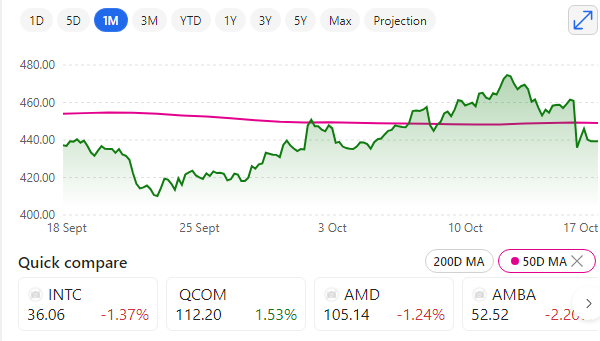
Nvidia Corp one month chart – closed at 439.38 17th October 2023
Although the curbs also affect other chip makers, analysts believe Nvidia will be hit the hardest because China accounts for up to 25% of its revenues from data centre chip sales. Nvidia’s shares, which are considered a star stock, fell by as much as 4.7% in the wake of the announcement.
Semiconductor Industry Association
The Semiconductor Industry Association, which represents 99% of the U.S. semiconductor industry by revenue, said in a statement that the new measures are ‘overly broad‘ and ‘risk harmingthe U.S. semiconductor structure without advancing national security as they encourage overseas customers to source elsewhere’.
China reacts
A spokesperson for the Chinese embassy also said that it ‘firmly opposes‘ the new restrictions, which also target Iran and Russia and go into effect in 30 days.
Nvidia stock falls after restrictions on AI chip exports from U.S. to China
Two months ago, China retaliated by restricting exports of two materials, gallium and germanium, which are key to the semiconductor industry.
The materials are ‘minor metals‘, meaning that they are not usually found on their own in nature, and are often the by-product of other processes. It’s not only the U.S., Japan and the Netherlands – which is home to key chip equipment maker ASML – have also imposed chip technology export restrictions on China.
Fallout
The constant ‘fall-out’ between the world’s two biggest economies has raised concerns over the rise of so-called ‘resource nationalism‘ – a practice where governments hoard critical materials to exert influence over other countries.
It means prices are still rising at the same rate as the previous month.
Petrol and diesel costs kept inflation up, the Office for National Statistics (ONS) says, but food and non-alcoholic drink prices fell for the first time since September 2021.
Food inflation falls the most
Milk, cheese and eggs are among the products that went down the most; the price of household appliances and airfares fell to.
In response to the latest figures, Chancellor Jeremy Hunt said, ‘inflation rarely falls in a straight line’. He pledged to stick to the government’s promise to get the main rate of inflation down to 5% by the end of the year.
Thank you for that enlightening comment, Mr Hunt. May I remind you that even if you hit the target the government set of 5% by the end of the year; inflation will still be a whopping 3% above the Bank of England (BoE) original target!
Targets! Targets! Targets!
Thank you for that enlightening comment, Mr Hunt. May I remind you that even if you hit the target the government set of 5% by the end of the year; inflation will still be a whopping 3% above the Bank of England (BoE) original target!
Come on – get your act together! You really should have prepared batter and seen this coming.
The world may be facing ‘the most dangerous time… in decades’, bank boss Jamie Dimon has reportedly warned.
The chief executive of JP Morgan Chase told investors recently that he was concerned about the risks to the economy from rising geo-political tensions. He said wars in Ukraine and Israel could hit energy and food prices, and global trade.
Thousands have been killed in Israel and Gaza after an unprecedented attack by Palestinian militant group Hamas. Mr Dimon, who leads America’s biggest bank, was speaking as the firm revealed its latest quarterly results.
Banking the profits from higher interest rates
The bank reported $13 billion (£10.7 billion) in profit over the three months to September 2023, up 35% from the same period in 2022.
Dimon said the bank had benefited from U.S. households and business in healthy financial shape but warned that he remained cautious about the state of the global economy, given the many risks emerging. What about the effect of interest rate increases on profits the bank has benefitted from too?
‘My caution is that we are facing so many uncertainties out there,‘ he reportedly said. So helpful Mr. Dimon. He told investors they should be prepared to face higher interest rates, persistent inflation, as well as fallout from the violent conflicts.
How perceptive?
I wouldn’t necessarily call his comments very intuitive – interest, inflation and conflict is there for all to see.
Shame he didn’t use his super magical powers of detection to get ahead of the inflation problem earlier.
Will these projects alter the world weather pattern?
According to a study, installing large-scale wind and solar farms in the Sahara desert could increase rainfall and vegetation in the region. The researchers simulated the effects of covering 20% of the Sahara with solar panels and wind turbines and found that it would trigger a feedback loop of more monsoon rain and more plant growth.
This could have benefits for the local environment and the global climate, as well as providing a huge amount of clean energy for the world.
Could it also create a detrimental effect to the ecosystem too?
10.5 GW solar energy
The desert project would produce 10.5 GW of solar power and 3 GW of wind power. However, there are also challenges and uncertainties involved, such as the cost, feasibility, and environmental impacts of such a massive undertaking.
The Sahara is a desert on the African continent. With an area of 9,200,000 square kilometres, it is the largest hot desert in the world and the third-largest desert overall, smaller only than the deserts of Antarctica and the northern Arctic.
Daily global electricity energy demand
The global electricity energy demand is the amount of electricity that the world needs in a given day. It can be calculated by multiplying the average global electricity demand in GW by 24 hours. According to the International Energy Agency (IEA), the average global electricity demand in 2020 was about 3 TW or 3 000 GW. This means that the global electricity energy demand in 2020 was about 72 000 GWh or 72 TWh per day. However, this is an average value, and the actual demand may vary depending on the season, time of day, weather, and other factors.
The researchers simulated the effects of covering 20% of the Sahara with solar panels and wind turbines and found that it would trigger a feedback loop of more monsoon rain and more plant growth.
In the Announced Pledges Scenario, renewables in electricity generation rise from 28% in 2021 to about 50% by 2030 and 80% by 2050.
The interest the government pays on national debt has reached a 20-year high as the rate on 30-year bonds touches 5.05%.
A rise in the cost of borrowing comes at a difficult time for the chancellor, Jeremy Hunt, as he prepares for the autumn statement on 22nd November 2023. The chancellor has already made clear that tax cuts will not be announced in the autumn statement.
National debt £2,590,000,000,000
The total amount the UK government owes is called the national debt and it is currently about £2.59 trillion – £2,590,000,000,000.
The government borrows money by selling financial products called bonds. A bond is a promise to pay money in the future. Most require the borrower to make regular interest payments over the bond’s lifetime.
UK government bonds – known as ‘gilts’ – are normally considered very safe, with little risk the money will not be repaid. Gilts are mainly bought by financial institutions in the UK and abroad, such as pension funds, investment funds, banks and insurance companies.
QE
The Bank of England (BoE) has also bought hundreds of billions of pounds’ worth of government bonds in the past to support the economy, through a process called quantitative easing or QE.
A higher rate of interest on government debt will mean the chancellor will have to set aside more cash, to the tune of £23 billion to meet interest payments to the owners of bonds. This in-turn means the UK government may choose to spend less money on public services like healthcare and schools at a time when workers in key industries are demanding pay rises to match the cost of living.
Double debt
The current level of debt is more than double what was seen from the 1980s through to the financial crisis of 2008. The combination of the financial crash in 2007/8 and the Covid pandemic pushed the UK’s debt up from those historic lows to where it stands now. However, in relation to the size of the economy, today’s debt is still low compared with much of the last century.
UK debt £2,590,000,000,000
The U.S, German and Italian borrowing costs also hit their highest levels for more than a decade as markets adjusted to the prospect of a long period of high interest rates and the need for governments around the world to borrow.
It follows an indication from global central banks, including the United States Federal Reserve and the Bank of England (BoE), that interest rates will stay ‘higher for longer’ to continue their jobs of bringing down inflation.
£111billion on debt interest in a year
During the last financial year, the government spent £111 billion on debt interest – more than it spent on education. Some economists fear the government is borrowing too much, at too great a cost. Others argue extra borrowing helps the economy grow faster – generating more tax revenue in the long run.
The Office for Budget Responsibility (OBR), has warned that public debt could soar as the population ages and tax income falls. In an ageing population, the proportion of people of working age drops, meaning the government takes less in tax while paying out more in pensions, welfare and healthcare services.
Services output was the main contributor to growth in August 2023, adding 0.4% on the month to offset a fall in production output of 0.7% and a decline in construction output by 0.5%.
This data shows early signs of a cooldown in the labour market and thus, lower inflation further down the economic road.
Bank outlook
The data and outlook for the Bank of England (BoE) suggests that Bank rate increases do not have much upside from here and will most likely remain at current levels, but for a longer period.
The UK economy returning to growth in August 2023 has re-kindled expectations that interest rates will be left unchanged again in Novemeber 2023.
The economy grew marginally by 0.2% in August following a sharp fall in July 2023.
The International Monetary Fund (IMF) is an international organization that monitors the health of the global economy and provides financial assistance to countries in need.
UK interest rate warning from the IMF
The IMF has warned that the UK faces another five years of high interest rates to stem rising prices, which have been falling but remain stubbornly above target.
The IMF expects the UK to have the highest inflation and slowest growth next year of any G7 economies, which includes the US, France, Germany, Canada, Italy and Japan.
The IMF says the UK’s immediate prospects are being weighed down by the need to keep interest rates high to control inflation, which is partly caused by the terms-of-trade shock from high energy prices, the aftereffects of the global pandemic, Brexit fallout and the Russia/Ukraine war.
Peak at 6%!
The IMF believes Bank of England rates will peak at 6% and stay around 5% until 2028. Rates are currently 5.25%.
Utterly shocking eye watering covid fraud related losses incurred through government incompetence.
The UK covid fraud amount is not a single figure, but rather a sum of various losses due to fraud and error across different government schemes and programmes.
List of government failures and waste
£21bn of public money lost in fraud since COVID pandemic began and most will never be recovered.
£34.5m stolen in pandemic scams by more than 6,000 cases of Covid-related fraud and cyber-crime.
£16bn lost due to fraud and error in Covid loans schemes.
£4.5bn in Covid-19 support lost to error and fraud since 2020.
Breathtaking incompetence
These figures are based on the reports and audits by the National Audit Office, the Action Fraud team, the HMRC, and other sources. However, they may not reflect the full extent of the problem, as some fraud cases may not be reported or detected.
The UK government has taken some measures to tackle fraud and recover the losses, such as creating the Public Sector Fraud Authority, the taxpayer protection taskforce, and the Dedicated Card and Payment Crime Unit.
The incompetence shown by the UK government is utterly breathtaking.
The average rate on the popular 30-year fixed mortgage rose to 7.72% on Tuesday 3rd October 2023, according to latest data
Mortgage rates follow loosely the yield on the 10-year Treasury, which has been climbing this week following strong economic data. Rates have not been this high since the end of 2000.
At the beginning of this year, the 30-year fixed rate dropped mortgage to around 6%, creating a short-lived burst of activity in the spring 2023. But it began rising steadily again over the summer months, causing sales to drop, despite strong demand. The current trend appears to be even higher, with the possibility of rates reaching over 8%.
U.S. mortgage rates, which are close to 8% according to some sources. This is a very high level compared to the recent years, and it may have significant implications for the housing market and the economy.
Main points
Some experts believe that rates could reach 8% later by the end of October, and possibly stay at that level for the remainder of the year. Others, however, think that rates may stabilize or decline slightly if the economic growth slows down or inflation eases.
30 year fixed mortgage rate at 7.72%
The average rate on the popular 30-year fixed mortgage rose to 7.72% as of Oct. 3, according to Mortgage News Daily. This is the highest rate since 2000.
Rates are rising as more economic indicators point to a strong U.S. economy, which increases the likelihood of the Federal Reserve to hike rates further. The 10-year Treasury yield, which closely tracks the mortgage rates, reached 4.8% on Tuesday, the highest level since August 2007.
Hitting 8% will be like crossing a psychological barrier for many buyers, as it will increase their monthly payments and reduce their affordability. It may also dampen the demand for housing, which has already been affected by low inventory and high prices.
Some buyers are already seeing 8% mortgage rates, especially those who have high loan-to-value ratios, high balance-conforming loans, or non-qualified mortgage loans. These could also be borrowers with lower credit scores or non-prime borrowers.
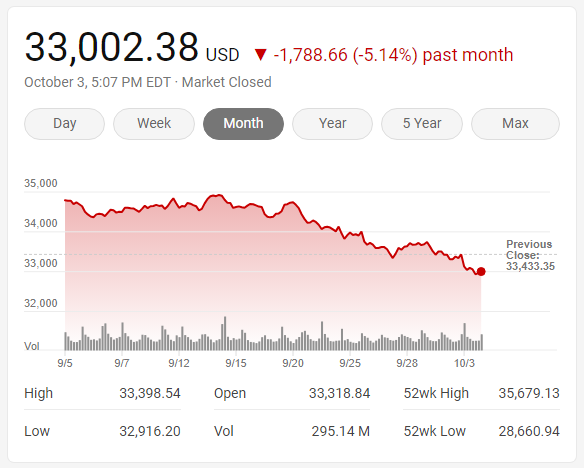
Dow Jones Industrial Average (Dow) performance on 3rd October 2023.
The Dow fell more than 400 points, turning negative for the year. The main reason for the drop was the surge in U.S. Treasury yields, which reached their highest levels in 16 years.
Higher yields mean higher borrowing costs for businesses and consumers, which could hurt the economic recovery and the housing market.
S&P 500 on 3rd October 2023
Nasdaq on 3rd October 2023
The tech-heavy Nasdaq Composite gained a 0.7% on October 3rd, 2023, as some investors saw an opportunity to buy some of the high-growth stocks that had been under pressure recently.
The stock market has been experiencing some volatility and uncertainty in September and October 2023, as investors fret about inflation, interest rates, and the possibility of a U.S. recession.
Main facts affecting the current stock market
The month of October has produced some severe stock market crashes over the past century, such as the Bank Panic of 1907, the Wall Street Crash of 1929, and Black Monday 1987.
October has also marked the start of several major long-term stock market rallies, such as Black Monday itself and the 2002 nadir of the Nasdaq-100 after the bursting of the dot-com bubble.
The S&P 500 dropped 4.5% in September 2023 and finished the third quarter in the red.
The U.S. Treasury yield curve has been inverted for months – which is a historically strong recession indicator.
The Fed maintained interest rates at the current target range of between 5.25% and 5.5% in September 2023, but signalled that it may need to raise rates again to combat inflation.
The consumer price index gained 3.7% year-over-year in August 2023, down from peak inflation levels of 9.1% in June 2022 but still well above the Fed’s 2% long-term target.
The bond market is currently pricing in an 81.7% chance the Fed will choose not to raise rates again on 1st November 2023.
The Dow Jones Industrial Average was down at 33002, Tuesday 3rd October 2023.
Stocks fell as investors pulled money from equities and moved it to the hot bond market.
International markets also faced significant turmoil, sending mini shockwaves through global financial centres, which reverberated in equities.
The dollar rose to the highest since December and is heading towards the twelfth positive week in a row.
Uncertainty
Uncertainty in the U.S. political system is having a major affect too. Especially with the ousting of the speaker and the real fear of a government shutdown looming large.
The U.S. Treasury yields are the interest rates that the U.S. government pays to borrow money. The 10-year and 30-year Treasury yields are the most widely followed indicators of the long-term health of the U.S. economy and the expectations of inflation and growth.
10 year yield at 4.80%
According to the latest data, the 10-year Treasury yield surged to 4.80% on Tuesday, 3rd October 2023, which is the highest level since 12th October 2007.
30 year yield at 4.79
The 30-year Treasury yield rose to 4.79% on Monday, 2nd October 2023, which is the highest since 6th April 2010.
The main reasons for the rise in the Treasury yields
The strong U.S. economic data that showed that the labour market remains hot and the manufacturing sector rebounded in September 2023.
The Federal Reserve’s ‘higher for longer’ mantra signalled that the central bank would keep raising rates until inflation is under control.
The reduced demand for safe-haven assets as the U.S. government averted a shutdown over the weekend by passing a short-term stopgap funding measure.
Uncertainty at the heart of the U.S. political system.
The implications of higher Treasury yields
The higher borrowing costs could weigh on the economic growth and consumer spending in the future.
Higher inflation expectations could erode the purchasing power of the fixed-income investors and increase the risk of a bond market sell-off.
The higher interest rate differential could attract more foreign capital inflows into the U.S. dollar and strengthen its value against other currencies.
It has been suggested Rishi Sunak and Boris Johnson have overseen biggest tax rises since the Second World War
‘Fiscal responsibility’ – code words for ‘cock-up!’
Chancellor Jeremy Hunt and Prime Minister Rishi Sunak have stressed the need for ‘fiscal responsibility’ amid still-high inflation and rising debt costs.
According to the Institute for Fiscal Studies (IFS), by the time of the next general election, taxes will likely have risen to around 37% of national income, which is the highest level since comparable records began in the 1950’s.
The IFS said that this is equivalent to around £3,500 more per household, but it will not be shared equally across income group.
Health and Welfare massive tax burden
The IFS also said that this is not a direct consequence of the pandemic, but rather a result of decisions to increase government spending on health and welfare, and some unwinding of austerity. They predicted that this parliament would mark a decisive and permanent shift to a higher-tax economy.
Other think tanks, such as the Nuffield Foundation, have echoed this view and said that there will be strong pressure in future parliaments to raise taxes further to meet growing demand for public services.
Dissatisfied
Some Conservative MPs have expressed their dissatisfaction with the lack of tax cuts from the government, as they believe that reducing taxes is a key part of the party’s philosophy. Chancellor Jeremy Hunt and Prime Minister Rishi Sunak have stressed the need for fiscal responsibility amid still-high inflation and rising debt costs.
Lurching from one problem to the next
We saw this type of response under George Osborne during the ‘austerity’ period after the financial crisis of 2008. And now again, after Brexit and the pandemic. They were all Conservative governments.
Hunt has reportedly said it would be virtually impossible to cut taxes at the moment – no surprise there then!
Labour has criticised the government for clobbering the general public with tax rises and failing to deliver growth and wages.
Luddites were a group of workers who protested against the use of machinery that threatened their livelihoods in the early 19th century in Britain. They were not opposed to technology in general, but to the specific machines that were ‘taking away their livelihoods’.
They attacked factories and smashed machines that were replacing their jobs with cheaper and less skilled labour.
BIG tech Luddite comparison – is AI the latest threat?
Some people have compared the Luddites to the modern movements that resist the effects of Big Tech and artificial intelligence (AI) on workers’ lives. They argue that these technologies are creating a new wave of automation that is displacing workers, eroding their rights, and increasing inequality.
They also point out that the Luddites had the support of a majority of English people and eventually led to changes in the law that improved workers’ conditions.
Progress?
However, others have criticized this comparison as inaccurate or misleading. They claim that the Luddites were not successful in stopping technological progress, and that their actions were violent and destructive.
Technology will create new jobs
They also suggest that the Luddite fallacy, which refers to the belief that technological progress causes mass unemployment, has been proven wrong by history. They contend that technology can create new opportunities and benefits for workers, as long as society adapts and regulates it properly.
The question of whether a new modern Luddite rebellion can rise against Big Tech is not a simple one. It depends on how we define Luddites, how we evaluate the impacts of technology, and how we respond to the challenges and opportunities it presents.
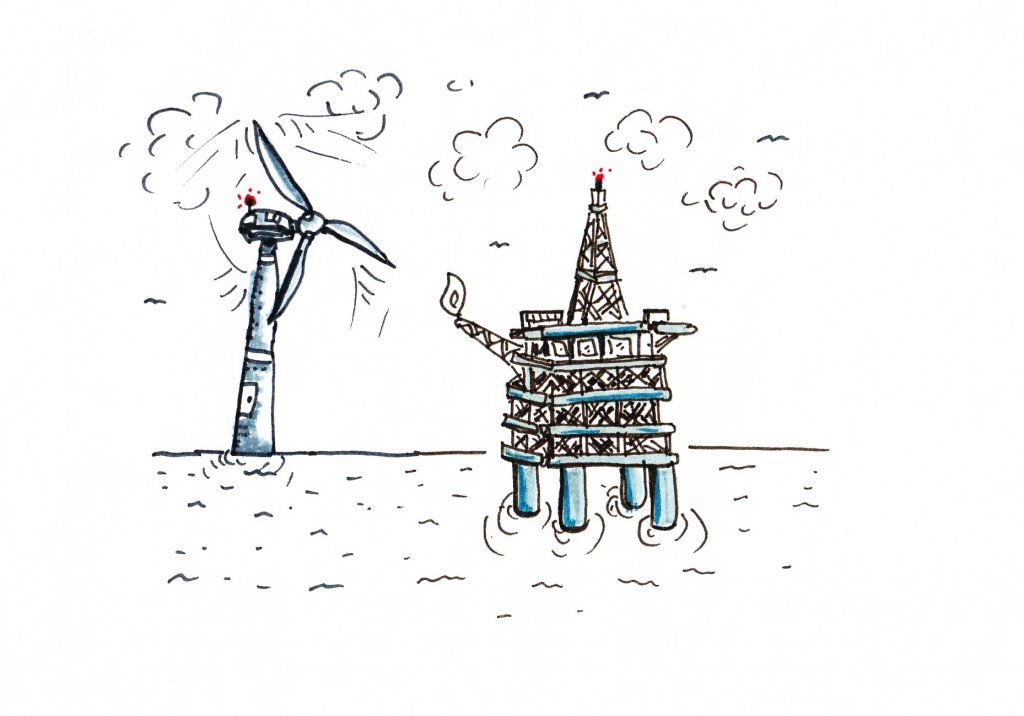
The Rosebank oil and gas field is a controversial project that has been approved by the UK government despite the concerns of environmental activists and some politicians.
It is located about 80 miles west of Shetland in the North Sea and is estimated to contain 500 million barrels of oil. It is operated by Equinor, a Norwegian state-owned energy company, with its partners Ithaca Energy and Suncor Energy. The development of the field is expected to cost £6 billion and create 2,000 jobs.
Carbon conflict
It is also expected to produce 200 million tonnes of carbon dioxide over its lifetime, which is equivalent to the annual emissions of 40 million cars.
The approval of the Rosebank field has sparked a debate over the role of fossil fuels in the UK’s energy transition and its commitment to net zero emissions by 2050. Critics argue that the project is incompatible with the UK’s climate goals and that it will undermine its credibility. They also claim that most of the cost of the development will be borne by the taxpayers through tax reliefs and subsidies.
UK not yet ready to turn off the oil and gas
However, some supporters of the project contend that it will provide a reliable source of energy and revenue for the UK, as well as support thousands of jobs in the oil and gas sector. They also point out that the UK still relies on fossil fuels for most of its energy needs and that it will need to import more oil and gas from abroad if it does not develop its own resources.
‘Didn’t expect to see you here again, thought you’d retired’. ‘Yeah, me too!’
They argue that the Rosebank field will be developed with high environmental standards and that it will contribute to the UK’s transition to a low-carbon economy by investing in renewable energy and carbon capture technologies.
Contentious
The Rosebank oil and gas field is a complex and contentious issue that reflects the challenges and trade-offs involved in balancing economic growth, energy security, and environmental protection. It is likely to remain a topic of heated discussion.
The field is expected to start producing oil from 2026
If drilling starts on time, Rosebank could account for 8% of the UK’s total oil production between 2026 and 2030.
Roughly 245 million barrels will be produced in the first five years of drilling, with the remaining being extracted between 2032 and 2051.
Though oil is the main product, the site will also produce gas.
About 1,600 jobs are expected to be created during the peak of construction. Long term, the operation will create 450 jobs.
Will it mean lower energy bills in the UK?
No! Oil and gas from UK waters is not necessarily used here – it is sold to the highest bidder on global markets.
What Rosebank produces will be sold at world market prices, so the project will not cut energy prices for UK consumers.
The Norwegian state oil company Equinor – which is the majority owner of Rosebank – has confirmed this.
Oil also tends to be sent around the world to be refined – the UK does not have the capacity to refine all its own oil-based products.
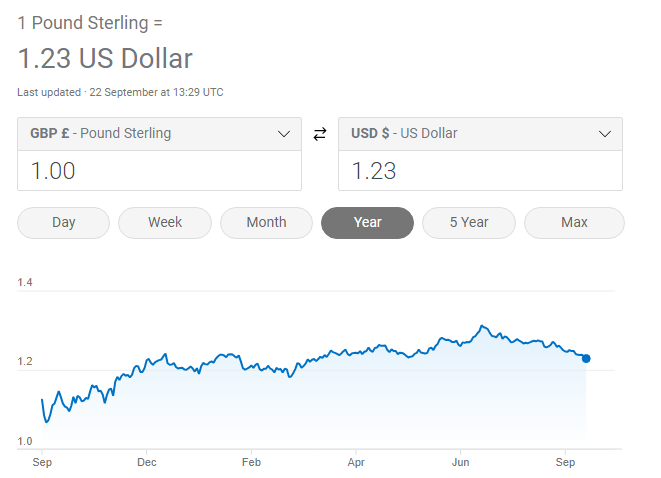
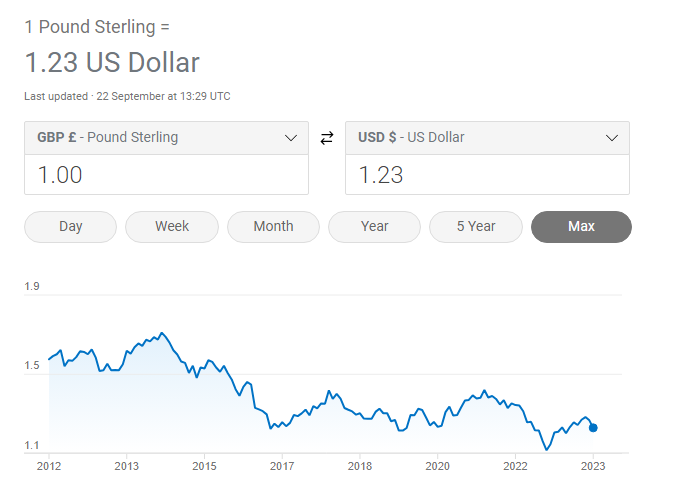
According to the latest data, 1.00 GBP is equal to 1.22 USD
This means that one British pound can buy 1.22 U.S. dollars at the current market rate. The exchange rate fluctuates depending on various factors such as supply and demand, interest rates, inflation, trade balance, and political stability.
Weak against U.S. dollar
The British pound has been weakening against the U.S. dollar since the Brexit referendum in 2016, when the UK voted to leave the European Union. The uncertainty and instability caused by the Brexit process have reduced the confidence and attractiveness of the British currency in the global market. The U.S. dollar, on the other hand, has been strengthening due to its status as a safe haven and a reserve currency in times of crisis.
In September 2022 the pound fell to its lowest level against the U.S. dollar
Excessive government spending and tax cuts that undermined confidence in the UK economy.
Price caps and record high inflation that eroded the purchasing power of the pound.
The strength of the dollar as a safe haven currency amid global uncertainty.
The prospect of a new Scottish independence referendum that increased political risk.
The impact of the Covid pandemic and the Russia-Ukraine conflict on supply chains and trade.
Artwork of GBP
UK pound closes in on a six month low
September 2022
The pound reached $1.0327 at one point in late September 2022, its lowest since Britain went decimal in 1971. It also fell more than 1% against the euro to about 86.80p, its lowest level since May 2020.
Today, 22nd Septmber 2023
The current exchange rate of 1.22 USD per GBP is near the lowest point in the last 30 and 90 days, which was 1.2383 USD per GBP.
The highest point in the same period was 1.3128 USD per GBP. The average exchange rate in the last 30 days was 1.2563 USD per GBP, and in the last 90 days was 1.2721 USD per GB pound.
‘Have you noticed everytime the government needs to persuade the public that their ‘message’ is so super important – they roll out the magic message lectern”.
Introducing the UK magic message government lectern
Other important messages
And this…
And this one…
The latest government slogan… ‘LONG-TERM DECISIONS FOR A BRIGHTER FUTURE’
Let’s roll out the advertisements to persuade the UK public the government knows best… again.
They convinced me!
Not!
It’s a joke!
The UK government is trying to peruade the public that the recent Sunak climate rollback decision is a good thing… ‘LONG-TERM DECISIONS FOR A BRIGHTER FUTURE’
TikTok is a popular social media app that allows users to create and share short videos. But, it has faced some controversies regarding its algorithm, design, and data protection.
Tiktok has issues
The company was fined $368 million in Europe for failing to protect children’s data. The Irish Data Protection Commission, which oversees TikTok’s activities in the European Union, said that the company had violated the bloc’s signature privacy law.
An investigation by the DPC found that in the latter half of 2020, TikTok’s default settings didn’t do enough to protect children’s accounts.
Anti-social app
TikTok drove online ultra online ‘frenzies’ that encouraged anti-social behaviour to spill over into the real world, a BBC Three investigation revealed.
Ex-employees said that the issue was not being tackled for fear of slowing the growth of the app’s business. These ‘frenzies’ were evidenced by interviews with former staffers, app users and BBC analysis of wider social media data. They included false murder accusations, interference in police investigations, school vandalism, and riots.
TikTok’s algorithm is reportedly failing to provide a safe and positive experience for its users and for society
Anti-social algorithm
The algorithm and design means people are seeing videos which they wouldn’t normally be recommended – which, in turn, incentivise them to do unusual things in their own videos on the platform.
Former employees likened these frenzies to ‘wildfires’ and described them as ‘dangerous’, especially as the app’s audience can be young and impressionable.
UK interest rates have been left unchanged at 5.25% by the Bank of England (BoE).
The decision comes a day after figures revealed an unexpected slowdown in UK nflation in August 2023.
The Bank had previously raised rates some14 times in a row to tackle inflation, leading to increases in mortgage payments, business loans and consumer borrowing. But it also delivered higher savings rates.
The maker of weight-loss drug ‘Wegovy’ has become Europe’s most valuable company, dethroning the French luxury conglomerate LVMH.
Is there an irony here…? Exploitation of the obese, or a genuine attempt to help? It is used in the fight against diabetes too.
It’s a business after all
Wegovy is a brand name for ‘Semaglutide‘, a prescription medicine used for weight loss in obese or overweight adults with other weight-related medical issues. It works by regulating appetite and reducing calorie intake, leading to weight loss and helping with weight management.
Wegovy was launched in the UK on 4th September 2023 and is available on the NHS as an ‘option‘ for weight management in line with NICE guidance, alongside a reduced-calorie diet and increased physical activity. However, only people with the highest medical need may qualify for the drug, as it is in short supply and its use will be restricted – but celebrities have direct access – do they have the ‘highest medical needs’? Of course they do.
Clinical trials
Wegovy has been shown to be effective in clinical trials, achieving up to a 15% reduction in body weight after one year. It has also been found to reduce the risk of a heart attack or stroke in obese people with cardiovascular disease by 20%.
To get Wegovy on the NHS, eligible adults would need a referral to an NHS specialist weight management service, which would usually be made by a GP. Alternatively, Wegovy can be obtained privately, but it may be expensive and not covered by insurance.
Watercolour image of a generic medicine bottle. Wegovy is a brand name for ‘Semaglutide‘, a prescription medicine used for weight loss in obese or overweight adults with other weight-related medical issues.
Shares rose after the Danish pharmaceutical giant, Novo Nordisk, launched the popular drug in the UK.
At the close of trading on Monday, 4th September 2023, the company had a stock market valuation of $428bn (£339bn).
The drug is now available on the National Health Service in the UK and also via private outlets.
Obesity treatment
Wegovy is an obesity treatment that is taken once a week which tricks people into thinking that they are already full, so they end up eating less and losing weight.
Famous personalities such as Elon Musk are among the reported users of the drug, which has gained traction in Hollywood and with the public more widely since it was approved by regulators in the US in 2021.
Wegovy and Ozempic – a diabetes treatment with similar effects – have been described as ‘miracle’ drugs. Would that be a ‘miracle for the user or for the pharmaceutical company – or both perhaps?
Experts warn the drug is not a quick fix nor a ‘substitute for a healthy diet and exercise’.
In trials, users often put weight back on after stopping treatment.
‘Supply restriction as production ramps up’
There has been a global shortage of the drug, so only limited is awailable for the NHS in the UK.
The company said it will continue to restrict global supplies as it works to ramp up manufacturing.
While the findings still have to be fully reviewed, experts agreed the results were potentially significant.
The Federal Reserve held interest rates steady in a decision released Wednesday 20th September 2023, while also indicating it still expects one more hike before the end of the year and fewer cuts than previously indicated next year.
That final increase, if realised, would be it for now according to data released at the end of the Fed two-day meeting. If the Fed goes ahead with the move, it would be the twelfth rate hike since policy tightening began in March 2022.
No change priced in
Markets had fully priced in no move at this meeting, which kept the fed funds rate targeted in a range between 5.25%-5.5%, the highest in some 22 years. The rate fixes what banks charge each other for overnight lending but also affects many other forms of consumer debt too.
While the no-hike was expected, there was plenty of uncertainty over where the rate-setting Federal Open Market Committee (FOMC), would go from here.
Judging from reports released Wednesday 20th September 2023, the bias appears towards more restrictive policy and a higher-for-longer approach to interest rates.
Water stress measures the amount of available supply a country uses to meet demand, and is expected to worsen as the climate warms.
A quarter of the world’s population is currently exposed to extremely high annual water stress, according to new data from the World Resources Institute (WRI).
New data from WRI’s Aqueduct Water Risk Atlas show that 25 countries – housing one-quarter of the global population – face extremely high water stress each year, regularly using up almost their entire available water supply. And at least 50% of the world’s population – around 4 billion people – live under highly water-stressed conditions for at least one month of the year.
Living with this level of water stress jeopardizes people’s lives, jobs, food and energy security. Water is central to growing crops and raising livestock, producing electricity, maintaining human health, fostering equitable societies and meeting the world’s climate goals.
Without better water management, population growth, economic development and climate change are poised to worsen water stress.
What’s Causing Global Water Stress?
Across the world, demand for water is exceeding what’s available. Globally, demand has more than doubled since 1960.
25 Countries, Housing One-quarter of the World’s Population, Face Extremely High Water Stress
Increased water demand is often the result of growing populations and industries like irrigated agriculture, livestock, energy production and manufacturing. Meanwhile, lack of investment in water infrastructure, unsustainable water use policies or increased variability due to climate change can all affect the available water supply.
Water stress, the ratio of water demand to renewable supply, measures the competition over local water resources.
The smaller the gap between supply and demand, the more vulnerable a place is to water shortages. A country facing ‘extreme water stress’ means it is using at least 80% of its available supply, ‘high water stress’ means it is withdrawing 40% of its supply.
Without intervention – such as investment in water infrastructure and better water governance – water stress will continue to get worse, particularly in places with rapidly growing populations and economies.
Which Countries Face the Worst Water Stress?
The data shows that 25 countries are currently exposed to extremely high water stress annually, meaning they use over 80% of their renewable water supply for irrigation, livestock, industry and domestic needs. Even a short-term drought puts these places in danger of running out of water and sometimes prompts governments to shut off the taps. We’ve already seen this scenario play out in many places around the world, such as India, Iran, Mexico, South Africa, and even in England.
The five most water-stressed countries are Bahrain, Cyprus, Kuwait, Lebanon, Oman and Qatar. The water stress in these countries is mostly driven by low supply, paired with demand from domestic, agricultural and industrial use.
The most water-stressed regions are the Middle East and North Africa, where 83% of the population is exposed to extremely high water stress, and South Asia, where 74% is exposed.
The 25 counties currently experiencing extreme water stress annually.
1. Bahrain
2. Cyprus
3. Kuwait
4. Lebanon
5. Oman
6. Qatar
7. United Arab Emirates
8. Saudi Arabia
9. Israel
10. Egypt
11. Libya
12. Yemen
13. Botswana
14. Iran
15. Jordan
16. Chile
17. San Marino
18. Belgium
19. Greece
20. Tunisia
21. Namibia
22. South Africa
23. Iraq
24. India
25. Syria
Water Demand Is Exploding in Africa but Plateauing in Wealthier Nations
The biggest change in water demand between now and 2050 is expected to occur in Sub-Saharan Africa. While most countries in Sub-Saharan Africa are not extremely water-stressed right now, demand is growing faster there than any other region in the world. By 2050, water demand in Sub-Saharan Africa is expected to skyrocket by 163% – 4 times the rate of change compared to Latin America, the second-highest region, which is expected to see a 43% increase in water demand.
Demand has plateaued in wealthier countries in North America and Europe. Investment in water-use efficiency has helped reduce in-country water use in high income countries, but water use and dependencies extend beyond national boundaries, and the water embedded in international trade from lower-middle income countries to high income countries will increasingly contribute to rising water stress in low and lower-middle income countries.
Water Stress Could Disrupt Economies and Agricultural Production
Increasing water stress threatens countries’ economic growth as well as the world’s food security.
According to data from Aqueduct, 31% of global GDP – a whopping $70 trillion – will be exposed to high water stress by 2050, up from $15 trillion (24% of global GDP) in 2010. Just four countries – India, Mexico, Egypt and Turkey – account for over half of the exposed GDP in 2050.
According to data from Aqueduct, 31% of global GDP – a whopping $70 trillion – will be exposed to high water stress by 2050
Energy, industrial and agricultural production issues
Water shortages can lead to industrial interruptions, energy outages and agricultural production losses – like those already being seen in India, where a lack of water to cool thermal powerplants between 2017 and 2021 resulted in 8.2 terawatt-hours in lost energy – or enough electricity to power 1.5 million Indian households for five years. Failing to implement better water management policies could result in GDP losses in India, China and Central Asia of 7% to 12%, and 6% in much of Africa by 2050 according to the Global Commission on Adaptation.
Global food security is also at risk. Already, 60% of the world’s irrigated agriculture faces extremely high water stress – particularly sugarcane, wheat, rice and maize. Yet to feed a projected 10 billion people by 2050, the world will need to produce 56% more food calories than it did in 2010 – all while dealing with increasing water stress as well as climate-driven disasters like droughts and floods.
Better Management for a Water-secure Future
It’s good to understand the state of the world’s water supply and demand, but water stress doesn’t necessarily lead to water crisis. For example, places like Singapore and the U.S. city of Las Vegas prove that societies can thrive even under the most water-scarce conditions by employing techniques like removing water-thirsty grass, desalination, and wastewater treatment and reuse.
Solution is NOT expensive
In fact, WRI research shows that solving global water challenges is cheaper than you might think, costing the world about 1% of GDP, or 29 cents per person, per day from 2015 to 2030. What’s missing is the political will and financial backing to make these cost-effective solutions a reality.
If this cost conclusion is accurate – why aren’t we doing it?