The UK energy price cap is expected to rise by 5% in January 2024, which means that a typical household who pays by Direct Debit will face an annual bill of £1,931, up from £1,834 in the previous quarter.
This increase comes at a “difficult period” for struggling households, as many are already facing higher costs of living due to the pandemic, Brexit, and inflation.
Designed to protect customers
The energy price cap is designed to protect customers from unfair price hikes and ensure that they pay a fair price for their energy. However, it does not limit the total bill, which depends on how much energy is actually used.
Therefore, customers are advised to shop around for better deals and switch to cheaper tariffs if possible. This, however, is easier said than done.
It is also recommended that struggling customers contact suppliers if they have difficulty paying their bills and seek help from schemes, grants, and benefits.
The UK energy price cap is a limit on the maximum amount that energy suppliers can charge customers on standard or default tariffs for each unit of gas and electricity they use. It is set by Ofgem, the energy regulator, every three months based on the underlying costs of energy and inflation.
Some of the main takeaways from the chancellor’s autumn statement November 2023
National Insurance rate cut from 12% to 10% from 6 January, affecting 27 million people.
The 75% business rates discount for retail, hospitality and leisure firms in England extended for another year.
Class 2 National Insurance – paid by self-employed people earning more than £12,570 – abolished from April.
Class 4 National Insurance for self-employed – paid on profits between £12,570 and £50,270 – cut from 9% to 8% from April.
Full tax break permitting companies to deduct spending on new machinery and equipment from profits – now made permanent.
Funding of £4.5bn to attract investment to strategic manufacturing sectors, including aerospace, green energy, aerospace, life sciences and zero-emission vehicles.
Some £500m over the next two years to fund artificial intelligence (AI) innovation centres.
New premium planning services for England, with faster decision times for major business applications and fee refunds when these are not met.
Defence spending to remain at 2% of national income – a Nato commitment.
Overseas aid spending kept at 0.5% of national income, below the official 0.7% target.
Reaffirms previous commitments made last autumn to provide £14.1bn for the NHS and adult social care in England, as well as an extra £2bn for schools, in both 2023‑24 and 2024-25.
Fuel duty remains 52.95p per litre for petrol and diesel, after the chancellor announced a 5p per litre cut for 12 months in March 2023
State pension payments to increase by 8.5% from April, in line with average earnings.
Claimants in England and Wales deemed able to work who refuse to seek employment to lose access to their benefits and extras like free prescriptions.
UK autumn statement – art illustration of office worker preparing data
Further £1.3bn to help people who have been unemployed for over a year.
National Living Wage – to increase from £10.42 to £11.44 an hour from April.
Funding of £1.3bn over the next five years to help people with health conditions find jobs.
OBR Stats
Independent Office for Budget Responsibility (OBR) expects the economy to grow by 0.6% this year and 0.7% next year, rising to 1.4% in 2025; then 1.9% in 2026; 2% in 2027 and 1.7% in 2028.
Living standards not expected to return to pre-pandemic levels until 2027-28.
Underlying debt forecast to be 91.6% of GDP next year; 92.7% in 2024-25; 93.2% in 2026-27; before declining to 92.8% in 2028-29.(One to watch)
OBR forecasts that inflation – the rate prices are rising – will fall to 2.8% by the end of 2024, before reaching the Bank of England’s 2% target rate in 2025.(One to watch)
The OBR says higher inflation means real value of departmental budgets will be £19bn lower by 2027/28 compared with March 2023 forecasts.
Borrowing forecast to fall from 4.5% of GDP in 2023-24; to 3% in 2024-25; 2.7% in 2025-26; 2.3% in 2026-27; 1.6% in 2027-28 and 1.1% in 2028-29.(One to watch)
Federal Reserve members, in their most recent meeting, gave little indication of cutting interest rates anytime soon, particularly as inflation remains well above their goal of 2%, according to minutes released Tuesday 21st November 2023.
The detail of the meeting held 31st October – 1st November 2023, showed that Federal Open Market Committee (FOMC) members are still concerned that inflation could be stubborn or move higher, and that more may need to be done.
They indicated that policy would need to stay ‘restrictive’ at the very least, inflation is on a convincing move back to the central bank’s 2% goal.
Stan Lee was an American comic book writer, editor, publisher, and producer. He rose through the ranks of a family-run business called Timely Comics which would later become Marvel Comics.
Art illustration of a comic book page.‘With great power there must also come great responsibility!’
Tech execs have expressed concern that the development of artificial intelligence (AI) is concentrated in the hands of too few companies, potentially giving them too much power. OpenAI’s ChatGPT marked the start of what many in the industry have called an AI arms race, as tech giants including Microsoft and Google have sought to develop and launch AI models.
A number of tech execs have said that they feel users have lost control of their data online and that it is being harnessed by technology giants to feed their profits.
The development of artificial intelligence (AI) is concentrated in the hands of too few companies, potentially giving them excessive control over the rapidly evolving technology.
OpenAI’s ChatGPT
An explosion of interest in AI was sparked by OpenAI’s ChatGPT late last year thanks to the novel way in which the chatbot can answer user prompts. Its popularity contributed to the start of what many in the tech industry have called an AI arms race, as tech giants including Microsoft and Google seek to develop and launch their own artificial intelligence models. These require huge amounts of computing power as they are trained on massive amounts of data.
Meredith Whittaker reportedly said of large tech companies and the current deployment of AI…
‘Right now, there are only a handful of companies with the resources needed to create these large-scale AI models and deploy them at scale. And we need to recognize that this is giving them inordinate power over our lives and institutions’,Meredith Whittaker, president of encrypted messaging app Signal, is reported to have said. ‘We should really be concerned about, again, a handful of corporations driven by profit and shareholder returns making such socially consequential decisions’.
Whittaker previously spent 13 years at Google but became disillusioned in 2017 when she found out the search giant was working on a controversial contract with the Department of Defence known as Project Maven. Whittaker grew concerned Google’s AI could potentially be used for drone warfare and helped organize a walkout at the company that involved thousands of employees.
‘AI, as we understand it today, is fundamentally a technology that is derivative of centralized corporate power and control’, Whittaker reportedly said. ‘It is built on the concentrated resources that accrued to a handful of large tech corporations, largely based in the U.S. and China via the surveillance advertising business model, which gave them powerful computational infrastructure and huge amounts of data; large markets from which to pull that data; and the ability to process and structure that data in ways useful for creating new technologies.’
In essence, BIG TECH has far too much power in AI technology.
Tim Berners-Lee
The inventor of the web, Tim Berners-Lee, has also raised concerns about the concentration of power among the tech giants. Jimmy Wales, the founder of Wikipedia, says it is the state of social media that is of particular concern right now. On AI, however, he feels that while the technology giants now are leading the way, there is space for disruption.
Big tech and social media giants are inflicting profound damage on our society, and he believes AI could make this worse.
Binance is still open for business and is now being run by, Richard Teng. But who is the new boss of Binance?
Mr Teng, from Singapore joined Binance just over two years ago as the chief executive of the Singapore business. That was the year when Binance came under a Justice Department investigation, and as regulatory scrutiny of the company and Zhao intensified. Richard Teng was rapidly climbing the ranks in the background.
He only stayed in his original position as the Singapore CEO for five months, according to his LinkedIn page, before he was promoted to regional head of Europe, Asia and the Middle East and North Africa in April 2023.
Mr Teng later moved to become head of regional markets in May 2023 before he was appointed to the top job on Tuesday 21st November 2023.
In announcing his successor, Mr Zhao called Mr Teng a ‘highly qualified leader‘, adding that ‘with over three decades of financial services and regulatory experience, he will navigate the company through its next period of growth’.
Traditional financial background
Prior to joining Binance, Mr Teng worked in the more traditional financial sectors as a director of corporate finance at the Monetary Authority of Singapore (MAS) and a chief regulatory officer of the Singapore Exchange (SGX). He then moved on to the become chief executive of the Abu Dhabi Global Market (ADGM), an international financial centre in the United Arab Emirates, where he stayed for six years. The ADGM regulates the trading of digital assets.
In a statement on Wednesday 22nd November 2023, Mr Teng said he was honoured to take this position, adding that he would focus on reassuring Binance’s 150 million users about ‘the financial strength, security and safety of the company’.
Despite this, Mr Teng has reiterated that Binance is ‘here to stay‘, adding that company’s foundation stands ‘stronger than ever’.
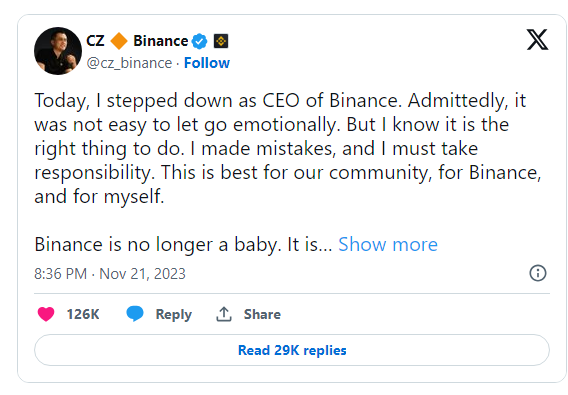
Binance chief Changpeng Zhao pleaded guilty Tuesday to criminal charges and stepped down as the company’s CEO as part of a $4.3 billion settlement with the Department of Justice, according to court documents.
The plea arrangement with the U.S. government resolves an investigation into the world’s largest cryptocurrency exchange.
Zhao said Tuesday in a post on X, that he had ‘made mistakes’ and ‘must take responsibility’. He said Richard Teng, the company’s former global head of regional markets, is the new CEO of Binance.
Action taken against Binance
The action against Binance and its founder was a joint effort by the Department of Justice, the Commodity Futures Trading Commission and the Treasury Department. The Securities and Exchange Commission (SEC) was absent.
Treasury Secretary Janet Yellen reportedly said in a release Tuesday 21st November 2023 that the cryptocurrency exchange permitted ‘illicit actors’ to make transactions that supported activities such as terrorism and illegal narcotics and that it allowed more than 1.5 million virtual currency trades that violated U.S. sanctions.
Plea deal
Zhao personally pleaded guilty to violating and causing a financial institution to violate the Bank Secrecy Act, according to the plea agreement. The DOJ is also recommending that the court impose a $50 million fine on Zhao.
Zhao has been released on a $175 million bond secured by $15 million in cash and has a sentencing hearing scheduled for 23rd February 2024.
Continue to operate
Binance will continue to operate but with new strict rules. The company will be required to maintain and enhance its compliance program to ensure its business is in line with U.S. anti-money-laundering standards. The company is required to appoint an independent compliance monitor.
The case against Binance shows that three criminal charges were brought against the exchange, including conducting an unlicensed money-transmitting business, violating the International Emergency Economic Powers Act, and conspiracy. Binance has agreed to forfeit $2.5 billion to the U.S. government, as well as to pay a fine of $1.8 billion.
SEC takes aim too
The SEC targeted the company with a lawsuit in June 2023, alleging that Binance was running an illegal securities exchange and mishandling customer funds.
The SEC also challenged rival crypto exchange Coinbase with a similar lawsuit, alleging it is operating as an unauthorized securities exchange, broker and clearing agency.
And on Monday 20th November 2023 the SEC sued Kraken, alleging that the exchange commingled $33 billion in customer crypto assets with its own company assets, creating the potential for a significant risk of loss to its users.
Binance battered as CEO Changpeng Zhao (CZ) pleads guilty to federal charges, steps down.
In the charges brought against Binance by the SEC, the agency accused Binance of ‘commingling’ billions of dollars in customer money with Binance’s own funds, similar to allegations made against the now bankrupt and disgraced crypto exchange FTX. The founder of FTX, Sam Bankman-Fried was convicted of fraud and now awaits sentencing.
EC Chair, Gary Gensler reportedly said, ‘Zhao and Binance entities engaged in an extensive web of deception, conflicts of interest, lack of disclosure, and calculated evasion of the law’.
Binance origin
Started by the Chinese-born entrepreneur in 2017, Binance went from being a relatively obscure name to being a major force in crypto in a matter of weeks. Binance remains the world’s largest crypto exchange globally, processing billions of dollars in trades every year.
While its holding company is based in the Cayman Islands, Binance doesn’t have a global headquarters and Zhao frequently resisted calls to create one, saying he wanted the platform to run on a ‘decentralized’ operating model.
UK ban
In 2021, the U.K.’s Financial Conduct Authority (FCA) barred Binance’s U.K. unit from operating in the country, saying it wasn’t authorized to carry out regulated activities. More recently, Binance scrapped plans to pursue a full U.K. license after the regulator said its ‘know-your-customer and anti-money-laundering’ controls didn’t meet its requirements.
Binance and Zhao filed a motion in July 2023 to dismiss the CFTC’s suit. The U.S. arm of the exchange is also pushing back on the SEC’s lawsuit, filing a protective order against what they call the SEC’s ‘fishing expedition’.
Crypto industry concern
Of particular concern for the crypto industry are the implications of the crypto crackdown for a myriad of altcoins or tokens and blockchains, not just the exchanges.
The SEC maintains that several of the tokens Binance and Coinbase offer on their platforms such as: Solana’s SOL, Cardano’s ADA , and Polygon’s MATIC are all securities that should have been registered.
Nvidia’s revenue grew 206% from year 2022 during the quarter ending 29th October 2023, according to data from Nvidia.
Net income, at $9.24 billion, or $3.71 per share, was up from $680 million, in the same quarter of 2022.
The company’s data centre revenue came in at: $14.51 billion, up a massive 279% and above consensus of $12.97 billion. Half of the data centre revenue came from cloud infrastructure providers such as Amazon, and the other from consumer internet and large companies, Nvidia said. Healthy uptake also came from clouds that specialized in renting out GPUs to clients.
Earnings: $4.02 per share, adjusted, vs. $3.37 per share expected
Revenue: $18.12 billion, vs. $16.18 billion expected
The gaming segment contributed $2.86 billion, up 81% and higher than the $2.68 billion general consensus. Nvidia’s future guidance suggested $20 billion in revenue for Q4, implying a nearly 231% revenue growth.
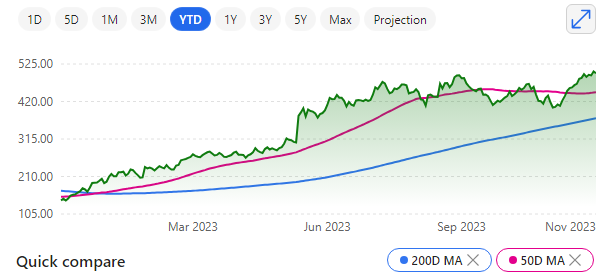
Year on year Nvidia share price movement.
Year on year Nvidia share price movement – Nov 2022 – Nov 2023
During the quarter, Nvidia announced the GH200 GPU, which has more memory than the current H100 and an additional Arm processor onboard. The H100 is expensive and in demand. Nvidia said Australia-based Iris Energy, an owner of bitcoin mining data centers, was buying 248 H100s for $10 million, which works out around $40,000 each.
Nvidia share price moved down 1% in after-hours trading on Tuesday 21st November 2023 after the reporting fiscal Q3 results that surpassed predictions. But the company called for a negative impact in the next quarter because of export restrictions affecting sales to organizations in China and other countries.
‘We expect that our sales to these destinations decline significantly in the Q4 2024, though we believe the decline will be more than offset by strong growth in other regions’, Nvidia reported.
At the speed of AI, the story at OpenAI moves at lightning speed.
Hundreds of OpenAI employees signed a letter demanding the OpenAI board resign or face an employee exodus to Sam Altman’s new venture at Microsoft ‘imminently‘.
The board then attempted to negotiate Altman’s return, but those talks were unsuccessful.
At the touch of a button – resignation letter sent to the OpenAI board of directors
To the Board of Directors at OpenAI
OpenAI is the world’s leading AI company. We, the employees of OpenAI, have developed the best models and pushed the field to new frontiers. Our work on AI safety and governance shapes global norms. The products we built are used by millions of people around the world. Until now, the company we work for and cherish has never been in a stronger position.
The process through which you terminated Sam Altman and removed Greg Brockman from the board has jeopardized all of this work and undermined our mission and company. Your conduct has made it clear you did not have the competence to oversee OpenAI.
When we all unexpectedly learned of your decision, the leadership team of OpenAI acted swiftly to stabilize the company. They carefully listened to your concerns and tried to cooperate with you on all grounds. Despite many requests for specific facts for your allegations, you have never provided any written evidence. They also increasingly realized you were not capable of carrying out your duties, and were negotiating in bad faith.
The leadership team suggested that the most stabilizing path forward – the one that would best serve our mission, company, stakeholders, employees and the public – would be for you to resign and put in place a qualified board that could lead the company forward in stability. Leadership worked with you around the clock to find a mutually agreeable outcome. Yet within two days of your initial decision, you again replaced interim CEO Mira Murati against the best interests of the company. You also informed the leadership team that allowing the company to be destroyed “would be consistent with the mission.”
Your actions have made it obvious that you are incapable of overseeing OpenAI. We are unable to work for or with people that lack competence, judgement and care for our mission and employees. We, the undersigned, may choose to resign from OpenAI and join the newly announced Microsoft subsidiary run by Sam Altman and Greg Brockman. Microsoft has assured us that there are positions for all OpenAI employees at this new subsidiary should we choose to join. We will take this step imminently, unless all current board members resign, and the board appoints two new lead independent directors, such as Bret Taylor and Will Hurd, and reinstates Sam Altman and Greg Brockman.”
In just 5 days
Sam Altman sacked from OpenAI.
Altman appears to move to Microsoft.
OpenAI staff revolt.
No confidence in OpenAI board.
Space for staff to move to Microsoft and create new AI company under Altman’s leadership.
OpenAI mass employee resignation letter emerges.
Microsoft CEO Nadella says OpenAI governance needs to change no matter where Altman ends up.
Altman back at OpenAI after board changes.
Now, Altman is back after getting the sack.
So, is all OK at OpenAI? I asked CHATGPT the question, here is the answer…
Nvidia stock closes at all-time high, a day before earnings
Shares of Nvidia closed up 2.3% at an all-time high of $504 on Monday 20th November 2023. The record comes ahead of the company’s Q3 results due Tuesday 21st November 2023, when analysts are expecting to see revenue growth of over 170%.
And, if that’s not enough, the forecast for Q4, according to some analysts, is likely to show a number close to 200% growth.
Nvidia is still by far the market leader in GPUs for AI, but high prices and competition are fast becoming an issue.
Can Nvidia continue the AI ride and hold this remarkable market share position?
Party politics and petty petulance – toys out the pram again at No. 10
Welcome politics at No. 10 Downing street
The phrase ‘throwing your toys out of the pram’ is a British idiom that means to behave in a childish or immature way when you are angry or frustrated. It is usually used to criticize someone who is acting unreasonably or making a fuss over something trivial.
Right now, it sums up everyday behaviour at No. 10 Downing Street.
Sam Altman, the former CEO of OpenAI, who was fired last week in a controversial board decision.
According to the latest reports, Altman is joining Microsoft to lead a new AI research team that will focus on advanced and ethical AI development.
Altman is a well-known entrepreneur and investor who has been involved in several AI-related projects.
He was one of the co-founders of OpenAI, a research organization that aims to create artificial general intelligence (AGI) that can ‘benefit humanity without causing harm’ or being controlled by a few elite players.
Leadership and ideology clash
However, Altman’s vision and style clashed with some of the board members and researchers at OpenAI, who reportedly accused him of being too ambitious, secretive, and authoritarian. They also reportedly claimed that he was pursuing a dangerous goal of creating artificial superintelligence (ASI).
The disagreements escalated when Altman announced a partnership with Microsoft in 2023, which gave Microsoft exclusive access to OpenAI’s GPT-4 Turbo model, a powerful natural language processing system that can generate realistic text on any given topic.
Some of the OpenAI staff and community members reportedly felt let-down by this deal, which they saw as a violation of OpenAI’s original mission of creating and sharing ‘AI for the common good’.
On Friday 17th November 2023, the board of OpenAI voted to remove Altman as CEO, citing irreconcilable differences and lack of trust. He was replaced by Emmett Shear, the former CEO of Twitch, who promised to restore transparency and collaboration at OpenAI.
Altman to join Microsoft
Altman did not comment on his dismissal. However, on Monday 20th November 2023, he rocked the AI world by announcing he was joining Microsoft as the head of a new AI research team.
He reportedly said that he was excited to work with Microsoft’s talented people and that he would continue to pursue his vision of creating beneficial and ethical AI for humanity.
Altman’s move to Microsoft has sparked mixed opinions from the AI community. Some have praised him for his innovation and courage, others have criticized him for his arrogance and recklessness.
There were reports over weekend suggesting employees and investors including Microsoft were pushing for Mr Altman to be reinstated. Some employees resigned in support of Altman.
Some have expressed concern about the potential impact of his new role on the future of AI development and regulation.
Where do OpenAI, Microsoft and the AI go from here?
It was reported Friday 17th November 2023 by the city-state’s central bank that Singapore will be piloting the live issuance and use of wholesale central bank digital currencies in 2024.
During the pilot, the Monetary Authority of Singapore, (MAS) will partner with local banks to pilot the use of wholesale CBDCs to facilitate domestic payments.
What is a CBDC?
A CBDC is a digital form of a country’s fiat currency, issued and regulated by the central bank or monetary authority of that country. CBDCs are different from cryptocurrencies, which are decentralized and not backed by any government.
Singapore is one of the countries that has been actively exploring the potential of CBDCs, both for wholesale and retail purposes. Wholesale CBDCs are meant for interbank transactions and cross-border payments, while retail CBDCs are meant for general public use and everyday payments.
CBDC MAS timeline
In November 2021, the Monetary Authority of Singapore (MAS) launched Project Orchid, a retail CBDC project that aims to build the infrastructure and test the use cases for a digital Singapore dollar. The project will explore the concept of purpose-bound digital Singapore dollars, which allow senders to specify how and where the money will be used.
In August 2021, MAS announced Project Dunbar, a wholesale CBDC project that involves the collaboration of the Reserve Bank of Australia, Bank Negara Malaysia, and South African Reserve Bank. The project will develop prototypes of shared platforms for cross-border transactions using multiple CBDC’s.
In June 2021, MAS published a monograph on the economic considerations of a retail CBDC in the Singapore context. The monograph concluded that there is no urgent case for a retail CBDC in Singapore, but MAS wants to be prepared in case the situation changes in the future.
In April 2021, MAS extended the regulatory sandbox for Project Ubin, a wholesale CBDC project that started in 2016. Project Ubin has successfully demonstrated the feasibility of using blockchain technology for clearing and settlement of payments and securities.
Singapore to pilot use of wholesale central bank digital currencies in 2024
In March 2021, MAS joined the Multiple CBDC (m-CBDC) Bridge initiative, a wholesale CBDC project that involves the Bank of Thailand, the Hong Kong Monetary Authority, and the Bank for International Settlements. The project will explore the use of distributed ledger technology to enable real-time cross-border transactions using multiple CBDC’s.
Process
Banks will issue tokenized bank liabilities in the form of claims in balance sheets. Retail customers can then use the tokenized bank liabilities in transactions with merchants, who will then credit these bank liabilities with their respective banks. Tokenization refers to the process of issuing a digital form of an asset on a blockchain.
The CBDC will then be automatically transferred to the merchant as a form of payment during the transaction.
Many central banks are testing and exploring their own digital currencies, includung the UK and U.S.
European Central Bank President Christine Lagarde on Friday 17th November 2023 reportedly said that Europe is now at a critical juncture, with deglobalization, demographics and decarbonization looming on the horizon.
Fragmentation
‘There are increasing signs that the global economy is fragmenting into competing blocs’, she said at the European Banking Congress, according to a transcript.
Focusing on Europe, she said that a continuous decline in the population of working age looks set to start as early as 2025, alongside climate disasters that are increasing every year.
Her answer to these shocks was that massive investment would be needed in a short space of time, requiring what she called a ‘generational effort‘.
Barriers
‘As new trade barriers appear, we will need to reassess supply chains and invest in new ones that are safer, more efficient and closer to home‘, Lagarde reportedly said.
‘As our societies age, we will need to deploy new technologies so that we can produce greater output with fewer workers. Digitalization will help. And as our climate warms, we will need to advance the green transition without any further delays‘.
Shoppers bought less food and fuel in October 2023 as they were hit by rising living costs and poor weather, according to ONS data.
The volume of products sold last month fell by 0.3% to the lowest level since February 2021 when large parts of the UK were in Covid lockdowns. Retail sales had been expected to grow in October 2023.
Demand for other goods was also lower, the ONS reported.
The CNBC/NRF Retail Monitor, which tracks card transactions, also reported a drop in consumer spending in October 2023, with retail sales, excluding autos and petrol/diesel, falling by 0.08%, and core retail, which also removes restaurants, declining by 0.03%.
The report suggested that the consumer took a spending break ahead of the holiday season, amid rising inflation, supply chain disruptions, and labour shortages.
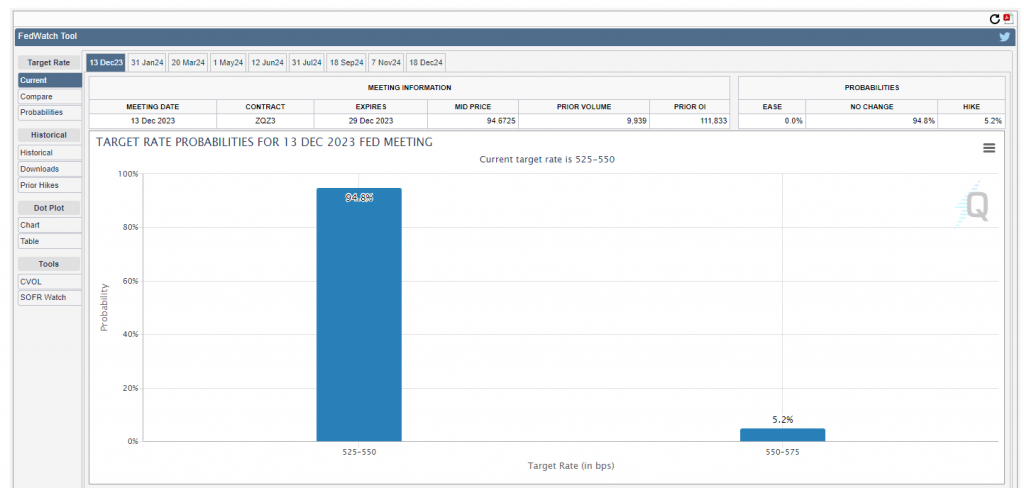
Observing the data available at CME FedWatch the stock market does not seem to expect the Fed to start cutting rates aggressively anytime soon, this opinion is based on the current pricing data of the fed-funds futures market.
According to the CME FedWatch Tool, the probability of a rate cut in the next FOMC meeting on 13th December 2023 is very low. It is likely interest rates will be left unchanged.
The market seems to expect the Fed will hold the current rate of 5.25% until at least March 2024, but will then gradually lower it to 4.75% by December 2024.
The market seems to be more optimistic about the U.S. economic outlook and the Fed’s ability to control inflation. The mood on rates has been buoyed recently with inflation data coming in better than expected.
It is highly likely that the Fed will have to cut rates more aggressively in 2024 and 2025 to stimulate the economy and avoid a potential prolonged recession.
Microsoft is working on its own artificial intelligence chip, code-named Athena, that could compete with Nvidia’s products.
The company introduced two new microchips.
The first, its Maia 100 artificial intelligence chip, could compete with Nvidia’s highly sought-after AI graphics processing units.
The second, a Cobalt 100 Arm chip, is aimed at general computing tasks and could compete with Intel processors.
The chip is designed for training large language models (LLM’s) like ChatGPT and powering AI applications. Microsoft has been developing the chip since 2019 using Taiwan Semiconductor’s 5-nanometer process. The chip is currently being tested by a small select group of Microsoft and OpenAI employees.
Long-term objective
Microsoft’s objective is to reduce its dependency on third-party hardware providers and to customize its AI infrastructure for its own projects.
Microsoft has invested billions in OpenAI, which makes ChatGPT, to enhance its position in the AI field. The Athena chip could also enable Microsoft to add AI capabilities to its Office products and GitHub, but it has already achieved this using the OpenAI system.
Microsoft has not announced when the chip will be available to the public or to its Azure cloud customers.
IMF’s Kristalina Georgieva reportedly said that the public sector should keep preparing to deploy central bank digital currencies (CBDC’s) and related payment platforms in the future.
But according to data from the Atlantic Council, only 11 countries have adopted CDBC’s thus far.
Alternative to cash
Central bank digital currencies (CBDC’s) have the potential to replace cash. But adoption could take time, said Kristalina Georgieva, managing director of the International Monetary Fund on Wednesday 15th November 2023.
‘CBDC’s can replace cash which is costly to distribute”, she is reported to have said at the Singapore FinTech event. ‘They can offer resilience in more advanced economies. And they can improve financial inclusion where few hold bank accounts’.
‘CBDC’s would offer a safe and low-cost alternative to cash. They would also offer a bridge between private monies and a yardstick to measure their value, just like cash today which we can withdraw from our banks’, the IMF chief reportedly said.
Fiat currency
CBDC’s are the digital form of a country’s fiat currency, which are regulated by the country’s central bank. They are powered by blockchain technology, allowing central banks to channelgovernment payments directly to households.
Central Bank digital money to replace cash. IMF’s Kristalina Georgieva reportedly said that the public sector should keep preparing to deploy central bank digital currencies (CBDC’s) and related payment platforms in the future.
‘The level of global interest in CBDCs is unprecedented. Several central banks have already launched pilots or even issued a CBDC’, the IMF said in a September 2023 report.
According to a 2022 survey conducted by the Bank for International Settlements, of the 86 central banks surveyed, 93% said they were exploring CBDCs, while 58% said they were likely to or may possibly issue a retail CBDC in either the short or medium term.
But as of June 2023, only 11 countries had adopted CBDC’s, with an additional 53 in advanced planning stages and 46 researching, according to data from the Atlantic Council.
UK inflation fell to 4.6% in October 2023, down from 6.7% in September 2023.
This is the lowest rate of price increases since 2021 and the bigger than expected fall should provide some relief to UK households gripped by the cost-of-living crisis.
The main factors that contributed to the drop in inflation were largely due to lower energy prices, food and non-alcoholic drink prices, and airfares. Economists suggested that the main reason inflation fell from its peak of 11.1% in October 2022 was due to the fall in the energy price cap, which limits what suppliers can charge consumers per unit of energy.
However, the UK still has the highest inflation rate of any G7 country, and some economists warn that the Bank of England (BoE) may need to raise interest rates to prevent inflation from rising again.
Target hit
The UK government will no doubt rejoice today as the end-of-year 5% has been achieved earlier than expected. But don’t party too early, the actual target is 2%. There is a limit to how much credit ministers can take for the fall as energy prices settle.
The FTSE100 was happy, it climbed some 100 points in morning trade.
U.S. Inflation was flat in October from the previous month, providing a positive sign that high prices are finally easing their tight grip on the U.S. economy. Is this also a green light for the Federal Reserve to stop raising interest rates.
The consumer price index (CPI) was flat in October 2023 from the previous month but up 3.2% from a year ago. Both were below analysts’ estimates, sparking a major stock market rally.
Excluding volatile food and energy prices, the core CPI rose 0.2% and 4%, against the forecast of 0.3% and 4.1%. The annual rate was the smallest increase since September 2021.
The flat reading on the headline CPI came as energy prices declined 2.5% for the month, offsetting a 0.3% increase in the food index.
Traders do not anticipate that the Fed will raise interest rates in December 2023, according to data from the CME Group.
Traders do not anticipate that the Fed will raise interest rates in December 2023, according to data from the CME Group.
U.S. Treasury yields fall
U.S. Treasury yields fell on Tuesday 14th November 2023 as key inflation data showed a surprisingly ‘soft’ change in prices last month.
The 10-year Treasury yield fell to about 4.45%. The 2-year Treasury yield fell more to under 4.9%.
Good data
Inflation stabilising, yields falling and equities up – are the stars aligning for a stock market rally leading into Christmas 2023?
This is from As You Like It, Act 2, Scene 7, where Jaques describes the ages of human life.
All the world’s a stage, and all the men and women merely players. They have their exits and their entrances; and one man in his time plays many parts’.
Nvidia has recently announced its latest high-end chip, the GH200 Grace Hopper Superchip, which is designed for training AI models at giant scale.
The GH200 is a breakthrough accelerated CPU that combines the NVIDIA Grace™ and Hopper™ architectures using NVIDIA® NVLink®-C2C to deliver a CPU+GPU coherent memory model for AI and HPC applications. The superchip delivers up to 10X higher performance for applications running terabytes of data, enabling scientists and researchers to reach unprecedented solutions for the world’s most complex problems.
The technical bit
The GH200 features 72 cores of Grace CPU outfitted with 480 GB of ECC LPDDR5X memory, as well as the GH100 compute GPU that is paired with 141 GB of HBM3E memory that comes in six 24 GB stacks and uses a 6,144-bit memory interface.
The GH200 also has a new 900 gigabytes per second (GB/s) coherent interface, which is 7X faster than PCIe Gen5, and supercharges accelerated computing and generative AI with HBM3 and HBM3e GPU memory. The GH200 can run all NVIDIA software stacks and platforms, including NVIDIA AI Enterprise, HPC SDK, and Omniverse™.
Nvidia unveils its newest GH200 high-end AI Superchip.
The GH200 is available as part of the NVIDIA DGX GH200, a massive memory supercomputer that fully connects 256 GH200 Superchips into a singular GPU. The DGX GH200 offers 144 terabytes (TB) of shared memory with linear scalability for giant AI models.
The DGX GH200 is a turnkey data centre-class solution that includes integrated software and white-glove services from NVIDIA, from design to deployment, to speed the ROI of AI.
The DGX GH200 is the only AI supercomputer that offers a massive, shared memory space of 144TB across 256 NVIDIA Grace Hopper Superchips, providing developers with nearly 500X more memory to build giant models.
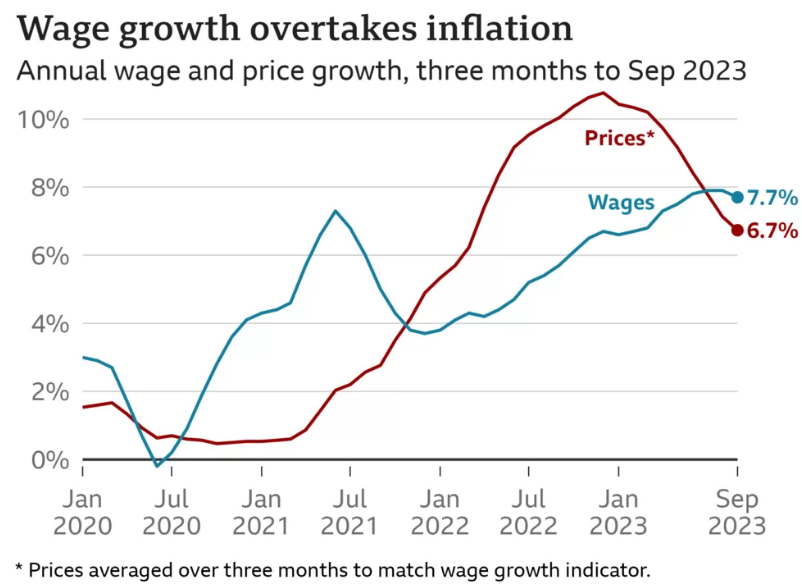
Pay growth has outstripped inflation by the most since 2021, in a further sign that the pressure on living costs may be starting to ease.
Regular pay rose at an annual rate of 7.7% between July and September 2023, official figures show; higher than average inflation over the same three months.
But job vacancies fell for the 16th month in row, in a worrying sign that the jobs market is weakening. Between August and October 2023, the estimated number of vacancies in the UK fell to 957000, down 58000 – although the Office for National Statistics (ONS) said the total remains well above pre-pandemic levels.
Data Source: Office for National Statistics Data
UK pay outstrips inflation by highest amount for two years
The UK’s unemployment rate was largely unchanged between July to September 2023 at 4.2%, according to ONS data.
Microsoft has confirmed problems with accessing its Xbox gaming platform and Teams messaging app in the UK and Europe have now been resolved.
More than 1500 people in the UK reported issues with Xbox Live, according to the outage tracker Downdetector.A similar number also said there were problems with the Teams app.
It left some who had purchased the latest game in the Call of Duty series unable to play. But Microsoft said this had since been fixed.
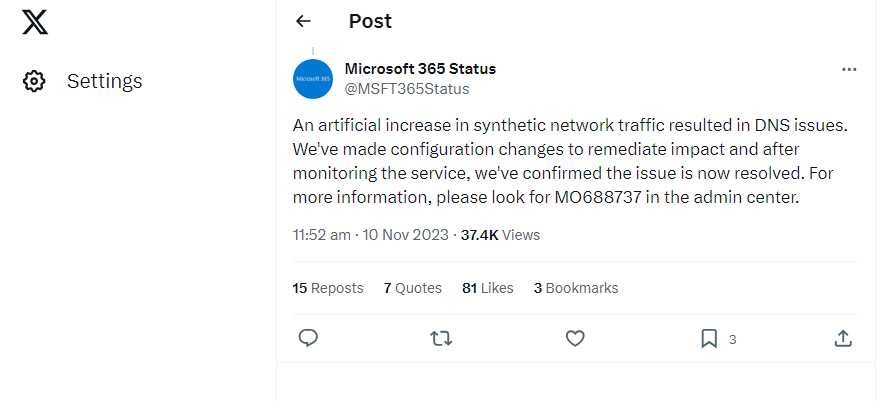
An artificial increase in synthetic network traffic – whatever that is
On X, Microsoft said the services were impacted by ‘an artificial increase in synthetic network traffic’. Could someone please explain to me what this actually means…? Microsoft went on to say: ‘We’ve made configuration changes to remediate impact and after monitoring the service, we’ve confirmed the issue is now resolved.’ Microsoft previously said it had ‘identified some anomalies within our network infrastructure’. Really, what do these explanations actually explain?
Problem unique to UK & Europe
The problem was unique to customers in the UK and Germany, Microsoft had said earlier on Friday, but it was also reported, on social media, that people in Sweden, Finland and Poland had been unable to access services.
There were reports from both of these countries on Downdetector, as well as other European countries.