

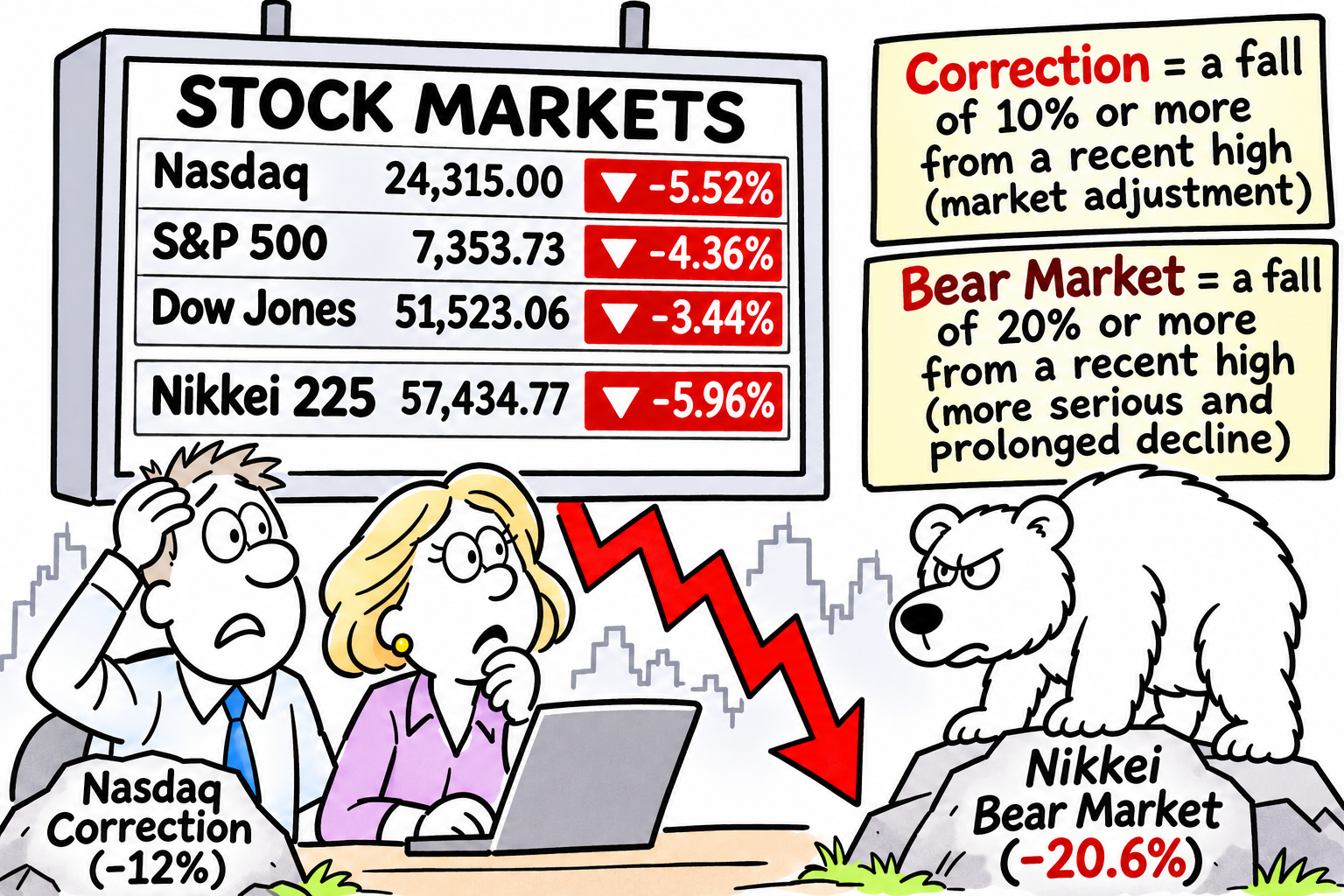
Wall Street has suffered one of its sharpest selloffs in recent months, sending the technology-heavy Nasdaq Composite into correction territory and triggering a fresh wave of selling across global markets.
Market turmoil spreads
The turmoil has subsequently spread to Asia, where Japan’s Nikkei 225 has fallen into bear market territory, raising concerns about the possibility of a much deeper global stock market decline.
Thursday’s trading session, 5th November 2026, was particularly brutal for American investors. The Nasdaq Composite plunged around 5.50% to close at 24,315 points, its worst single-day percentage decline since April 2025.
The index has now fallen approximately 12% from its record high reached on 6 October.
Indices
The wider American market was also heavily affected. The S&P 500 dropped 4.36% to 7,353.73, while the Dow Jones Industrial Average shed 1,833 points, or 3.44%, to finish at 51,523.06. The Russell 2000, representing smaller American companies, fell 4.45% to 2,729.89.
The technology sector was at the centre of the rout. Nvidia lost approximately 9.3%, while SanDisk plunged 22%. Semiconductor shares suffered particularly heavy losses as investors questioned whether the enormous sums being invested in artificial intelligence infrastructure would ultimately deliver sufficient returns.
Correction or bear market: what is the difference?
A stock market correction is generally defined as a decline of at least 10% from a recent peak. It is often considered a relatively normal market adjustment, particularly following a prolonged period of rising share prices.
A bear market is more serious, conventionally defined as a fall of 20% or more from a recent high. It can indicate a prolonged deterioration in investor confidence, economic conditions and corporate earnings expectations.
Japan is now experiencing the latter. The Nikkei 225, which reached a record 72,831.73 points on 22nd June 2026, fell to approximately 57,320 points during Friday’s trading. That represents a decline of more than 21% from its peak, taking the index into bear market territory.
What has triggered the sell-off?
Artificial intelligence is increasingly becoming a source of investor anxiety rather than unqualified optimism.
The enormous expenditure required to construct data centres, purchase semiconductors and secure electricity supplies has raised questions about the profitability of the AI revolution.
The recent American midterm elections have added another dimension. Democratic victories have increased concerns about potential regulatory scrutiny of technology companies and restrictions on future data-centre development.
Investors are also reassessing highly valued technology shares, taking profits and reducing exposure to companies whose valuations have become increasingly dependent on future AI growth.
Where do markets go from here?
The immediate question is whether this is a sharp but temporary correction or the beginning of something considerably more damaging.
A recovery is possible if investors regain confidence in technology earnings, AI investment and the wider economic outlook. However, continued selling could push the Nasdaq further down, particularly if major technology companies fail to justify their enormous valuations.
The danger is that weakness spreads beyond technology. Pension funds, institutional investors and other market participants exposed to falling equities could reduce their positions further, creating additional selling pressure.
Investors will also be watching interest rates, bond yields, inflation and economic growth for signs of whether financial conditions are becoming more restrictive.
For now, the warning signs are difficult to ignore. The Nasdaq is in correction territory, Japan’s Nikkei has crossed into a bear market, and confidence in the once unstoppable AI investment boom is being seriously tested.
The next few weeks could prove crucial in determining whether global markets find a floor or whether this sell-off develops into a much broader market downturn.