

Humanoid Robots on the Front Line in Ukraine Signal a New Frontier in Warfare

The testing of humanoid robots in Ukraine marks a striking moment in the evolution of modern warfare, blending Silicon Valley ambition with the brutal pragmatism of a live conflict.

Foundation Future Industries

Foundation Future Industries, a San Francisco start-up founded in 2024, has positioned itself at the centre of this shift by deploying its Phantom MK‑1 robots for pilot demonstrations on the Ukrainian front lines.

The company’s pitch is simple but provocative: humanoid robots should be used not for household chores, but for the world’s most dangerous jobs. Ukraine, now in its fifth year of war, has become the proving ground.

The MK‑1 units tested so far are limited — they carry modest payloads, lack waterproofing, and cannot yet operate at scale. But their early tasks, such as retrieving supplies from hazardous areas, hint at the potential of autonomous systems shaped for human environments.
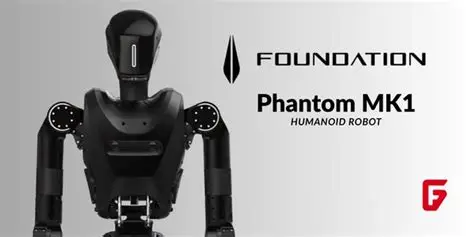
Urban combat, with its stairwells, basements and narrow corridors, is inherently built around the human form. Analysts note that this gives humanoid robots theoretical advantages over tracked or quadruped machines in certain scenarios.

Yet the technology’s military promise is entangled with political controversy. The company recently appointed Eric Trump as chief strategy adviser, prompting accusations of impropriety given its $24 million in U.S. government research contracts.

Two humanoid robots were reportedly sent to Ukraine in February 2026.

Foundation insists the partnership reflects a shared vision of rebuilding American manufacturing, but the optics are unavoidable.

Multiple sources describe this as the first recorded deployment of humanoid robots to an active warzone — not just Ukraine, but any modern conflict.

The robot race

The broader context is a deepening geopolitical race. Foundation openly frames its mission as part of a contest with China, whose own robotics sector has showcased early military prototypes.

The U.S. military, meanwhile, has not yet deployed humanoid systems, though it is increasingly integrating AI into battlefield decision-making.

Experts caution that cost, complexity and manufacturability may ultimately limit humanoids’ role. But the symbolism is unmistakable.

Whether or not these machines succeed, Ukraine has become the first real-world laboratory for autonomous, human-shaped robots — a glimpse of how future conflicts may be fought.

South Korea’s Market Faces a Fragile Balancing Act

Risks to South Korea stocks

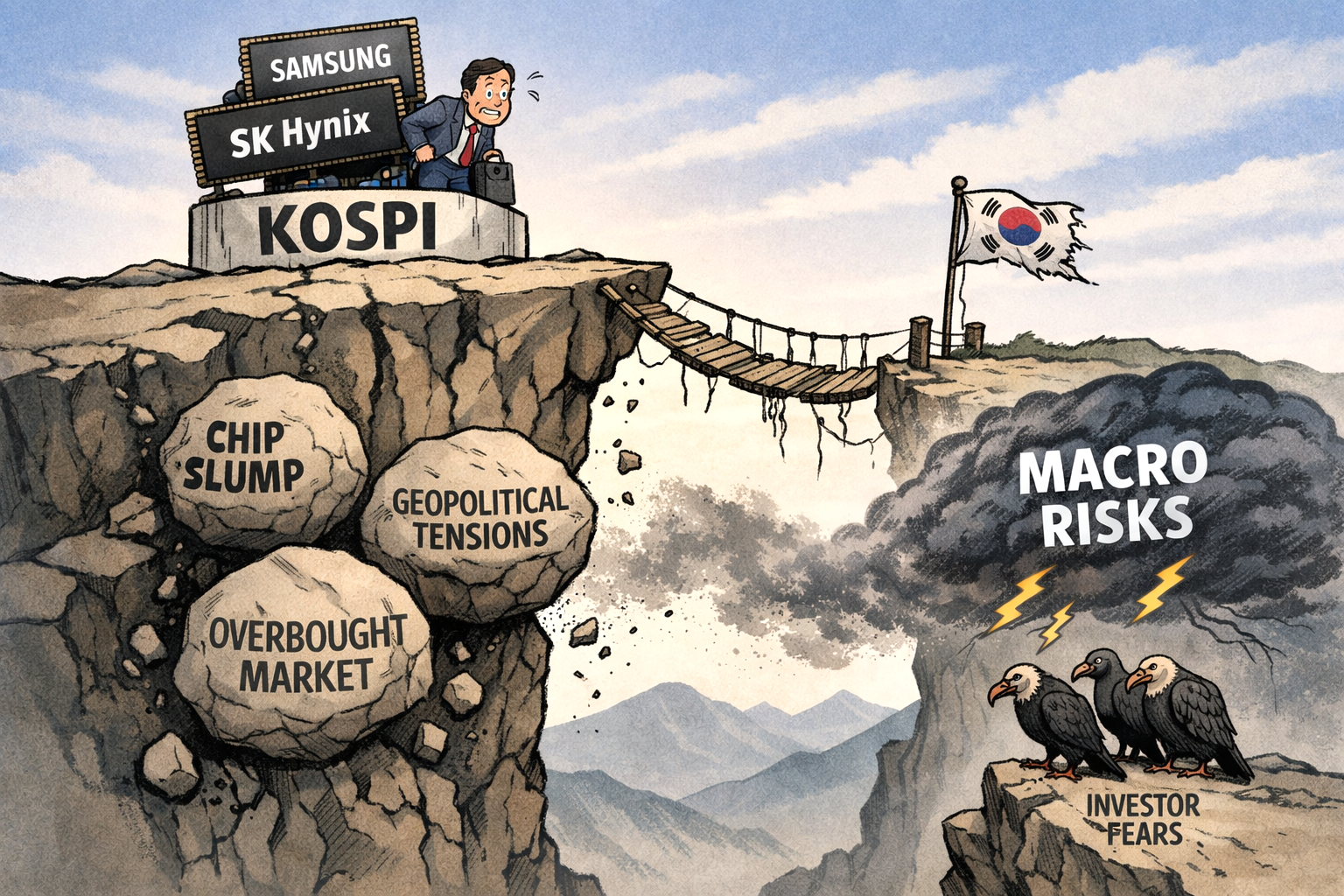
South Korean equities are showing signs of strain after a powerful rally led almost entirely by semiconductor giants Samsung Electronics and SK Hynix.

Analysts warn that the market’s narrow leadership leaves it exposed to sudden reversals if global chip demand cools or investor sentiment shifts.

Overbought

It has been cautioned that the Kospi’s momentum indicators are flashing overbought signals, suggesting limited room for further gains before a correction sets in.

The country’s heavy reliance on the semiconductor cycle means any slowdown in AI‑related investment or memory‑chip orders could quickly erode confidence.

Broader industrial and consumer sectors have lagged, amplifying the sense that Korea’s stock market is running on a single engine.

Risks

While optimism remains high, the risks are clear: a fragile rally built on concentrated strength and global tech exuberance.

If macro headwinds return, the dust from “macro risks” may finally settle on Seoul’s fast‑moving market.

South Korea’s Kospi hit another new record high despite mixed trading across Asia-Pacific markets and this despite U.S. Iran deal caution.

All three major U.S. indices closed at new all‑time record highs on Friday 29th May 2026 – ending May 2026 on a high!

All three U.S. indices hit new reocrd highs!

Wall Street ended Friday 29th May on a historic note, with the Dow, S&P 500 and Nasdaq each closing at fresh record highs.

The Dow broke decisively above the 51,000 mark for the first time, finishing at 51,032.46, driven by powerful gains in AI‑linked industrial and technology names.

The S&P 500 closed at 7,580.06, extending its remarkable nine‑week winning streak — its longest run since 2023 — as investors continued to reward strong earnings and the broadening impact of AI infrastructure spending.

The Nasdaq also set a new peak at 26,972.62, supported by renewed momentum across semiconductors and enterprise technology.

Record Closing Levels — Friday 29 May 2026

Dow Jones Industrial Average: 51,032.46

S&P 500: 7,580.06

Nasdaq Composite: 26,972.62

Markets took geopolitical tensions and mixed macro signals in their stride, focusing instead on resilient corporate performance and easing energy pressures.

Despite narrow market breadth, the rally underscored investors’ confidence that the AI‑driven earnings cycle remains intact heading into the summer.