

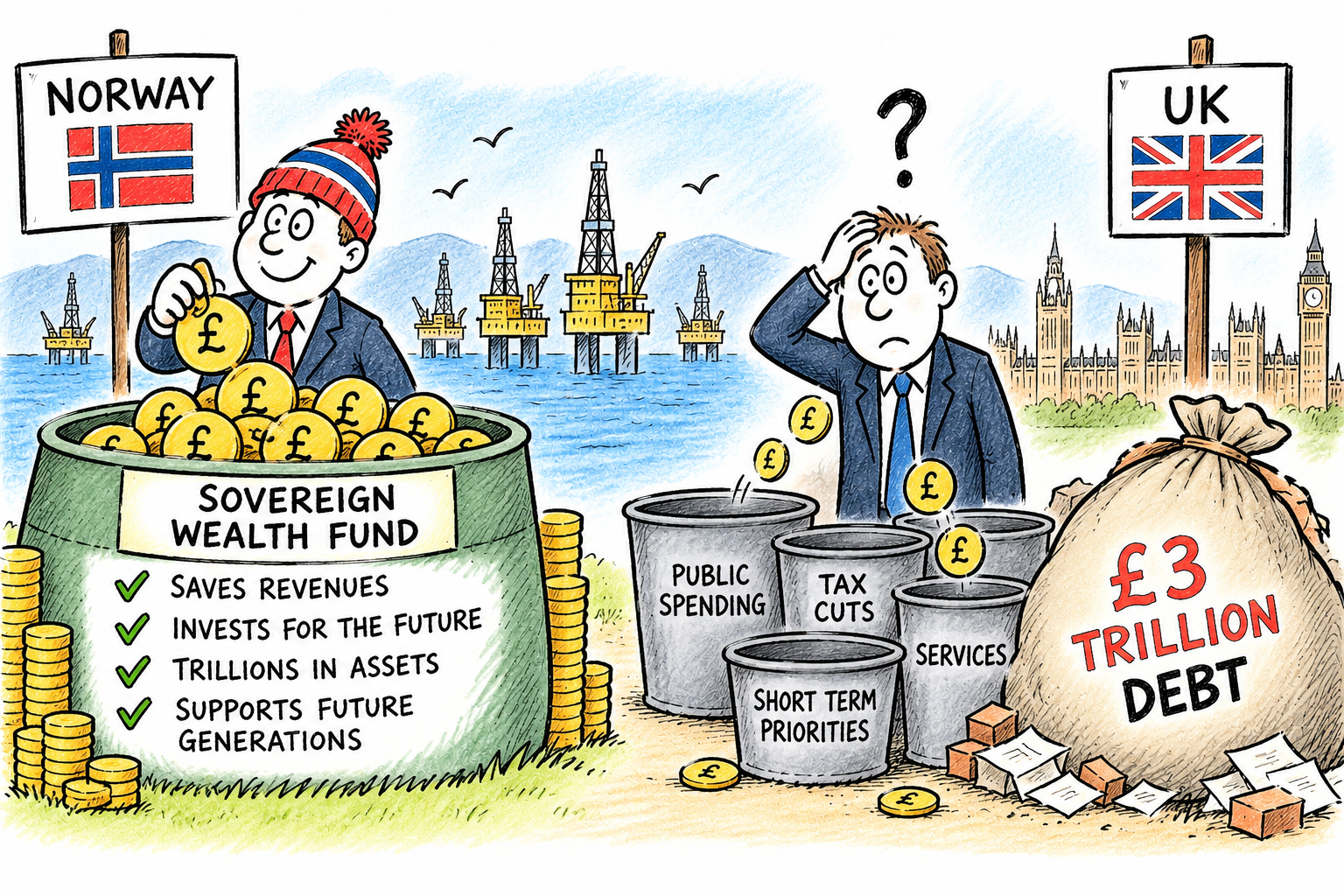
Britain’s £3 Trillion Debt: The Oil Fund Norway Built and the UK Never Did

UK debt and no wealth fund problem

Britain sits on a mountain of public debt approaching £3 trillion, yet decades ago it discovered a resource that could have transformed the nation’s financial future.

North Sea oil generated enormous revenues, but unlike Norway, Britain failed to turn its petroleum wealth into a lasting national investment fund.

The missed opportunity remains one of the most striking examples of short-term political thinking in modern economic history.

Oil production sideline

When North Sea oil production expanded during the 1970s and 1980s, the UK government received substantial revenues from petroleum taxes and royalties.

Norway, whose North Sea oil industry developed around the same period, took a different approach. It established a sovereign wealth fund in 1990, subsequently investing much of its petroleum wealth in international financial markets for the benefit of future generations.

Norway’s Government Pension Fund Global

Today, Norway’s Government Pension Fund Global is worth trillions of pounds. Its investments span thousands of companies, bonds and other assets worldwide, generating returns that help support Norway’s public finances.

The fund has become a financial buffer against economic shocks and the eventual decline of oil and gas production.

Spend

Britain, by contrast, largely spent its oil revenues as they arrived. They helped support government finances during a period of economic restructuring, tax reductions and changing public spending priorities.

The revenues also contributed to the wider economy, while North Sea production helped improve the UK’s balance of payments.

The argument is not that every pound of British oil revenue simply disappeared. Rather, the country failed to preserve a substantial share of this finite natural resource wealth in a dedicated, long-term investment fund.

Why?

Why did Britain make such a different choice? Politics was central. Successive governments faced immediate demands to control borrowing, finance public services, manage unemployment and respond to economic difficulties.

Creating a fund would have required the political discipline to save revenues rather than use them to meet current priorities.

There was also no lasting national consensus that oil wealth should be treated as capital belonging to future generations. Norway built institutions and rules around that principle. Britain never established an equivalent framework on a comparable scale.

Consequnce

The consequences are difficult to quantify precisely. A British sovereign wealth fund would not automatically have accumulated the same returns as Norway’s, and its performance would have depended on how much was invested, when investments were made and how they were managed.

Nevertheless, even a smaller fund could have provided valuable national assets and an additional source of investment income.

With public debt now approaching £3 trillion, the contrast is uncomfortable. Britain extracted a finite resource but did not convert enough of its proceeds into lasting financial wealth.

Norway saved a significant share of its oil windfall. Britain largely consumed its own. The question is whether future generations will repeat that mistake.

Note:

The £1 trillion figure is a hypothetical Treasury estimate based on investing roughly £200 billion in historical North Sea revenues and allowing the money to grow at a rate comparable to Norway’s fund. It is not a guaranteed amount Britain would have accumulated.

The UK’s public sector net debt was provisionally estimated at £3.005 trillion at the end of September 2026, according to the Office for National Statistics.
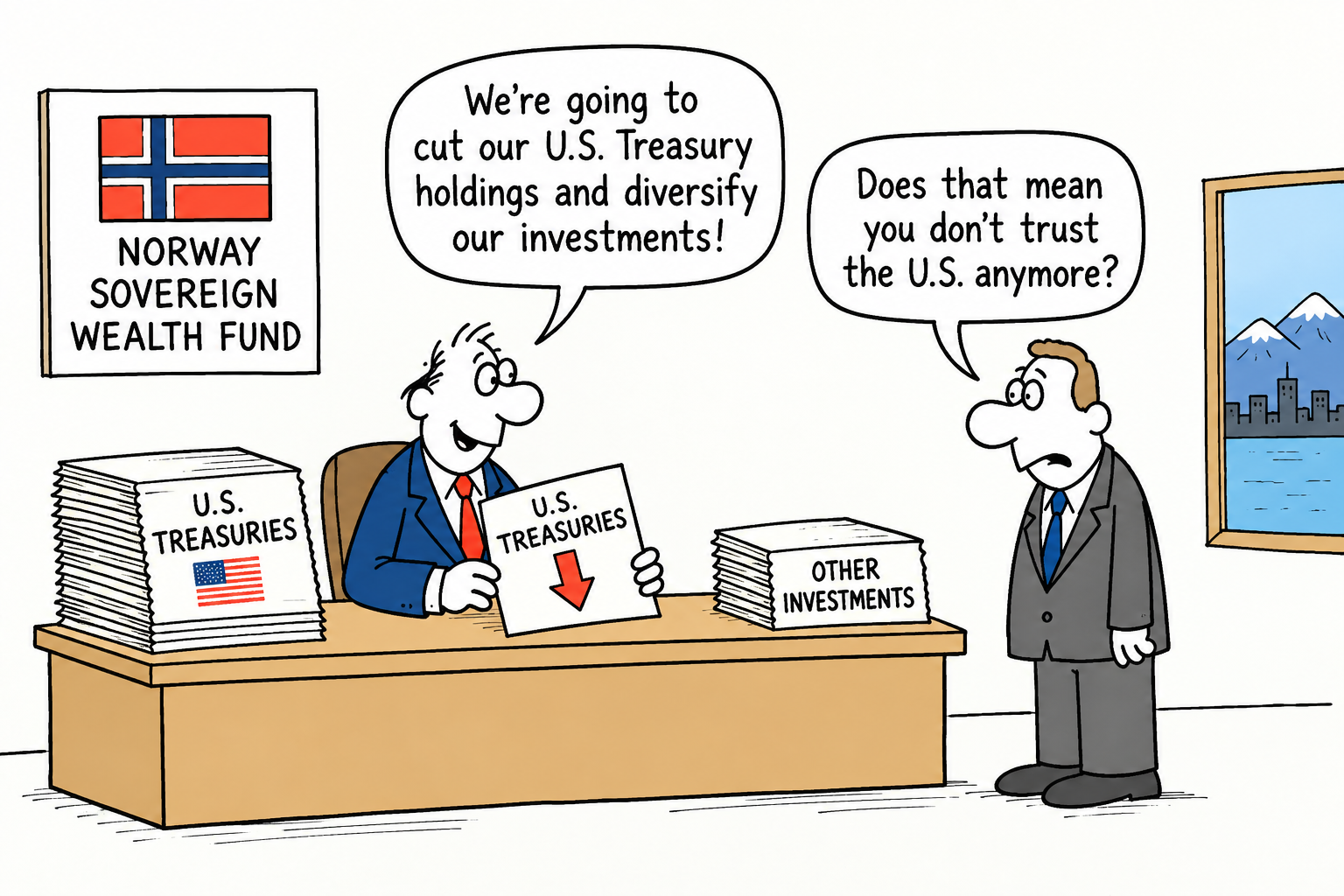
Norway’s Wealth Fund Signals a Shift Away From U.S. Treasuries

Norway’s enormous sovereign wealth fund is considering a significant reduction in its holdings of U.S. government debt, in a move that could add to concerns surrounding the future of the Treasury market.

Norges Bank Investment Management, which oversees Norway’s roughly $2.3 trillion Government Pension Fund Global, has proposed reducing the proportion of government bonds in its benchmark portfolio from 70% to 50%.

U.S. Treasuries

U.S. Treasuries supposedly would take the largest share of the reduction, potentially cutting the fund’s holdings by almost $80 billion from around $215 billion.

The proposal reflects a desire to diversify the fund and improve returns rather than abandon U.S. assets altogether.

Non-Government U.S. Debt

The fund intends to increase its exposure to non-government U.S. debt, including mortgage-backed securities and other government-related bonds. Its overall exposure to the U.S. dollar would remain broadly unchanged.

The timing is nevertheless significant. Government bond markets have faced renewed pressure as investors worry about high inflation, mounting government debt and rising long-term borrowing costs.

Warning?

Norway’s decision could therefore be interpreted as another warning that some major institutional investors are becoming less comfortable holding large quantities of traditional government debt.

Japanese Government Bonds

The fund also plans to increase its allocation to Japanese government bonds, while reducing exposure to euro-area government debt.

Importantly, this is reportedly a proposal rather than an immediate sell-off. Any changes would likely be introduced gradually, with Norway’s Finance Ministry and parliament involved in the approval process. The earliest significant changes are not expected before 2027.

Nevertheless, when one of the world’s largest investors starts questioning the traditional role of government bonds, markets are likely to take notice.

World’s largest sovereign wealth fund posts $76 billion profit in latest quarter

Investment data

Norway‘s massive world record breaking sovereign wealth fund reported a third-quarter profit of 835 billion Norwegian kroner ($76.3 billion) on Tuesday 22nd October 2024.

The fund’s performance was attributed to a stock market surge due to the decline interest rates.

The overall return for the quarter stood at 4.4%, which was 0.1 percentage points below the return of its benchmark index.

Surging tech stocks allow world’s largest sovereign wealth fund to post $110 billion profit in Q1

Wealth fund

Norway’s massive sovereign wealth fund reported a first-quarter profit of 1.21 trillion kroner ($109.9 billion) – bolstered by strong returns from its technology stock investments it was announced on Thursday 18th April 2024.

Established in the 1990s, Norway’s sovereign wealth fund, the largest in the world, invests the surplus revenue from the nation’s oil and gas sector. The fund has invested in over 8,800 companies across more than 70 countries to date.

World’s largest sovereign wealth fund announces record $213 billion profit

Fund manager

Norway’s giant sovereign wealth fund reported record profit of 2.22 trillion kroner ($213 billion) in 2023, supported by returns on its investments in technology stocks.

Despite high inflation and geopolitical unrest, the equity market in 2023 was strong, compared to a very weak year in 2022. It follows a record loss of 1.64 trillion Norwegian kroner for the whole of 2022, which the fund attributed to ‘very unusual’ market conditions at the time.

Norway’s sovereign wealth fund on Tuesday 30th January 2024 reported a record profit of 2.22 trillion kroner ($213 billion) in 2023, supported by robust returns on its investments in technology stocks.

Government Pension Fund Global

The ‘Government Pension Fund Global’, one of the world’s largest investors, reportedly said the fund marked its highest return in kroner ever, with the fund’s return on investment last year coming in at 16% for the year.

Norway’s sovereign wealth fund, the world’s largest, was established in the 1990s to invest the surplus revenues of the country’s oil and gas sector. To date, the fund has put money in more than 8,500 companies in 70 countries around the world.

See wealth fund rankings table here