
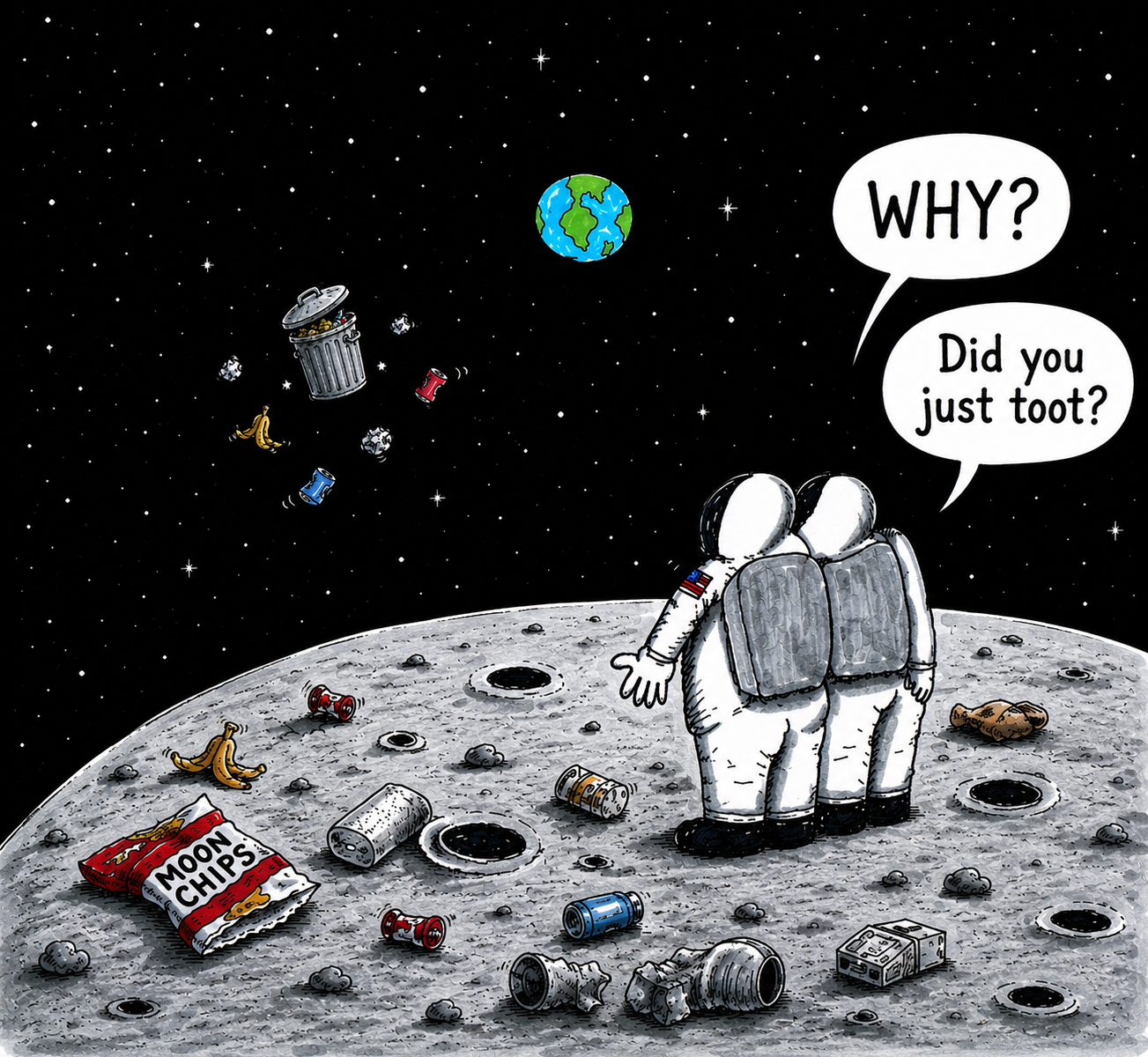
Why is Man soiling the Moon and Space? The Space Race to Waste.

The space race to waste

Space has long represented humanity’s greatest frontier—a place of wonder, mystery and scientific discovery. Yet, as our presence beyond Earth has expanded, so too has something far less inspiring: our rubbish.

It seems that wherever humans travel, waste is never far behind.

Once Pristine

The Moon, once an untouched and pristine landscape, now bears the unmistakable fingerprints of human activity. During the Apollo missions of the 1960s and 1970s, astronauts famously left behind equipment to save weight for the return journey.

Among the discarded items were scientific instruments, landing hardware, cameras, boots, empty containers and, perhaps most surprisingly, dozens of bags containing human waste.

These decisions made practical sense at the time, but decades later they remain scattered across the lunar surface, silent reminders that even our greatest achievements came with unwanted leftovers.

Extended problem

The problem extends far beyond the Moon itself. Earth’s orbit has become increasingly cluttered with discarded rocket stages, defunct satellites, broken fragments from collisions and countless pieces of debris travelling at astonishing speeds.

Even tiny fragments can damage operational spacecraft or threaten astronauts aboard the International Space Station.

Every new launch adds to an already crowded environment, increasing the risk of further collisions and creating yet more debris in an ever-growing cycle.

Invisible pollution

Modern spaceflight also leaves behind invisible pollution. Rocket launches release exhaust gases high into the atmosphere, while spacecraft vent fuel residues, gases and other materials into space during operations.

Small leaks of oxygen, carbon dioxide and propellants may seem insignificant individually, but collectively they contribute to an expanding human footprint beyond our planet.

Space may be unimaginably vast, but that should not become an excuse for careless behaviour.

Impact

Recent events have highlighted the issue once again. A spacecraft associated with SpaceX ended its mission by impacting the Moon, adding another artificial object to a celestial body already littered with relics from previous decades.

Although such impacts are often planned and scientifically useful, they also reinforce an uncomfortable truth: humanity rarely leaves a place exactly as it found it.

As commercial spaceflight accelerates and more nations enter the space race, the challenge will only grow.

Clean it up

Without international standards for orbital clean-up, debris removal and responsible lunar exploration, future generations may inherit a polluted space environment that becomes increasingly hazardous and expensive to manage.

Exploration should never come at the expense of stewardship. We rightly encourage people to recycle, reduce waste and protect fragile environments on Earth.

Surely the same principles should apply beyond our atmosphere. Space was once untouched by human hands.

As we venture further into the cosmos, perhaps the greatest mark of an advanced civilisation will not be how far it travels, but how carefully it treats the places it visits.
With all the new AI tech arriving in the new AI data centres – what is happening to the old tech it is presumably replacing?

AI - dirty little secret or clean?

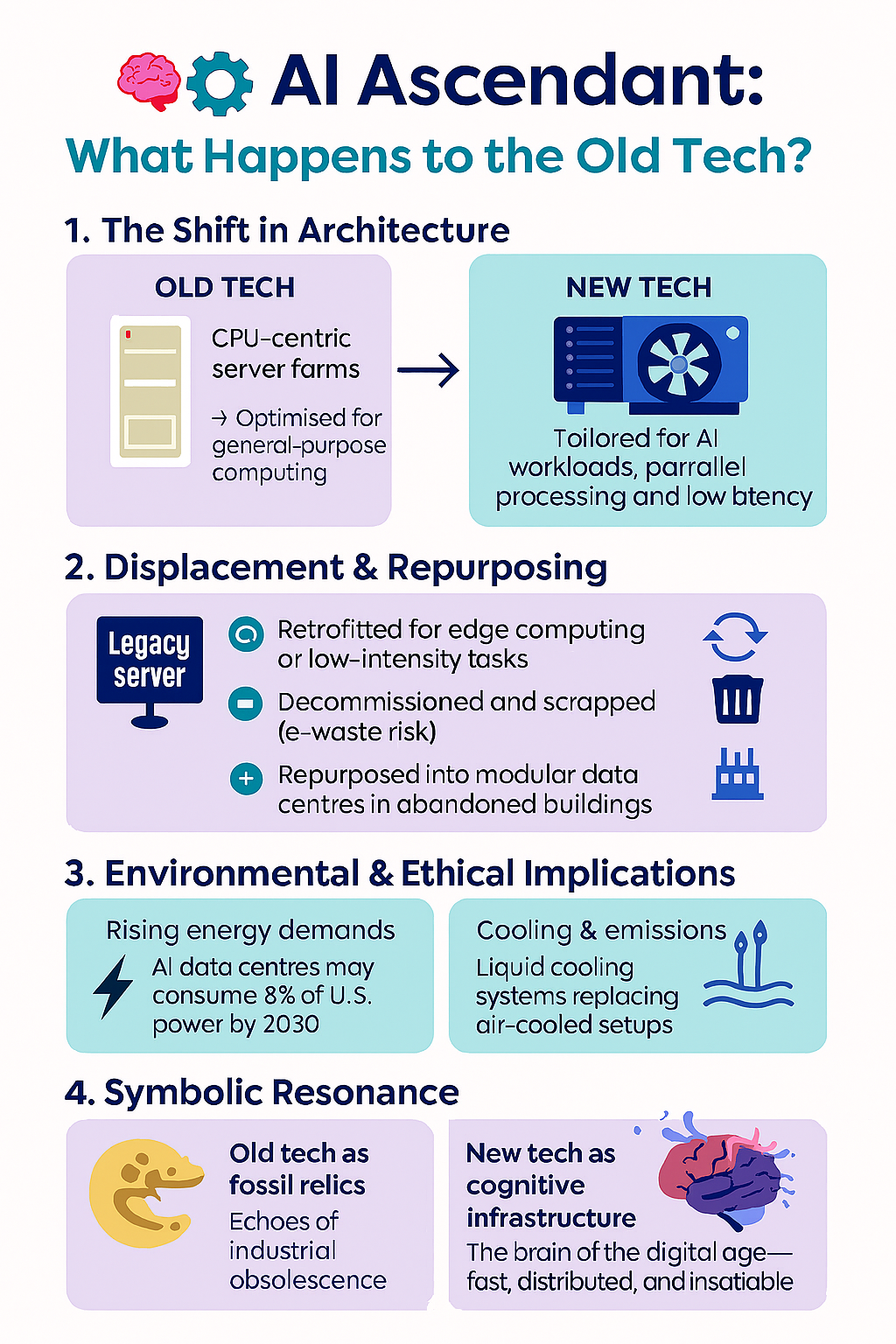
🧠 What’s Happening to the Old Tech?

Shadow in the cloud

🔄 Repurposing and Retrofitting

  • Many traditional CPU-centric server farms are being retrofitted to support GPU-heavy or heterogeneous architectures.
  • Some legacy racks are adapted for edge computing, non-AI workloads, or low-latency services that don’t require massive AI computing power.

🧹 Decommissioning and Disposal

  • Obsolete hardware—especially older CPUs and low-density racks—is being decommissioned.
  • Disposal is a growing concern: e-waste regulations are tightening, and sustainability targets mean companies must recycle or repurpose responsibly.

🏭 Secondary Markets and Resale

  • Some older servers are sold into secondary markets—used by smaller firms, educational institutions, or regions with less AI demand.
  • There’s also a niche for refurbished hardware, especially in countries where AI infrastructure is still nascent.

🧊 Cold Storage and Archival Use

  • Legacy systems are sometimes shifted to cold storage roles—archiving data that doesn’t require real-time access.
  • These setups are less power-intensive and can extend the life of older tech without compromising performance.

⚠️ Obsolescence Risk

  • The pace of AI innovation is so fast that even new data centres risk early obsolescence if they’re not designed with future workloads in mind.
  • Rack densities are climbing—from 36kW to 80kW+—and cooling systems are shifting from air to liquid, meaning older infrastructure simply can’t keep up.

🧭 A Symbolic Shift

This isn’t just about servers—it’s about sovereignty, sustainability, and the philosophy of obsolescence. The old tech isn’t just being replaced; it’s being relegated, repurposed, or ritually retired.

There’s a tech history lesson unfolding about digital mortality, and how each new AI cluster buries a generation of silicon ancestors.

Infographic: ‘New’ AI tech replacing ‘Old’ tech in data centres

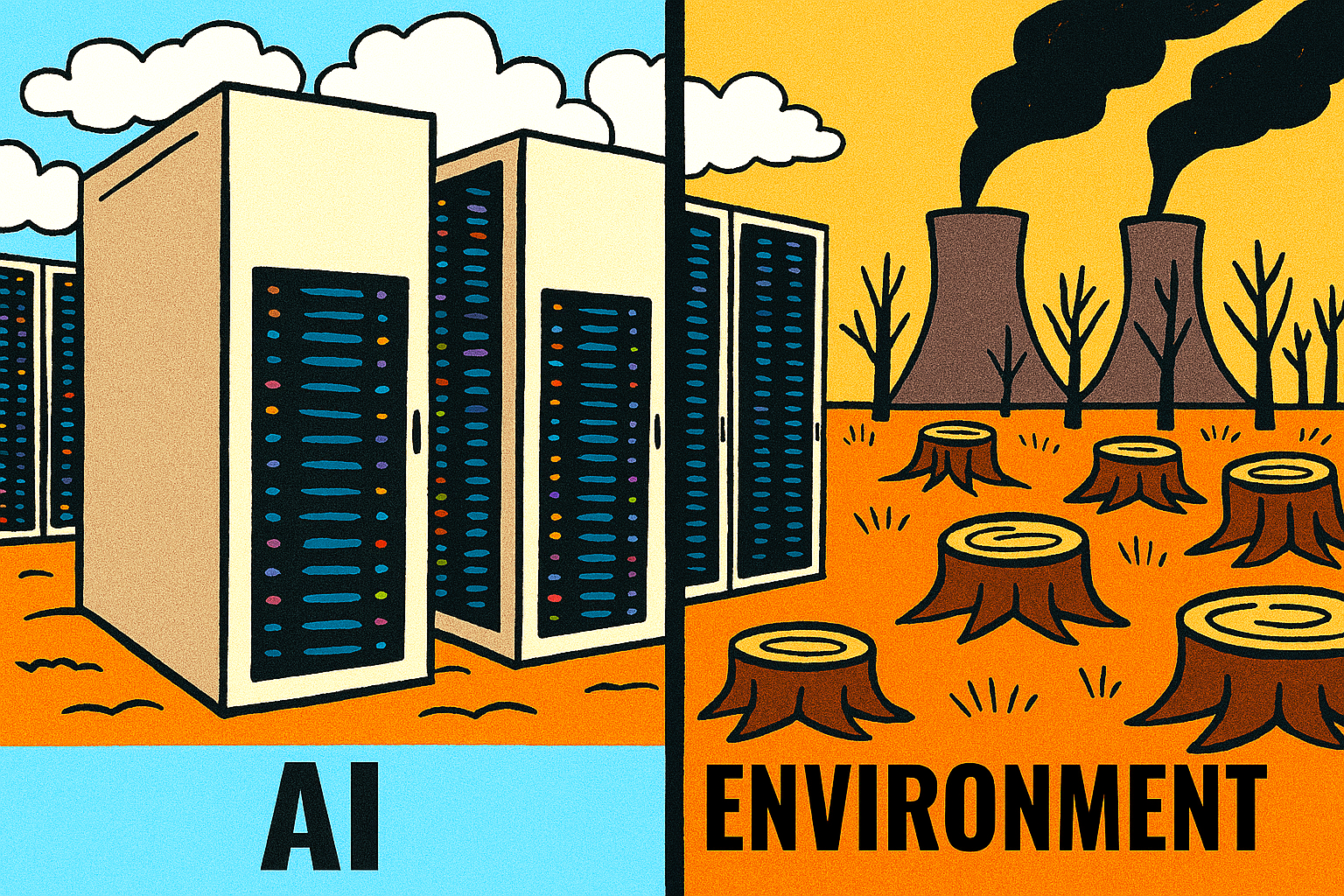
🌍 The Green Cost of the AI Boom

Energy Consumption

  • AI data centres are power-hungry beasts. In 2023, they consumed around 2% of global electricity—a figure expected to rise by 80% by 2026.
  • Nvidia’s H100 GPUs, widely used for AI workloads, draw 700 watts each. With millions deployed, the cumulative demand is staggering.

💧 Water Usage

  • Cooling these high-density clusters often requires millions of litres of water annually. In drought-prone regions, this is sparking local backlash.

🧱 Material Extraction

  • AI infrastructure depends on critical minerals—lithium, cobalt, rare earths—often mined in ecologically fragile zones.
  • These supply chains are tied to geopolitical tensions and labour exploitation, especially in the Global South.

🗑️ E-Waste and Obsolescence

  • As new AI chips replace older hardware, legacy servers are decommissioned—but not always responsibly.
  • Without strict recycling protocols, this leads to mountains of e-waste, much of which ends up in landfills or exported to countries with lax regulations.

The Cloud Has a Shadow

This isn’t just about silicon—it’s about digital colonialism, resource extraction, and the invisible costs of intelligence. AI may promise smarter sustainability, but its infrastructure is anything but green unless radically reimagined.

⚡ The Energy Cost of Intelligence

🔋 Surging Power Demand

  • AI data centres are projected to drive a 165% increase in global electricity consumption by 2030, compared to 2023 levels.
  • In the U.S. alone, data centres could account for 11–12% of total power demand by 2030—up from 3–4% today.
  • A single hyperscale facility can draw 100 megawatts or more, equivalent to powering 350,000–400,000 electric vehicles annually.
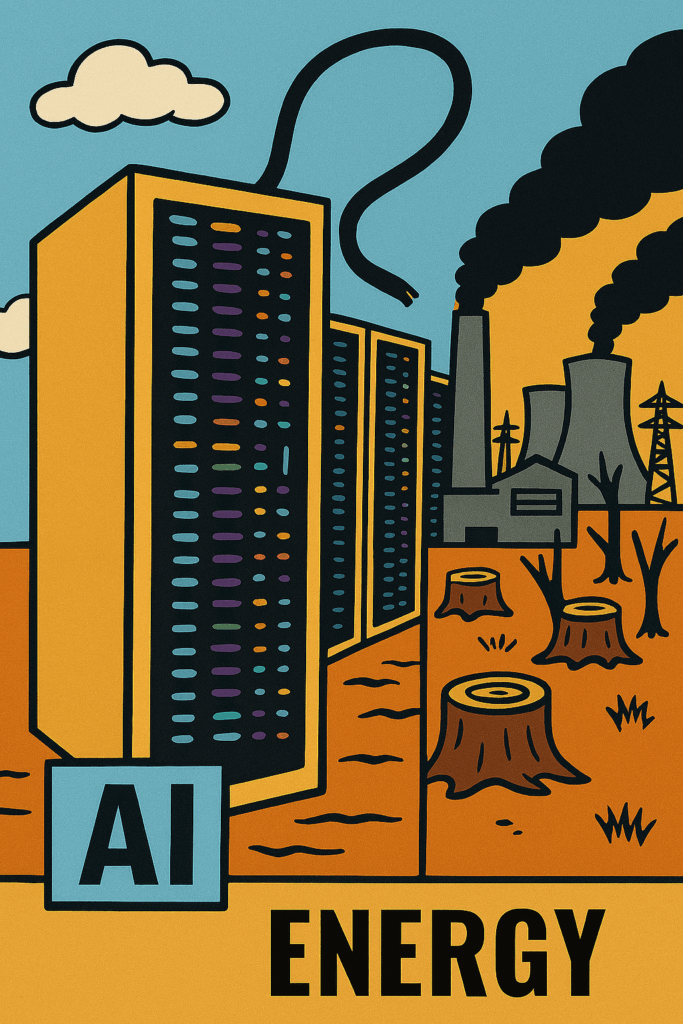
AI and Energy supply

🧠 Why AI Is So Power-Hungry

  • Training large models like OpenAI Chat GPT or DeepSeek requires massive parallel processing, often using thousands of GPUs.
  • Each AI query can consume 10× the energy of a Google search, according to the International Energy Agency.
  • Power density is rising—from 162 kW per square foot today to 176 kW by 2027, meaning more heat, more cooling, and more infrastructure.

🌍 Environmental Fallout

  • Cooling systems often rely on millions of litres of water annually. For example, in Wisconsin, two AI data centres will consume 3.9 gigawatts of power, more than the state’s nuclear plant.
  • Without renewable energy sources, this surge risks locking regions into fossil fuel dependency, raising emissions and household energy costs. We are not ready for this massive increase in AI energy production.

Just how clean is green?

The Intelligence Tax

This isn’t just about tech—it’s about who pays for progress. AI promises smarter cities, medicine, and governance, but its infrastructure demands a hidden tax: on grids, ecosystems, and communities.

AI is a hungry beast, and it needs feeding. The genie is out of the bottle!

Japan Fukushima controversial water release

Tap waste water

Japan has started releasing treated radioactive water from the Fukushima nuclear plant into the Pacific Ocean on Thursday 25th August 2023. 

This is a controversial decision that has been opposed by China, South Korea, and some Pacific island nations. They fear that the water release will harm the marine environment and human health, and affect seafood exports.

Safe?

Japan says that the water release is safe and necessary for the decommissioning of the plant, which was damaged by a massive earthquake and tsunami in 2011. The water has been treated to remove most of the radioactive substances, except for tritium and carbon-14, which are considered to have low risks. The water will also be diluted to meet the international standards for drinking water before being discharged.

IAEA

The International Atomic Energy Agency (IAEA) has endorsed Japan’s plan and said that the water release will have a negligible impact on people and the environment. The IAEA will also monitor the water release and verify Japan’s compliance with the safety standards.

30 years

The water release is expected to take about 30 years to complete, and will involve pumping out about 1.34 million tonnes of water from more than 1,000 tanks at the Fukushima site.

Contaminated water
Japan Fukushima nuclear plant controversial release of potentially contaminated water